




Ruger and Browning Win .270 Bolt-Action Matchup
Of four centerfire rifles suitable for hunting whitetails, Rugers M77R Mark II and Brownings Medallion A-Bolt II nudge out models from Remington and Winchester.
![]() |
Brownings Medallion A-Bolt II model shot sub-inch average |
In the past, serious hunters who wanted to shoot tackdrivers had to spend hundreds of dollars for new triggers and bedding jobs on commercial models or thousands to buy custom-built rifles, and then ramp up handloaded ammunition that shot well in a particular gun.
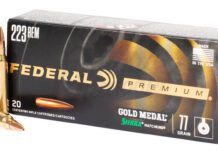
But a recent Field Tests evaluation suggests that several manufacturers are making their products shoot near or below the 1-inch-at-100-yards standard without costly gunsmithing, and some commercial cartridges may be making handloading a pastime rather than a pursuit. Our results show that Brownings Medallion A-Bolt II model shot sub-inch average groups with two different Federal Cartridge .270 Winchester roundsand models from Remington, Ruger, and Winchester each shot groups below an inch with at least one over-the-counter Federal loading. Moreover, when we averaged the performance of our test guns across three Federal rounds, only three-tenths of an inch in overall group size separated the Browning A-Bolt II Medallion (0.89 inches) from the Remington Model 700 BDL DM (1.19 inches), with the Ruger M77R Mark II (0.99 inches) and Winchester Model 70 Classic Sporter (1.17 inches) in between.
In our view, this kind of performance gives hunters who want to shoot even tighter centerfire groups a good place from which to start. In the copy below, we cover in more detail how each rifle performed with a particular cartridge, and we also evaluate the rifles fit and finish, metalwork, and mechanical function:
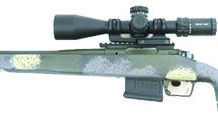
Ruger M77R Mark II
The Ruger .270 accounted itself well in our test, consistently developing groups very near 1 inch, satisfactory downrange performance in a hunter-class silo rifle or hunting-only rifle.
Also, cosmetically and operationally, the M77R was one of the tests best. The Rugers straight stock, which was a beautifully grained light walnut, was accented by a low-sheen finish and sharp, deep checkering on the grip and forearm. Its stainless-steel bolt and stainless bolt handle also gave the gun a distinctive appearance we liked, and the bolt operated very smoothly.
On the downside, the test rifle had a horrible trigger, which suffered from substantial creep before the shot let off at 51/2 pounds. However, Ruger factory guns have a well-earned reputation for atrocious trigger adjustment when they come from the plant. But in our experience, those triggers can be lightened, smoothed, and made crisper by a gunsmithusually for around $35. That, plus a bedding job, would draw the price of the Ruger about equal to the Browning in value for the dollar. Theres only 1/4-pound difference in weight between the M77R and the Medallion, and the difference in how well they shot was thin: the Medallion performed 1/10-inch better overall.
On the other hand, the Ruger had an edge in that it came with integral scope rings and bases, while the Medallion didnt. Also, we liked the Mauser-style bolt on the Ruger better than the bolt on the Medallion. It was very smooth and fed and extracted shells more smoothly than the others.
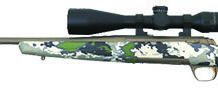
Browning A-Bolt II Medallion
This model was the most accurate in the test, shooting groups that, overall, averaged 0.89 inches in size. We think the Medallion gained this slight margin over the Ruger because the Medallion comes from the factory with a free-floating barrel.
Bedding a rifle action to float a barrel away from the stock is a technique gunsmiths routinely perform to accurize poor-shooting rifles. If the wooden stock, which can warp due to heat, cold, humidity, or other factors, comes in contact with the barrel, the barrel can move on and off zero, which, of course, makes it shoot inconsistently.
Clyde Rose, Brownings chief design engineer, said the company uses a special rubber bedding that free-floats the barrel away from the rifles forearm stock and dampens some barrel vibration. This consistency leads to a consistent performance on the target, Rose avers, and our testing bears him out.
Though we shot our test rifles in the temperature- and humidity-controlled Federal facility, we saw the Ruger, Remington, and Winchester rifles string shots vertically and horizontally as their barrels warmed and cooled. The Browning didnt exhibit this trait.
The $672.95 Medallion A-Bolt II had a slightly better trim level that our other test guns, including a lightly engraved receiver and magazine floor plate, a rosewood grip cap, a rosewood forearm cap, and a highly polished barrel. As well as being accurate, the rifle had a crisp trigger free of creep and mushiness, and its short-throw (60-degree rotation) bolt operated smoothly. Its deep grip and forearm checkering provided solid gripping surfaces, though we wish the forearm checkering wrapped under the stock like on the Winchester and Remington models.
Otherwise, we only have nits to pick with the Medallion. The guns dark walnut stock and the high-luster finish were smoothly executed, but because game animals might see the flash of the Medallions shiny stock, we prefer the low-luster finish on the Ruger and Winchester rifles.
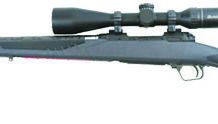
Winchester Model 70 Classic Sporter
Overall, this U.S. Repeating Arms Co. (USRAC) rifle, which carries the Winchester name, shot groups measuring under 1.2 inches, and with Federals Classic Hi-Shok 150-grain round-nose soft-point ammunition, it averaged 0.86 inches in test groups.
It also has a Mauser claw extraction-style bolt (also found on the Ruger), which harks back to the famous pre-64 actions many hunters cherish.
The Classic Sporters appearance, like the Rugers, is restrained but attractive, particularly the stocks low-sheen finish, which showed off the walnuts straight grain. Also, unlike the other rifles, the Model 70 didnt have a highly polished gold trigger (like the Browning) or a shiny stainless trigger shoe or bolt handle (like the Ruger), or a reflective stock finish (like the Remington) that might alert game animals.
Remington Model 700 BDL DM
As with the Winchester, the Model 700s downrange performance is slightly worse than the Ruger and Browning guns. With two of the three Federal rounds, the Remington shot very near 1 minute of angle, and at its worst, it still printed 11/2-inch groups. For many hunter silhouette shooters, thats more than sufficient.
Additionally, this rifle has some other things going for it. It has a flashy styling that many outdoorsmen prefer, with white-line spacers setting off the black butt plate, grip cap, and forearm cap. The guns 20-lines-to-the-inch skip-line checkering was deep and sharp, which provided excellent grasping surfaces on the grip and forearm. Operationally, its very smooth and refined overall, but we noticed some trigger creep that should be smoothed out by a gunsmith.
Field Tests Recommends
For hunters who want serviceable ballistic performance in an over-the-counter rifle, any of these standard bolt actions from Browning, Ruger, Winchester, and Remington will provide 1-MOA accuracy with the right loads, our tests showed. In our informed opinion, these companies turn out serviceable, affordable firearms, any of which will do the job.
However, if we were picking between the Remington Model 700 BDL DM, the Winchester Model 70 Classic Sporter, the Ruger M77R Mark II, or the Browning A-Bolt II Medallion, we would shop around for the best deal we could find between the Ruger and Browning models. Those two rifles were slightly more accurate in our tests, and showed good overall cosmetics, fit and finish, and function.
Also With This Article
Click here to view "How We Tested."
Click here to view "Accuracy Results."
Click here to view "Specifications."


![Publishing Systems Powered by iProduction [ling] Publishing Systems Powered by iProduction [ling]](/media/ui/logo_poweredby_static.gif)