







Junior 22s: We Pick Marlins Model 2000 Target
In key areas, the Anschütz Achiever ST smallbore rifle has an edge over Marlins product, but the West German product has what we think is a fatal flaw.
![]() |
Smaller junior shooters had some trouble |
Today, however, young shooters have a much broader selection of rifles from which to choose. Two of the more popular .22 Long Rifle models hail from Germany and the United States, respectively: Anschutzs Achiever Super Target and the Marlin Model 2000 Bolt Action Target Rifle. The Achiever is marketed directly into the young-shooters market. The 8-pound, 41-inch-long Model 2000 is described in the Marlin catalog as a reasonably priced, entry-level target rifle with the features and quality of a true competition rifle. However, the 2000 isnt sold solely as a youth gun; an optional summer biathlon kit is also offered.
The Super Target (ST) sells for $485 in red-blooded American retail dollars, and the Model 2000 goes for $602.30, which includes a Lyman adjustable peep rear sight and a hooded globe front sight with inserts. Sights for the ST must be purchased separately. The Anschutz Sight Set 1, which is comparable to the Lyman sight Marlin supplies with the 2000, costs $74.75 at retail. Anschutzs Sight Set 2, which is the micrometer rear sight that ships with the companys high-end competition rifles, sells for $279.85. As an option, Marlin offers an Anschutz rear sight with adapter blocks for the 2000. That sight (part number 804341) costs $164.85 and requires the purchase of adapter bases (part 804239), which cost $32.90.
We had the fine and uplifting experience recently to purchase and shoot these rifles side by side. We bought the ST and the expensive Sight Set 2 for a list price of $764.85. We bought the standard Model 2000 for $602.30. We fired the two bolt actions extensively at the range, chronographing and accuracy testing them with benchrest scopes (see How We Tested sidebar). We also put them in the hands of several junior shooters to see how the guns lengths and weights were borne by small-framed individuals. We detail the performance of each gun on a function-by-function basis below.
VARYING TRIGGER PERFORMANCE
When we took the guns out of their boxes for initial function testing, we were underwhelmed with both guns triggers.
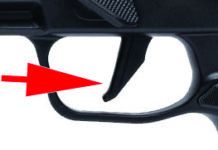
The Anschutz owners manual said the ST was supplied with a two-stage trigger, part number 5066/2. According to the manual, the trigger has a preliminary stage of free travel or slack before engagement of the firing mechanism. The trigger has been set by the factory to its best performance adjustment. Note the red warning label on the trigger mechanism which must never be removed. Every trigger part is factory adjusted to provide optimum performance. Do not change this adjustment or tamper with the trigger.
In our view, the trigger was adjusted to supply a decidedly non-optimal performance, and it would have to be tampered with to allow a young shooter to perform well with it. The first stage pulls up smoothly enough, coming to a hard stop at the beginning of the second stage. The second stage in our ST broke at 50 ounces (3 pounds 2 ounces, rather than the specified 2 pounds 6 ounces). This pull weight is neither objectionable nor too heavy, since it comes very near conventional competition trigger-weight standards.
The sear engagement, however, was too advanced, meaning the second stage of the trigger didnt break cleanly. The shooter would pull up the first stage and come to the point where the gun was ready to fire. But in the crucial second stage, the trigger should be adjusted to release the shot the instant the sights settle in the 10-ring. Initially, that wasnt possible with the Anschutz trigger. Even on the bench, we found it difficult to break shots evenly because it was difficult to learn where the trigger would break.
We realize this criticism will not be viewed with favor among product-liability lawyers and design engineers who worship at the Temple of Litigation. They produce products that are optimized to avoid lawsuits, not shoot well. Still, Olympic gold medalist and Performance Shooter Contributing Editor Lanny Bassham maintains that giving a good trigger to a safe young shooter is the best thing a coach or parent can do to improve performance. In our opinion, the Anschutz trigger as it comes out of the box simply isnt satisfactory.
However, because we are meddling and irresponsible firearms consumers, we unscrewed the barreled action from the stock and looked at the trigger. A small set screw behind the top of the trigger controls the amount of first-stage take up. Since that was satisfactory, we didnt adjust it (or the weight either). A nut (painted red) in front of the trigger controls sear engagement, and we rotated that knob clockwise until the sear broke as cleanly as a leaf falling from a tree.
Of course, it is also possible to advance the sear to the point that the gun goes off when the action closes. Thats bad. So if you know what youre doing, you can make the 5066/2 trigger perform well in about a minute. If you dont know what a good trigger feels like, have a competition-rifle gunsmith show you and safely perform the sear-engagement adjustment.
Initially, the Marlins trigger wasnt too hot either. And it stayed that way. The first stage was gravelly, and the trigger didnt break cleanly in the 45-ounce-pull second stage. In the sloppy second stage, the shooter could move the trigger without the shot going off. Moreover, these problems werent easily correctable.
An examination of the trigger showed that a sliding sear prop pinned into the trigger shoe engaged the sear itself upon cocking. The sear advanced, firing the action, when the backward movement of the trigger disengaged the sear prop from the sear notch. A look at the owners manual showed the sear (part 35), the sear prop (part 37), and the trigger (part 55) to be restricted parts only available to gunsmiths. Thus, we were unable to adjust and improve the 2000s let-off point. A gunsmith might be able to polish the engagement point between the sear and sear prop, but many wont because of liability problems. Thus, the trigger you get with the Marlin is the trigger youre stuck with.
ACCURACY FAVORS ANSCHÜTZ
As the accompanying table shows, we got far better overall accuracy out of the little ST than we did the 2000. We shot the guns on the same day, firing three record five-shot strings per brand of ammo.
The best the Marlin could do at 50 yards was 0.6-inch groups, which we shot with Eley Tenex. Three other ammo lots, CCI Green Tag Competition, Dynamit Nobels RWS R50, and Lapua Dominator, averaged 0.7-inch groups. The 2000 didnt like Federals Gold Medal Match rimfire ammo, shooting 0.9-inch groups.
The STs group sizes either matched or beat the 2000s in every ammo branda clear indication the ST is the superior product in terms of accuracy. The ST shot Eley Tenex on par with the 2000, notching 0.6-inch groups. CCI Green Tag and RWS R50 ammo recorded 0.5-inch groups, and Lapuas Dominator fodder cranked out exceptional 0.4-inch cloverleafs. Furthermore, the ST liked the Federal Gold Medals 40-grain leadheads. That ammo averaged 0.3-inch groups. The best Federal group was 0.2 inch.
BOLTS, ACTIONS, BARRELS
Both guns showed some metalwork problems, none of which were serious.
The Anschutzs stainless-steel bolt was hard to work initially, but it broke in somewhat as the test progressed. However, the STs bolt never became easy to work, even for adults. When rounds were shoved into the chamber and then driven home with the bolt, the handle was very hard to close. We attribute this pecularity to tight headspacing in the chamber, which also probably accounted for a great deal of the guns accuracy edge.
The 2000s bolt was very easy to work, in large part because of the 3-inch-long bolt handle. It gave the shooter a lot of mechanical advantage.
Both barrels were free of bluing blemishes and other defects. The 2000 had a recessed match-style crown the ST lacked. The 22-inch-long, 3/4-inch-diameter ST barrel showed tool marks in its front-sight groove. It also had the first editorial statement weve ever read on a barrel. Midway up the tube, the following message was stamped in the steel: Unsafe for use by minors except under the supervision of a responsible and qualified adult. Both barrels were free-floated away from the front part of the stock forearms, but neither were glass bedded.
The ST was much easier to load than the 2000 because it had a stainless-steel ramp under the chamber. It was easy to flop a round onto the STs ramp and push it home with the finger, then work the bolt to close the action. In contrast, the 2000 lacked such a ramp because the gun can be converted to clip-fed operation for silhouette or biathlon use. Still, the plastic insert that feeds up through the action is a poor substitute for a ramp. Rounds that missed the breech could fall into the cramped area ahead of the bolt. They required the shooter to break position and dig out the round.
Both safeties worked by blocking the progress of the trigger. To activate the Anschutz safety, the shooter pulls an external button rearward, which slips a U-shaped piece of metal around the back of the STs trigger. Similarly, the 2000s safety places a piece of metal in front of a stop on the trigger to block its movement. Both guns have chamber-loaded indicators. Extraction was positive in both guns, and spent cases were thrown varying distances to the right of the shooter depending on how hard the bolt was worked.
Bolts on both guns could be removed by opening the action, holding the trigger rearward, and sliding the bolt out of the receiver. However, because the 2000s bolt body wasnt fixed, it was more difficult to put its bolt back into the gun. The bolt face could rotate out of alignment with the chamber. The rigid bolt of the Anschutz simply slid home with no muss or fuss.
STOCKWORK AND ERGONOMICS
One of the few edges the Model 2000 has over the Anschutz is in its stock, but it is a significant advantage.
The ISU standard-rifle styled Marlin stock is a fiberglass/Kevlar (Carbelite) combination with a high comb and stippled forearm and pistol grip. The stock is finished with two coats of blue oven-cured, two-part epoxy. Marlin says this stock will be replaced with a laminated wood version in 1996. The distinctive color of the gun is attractive, and the tacky gripping surfaces its finish provides are helpful in controlling the piece. The 2000s serrated-rubber buttplate is adjustable for height, length of pull, and cant. It has a forearm rail that runs the length of the gun.
In comparison, the ST falls short in stockwork. The hardwood stock is cosmetically unremarkable, but in case anyone doesnt know your kid is shooting an Anschutz, a sticker on the right side of the stock spells out the company name in inch-tall letters. Stippled areas on the forearm and pistol grip afford good grip surfaces, but the forearm stippling doesnt come all the way back to the trigger guard, and neither does the accessory rail. This is a peculiar arrangement because young shooters, who generally have shorter arms than adults, will almost always work the middle and breech end of the forearm more than they will the muzzle end. Six vents in the forearm (the 2000 has four vents) expose more of the barrel to air circulation, but were not sure why thats necessary or helpful. The STs buttplate is adjustable for height only, though spacers are available to increase the length of pull.
SHOOTING THE RIFLES
Despite their faults, we had a good time shooting these products.
The 6.5-pound, 38.7-inch-long ST is noticeably lighter than the 8-pound 2000. For many junior shooters up to 80 to 100 pounds, we think the ST is easier to shoot simply because of its weight. Also, the ST is well balanced. The break-over point occurs just in front of the receiver. Once the STs trigger was adjusted, we used it capably on metallic silhouettes and on paper targets, noting that in prone it was very comfortable to shoot because we didnt need to make buttplate cant changes. In standing and kneeling, however, the buttplates limited adjustability was a major discomfort. Many shooters couldnt construct good positions without twisting the gun into place, which was hindered by the buttplate. The comb needed more height to bring some shooters eyes into line, which we accomplished by building up a cheekpiece pad with athletic training tape. We found that the forearm stippling held the textured surface of a Gehman shooting glove very well. Smaller shooters were bothered by the lack of inward adjustment on the hand rail. They wound up placing their left hand on the smooth surface of the stock directly below the receiver rather than on the stippled wood surface. The Anschutz gun didnt come with a handstop; we pirated one from another Anschutz gun in house, but you should be aware youll have to buy a stop. The Anschutz Sight Set 2 was superb. It is an international-class product that is repeatable and adjustable for cant.
At 50 feet, we didnt notice any accuracy difference between the two guns, so the Model 2000 ranked on par with the ST at the most common shooting distance. It was also more comfortable to shoot for advanced junior shooters who could handle its weight. The Lyman rear sight was a disappointment. Mounted to the left rear side of the receiver, its location on the gun cant be varied easily for each position (eye relief), as can a sight which moves in the receiver groove. We would strongly recommend buying the optional Anschutz sight and adapter bases for the 2000. The 2000 came with a handstop, which would serve most shooters well.
Also With This Article
Click here to view "How We Tested."
Click here to view sight information.
Click here to view "Performance Shooter Recommends."
Click here to view "Accuracy Table."
-By Todd Woodard


![Publishing Systems Powered by iProduction [ling] Publishing Systems Powered by iProduction [ling]](/media/ui/logo_poweredby_static.gif)