





June 2013
1911 Value Shootout: Standard GI, or Kimber Custom Eclipse?
A difficult question often posed to the staff concerns subjective aspects of the handgun. Is the Italian Beretta a better handgun than the U.S.-made pistol? Is the pinned and recessed Smith & Wesson revolver the better shooter than the modern slip-barrel revolver? Among those that seem to invite the most comments is the difference between GI 1911 pistols and the semi-custom factory pistols. By semi-custom we mean pistols with high-profile sights, a custom grade beavertail safety, extended controls, and claims of superior fitting in the barrel, bushing, and barrel hood. The plain old GI pistol that served without complaint in two world wars is seen as the underdog in such a match up. The GI pistol cannot possibly play on an even field with the modern enhanced 1911, can it? The answer is, it depends.
S&W Bodyguards: Revolver Or Semiauto for Self Defense?
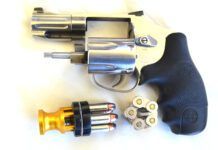
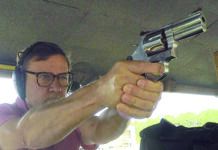
In this report we look at S&Ws two so-called Bodyguards, one a revolver in 38 Special, the other a semiautomatic pistol in 380 ACP. Both were fitted with adjustable laser sights. The first thing we found was the lasers are useless outdoors in bright daylight, no matter what youve been led to believe by various TV shows. On an overcast day, the lasers on these two pistols might be of some value, but we much prefer to use iron sights when we can see em. With them, theres nothing to turn on, no buttons to push.
Two Pieces of Firearms History: Sterling, Pioneer Arms Compete
We acquired two historical and technically interesting firearms for this test. The guns were the 9mm Wise Lite Arms Sterling L2A3 9mm, about $500, and the Inter Ordnance/Pioneer Arms PPS-43C Pistol chambered in 7.62x25 Tokarev, also in the $500 range. The latter is officially a pistol because its folding stock is welded in the folded position. We found the folding stocks do nothing for their handling or practical function, but in close quarters that might be a handy feature. Both designs originally fired from an open bolt, and the Sterling was originally selective fire. These two test guns are both manufactured to fire semiauto-only, and they both fire from a closed bolt. We managed to find three types of 9mm ammo and two brands of 7.62x25 Tokarev, enough to wring out both guns. Heres what we found.
Ruger LC380 ACP Pistol: Downsized 'Nine' That Works
Being a magazine that deals primarily with the testing and evaluation of firearms and accessories, were always looking for the next big thing. Not long ago the next big thing was the small concealment pistol chambered for 380 Auto. One such pistol was the Ruger LCP380, and it seemed like every maker was bringing out a small pistol with barrel lengths shorter than 3 inches and an overall size that could fit inside the dimensions of the average adults hand. One of the things that worked against these guns was the lack of availability of ammunition. Call it 9mm Browning, 9mm Corto, 9mm Kurz in English, 9mm Short 380 ACP ammunition was difficult to find. Another factor that seemed to cool enthusiasm for the little 380s was handling and recoil.
UTAS-15 Pump: We'd Wait On It
You may not have heard of this company, UTAS (pronounced YOO-tash), a Turkish firm that specializes in firearms design, engineering and OEM manufacturing. UTAS has had its designs voted Gun of the Year by the NRAs American Rifleman magazine in 2006 and in 2007. One product from UTAS is the UTS-15 tactical shotgun, a 12-gauge pump-action shotgun with two 7-round alternately feeding or selectable magazine tubes. We recently tested a UTS-15 as a follow-up to our November 2012 test of high-capacity shotguns, the Akdal Arms MKA 1919 3-inch 12 Gauge, $799; the Kel-Tec KSG 3-inch 12 Gauge, $1075; the Saiga IZ-107 12 Gauge, $640; and a Red Jacket Saiga RTS-SBS-12 Short-Barrel 12 Gauge, $1939. Of that quartet, we preferred the Saiga and the KSG.
Laser Rangefinders Under $200: Simmons, Nikon, and Redfield
It does not matter what type of implement you use modern firearm, muzzleloader, or bow determining distance to your target is critical. For a primitive-weapons hunter, it means waiting until the beast comes into range. For a user of modern firearms, it might mean dialing in exactly the right amount of hold-over or passing up a shot on a trophy thats at the edge of your ability to shoot accurately. One of the fastest, easiest to use, and affordable means of accurately gauging distance to various targets is a laser rangefinder. Laser rangefinders are basically a monocular that send out a pulsating laser beam that bounces off a target back to the unit and provides an instantaneous readout in yards or meters. The laser is similar technology to that used in autofocus cameras.


![Publishing Systems Powered by iProduction [ipp-epg-eugene] Publishing Systems Powered by iProduction [ipp-epg-eugene]](/media/ui/logo_poweredby_static.gif)