







Home Shotguns Page 27

Shotguns

BATFE Rules on Manufacturing of Firearms Points
Below are examples of operations performed on firearms and guidance as to whether or not such operations would be considered manufacturing under the Gun Control Act (GCA).

Duel at the Mostly OK Corral: 12-Ga. Cowboy Action Shotguns
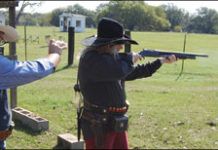
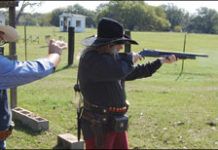
Cowboy Action Shooting members, whose increasing numbers show no need of a stimulus package, have developed their hobby into a tribute to the gun battles of the Old West-both real and fictional. Shotguns often figured into these armed conflicts, normally giving the scattergun handler a distinct advantage over opponents armed with a handgun or rifle, as long as the battle was up close and personal.One of Hollywoods classic depictions of how a shotgun could turn the tide in a gun battle was in the 1966 movie The Professionals, featuring Academy-award-winning actors Lee Marvin and Burt Lancaster.Marvin, armed with a Winchester Model 1897 pump-action shotgun, faces down eight mounted bandits armed with bolt-action rifles as they meet in a narrow canyon. With just a little help from Lancaster, himself armed with a Winchester lever-action rifle, Marvin clears the canyon of bandits as he touches off seven shotgun blasts in rapid succession. Most of the bad guys dont even have a chance to get off a shot before they are knocked out of the saddle.Although the battle is pure Hollywood, this type of shotgun action and its recreation on film has become a driving force behind the increasing popularity of the veteran firearms. Both the side-by-side hammer guns and the pump-action hammer guns of old left a distinct mark in history and are now resurfacing in the form of replicas finding favor at shooting competitions across the country. The popularity of the simple and easy-to-handle shotguns is also growing among people interested in home-defense firearms.For our trip back to the past, we selected both a side-by-side and a pump action to see if there is any advantage or downside-other than the number of shots-with either Old West style shotgun.Our test shotguns were a Cimarron T.T.N. Model 1878 Coach Gun 12 Gauge Side-by-Side and a Cimarron Model 1897 Pump 12 Gauge Shotgun,both carrying a price tag of $480 in the new gun rack at Durys Gun Shop in San Antonio (www.durysguns.com). Because of the popularity of the firearms, we waited more than six months to receive the back-order Model 1897.Both of the shotguns are recreations of solid, dependable and well-used scatterguns of the Old West. With their 20-inch barrels and simple actions, the two firearms are also fulfilling a modern duty as self-dense shotguns for home owners. Shotguns firing typical hunting loads in a home-defense situation have the advantage of providing stopping power that will not pass through walls like handgun or rifle slugs.To determine the effectiveness of both shotguns, we selected three distinctly different types of ammunition for our testing. For the Cowboy-Action range, our ammunition was Rio Target 2.75-inch loads with 1 ounce of No. 8 shot that produced an average muzzle velocity of 1,210 fps. For our home-defense loads, we used Winchester 00 Buckshot 2.75-inch loads firing nine pellets at an average muzzle velocity of 1,325 fps, and Remington Express Power Piston 2.75-inch loads with 1.25 ounces of No. 6 shot pushed at an average muzzle velocity of 1,330 fps.In the home-defense simulations, we limited our patterning tests to a range of 20 feet (recreating a shot across a typical room) and relied upon Birchwood Casey Shoot-N-C 12-inch targets to determine pattern effectiveness. Heres our test report:

Duel at the Mostly OK Corral: 12-Ga. Cowboy Action Shotguns

Cowboy Action Shooting members, whose increasing numbers show no need of a stimulus package, have developed their hobby into a tribute to the gun battles of the Old West-both real and fictional. Shotguns often figured into these armed conflicts, normally giving the scattergun handler a distinct advantage over opponents armed with a handgun or rifle, as long as the battle was up close and personal.One of Hollywoods classic depictions of how a shotgun could turn the tide in a gun battle was in the 1966 movie The Professionals, featuring Academy-award-winning actors Lee Marvin and Burt Lancaster.Marvin, armed with a Winchester Model 1897 pump-action shotgun, faces down eight mounted bandits armed with bolt-action rifles as they meet in a narrow canyon. With just a little help from Lancaster, himself armed with a Winchester lever-action rifle, Marvin clears the canyon of bandits as he touches off seven shotgun blasts in rapid succession. Most of the bad guys dont even have a chance to get off a shot before they are knocked out of the saddle.Although the battle is pure Hollywood, this type of shotgun action and its recreation on film has become a driving force behind the increasing popularity of the veteran firearms. Both the side-by-side hammer guns and the pump-action hammer guns of old left a distinct mark in history and are now resurfacing in the form of replicas finding favor at shooting competitions across the country. The popularity of the simple and easy-to-handle shotguns is also growing among people interested in home-defense firearms.For our trip back to the past, we selected both a side-by-side and a pump action to see if there is any advantage or downside-other than the number of shots-with either Old West style shotgun.Our test shotguns were a Cimarron T.T.N. Model 1878 Coach Gun 12 Gauge Side-by-Side and a Cimarron Model 1897 Pump 12 Gauge Shotgun,both carrying a price tag of $480 in the new gun rack at Durys Gun Shop in San Antonio (www.durysguns.com). Because of the popularity of the firearms, we waited more than six months to receive the back-order Model 1897.Both of the shotguns are recreations of solid, dependable and well-used scatterguns of the Old West. With their 20-inch barrels and simple actions, the two firearms are also fulfilling a modern duty as self-dense shotguns for home owners. Shotguns firing typical hunting loads in a home-defense situation have the advantage of providing stopping power that will not pass through walls like handgun or rifle slugs.To determine the effectiveness of both shotguns, we selected three distinctly different types of ammunition for our testing. For the Cowboy-Action range, our ammunition was Rio Target 2.75-inch loads with 1 ounce of No. 8 shot that produced an average muzzle velocity of 1,210 fps. For our home-defense loads, we used Winchester 00 Buckshot 2.75-inch loads firing nine pellets at an average muzzle velocity of 1,325 fps, and Remington Express Power Piston 2.75-inch loads with 1.25 ounces of No. 6 shot pushed at an average muzzle velocity of 1,330 fps.In the home-defense simulations, we limited our patterning tests to a range of 20 feet (recreating a shot across a typical room) and relied upon Birchwood Casey Shoot-N-C 12-inch targets to determine pattern effectiveness. Heres our test report:

Remington Offers New 870 Express Compact Shotgun In Mossy Oak Pink Camouflage
MADISON, NC -- Remington's new 870 Express Compact with Mossy Oak comes outfitted with pink camouflage.

Home-Defense 12-Gauge Pumps: Ithaca, Remington, Mossberg

Perhaps due to the "Obama-effect"—wherein the fear of future gun bans is driving sales—the home-defense/tactical class of self-defense shotguns is booming like never before. But we must recognize that other factors figure into the segment's sales rise as well, not the least of which is that a 12-gauge pump-action shotgun is an effective close-quarters weapon.

To wit: The M97 version of John Browning's Winchester 1897 shotgun was the original "trench-sweeper." Widely considered the first truly successful pump shotgun, the M97 was fitted with a heat shield and the M1917 16-inch bayonet for combat duty. The highly effective use of the shotgun by United States forces in WWI had a dramatic effect on the morale of front-line German troops. As a result, on September 19 of 1918, the German government issued a diplomatic protest against the American use of shotguns, alleging that the law of war prohibited the shotgun. The 5+1 capacity M97 and OO buckshot defined the fast-handling, reliable close-quarters shotgun for about 30 years, the platform of the high-capacity pump persisting through to present day.

The reason to consider a shotgun for personal defense is what many combat studies have shown: the hit probability of a shotgun is roughly twice that of a rifle. For home defense, the shotgun is a quicker stopper than a handgun due to its being able to produce more wound trauma with multiple wound paths. It is considered easier to use in a high-stress situation, and minimizes wall penetration compared to some handgun ammunition. It is also economical to practice with.

Number 1 Buckshot is 30 caliber; it is the superior choice as defined by the International Wound Ballistics Association: "Number 1 buck is the smallest diameter shot that reliably and consistently penetrates more than 12 inches of standard ordnance gelatin when fired at typical shotgun engagement distances. A standard 2-inch 12-gauge shotshell contains 16 pellets of #1 buck. The total combined cross sectional area of the 16 pellets is 1.13 square inches. Compared to the total combined cross sectional area of the nine pellets in a standard #00 (double-aught) buck shotshell (0.77 square inches), the # 1 buck shotshell has the capacity to produce over 30 percent more potentially effective wound trauma. In all shotshell loads, number 1 buckshot produces more effective wound trauma than either #00 or #000 buck. Also, #1 buck is less likely to over-penetrate and exit an attacker's body." (For further reading, consult Dr. Martin Fackler and Duncan MacPherson's works on bullet penetration and wounding ballistics.)

This match-up includes the Ithaca Model 37 Defense Gun ($469), very close to the M37 "Trench Gun" that saw action in WWII and in Vietnam; the Remington Model 870 Tac-2 FS ($692), and the Mossberg 590A1 w/Black Aluminum Adjustable Stock ($693). The Mossberg 590A1 in various configurations is currently an active service shotgun for the U.S. Military. Here's what our test team thought about the trio:
Home-Defense 12-Gauge Pumps: Ithaca, Remington, Mossberg

Perhaps due to the "Obama-effect"—wherein the fear of future gun bans is driving sales—the home-defense/tactical class of self-defense shotguns is booming like never before. But we must recognize that other factors figure into the segment's sales rise as well, not the least of which is that a 12-gauge pump-action shotgun is an effective close-quarters weapon.

To wit: The M97 version of John Browning's Winchester 1897 shotgun was the original "trench-sweeper." Widely considered the first truly successful pump shotgun, the M97 was fitted with a heat shield and the M1917 16-inch bayonet for combat duty. The highly effective use of the shotgun by United States forces in WWI had a dramatic effect on the morale of front-line German troops. As a result, on September 19 of 1918, the German government issued a diplomatic protest against the American use of shotguns, alleging that the law of war prohibited the shotgun. The 5+1 capacity M97 and OO buckshot defined the fast-handling, reliable close-quarters shotgun for about 30 years, the platform of the high-capacity pump persisting through to present day.

The reason to consider a shotgun for personal defense is what many combat studies have shown: the hit probability of a shotgun is roughly twice that of a rifle. For home defense, the shotgun is a quicker stopper than a handgun due to its being able to produce more wound trauma with multiple wound paths. It is considered easier to use in a high-stress situation, and minimizes wall penetration compared to some handgun ammunition. It is also economical to practice with.

Number 1 Buckshot is 30 caliber; it is the superior choice as defined by the International Wound Ballistics Association: "Number 1 buck is the smallest diameter shot that reliably and consistently penetrates more than 12 inches of standard ordnance gelatin when fired at typical shotgun engagement distances. A standard 2-inch 12-gauge shotshell contains 16 pellets of #1 buck. The total combined cross sectional area of the 16 pellets is 1.13 square inches. Compared to the total combined cross sectional area of the nine pellets in a standard #00 (double-aught) buck shotshell (0.77 square inches), the # 1 buck shotshell has the capacity to produce over 30 percent more potentially effective wound trauma. In all shotshell loads, number 1 buckshot produces more effective wound trauma than either #00 or #000 buck. Also, #1 buck is less likely to over-penetrate and exit an attacker's body." (For further reading, consult Dr. Martin Fackler and Duncan MacPherson's works on bullet penetration and wounding ballistics.)

This match-up includes the Ithaca Model 37 Defense Gun ($469), very close to the M37 "Trench Gun" that saw action in WWII and in Vietnam; the Remington Model 870 Tac-2 FS ($692), and the Mossberg 590A1 w/Black Aluminum Adjustable Stock ($693). The Mossberg 590A1 in various configurations is currently an active service shotgun for the U.S. Military. Here's what our test team thought about the trio:

Remington Model 870 Express Pump Synthetic 7-Round 3-inch 20 gauge

The reason many shooters should prefer 20s for home defense over a bigger 12 gauge is that they’re noticeably lighter than 12s. In the September 2005 issue, we tested the Remington Model 870 Express Synthetic 12 Gauge Magnum No. 25077, $345, which weighed 7.25 pounds, and the Mossberg Persuader Model 590A1 12 Gauge Magnum No. 51411, $443, which weighed 6.9 pounds. The 20 we tested weighed three-quarters of a pound to nearly 2 pounds less than the counterpart 12s. But they don’t give up much in terms of hall-clearing power or capacity.

NRA Competitions Division Staying Busy
The NRA Competitions Division recently announced four bits of news important to shooters:

20-Gauge Auto Shoot-out: Beretta, Browning, Remington

Twenty-gauge high-performance lead loads can often outperform their commonly used 12-gauge counterparts-this has been shown vividly again and again. The most relevant example at hand is a load for wild pheasants. Often, the 12-gauge load selected happens to be the cheapest load available at the time, too often a promotional load with various sketches of birdies on the box. It will fall into the category of a 1.25-ounce 1330-fps load at an attractive price. Though the consumer might be told it is "ideal" for pheasants, things dont always work as described or as promised-one of the reasons for this publication.[IMGCAP(1)]Used with quality loads, such as 1-5/16 ounce Winchester Supreme STH2035 shotshells or the Federal PFC258 3-inch shells, we recently proved once again that 20-gauge autoloaders like the guns tested below can produce patterns not just the equal of common 12-gauge loads, but verifiably superior.In this shoot-off, we looked at three familiar names associated with gas-operated shotguns: Beretta, Browning, and Remington-to see what their blued-steel-and-walnut editions have to offer todays shotgunning enthusiasts. Our specific test products were the Beretta AL 391 Urika 2 Gold No. J39TB26 3-inch 20 Gauge, $1550; Browning Silver Hunter Twenty No. 011350605, $1079; and the Remington 1100 Premier Sporting Twenty No. 82846, $1385.Our test ammunition included both 7/8 oz. Estate loads and Winchester Super-X Heavy Game Loads No. XU20H7 with 1 ounce of No. 7 1/2 shot-what we use as an everyday dove load along with Fiocchi 20HV75 shells. We also patterned with Federal Mag-Shok high-velocity lead 3-inch 1-5/16 ounce No. 5 shot (No. PFC258) and Winchester Supreme 1-5/16 ounce 3-inch shells with No. 5 shot (No. STH2035). We shot our patterns at 40 yards, the patterning all shot from bag and cradle. We also fired the guns extensively at the range and in the field to record what we liked and didnt like about the guns. Heres what we learned:

Mossberg 500 Persuader/Cruiser 3-inch 20 Gauge 6-Shot

For home defense, the focus is usually on 12-gauge shotguns, but we recently tested two 20 gauges that for many—if not all—folks would be better choices because of their lighter weight and reduced recoil. One of our test products was the Mossberg 500 Persuader/Cruiser 3-Inch 20 Gauge 6-shot No. 50452, $388. In their commercial form, the Persuaders are virtual duplicates of the Mossberg military 500 and 590 models. Persuader shotguns are available in both 18.5-inch and 20-inch barrel lengths, traditional blued or non-glare matte finishes, and some come with Ghost Ring sights. Available in .410 bore, 20- and 12-gauge models, Mossberg Special Purpose shotguns feature an anti-jam elevator, dual extractors, black synthetic stocks, and drilled and tapped receivers (20 and 12 gauge only) for scope base and optics installation. The Persuader/Cruiser models come with standard stocks, but also include a Cruiser-style pistol grip kit, which we didn't use in our testing.
20-Gauge Semiautos: The 11-87 Beats the Silver and New SA-20

One of the major reasons hunters choose a 20 gauge over a 12 gauge is the former's smaller frame, weight, and recoil. Though they may already own a 12, many field sportsmen wind up reaching for their 20s because the smaller gun is just easier to handle, and there are just a few hunting situations—layback goose hunting and spring turkey hunting, to name two—in which the bigger payload might make a difference.

We recently tested a trio of autoloaders in 20 gauge that offer quite a savings in physical form over their bigger stablemates. Our 3-inch-chamber 20 gauges were the Browning Silver Mossy Oak Duck Blind No. 011366604, $1,064; Mossberg SA-20 No. 75771, $496; and the Remington 11-87 Sportsman No. 29825, $757. The Remington and Mossberg guns have black synthetic finishes, but the Silver 20 is only available in wood-and-blued and camo treatments. Since the stock underneath the Mossy Oak is composite, we opted for it rather than the wood finish.

In two cases, our test guns are the sub-gauge siblings of well-known 12s. The Remington Sportsman line has two 12s and three 20s. The 12s come in 26- and 28-inch barrels and weigh 8.1 pounds and 8.25 pounds respectively, compared to the weight of our test 28-inch-barrel gun, about a full pound lighter. The 28-inch 12-gauge Browning Silver, which is chambered for 3.5-inch shells rather than 3-inch shells like the 20, weighs in at 7.6. Our test Silver 20 was likewise a full pound lighter. The Mossberg is a new-for-2008 line for that company, so the SA-20 designation names just a single chambering, as you might expect. However, comparable guns in the 930 autoloader line, which are chambered only for 12 gauge, weigh 7.75 pounds to the SA-20's feathery 6.0 pounds.

ATI Announces New AR-Style 410 Shotgun, the T14

ROCHESTER, NY – American Tactical Imports Inc. has introduced the first-ever 410 caliber semiautomatic shotgun. The T14 is a smooth bore, open choke 410 shotgun based on the AR15 rifle.

DOJ Sues LA Sheriff for 2A Civil Rights Violations

Oh, man, this is so awesome. On September 30, 2025, the U.S. Department of Justice’s Civil Rights Division filed a lawsuit against the Los...