





Mixed Bag in Self Defense: Partner Handguns Fight It Out
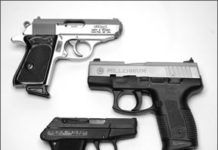
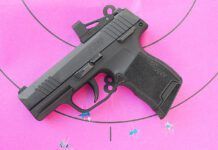
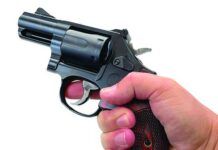
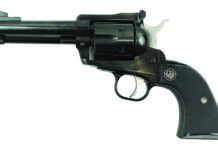
We recently read The Book of Two Guns, The Martial Art of The 1911 and AR Carbine, by Tiger McKee. McKee is the proprietor and headmaster of the Shootrite Firearms Academy (shootrite.org) located in Langston, Alabama. Printed in long hand with illustrations, McKee instructs and inspires the reader to consider what skills are necessary to effectively use the handgun and rifle weapon interdependently, as well as in transition from one to the other.With the two-gun concept in mind, we decided to go ahead with a story weve been considering for some time-evaluating two pairs of handguns that could also be used to work effectively in tandem, in this case, two revolvers against two pistols.In each pair, we picked one gun that was larger and better suited for primary carry, be it for duty or concealment. The other was significantly smaller and meant to be hidden in case of emergency. Each pair belonged to the same system, or as close as we could supply.For primary carry we chose two 45-caliber weapons, Rugers $836 Redhawk 45 Colt Model KRH454 and Springfield Armorys $785 Mil-Spec Full Size Stainless 1911A1. Paired with the Ruger revolver was the $450 32 H&R Magnum Smith & Wesson Airweight J-frame Model 431PD. To run with the Springfield, we added a $699 9mm Walther PPS semi-automatic, which was light weight and super slim.We could have selected any number of pairs of handguns to fill out our test roster. It is interesting to note that our four guns are each chambered for a different caliber. Certainly when it comes to a primary gun there is more leeway in choice. But when it comes to deep concealment larger calibers demand bigger, stronger and heavier frames. Bigger bullets can also limit capacity. Therefore we felt that system and size was more important than matching caliber.Our test ammunition was as follows. The 45 ACP was represented by Magtech 230-grain FMC, Hornady 185-grain JHP/XTC, and Black Hills 230-grain JHP+P ammunition. The 45 Colt test rounds for the Ruger were Winchester 225-grain Silvertip HP, Federal Champion 225-grain semi-Wadcutter hollowpoints, and Black Hills 250-grain roundnosed flat points. The 9mm ammunition was 125-grain HAP rounds from Atlanta Arms and Ammunition, Black Hills 124-grain full metal jacketed rounds, and Federals 105-grain Expanding FMJ ammunition. For the 32 H&R Magnum ammunition we chose Federal Personal Defense 85-grain JHPs, Federal Classic 95-grain lead semi-wadcutters, and Black Hills 85-grain JHP rounds.

Last-Gasp Self-Defense 32 ACPs From Walther, Kel-Tec, Taurus
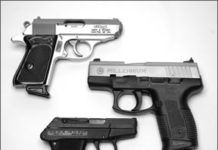
When a reader asks, "Which is the best gun for deep concealment?", or "Is there a good self-defense gun out there with limited recoil?", our minds immediately turn to guns chambered for 32 Auto (32 ACP).We understand that many, or most, GT readers would wonder about the 32s power, or lack of same, and that concern was addressed in one part of our test. Beside bench-shooting for accuracy, we also created an action test that focused on what these guns would most likely be used for-that is, rapid fire at little more than contact distance.In formulating our procedure, we took several factors into account. In close quarters there may be little or no opportunity to apply a support hand. Indeed, the hand opposite of the one holding the gun may be busy fending off a blow, the slash of a knife or, pushing back on the body of the assailant. Therefore, we decided to shoot this drill strong hand only.The target was placed 9 feet away, and we relied primarily upon point shooting. Three strings would be attempted, making note of accuracy and the elapsed time between shots (split times). Our target was an IDPA-style cardboard silhouette featuring an 8-inch-diameter circle in the upper "chest" area. We aimed for the middle of the circle.Start position was with the gun held in the right hand of our test shooter just below the point of aim with finger off the trigger. We decided that each string of fire should require that we empty a full magazine into the target. This speaks to the lower available power of 32 ACP, which in most cases produced less than 100 foot-pounds of muzzle energy.Our test guns in this and other assessments were the $361 Kel-Tec P32PK, an extremely lightweight Parkerized unit; the $573 Walther USA PPK, and the Taurus PT132SSP, $436 with stainless-steel slide. The Kel-Tec was the smallest and could be carried in a pocket holster. The Walther pistol was bigger and heavier but still easy to conceal. The Taurus offered the most capacity.Each gun was tested for accuracy from a sandbag rest. Test ammunition was American Eagle 71-grain TMJs, 60-grain Winchester Silvertip HP, and Speer Gold Dot 60-grain GDHP rounds. We had intended to limit testing of the Kel-Tec to a distance of 7 yards. But when we saw it print sub-1-inch groups, we decided to shoot the P32PK from 15 yards side by side with the Walter and the Taurus.Heres what we found:

Last-Gasp Self-Defense 32 ACPs From Walther, Kel-Tec, Taurus
When a reader asks, "Which is the best gun for deep concealment?", or "Is there a good self-defense gun out there with limited recoil?", our minds immediately turn to guns chambered for 32 Auto (32 ACP).We understand that many, or most, GT readers would wonder about the 32s power, or lack of same, and that concern was addressed in one part of our test. Beside bench-shooting for accuracy, we also created an action test that focused on what these guns would most likely be used for-that is, rapid fire at little more than contact distance.In formulating our procedure, we took several factors into account. In close quarters there may be little or no opportunity to apply a support hand. Indeed, the hand opposite of the one holding the gun may be busy fending off a blow, the slash of a knife or, pushing back on the body of the assailant. Therefore, we decided to shoot this drill strong hand only.The target was placed 9 feet away, and we relied primarily upon point shooting. Three strings would be attempted, making note of accuracy and the elapsed time between shots (split times). Our target was an IDPA-style cardboard silhouette featuring an 8-inch-diameter circle in the upper "chest" area. We aimed for the middle of the circle.Start position was with the gun held in the right hand of our test shooter just below the point of aim with finger off the trigger. We decided that each string of fire should require that we empty a full magazine into the target. This speaks to the lower available power of 32 ACP, which in most cases produced less than 100 foot-pounds of muzzle energy.Our test guns in this and other assessments were the $361 Kel-Tec P32PK, an extremely lightweight Parkerized unit; the $573 Walther USA PPK, and the Taurus PT132SSP, $436 with stainless-steel slide. The Kel-Tec was the smallest and could be carried in a pocket holster. The Walther pistol was bigger and heavier but still easy to conceal. The Taurus offered the most capacity.Each gun was tested for accuracy from a sandbag rest. Test ammunition was American Eagle 71-grain TMJs, 60-grain Winchester Silvertip HP, and Speer Gold Dot 60-grain GDHP rounds. We had intended to limit testing of the Kel-Tec to a distance of 7 yards. But when we saw it print sub-1-inch groups, we decided to shoot the P32PK from 15 yards side by side with the Walter and the Taurus.Heres what we found:

Kel-Tecs .380 And .32 ACPs VS. NAA

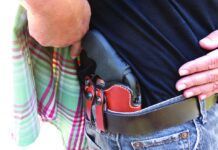
In this test we look at semi-automatic pistols that are small enough to fit into one's pocket and avoid detection. One such pistol is the proven Kel-Tec P32. Because that gun fared well in a previous test of pocket pistols (October 2001), we wanted to see how the parent company's slightly larger model in .380 ACP, the Kel-Tec P3AT, fared against the .32. To round out the field, we also tested another .32, this one a pistol from Guardian North American Arms in a proprietary cartridge, the .32NAA.

Naturally, we wanted to find out how reliable these guns were. We also wondered how much difference the round would make in this specific application, and we had questions about concealment and deployment. Is pocket carry safe? Under what conditions would these guns likely prove to be a valuable asset? Would these pistols convince us to buy into the concept of pocket pistols, or would we find too many liabilities for their owners to live with?

Here's what we learned:
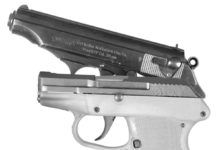
.32 ACPs: We Evaluate Kel-Tec, Walther, Beretta Pocket Guns

Kel-Tec's $295 P32 is a modern alternative to the Derringer, as is the $368 Beretta Alley Cat. But to our eyes, Walther's $499 PP is a durable icon with greater potential.

NAA Guardian Fared Well Against Seecamp, Beretta .32 Pistols

A major trend in pistols today is toward increased stopping power — the bigger the bullet, the better. This thinking, however, leaves a number of smaller cartridges and some otherwise good handguns sitting on the shelf.

The .32 ACP is one of those calibers which has been gathering dust, especially in the United States. Although it is still fairly popular in Europe, it has nearly been replaced by the more powerful .380 ACP in this country.

A minor comeback seems to be in progress for the .32 cartridge, as a number of handgun manufacturers have started offering pistols to exploit its capabilities. One of the few advantages the .32 ACP has over the .380 ACP is that it can be fired in sm...

.32 Pocket Pistol Update: Buy the Autauga Mark II

In the January 1999 issue of Gun Tests, we gave you an evaluation of three .32 ACP pocket pistols made by Seecamp, Beretta, and North American Arms. Recently Autauga Arms, Inc., entered the pocket .32 pistol market with a bang, and we think the company's 32 Mark II is a winner.

This Prattville, AL-based company offers a stainless-steel, double-action-only semiautomatic with no bells and whistles. You chamber a round and that's it. The gun is all ready to go. Simply pull the trigger, which requires about 8 pounds of pressure, and the little gun fires each of its six-plus-one shots reliably, and with all the accuracy anyone would want.

Autauga is no newcomer to guns, having made precisi...

We Shouldn’t Need A Reminder

I want to remind Gun Tests readers about how important it is to secure our firearms from the curious, the inept, and the deranged. Just...