










Lightweight Carry Options: A 9mm, a .40 S&W, and a .45 GAP
Glock's new $640 Model 37 excels with a brand-new round. Smith & Wesson's titanium $812 4040PD opens new doors, but the $550 FN P9 comes up short.

Subcompact .40 S&Ws: Glock 27 Versus Taurus Millennium Pro
Last month we tested two subcompact 9mm pistols that, based on the shared technology of polymer construction and striker-fired actions, were set to compete with the Glock Model 26. This month we take a look at Taurus's .40 S&W Millennium Pro 140SSP, matching it against Glock's subcompact, the GL27. The GL 27 and the Taurus pistols are almost identical to the 9mm handguns we tested previously, and we were particularly interested in how the .40s would stand up against the abuse the stouter S&W round delivers.
In the past, high-cap polymer 9mm semi-auto designs and frames rechambered for.40 S&W have not always shouldered the extra energy load too well. Structural failures sent many manufacturers back to the drawing board. Problems in polymer and steel-framed guns alike included cracked frames and slides and jumbled internal mechanisms.
Besides questions about durability, we also wanted to explore the operational differences between these two pistols. Would shooters be able to use the same techniques to ensure fast, accurate hits, or would the guns be so different that we would be forced to shoot them differently?
Here's what we found when we tested the Glock 27, $641; and the Taurus PT140 Millennium Pro 140SSP, $485, side by side:
Alloy-Framed .40 S&W Compacts: We Pit SIGArms against Beretta
Looking through the pages of the many different gun magazines, any shooter might be dizzied by the advertisements alone. New models seem to appear with every issue, while simple updates in the finish or style of an old design are trumpeted as well. In this test we will try out two pistols that get less than their share of press, the $620 SIGArms P239 and the $702 Beretta Mini Cougar 8040, both chambered for the stout .40 S&W round.
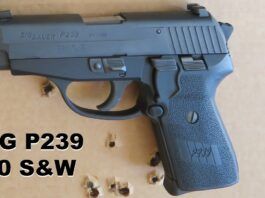
The P239, first issued in 9mm, has since been successfully chambered in much more powerful calibers such as the .357 SIG (see Gun Tests, August 2001) and the .40 S&W. The P239 is unusual among the SIGArms lineup. The P239 is one of few pistols in the Sigarms lineup that feed from a single-column magazine. Like the Beretta pistol in this test, most of the SIGArms pistols use a higher-capacity double-column magazine that results in a much wider and rounder profile at the grip. In terms of compact design we think of the P239 as a TDA variation of Colt's Officer's .45 ACP model. Both pistols share the advantages of being flat and easy to conceal while offering a natural point to the shooter's hand.
Compared to the SIGArms P239, the Beretta 8040 Mini Cougar is a more sophisticated weapon. The decocker lever (found on both sides of the pistol) can also disconnect the trigger, rendering the gun completely safe. Hammer-back safety on, or cocked-and-locked carry is not an option, however.
We learned a lot more about these two pistols when we loaded magazines and went to the range. Here's what we found out.
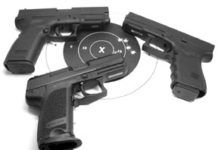
Compact Polymer .40 S&Ws: Glock, Springfield, and H&K
While older designs, such as the double-action revolver and the 1911 semi-automatic pistol, continue to prosper through new materials and manufacturing techniques, the polymer-framed pistol may be at the forefront of pistol development. The .40 S&W is the leading round chosen by today's local and federal law-enforcement professionals. Compact .40s (3.5- to 4.25-inch barrels) bridge the gap between plainclothes duty and civilian concealed carry, and of these, the lightweight "plastic" pistols lead the way. And the Glock line of pistols is perhaps synonymous with the word "polymer."
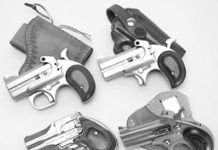
Derringer Match-Up: Are These Pocket Guns Right For You?
In our view, these limited-capacity pistols have limited usefulness for most shooters. Reviewed: American Derringer DA 38 and Model 1, and Bond Arms' Texas Defender and Cowboy Defender.
A Balky Trio: 1911 Pistols Chambered for .40 S&W
First manufactured in 1907, a John Browning-designed pistol was forever christened the "1911" when it was chosen in that same year to be the sidearm of the American armed forces. Another name for the unit that sports a 5-inch .45 ACP-chambered barrel is the Government model. Since then the 1911 has also been available in 9mm Parabellum, but with much less popularity. Said simply, the mating of the 1911 and .45 ACP was perfect. The big nose of the .45-caliber bullet slides forgivingly when feeding from a wide-mouthed chamber set in a narrow frame and slide. Fully loaded, the heavy bullets counterbalance the mass of the big steel pistol and the slide. Also, not being asked by this lower-pressure round to move terribly fast, the slide is able to cycle with glove-like precision.
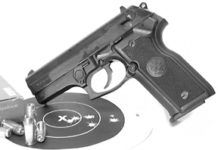
.40 S&W Semis Compared: We Like Berettas Midsized Cougar
In testing two lesser-known .40-caliber pistols, we found that Beretta's $700 Cougar is a very good choice, but we had a couple of problems with the polymer Steyr M40.

USPSA Limited 10-Division Guns: We Test Four Practical Pistols
After testing .45 ACP and .40 S&W pistols from Para Ordnance, CZ-USA, and STI, we found that pistol companies are making great guns for this new classification.
Forty-Caliber Concealed Dynamos: We Prefer Glocks Model 27
Chambered for the potent .40 S&W round, the $616 GL27 offered a wild ride, but we liked it better overall than the Taurus PT140 and Kahr's K40.
Uzi Eagle Soars Over EAA, Daewoo .40 S&W Pistols
The three pistols included here are among many you could buy that meet the criteria of the U.S. Limited Division of I.P.S.C. competition. They are production guns available to the general public. More than 1000 of each has been manufactured in the last 12 months. Out of the box, they have no optical, electronic or custom sights; no compensators or ported barrels....
Smith & Wesson 4013 TSW Beats Sig, Beretta Compacts
If you have found the full-size pistol you bought is just too big and heavy to carry around for hours at a time, you are not alone. Fortunately, most of the manufacturers are way ahead of us on this one. Chances are you can buy a compact model in the same caliber and from the same company that made your big service-type pistol.
This can be a good thing or it can be a bad thing, depending on your expectations. If you think you are going to shoot the smaller pistol as well as you shoot the larger model, you will probably be disappointed. It isn't that short-barrelled handguns are less accurate, per se. Quite often they are not. But, for the compacts to shoot as well as their full-size coun...
Glock 22 Our Pick Over Five Other .40 S&W Defense Pistols
Because of its popularity and wide acceptance, the .40 S&W is destined to become one of the great cartridges. For the most part, anything a 9mm can do, a .40 S&W can do better. If a manufacturer has a 9mm handgun in its product line, it is very likely that there is a .40 S&W counterpart. Many police departments, who switched from the .38/.357 double-action revolver to the 9mm pistol, are now rearming with the .40 pistol.
Six full-size .40 S&W pistols in the $600 to $800 range are the subjects of this test. They are the Smith & Wesson 4006, the Glock 22, the Walther P99, the Beretta Model 96, the Heckler & Koch USP40 and the Sig Sauer P229.
Concealed carry aside, full-size models do ev...