
308 Semi-Auto Rifles: FNH-USA, Springfield, Fulton, and DSA
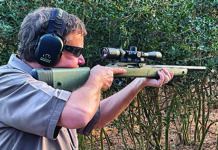
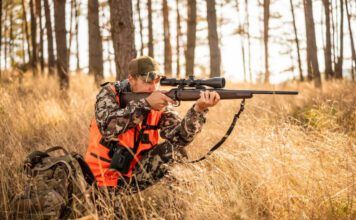
Todays semi-automatic rifle is more accurate and easier to care for than ever before. Theyre also a lot of fun. The most popular platform continues to be the AR-15, but not everyone is satisfied with chambering 22-caliber ammunition. The fact is that a number of calibers are coming (and going) in an attempt to increase stopping power. In this test we will evaluate four semi-automatic rifles chambered for 308 Winchester. The increase in power is significant, and 308 is a time-tested widely available cartridge. Our test rifles were the $2095 DSA SA58 21-inch Bull Barrel, the $1821 FNH USA FNAR, the $2363 Springfield Armory M1A Loaded, and the $1969 Fulton Armory UPR rifle, an AR-style gun is based on Fultons Titan II lineup. Each one of our rifles, with the exception of the FNAR, was available with options from a menu of upgrades, so we took advantage of this when we could. The FN rifle does come with modular components to help suit the needs of different shooters. To test our rifles we visited American Shooting Centers in Houston (www.amShootCenters.com). Our first shots from each rifle were to sight in a Nightforce 5.5-22x50mm NXS scope (www.NightforceOptics.com). We chose the Nightforce scope because of its clarity and versatility. It had a mil-dot reticle with see-through mil-dots plus illumination on demand. Pulling outward on the left-side focus supplied an ideal level of illumination. The reticle remained sharply defined at all times. Because we would be flipping this one scope from rifle to rifle, we needed a system that offered quick, strong, and precise re-mounting. We could have gone with a quick-release unit, but instead we chose Nightforce rings that attached to the base via a half-inch hex nut. We used a 65-inch-pound Seekonk calibrated torque wrench with T-handle ($98, from www.Brownells.com) to make sure the unit was properly locked into place each time. The repeatable zero of the Nightforce scope made sighting in a simple mechanical chore. Suggested retail prices for the rings and scope were $160 and $1700, respectively.
Home-Defense 12-Gauge Pumps: Ithaca, Remington, Mossberg
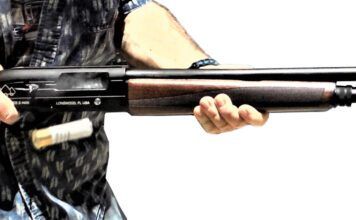
Perhaps due to the 'Obama-effect'wherein the fear of future gun bans is driving salesthe home-defense/tactical class of self-defense shotguns is booming like never before. But we must recognize that other factors figure into the segments sales rise as well, not the least of which is that a 12-gauge pump-action shotgun is an effective close-quarters weapon. To wit: The M97 version of John Brownings Winchester 1897 shotgun was the original 'trench-sweeper.' Widely considered the first truly successful pump shotgun, the M97 was fitted with a heat shield and the M1917 16-inch bayonet for combat duty. The highly effective use of the shotgun by United States forces in WWI had a dramatic effect on the morale of front-line German troops. As a result, on September 19 of 1918, the German government issued a diplomatic protest against the American use of shotguns, alleging that the law of war prohibited the shotgun. The 5+1 capacity M97 and OO buckshot defined the fast-handling, reliable close-quarters shotgun for about 30 years, the platform of the high-capacity pump persisting through to present day. The reason to consider a shotgun for personal defense is what many combat studies have shown: the hit probability of a shotgun is roughly twice that of a rifle. For home defense, the shotgun is a quicker stopper than a handgun due to its being able to produce more wound trauma with multiple wound paths. It is considered easier to use in a high-stress situation, and minimizes wall penetration compared to some handgun ammunition. It is also economical to practice with.
Two Big 9mms: High-Capacity, Full-Size Self-Defense Picks
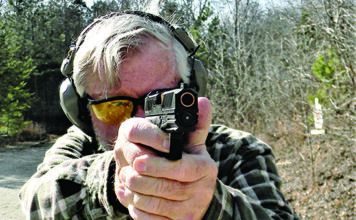
While many of us prefer full-caliber cartridges in full-size pistols, there are many reasons and many mandates to pack a large, high-capacity 9mm handgun. There are plenty out there to choose from. For this test we chose one of the oldest, a double-action CZ 75 B ($597), and one of the newest, the S&W M&P9 ($679) to compare. Both held a lot of rounds, 16 and 17 respectively, and both were big handguns by any measure. They approached the bulk of a full-size 1911 45 ACP, though both were shorter and the M&P was a good deal lighter
unloaded, of course. We tested them with Fiocchi 115-grain jacketed hollowpoints, American Eagle 115-grain full-metal-jacket rounds, and Black Hills 147-grain full-metal-jacket bullets. We 'broke them in' with a mix of other types of ammo to get a feel for the guns before serious accuracy and function testing. Here is what we found. A short while back we tested the single-action CZ 75 B SA 9mm pistol and liked it fairly well. We recently had a chance to test the DA version, and got a feel for what it offers that the SA version does not. Besides being double action for the first shot, the DA version of the CZ 75 can also be carried cocked and locked, not a common thing for DA pistols. That feature, we thought, would make this DA gun more attractive to those who are required to carry a DA pistol, but have the option to carry it in whatever condition they choose. The use of cocked-and-locked carry gets away from the need to shoot the first two shots with widely varying trigger pulls, which is generally not conducive to best shooting.
High-End 45 ACP Follow-Up: Michiguns Commander Custom
In the April 2009 issue, our test team shot and evaluated three high-end custom full-size 1911s: the Combat Custom, $2895, from Luke Volkmann of Volkmann Custom Inc.; Wilsons CQB, $2550, and Les Baers Premier II Super-Tac, $2280. Attempting to pick the best one was anything but easy. They were all excellent. But we graded the Wilson CQB as the best of that trio. At the same time we also shot and evaluated a fourth product, but held back the test data for this special report because the gun was massively more expensive and harder to get than the other three. This follow-up will cover a Michiguns 45 Commander Custom, about $5000, available from Ned Christiansen. If you want a gun from Michiguns, be prepared to wait five or six years. Christiansens innovative touches and incredible machining skills (hes a one-man shop) have vaulted him to the top echelon of gunsmiths, with a resultant huge backlog. As before, we tested with four types of ammunition, Black Hills hardball, Federal 185-grain Hi-Shok JHP, Cor-Bon 230-grain JHP, and with cast-lead, 230-grain round-nose Ultramax. We tested during a severe winter in Idaho, and thus had trouble achieving the guns full accuracy potential. With the Federal 185-grain JHPs, the Commander bested the CQB slightly, with an average group size of 1.5 inches to 1.6 inches. The margin was a little wider with the Cor-Bon 230-grain JHPs, with the Commander shooting average group sizes of 1.4 inches compared to the CQBs 2.0-inch average. The measurements with the Ultramax 230-grain cast roundnose had the Commander in front 1.4 inches to 1.7 inches, and likewise for the Black Hills 230-grain ball, 1.3 inches to 1.6 inches. All were five-shot groups fired at 15 yards.


![Publishing Systems Powered by iProduction [gladys] Publishing Systems Powered by iProduction [gladys]](/media/ui/logo_poweredby_static.gif)