





Gun Tests
Username:
Password:
Forgot your Password?
Home | Compare Guns | My Gun Vault | RSS/XML | About Us
 Advanced Search


Expert Knowledge For $2 a month

Thousands of detailed reviews. Dozens of new firearm reviews monthly. Five free comprehensive buying guides. Delivered to your door and online. Instant access - flexible payments.

First Name:
Address 1:
City:
Last Name:
Address 2:
State       Zip:
Email:

Bargain Upgrades For The 10/22 Rifle

Clark and Volquartsen can help you get the most out of this autoloading rimfire.

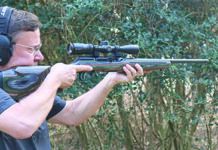
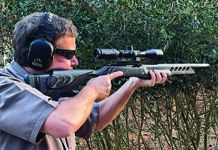
We investigated two ways to improve your
10/22’s accuracy—and save you money in the
process. One method is to tweak the 10/22T
(top). The other is to find a stripped-down
10/22 receiver and build your own gun from
parts (bottom). Either method can create a
tackdriver for between $500 and $600.

In the October 1996 issue, we compared three aftermarket Ruger 10/22 conversions from Volquartsen, Clark, and Briley to the then-new Ruger 10/22T. Though the factory gun didn’t win that Sportsmen’s Team Challenge evaluation, it did perform capably, and we thought it offered promise if we tweaked it. The question was, how much improvement did the gun need to close the performance gap with the full-custom guns, and what would that improvement cost? We decided to explore two upgrade paths for the 10/22T to see if it was possible to make the factory gun really shoot. Here’s what we found:

Raising The Bar
Like other guns in the STC segment, the $393 10/22T, which was introduced in 1996, has a heavy barrel that is supposed to improve the gun’s accuracy and shootability. However, companies like Houston-based Briley Manufacturing, Clark Custom Guns of Princeton, Louisiana, and Volquartsen Custom of Carroll, Iowa, have made thousands of refitted 10/22s that employ much more than barrels, including trigger jobs, fiberglass stocks, custom scope mounts, and proprietary chamber designs. But there’s a price to be paid for these niceties: Volquartsen’s Model Mossad, which won our previous evaluation, sells for $1,136. Clark’s Model RDCM goes for $560, and the Briley Model STC retails for $925. We wanted to see if we could make the Ruger 10/22T more competitive downrange using substantially fewer dollars. We chose two routes to accomplish this: sending a base gun off for further work, and refitting a factory gun ourselves with drop-in parts.

How We Tested
Our test guns were broken in by shooting 100 to 150 rounds in each of them. We cleaned the guns and reoiled them as needed, and double-checked the stock and scope-base screws frequently. We used a Leupold 36X, 40-mm scope with a 1/8-minute dot to shoot the accuracy tests with the test guns. Scope rings for all the guns were furnished by Volquartsen. Accuracy testing was done at the Bayou Rifle’s 100-yard tube in Houston, Texas. This is an enclosed building, which gave us consistent conditions for testing. Our Ransom Master Rifle Rest with Protecktor front and rear bags helped hold the test guns securely, minimizing any human error. To minimize movement between shots and speed realignment, we applied a 2-inch-wide strip of Velcro to the forend of each gun, and a similar strip to the front bag. This held the guns securely.

We used Pro-Shot Lead & Powder Bore Solvent and Pro-Shot .22 patches to clean the barrels between strings. We used an Otis Products Kit & Caboodle rifle kit to clean the bores. This product has a rubber-coated, flexible cleaning cable that feeds down the bore from the muzzle. It made cleaning easy and quick. Also, we used a Clark Custom muzzle guide during the cleaning process. This sleeve slips over the muzzle of a bull-barreled autoloader and protects the muzzle rifling when cleaning guns that have no access from the rear. Since all of our test barrels had roughly the same barrel OD, we were able to use it with all the test guns.

An Oehler 35P was used to log ten-shot strings with each gun and each ammunition. When shooting for accuracy, we collected ten five-shot groups, discarding groups when the shooter called an off round. We used Speedwell’s Police Rifle Shot Log targets for the accuracy test. Cleaning each gun after each lot, we shot 10 to 20 fouling rounds as needed when sighting in for next test.

Kay Clark’s Economical Magic
To begin our factory-gun upgrade, we shipped it to Kay Clark of Clark Custom Guns. Our primary concerns were to improve the gun’s baseline accuracy and make it a smoother operating piece overall. Clark’s suggestions were to perform a trigger job (without new internal parts) to drop the pull weight from 4 to a crisp 2.5 pounds. This job also included installing a trigger-overtravel screw mounted on the trigger. Also, Clark would trim the breech end of the barrel in order to cut a new match chamber. Part of this operation requires some modification to the V block to secure the barrel to the receiver. At the same time, Clark fine-tunes the extractor to make it perform reliably with the tighter match chamber. In Kay Clark’s estimation, the barrel did not need to be recrowned. She also added a quick-bolt release in the tune-up package, whose cost was $100. The only option we did not authorize was an extended magazine release, since it didn’t figure into the base accuracy or operation of the rifle. Had we added it, we would have spent another $15.

These services would not noticeably change any of the Ruger’s specifications. The 10/22T measured 38 inches in overall length and weighed 7.25 pounds. The straight, no-cheekpiece laminated stock had a length of pull of 13.75 inches. Drop at the comb was 1.5 inches and 2.25 inches at the heel. The forend was 2.1 inches thick. This gun had a hammer-forged round blued barrel (with spiral metalwork) to complement the satin black receiver and trigger guard. At the muzzle, the barrel diameter was 0.915 inches with a recessed crown. The barrel channel had a 1-inch barrel support near the front of the forend. The factory gun’s trigger pull measured 3.75 to 4 pounds.

To compare the before-and-after performance of the 10/22T, we used the same ammos shot in the same conditions. Our test brands were Fiocchi Super Match V325 Lot 136003B ($13.50/100); RWS Special Match, Lot 541WL582 ($14/100); Lapua Scoremax Lot 7811V ($11.50/100); Federal Gold Medal Ultra Match UM1 Lot L235 ($21.50/100); and Eley Tenex Lot WS1309 ($16/100). At the range, the unmodified Ruger shot an all-ammo group average of 1.89 inches, only 0.67 inches behind the Volquartsen Mossad in our first test. Its best group was 0.63 inches, shot with Eley Tenex, which also logged in a ten-group average of 0.91 inches.

After the modifications were performed, we found an overall 21-percent group-size reduction of 0.40 inches. Every ammo brand performed better, shooting 11 percent to 26 percent tighter groups. Eley Tenex groups improved to 0.81 inch on average—an 11 percent uptick. The Fiocchi Super Match and Lapua Scoremax brands both had 0.31-inch reductions in group size, which calculates out to 18- and 19-percent improvements, respectively. The Federal Gold Medal Ultra Match’s groups shrunk 0.33 inch, a 21-percent reduction. RWS Special Match, which shot poorly in all the guns originally, shot 26-percent tighter groups, dropping from a 3.61-inch average size to 2.68 inches, a 0.93-inch reduction.

Performance Shooter Recommends
Unquestionably, Clark’s minor adjustments to our base 10/22T markedly improved the gun, dropping the overall group size to 1.49 inches—only 0.15 inch behind the $925 Briley Model STC, 0.17 inch behind the $560 Clark RDCM, and 0.27 inches behind the test winner, the $1,136 Volquartsen Mossad. Comparing the guns’ best groups, the Clark-upgraded 10/22T fared even better. Its 0.81-inch group average with Eley Tenex outdid the Briley’s best groups, shot with Lapua, by a 0.35-inch margin. The Clark RCDM, which shot 1.03-inch groups with Federal’s Gold Medal Match, was 0.24 inch behind the Clark-modified 10/22T. The upgraded 10/22T also fared very well against the Volquartsen custom gun, which shot average groups of 0.91 inch with Eley Tenex and 0.93 inch with Federal Gold Medal Match.

In sum, the tweaked 10/22T performed on par—or in some cases better—than customized aftermarket 10/22s from some of the biggest names in the game. Admittedly, some of the price differences between the factory gun and the pricier custom guns buy better cosmetics, improved stocks, and other intangibles. But our tests show that for $499 plus shipping, using the right ammo in a modified 10/22T can deliver performance that ranks on par with much more expensive guns. We think that’s a bargain.

Retrofitting The 10/22:
Still Effective

Formerly, there were two ways to improve the performance of 10/22s: Buy a 10/22 and refit it yourself (or with the help of a gunsmith) with drop-in aftermarket components, or buy an already-tricked gun straight from an aftermarket supplier. From a performance perspective, the latter option is less palatable now that the 10/22T has been introduced, we believe. The former option, if you buy the right components, can still be effective and thrifty.

Based on our recent examination of a stock 10/22 that had been refitted with an accurizing package, we think shooters can build up their own 10/22 competition package, if you choose and install the right components properly.

Here’s one strategy that can be economical and still deliver a reasonably priced final package. Locate the lowest-cost 10/22 receiver you can find. The best solution is to find a little-fired 10/22 gathering dust in a relative’s closet that you can have for nothing. Barring that, cruise gun shows looking for just a receiver or for a used 10/22 rifle. Don’t spend more than $50 on either the receiver or the gun, but especially a complete gun. You’ll discard all the parts except the receiver anyway.

With the receiver in hand, you’re ready to marry it to an accurizing package like Volquartsen’s stock-barrel-mount combo, which runs $495 in the Brownells catalog. The kit (item number 930-122-200) includes the barrel, scope mount, bolt release, stock, barrel, and stainless-steel match hammer. The stock is 29.5 inches long, with a 14.5-inch length of pull, 1.5-inch drop at the comb, and a weight of 1 pound 10 ounces. It comes with sling swivel studs, bedding screw, and rubber recoil pad. The stock is a traditional brown-on-brown laminate with a rollover Monte Carlo cheekpiece. The barrel is a stainless-steel compensated bull barrel that drops into the supplied stock without modification. The kit’s cantilever scope mount accepts Weaver-style rings.

Putting these parts onto your receiver will likely take 2 to 4 hours. And if your results are anything like ours, you’ll be pleased. With our test-ammo group, a converted 10/22 shot 1.20-inch average groups. The ammo it liked the best was Federal Gold Medal Match, which popped 0.75-inch groups and a 0.47-inch best group. Eley Tenex was next (0.97-inch average; 0.67-inch best group), followed by Fiocchi Super Match (1.18-inch average; 0.95-inch best group), Lapua Scoremax (1.37-inch average; 1.13-inch best group), and RWS Special Match (1.71-inch average; 1.09-inch best group).

This package compares very favorably to the performance of the over-the-counter guns we have tested previously, and unlike the tweaked Clark gun, it offers most of the competition parts shooters like for less money—between $550 and $600, we estimate. The comparably outfitted Briley Model STC runs more than $900. The Clark Custom Guns Model RDCM costs about the same, except that Clark’s fluted stainless barrel would run another $100. The Volquartsen Custom Model Mossad costs another $500, most of which is the extra cost of the matte-black fiberglass thumbhole stock.

Performance Shooter Recommends
Even if you have a limited budget, you can still have a 10/22 that outshoots nearly everything else. By using the expert modifications available from Clark Custom Guns, you can take a stock 10/22T and make it shoot on par with top-end custom products. Or if you want to get your hands dirty and learn how to do it yourself, you can buy top-end components from Volquartsen Custom and roll your own. Either route will cost between $500 and $600—which choice you make depends on how adept you are putting puzzles together.


Also With This Article
Click here to view the chronograph results.
Click here to view the accuracy results.
Click here to view the contacts and addresses.


-By PS Staff


Publishing Systems Powered by iProduction [ling]Home | Subscribe | Customer Service | About Us | Contact Us | Privacy Policy | Site Map | Links
Copyright Belvoir Media Group, LLC. All rights reserved.