





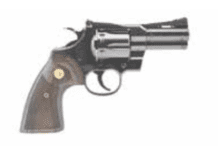

Charles Daly 1873 Standard Model .38 Special
We thought the Daly was a pleasant option for the cowboy-action shooter or anyone looking for a fun gun that gives a taste of the old West. It was well made, looked good, and would probably last a long time. The front sight needs filing, but most cowboy guns have that problem. The Daly was significantly cheaper than the AWA. It had an excellent trigger, with no creep and a break at 3.3 pounds, lighter than that of the AWA. Though its hammer action was not quite as light as the AWA Ultimate, we thought the price difference didn’t justify the extra money. Also, because you’d have to pay extra for case coloring on the AWA, the Daly would be our first choice of these two.
Smith & Wesson M&P #209001 9mm – Gun Tests Pistol of the Year
Our first impression of the $679 S&W M&P 9mm was that it felt extremely comfortable in the hand. It was well balanced, not too heavy—at least without a magazine full of 17 heavy-bullet loads—and was pleasantly devoid of extraneous controls and levers. We note S&W also sells a version with a thumb safety, along with a host of variants in 9mm, 40 S&W, and 45 ACP, and with longer or shorter barrels or grips, and in a variety of colors. One even has a pink grip insert.Our test gun came in a large case with two different grip inserts to make the handle larger or smaller. We liked it as it was, so we left it alone.
Qualification Done Right
Working with small arms is a core Soldier task, common to all branches and military occupational specialties. FM 7-0, Training The Force, admonishes unit leaders to train fundamentals first to establish a foundation. By learning basic skills to high proficiency, such as marksmanship, units can more easily integrate and master the more complex collective tasks. The problem is defining “proficient.” What judges a high, or sufficient, level of skill? Whom shall we have judge?
Prograde Offers Specialty Cowboy Grade Rounds
ProGrade Ammunition is offering hand-picked rounds for single-action revolvers and lever-action rifles used in Cowboy Action shooting.
New Videos on GunReports.com (September 12)
Here are new videos added to GunReports.com the week of September 12: JJ Racaza expands on Natural Point of Aim tactics in a multiple target scenario. Remington’s all-new platform, the Model 783. And a Barrett 50 Cal Impossible 'V-Drill' with Jerry Miculek.
Caracal Recalling — and Refunding— All Model C Pistols
Caracal is issuing a recall of all Model C pistols in all markets, following the completion of a full investigation. This recall affects all Model C pistols, including but not limited to those with serial numbers which start with the following letters: HM, AA, AD, AG, CA, CB, CC, CD, CE, CF, CG, CH, CI, CJ, CK, CL, CM, CN, CP, CR and CS.
Glock Model 26 9mm Parabellum, $599
(GunReports.com) -- The 9mm pistol was the breakthrough sidearm that ushered in today's massive popularity of the self-loading pistols. One of the ways in which the semi-auto has evolved is its variation in size, making it possible to conceal a smaller version of a full-size carry gun. One pistol with these assets is Glock's $599 Model 26.
Glock GL31 .357 Sig
Glock adapted this same pistol to other cartridges, including the .357 SIG, and we found the fully loaded GL31 handled much like the model 17. If you have ever felt that the Glock pistol chambered for .45 ACP or 180-grain .40s were somehow out of sync, then the .357 SIG is a more natural fit.
New Videos on GunReports.com (September 5)
Here are new videos added to GunReports.com the week of September 5: Jerry Miculek shoots a Barrett .50 Cal off the shoulder. Unbelievable. Gunsite Range Master Il Ling New talks about shooting from the bench. FPSRussia takes a look at his four favorite handguns.
SPS High-Capacity Stainless Mags Available
Spanish-made SPS high-capacity magazines for 38 Super, 9mm, 40 S&W and 45 ACP MAC 3011, SPS Pantera, and Vista and Para-Ordnance pistols are now available in 12- to 29-round capacities. The SPS magazines also fit STI and SVI pistols.
Infographic Shows How Gun Crimes Plummet while Gun Sales Rise
The first in a series of infographics that National Shooting Sports Foundation (NSSF) has created to highlight various firearms-related topics was released on Aug. 8 and immediately posted to the NSSF website.
Benelli USA Pledges $250,000 to NRA-ILA, NRA-Civil Defense Fund
Benelli USA owner Cav. Ugo Gussalli Beretta is doubling down on his concern about recent anti-gun legislation by matching up to $250,000 in contributions to NRA-ILA and the NRA Civil Rights Defense Fund.

Want a New York Carry Permit? Well, Let’s Go!
The Firearms Policy Coalition (FPC) is inviting people to apply for non-resident firearms-carry licenses under a recent settlement with New York State and several...