








French MAS Semiautos: History-Making Rifles Compete
Long before WWI the French were hard at work on semiauto rifle designs. Unfortunately they didn't have much in production at the start of the Great War, so they fought that war largely like the rest of the world did, with bolt-action rifles. It was not until 1949 that France had its own successful semiauto rifle in the MAS, chambered for the 7.5x54mm cartridge, which is similar to the 7.62 NATO round. That rifle was designated the Model 1949, and it incorporated some features of the bolt-action Model 1936, including its cartridge, rear-sight arrangement and two-piece stock. Later modifications developed the M1949 into the Model 1949-56. For this report we acquired one of each type from Collectors Firearms (www.collectorsfirearms.com), the M1949 chambered for the original cartridge and the ‘49-56 rechambered by some arsenal to 7.62 NATO. The French cartridge is a bit longer and very slightly fatter than the NATO cartridge, so we presume the barrel had to be set rearwards to effect the conversion.
MAS stands for Manufacture Nationale d'Armes de St-Etienne. This is a gas-driven design that would be familiar to the fans of the various AR-15/M-16 rifles. The gas tube impinges directly on the bolt carrier, blowing it rearward with each shot. There are no moving parts, like pistons or pushrods, in the gas system.
Although the rifles had essentially the same actions, the M1949 had only a stacking lug at the front and no muzzle brake, presenting what amounted to a naked barrel muzzle. The ‘49-56 had a grenade launcher, muzzle brake/flash hider, and folding grenade sights. The rear sight on each rifle was an aperture, adjustable upward from 200 to 1200 yards. The front blade on the M49 was a fixed post, but the later rifle had an elevation-adjustable front post.
The detachable magazines had their clasp as part of the magazine, a simple and rugged system that locked into a notch cut in the right side of the action. The 10-round magazines were interchangeable between our two test rifles. Apparently higher-capacity magazines have been available for the MAS rifles. The original parts kits issued with the rifles apparently were well thought out and included critical spare parts, magazines, bayonet, cleaning stuff, and for some, a compact 3.9X scope. All the MAS rifles have a rail on the left side of the action permitting easy scope mounting.
The later rifle had a larger trigger guard, permitting firing with gloves. Both rifles had a simple leather sling attached to the left side of the rifle. The 49-56 had a black slip-on recoil pad, apparently original issue.
Each rifle had a two-piece hardwood stock with a wood hand guard covering the forward part of the barrel and the gas tube. The woods were plain walnut and birch. The safety consisted of a lever located to the right front of the trigger guard. In the safe position it partially obscured the trigger opening, which was more obvious for right handers. Both bolts had a serrated white plastic covering on the bolt knob. The actions were solid, well-made, nicely machined items that looked to be extremely strong. There were no plastic nor flimsy metal parts anywhere on either rifle. These were serious war-time rifles made to work and to last.
Takedown for these rifles was remarkably simple. After clearing the rifle, remove the magazine and let the slide go forward. Then slide the large button at the rear of the receiver downward, toward the wrist of the rifle. Press forward on the top-rear portion of the action, which is the cover, and when it moves just over half an inch toward the front of the rifle it can be lifted off toward the rear, releasing tension on the recoil spring. Then slide the bolt carrier rearward until the bolt and carrier are all the way back, and they can then be lifted out. That's it. With a normal cleaning rod the barrel must be cleaned from the front. For reassembly reverse the process. You have to fight the spring a bit, but it's an easy job. If you have to remove the trigger assembly, you'll need a screwdriver to remove a slotted screw at the rear of the trigger guard.
Largely because of extremely poor winter weather, we tested the two rifles with one type of ammo each. For the Model 1949 we used Serbian Prvi Partizan 139-grain FMJ, and for the 1949-56 we used Magtech 150-grain FMC. Here's what we found.
7.62x39mm Semiautos: Three Alternatives to the AR-15 Rifle
7.62x39mm Semiautos: Three Alternatives to the AR-15 Rifle
We Try a Trio of 7.62mm Russian Rifles: Arsenal USA Wins The Day
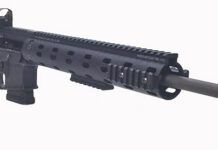
Despite its being the most prolific rifle in history, Mikhail Kalashnikov's AK-47 is still being manufactured in a vast variety of offerings at locations all over the world. One of those locations is Houston, Texas, where the Arsenal USA Co. assembles AKs using parts from Hungary and some made in Houston. We got one of that company's rifles for a recent test, pitting the hybrid U.S./foreign product against an imported wire-stocked Romanian-made rifle from Southern Ohio Gun. To complete the group of 7.62mm Russian rifles, we got a VZ 2000 from Ohio Ordnance Works. The VZ-2000 can be mistaken for an AK-47 look-alike, but is actually a close semiauto copy of the Czech Model 58.
All of these semiautomatic rifles fired the .30 Russian Short, which the 7.62x39 is sometimes called. We've recently noticed bargain-priced surplus rifles in odd calibers, but two boxes of ammunition can cost as much as the rifle. Not so the .30 Russian Short. We found 7.62x39 ammo to be plentiful and generally not very expensive. If you want to have fun with your AK, it's nice to know the fodder won't break the bank.

More SKS Rifles! Albanian and Yugoslavian Imports Slug It Out
The SKS is a homely brute, and many of its simple mechanisms are largely outdated by today's weapons' standards. But it works. It, like so many rifles based on the tapered 7.62 x 39 round, catches the cartridges that its two-piece bolt strips out of that fixed, ten-shot magazine with great ease. It fires them reliably and slings out the empties like an outraged matron encountering last week's garbage. The accuracy isn't generally good enough to be called that, unless you've got a lucky specimen on your hands. On average, they seem to shoot M1-Carbine-size groups. They'll put most of their shots into a four- or five-inch circle at a hundred yards, and that's plenty good enough for their intended job. But you'd never write home to mama about how attractive a rifle an SKS is.

7.62 x 39mm Field Rifles: Tough To Find, But Worth The Effort
These days one hears of the 7.62 x 39, also known as the .30 Russian Short or the Soviet M43, as commonly as one used to hear of the .30-30 a few decades ago. Even in out-of-the-way locales, the short Russian thirty pops up, and plays a major role in survival batteries and in hunting camps. Gun shops regularly stock ammunition for it, often at near-give-away prices. There are several good rifles made in the U.S. today for this cartridge, but the very inexpensive surplus semiauto rifles imported from China in stupendous quantities have started to dry up. A few years ago, they commonly sold for under $100. Today they bring about twice that. When they first appeared, they were new, fairly good guns, and there were so many of them that a significant aftermarket of stocks, scope mounts, high-capacity magazines, and other add-on parts appeared on the gunny scene, and many if not most of those parts are still available, if not everywhere still legal. Occasionally seen were the somewhat higher- quality Russian versions, complete with bayonet.
Along with the SKS types, the AK-47 clones in semiauto version also appeared, carrying names like MAC-90 and PolyTech Legend. There were, and still are in some areas, many rifles available for the Russian short thirty for not a lot of money. The proliferation of the cartridge and guns to shoot it made this generation of U.S. shooters very much aware of the cartridge, its potential and limitations. Many still wonder, however, about the 7.62 x 39. How good are the best pre-ban clones of the AK? Is the SKS, in any of its many variants, a good rifle? Are they reliable? How well do they shoot? And what about modern semiautomatic rifles chambered for this cartridge?
We thought it would be interesting to test some of the finest military-type versions of this cartridge alongside one of today's modern U.S. offerings, to give the reader some idea of where the cartridge came from and just how good the rifles are.
Tested: A Trio of Big-Game Busters in .375 H&H Magnum
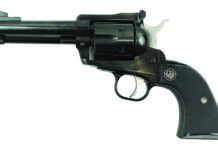
Ruger's Magnum takes the cake as a dangerous-game gun, and we also like Sako's 75 Hunter. Pass on the Winchester Model 70 Safari Express.