




















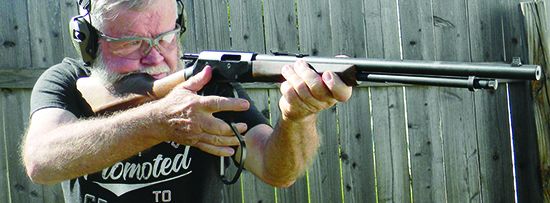
Lever-action rifles are part of Americana, with many qualifying as American icons. From The Rifleman on television to the Wild West shows of Buffalo Bill, lever-action rifles are instantly recognizable. While most shooters probably think of the lever gun as a 30-30 Winchester chambering, rimfire variations on the theme are also very popular. Many rimfire leverguns feature traditional wood stocks, blued finishes, and barley-corn open sights, but a newer breed of lever-action rimfires feature synthetic stocks and modern sights, even Picatinny rails. Manual safeties and large-loop cocking levers are also common.
In this shoot-out, we test two of the most recent introductions in the lever-action rimfire world. The Rock Island Armory TM22-LA-20, $300, is a modern-looking rifle with synthetic stock and Picatinny optics rail, as well as a detachable-box magazine. The Savage Revel Classic 46000, $400, is a traditional rifle with a nice glossy stock and deep blued finish, but it’s made with modern manufacturing techniques.
We fired both with a variety of 22 Long Rifle ammunition, including Winchester Super Speed HP 37-grain hollow points, CCI Standard Velocity 40-grain LRN rounds, and Federal’s Auto Match 40-grain LRN cartridges. Here’s what we thought:
Savage Revel Classic 46000 22 LR
$400
Gun Tests grade: C
We liked the Revel. It is a friendly rifle, easy to handle, light enough, and reliable. It is a nice-looking rifle. It would be useful for plinking. While the optics-mounting set up is common to lever-action rifles in the price range, it isn’t our favorite. The sights could not be adjusted down far enough to sight the rifle in. It’s a pleasant enough rimfire, but we’d pass on this rifle.
| Action Type | Lever, exposed hammer |
|---|---|
| Overall Length | 36.5 in. |
| Barrel Length | 18.0 in., medium contour |
| Barrel Twist Rate | 1:16 |
| Overall Height | 5.5 in. |
| Weight Unloaded | 6.1 lbs. |
| Weight Loaded | 6.7 lbs. |
| Receiver | Anodized black aluminum alloy |
| Barrel | Black carbon steel |
| Magazine Capacity | 12 |
| Magazine Type | Tubular |
| Magazine Price | NA |
| Stock | Turkish walnut |
| Stock Buttplate | Synthetic |
| Stock Length of Pull | 14.5 in. |
| Front Sight | Post |
| Rear Sight | Semi-buckhorn |
| Sight Radius | 14.6 in. |
| Trigger Type | Single action, curved |
| Pull Weight | 3.5 lbs. |
| Manual Safety | Crossbolt |
| Warranty | 1-year, original owner |
| Telephone | (800) 370-8708 |
| Website | SavageArms.com |
| Made In | Canada |
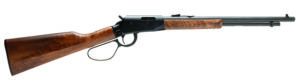
The Savage Revel lever-action 22 has a traditional look, yet it doesn’t resemble Henry or Rossi 22 LR lever-action rifles. The Revel is a bit shorter than the RIA TM22-LA-20 because the Revel features an unthreaded 18.5-inch barrel with a standard crown. Both are imported, with the Savage coming in from Canada and the Rock Island Armory being manufactured in Turkey. The Revel rifle’s branding information is stamped on top of the barrel in a script style used by Savage since the 1930s. The receiver is traditional to a point, but the receiver features a considerable taper in the flats of the receiver to a wider lower receiver. Most testers liked this look. The butt stock also features a sharp taper to a wider lower stock width.
The Revel’s fore end is a middle-width stock of well-finished wood. There is no barrel band. Although the spec sheet indicates that sling swivels are included, there are no sling swivels, and neither the stock nor fore end are drilled for sling swivels. This is a big oversight, in our view.
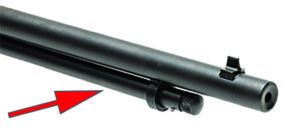
Because barrel length dictates magazine capacity in tubular-feed rimfire rifles, the magazine, beginning behind the muzzle, features a 12-round capacity. It is attached to the barrel, but the attachment doesn’t qualify as a barrel band, but is rather a barrel stud. The sights are standard fare with a post front dovetailed in place. The rear sight is a sheet-metal type with a leaf for elevation adjustment. Windage adjustment is possible by bumping the rear sight in the dovetail slot in the barrel. The barrel has a dark-blue finish. The receiver and other parts are hard-anodized aluminum. The buttstock is nicely finished, although unevenly finished, because the rear quarter of the stock was noticeably lighter than the forward portion. The thin butt plate is a pebble-grained synthetic.
The hammer-fired Revel features an audible safety notch in the hammer position. You may lower the hammer, and then bring it back to the safety notch. You will hear a click as the hammer settles into the safety position. We liked this feature. The lever loop is larger than the Rock Island’s, stylish, and easily handled. We like the push-button cross-bolt safety, pushing left to right to fire. We would put it on Safe when loading or unloading the rifle.
On Safe, the Savage’s trigger may be pressed, but the Revel’s hammer doesn’t fall. If the rifle is put on Safe with the hammer in the down position, the action may be opened to an extent, but it cannot be levered fully open. When the Revel’s hammer is cocked and the action is on Safe, the action may be operated, but the rifle’s hammer will not fall.
The trigger action is sharp, smooth, and useful. The trigger breaks at 3.5 pounds, much superior to the Rock Island’s trigger action. It resets as the action is manipulated, and there are two distinct clicks in the reset position. The top of the receiver is drilled for an optics mounting rail, but the rail isn’t supplied. Four screws are provided in the box to fill these holes, if desired. A Weaver rail would be necessary to mount an optic. We don’t like the optics-mounting system compared to the RIA’s. The rifle is already $100 more expensive than the RIA TM22, and then you must add the expense of a rail ($15 to $40) to mount an optic. The Rock Island system is also simpler and more modern, although it’s attached forward of the receiver.
In offhand firing, the Savage was a joy to shoot, partly because the Revel is slightly lighter than the Rock Island rifle. The action is also smoother and the trigger action better. The sights are not up to the RIA’s standards because the RIA’s small bead front sight was more visible in light. Also, while the Savage rear sight offers a leaf-style elevation ladder for adjustment, we were unable to set the rifle for the proper zero. Even when set at the lowest elevation point, all loads struck high, to the order of 2 to 2.5 inches at 25 yards.
Elsewhere, loading the tube isn’t a drawback. It is traditional, but it was easier to simply snap in a loaded magazine in the Rock Island TM22-LA-20. Fired for accuracy at 25 yards, the Savage rifle fell behind the Rock Island. Groups at 25 yards didn’t get as small as 1 inch, and most were in the 2-inch range. Moving to the 50-yard line, we had to concentrate hard to shoot the Revel’s iron sights accurately. We fired the accuracy test twice with each rifle for confirmation. The Savage’s average groups were 4, 4.25, and 4.6 inches at 50 yards compared to the RIA’s averages of 2.75, 3, and 3.25 inches. The rifle that needs an optic most is the one with the most difficulty in mounting an optical sight.
The Revel features pins in the receiver that can be pressed out to remove the action from the lower receiver. This makes the Revel easy to clean, which is no small thing. Ammunition for 22 LR rifles is dirty, so rimfire rifles require frequent cleaning. We took the rifle apart without difficulty. However, a pin worked loose in the receiver as we were firing. It did not fall out, but it was close. We pressed it in, but it continued to work loose. After this, we took the pin out completely and peened it on a vise, then returned it to the action. It was secure after that.
Our Team Said: In the end, we thought the Savage Revel is a fun gun. For informal plinking, this traditionally styled rifle will offer many hours of inexpensive enjoyment. But its accuracy was not the greatest, its sights could have been better, and we should have been able to zero the rifle. Also, the Revel’s optics-mounting system could have been improved easily by the factory.
We would much prefer a Henry Golden Boy H004 or a Rossi Rio Bravo (both reviewed in the February 2022 issue) over the Savage or RIA rifles. Or you can find other 22 LR rankings online at Gun-Tests.com by searching for “Top 10 22 LR Rifles for 2025,” or type that search p
| 22 LR RANGE DATA | ||
|---|---|---|
| CCI Standard Velocity 40-grain Lead Round Nose #35 | Rock Island Armory TM22-LA-20 | Savage Revel Classic |
| Average Velocity | 1222 fps | 1202 fps |
| Muzzle Energy | 133 ft.-lbs. | 128 ft.-lbs. |
| Small Group @ 25 Yards | 0.6 in. | 1.2 in. |
| Average Group @ 25 Yards | 0.8 in. | 1.6 in. |
| Average Group @ 50 Yards | 3.0 in. | 4.25 in. |
| Winchester Super-X Super Speed HP 37-grain Copper-Plated Hollow Point X22LRHSS1 | Rock Island Armory TM22-LA-20 | Savage Revel Classic |
| Average Velocity | 1244 fps | 1221 fps |
| Muzzle Energy | 127 ft.-lbs. | 122 ft.-lbs. |
| Small Group @ 25 Yards | 0.65 in. | 1.25 in. |
| Average Group @ 25 Yards | 1.25 in. | 2.25 in. |
| Average Group @ 50 Yards | 2.75 in. | 4.6 in. |
| Federal Auto Match 40-grain LRN AM22 | Rock Island Armory TM22-LA-20 | Savage Revel Classic |
| Average Velocity | 1119 fps | 1115 fps |
| Muzzle Energy | 111 ft.-lbs. | 110 ft.-lbs. |
| Small Group @ 25 Yards | 0.55 in. | 1.2 in. |
| Average Group @ 25 Yards | 1.3 in. | 2.0 in. |
| Average Group @ 50 Yards | 3.25 in. | 4.0 in. |
To collect accuracy data, we fired three-shot groups from a bench using an MTM Case-Gard K-Zone rest. Distances: 25 and 50 yards. We measured velocities with a Competition Electronics Pro Chrony, with the first screen 10 feet from the muzzles.
Written and photographed by Bob Campbell, using evaluations from Gun Tests Team members. GT