








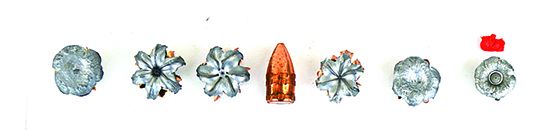
Recently, Fiocchi introduced a new line of ammunition. The CovertX is designed for performance in standard carry pistols, subcompact and compact types, versus service-size pistols. The projectile is intended to expand more quickly than the Fiocchi Extrema. The Extrema load uses the Hornady XTP bullet, a very good bullet designed for a good balance of expansion and penetration, leaning toward defeating barriers and light cover. The average civilian doesn’t demand that level of penetration. Faster expansion may be desirable. The CovertX also uses Fiocchi’s independently developed projectile.
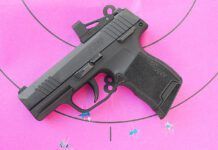
We elected to put the new load to the test. We collected a sample of the Fiocchi CovertX and other 9mm ammunition choices designed for performance in short-barrel pistols such as the SIG P365 with its 3.1-inch barrel. To add dimension to the test, we also tested with a Glock 19 9mm pistol with 4.02-inch barrel length.
Comparing the results from the different barrel lengths was interesting. We have also tested results in different barrel lengths up to and including 9mm carbines (August 2020 issue). In this installment, at the behest of several readers, we used a different medium, Clear Ballistics 10% Ballistic Gelatin rather than the usual water-jug testing.
The ammunition tested was reliable, without any type of failure to fire or malfunction, but the performance of each round was different. We found a number of loads well suited to personal defense and others not so much. Notably, this was among a very few tests we have done in which every load retained all of its weight after expansion and penetration, with each retaining 100% of its original weight. Also, standard deviations were low from shot to shot, and accuracy was good to excellent.
All of the loads tested are readily obtainable. Most of the loads came from big-box stores and a few from online suppliers. Here’s what we found.
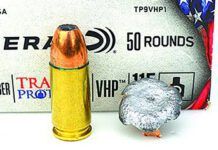
Federal Train & Protect 115-grain VHP TP9VHP1 9mm Luger
$35/50
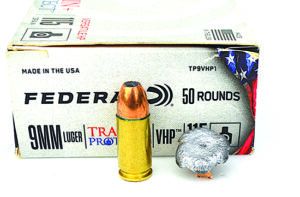
This is a 50-round box, making it one of the more affordable loads tested here at 70 cents a round. The load uses a brass case and standard cup-and-core jacketed hollow-point bullet. This is not a bonded-core type. This load appears to be the latest version of the Federal 9B hollow point, a good all-round choice and among the first factory hollow points that performed reliably. This load exhibited modest muzzle signature with a warm orange glow in some dim-light conditions in the SIG P365, but the signature was not at all noticeable in the Glock 19. Accuracy was the best of the test, a good showing for an economy load. This tracks because the 9B once had a reputation as a match-grade-accurate round. Velocity was barely 1100 fps in the SIG and 1145 fps in the Glock. Expansion showed a flat mushroom of 0.62 inch out of the SIG and 0.64 inch from the Glock. Penetration was an average of 12 inches out of each gun, but one of the test loads went only 11.5 inches out of the Glock.
Our Team Said: We found the Federal Protect & Defend to be a viable choice. Recoil was a gentle push despite good velocity. We rated it down a grade on penetration.
Gun Tests Grade: B
Federal Premium Tactical 124-grain HST JHP P9HST1 9mm Luger
$40/50
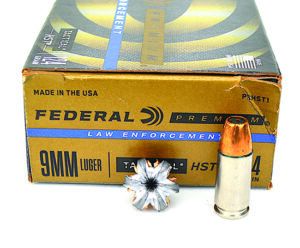
The HST is a bit pricier at 80 cents a round than the Train & Protect. Still, it’s a defense load, not a practice round. You will need to fire enough ammunition in your chosen pistol to confirm reliability. If a modern 9mm handgun doesn’t feed this load — a standard-pressure 124-grain JHP — then the gun is probably defective in some way. Velocities ran 1159 fps in the Glock and 1111 fps in the SIG. We noticed more kick with this than the 115-grain load. We were surprised, but there it is. The power factor rating is the highest of the test, so our perception of recoil is borne out. On the other hand, energy is also the highest of the test. This load tunneled a full 16 inches in gelatin when fired from the SIG and 17 inches from the Glock. Each bullet was uniform and practically indistinguishable from the other. Expansion was a uniform 0.65 inches in five bullets and 0.63 in one of the six fired, with accuracy being very good as well. Weight retention is 100%.
Our Team Said: The Federal HST is a popular service load, and rightly so. It is affordable, clean burning, and accurate.
Gun Tests Grade: A
Fiocchi CovertX 124-grain JHP 9CCWB
$21/20
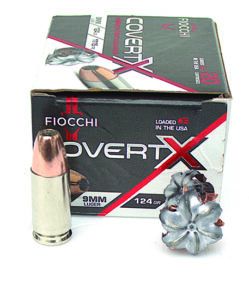
This load comes in a 20-round box, making the cost per round $1.05, some of which is likely due to the nickel-plated cartridge cases. The burn is clean, something we liked a lot. There isn’t any unburned powder to speak of. Muzzle signature is muted. This CovertX load exhibits good accuracy. We feel that Fiocchi paid a lot of attention to internal and external ballistics. Velocity was 1115 fps in the Glock and 1055 fps in the shorter-barrel SIG. Recoil is modest, a little less than the faster 124-grain HST. The Fiocchi CovertX penetrates 14 inches of Clear Ballistics gel and expands to a plump 0.64 inch. This is a very consistent loading. Fiocchi has used outsourced bullets in their previous loads, including the Extrema line, using primarily the Hornady XTP. The CovertX loading meets the company’s stated goal of offering better expansion in short-barrel guns and a faster-opening hollow point. This is a defense load that isn’t geared toward service use, where more penetration is needed.
Our Team Said: The CovertX load is accurate, clean burning, relatively low recoil, and offers good expansion. We’d buy 40 to 60 rounds to shoot in our primary carry gun and see how it did. If it cycles, then load the balance, carry it, and replenish with more 20-round boxes as needed.
Gun Tests Grade: A
Fort Scott Munitions 115-grain Solid Copper Spun Tumble Upon Impact (TUI) SCS Bullet 9mm-LUGER-TUI
$29/20
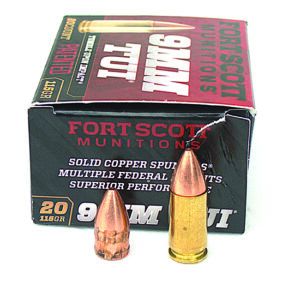
These loads feature a bullet that is designed to tumble on impact, according to Fort Scott. This is an unusual mechanism. Some military rifle loads break at the cannelure in the bullet, and we have tested 45 Colt 255-grain bullets that actually tumble. The TUI load doesn’t tumble enough to amount to anything, in our opinion. Firing into the gelatin block, we could see no tumbling. There may be a modest yaw toward the end neck of penetration, but the bullets were recovered nose first. Velocity is good, more than the advertised 1140 fps. The Glock 19 breaks 1199 fps, and the SIG P365 1138 fps. Accuracy is fair, not outstanding. The penetration channel is indistinguishable from a full-metal-jacketed bullet. However, there is something going on we cannot qualify because the bullet only penetrates 20 inches — a true FMJ bullet may penetrate more than 30 inches in gelatin. This load is accurate enough and fed reliably. Terminal ballistics offer no advantage over an FMJ, according to our tests.
Our Team Said: At $1.45 a round, this is by far the most expensive load in the test, and we can’t see a compelling reason to buy it. We rated the Fort Scott Munitions load down for its overpenetration and a failure to tumble, per its marketing, or expand, per our recovered bullets.
Gun Tests Grade: C
Hornady Critical Defense 115-grain FTX 90250
$27/25
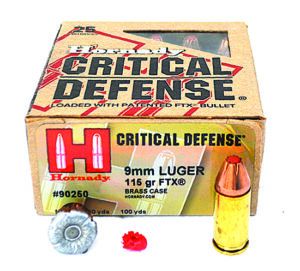
Note that the Critical Defense is a true half box, with 25 cartridges, which makes its cost per round $1.08. The Critical Defense rounds use a special polymer insert in the nose to instigate expansion at low velocity or when meeting some type of barrier. We think this results in very consistent expansion. The load breaks 1090 fps in the SIG and 1120 fps in the Glock 19. Accuracy is excellent. This is a consistently good performer in accuracy testing. Muzzle flash is muted, practically non-existent. Recoil is modest, even in comparison to loads with less velocity. In ballistic testing, the Critical Defense delivered good short-barrel performance. The FTX bullet may be counted on to penetrate 12 to 12.25 inches. Expansion is modest at 0.50 inch, but very consistent. The red polymer plug either adhered to the bullet during its travel or was found beside the projectile in gelatin. In the Glock pistol, velocity was greater, but the results were consistent, with the Critical Defense penetrating 11.25 to 11.5 inches, and expansion remaining solid at 0.50 inch.
Our Team Said: We would have liked more expansion and also more penetration, but the load is comparable to the other 115-grain loads in most regards.
Gun Tests Grade: B
SIG SAUER 365 115-grain V-Crown JHP E9MMA1-365-20
$22/20
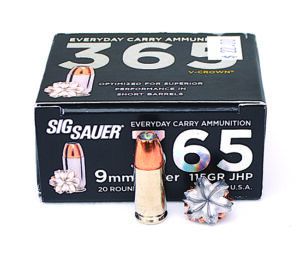
The SIG Sauer 365 load is designed to offer a suitable, even specialized, load for SIG’s compact P365 9mm handgun. The loads run $1.10 a shot for a 20-round box. While such things are subjective — muzzle blast affects your perception of recoil — this load was rated to be the lightest kicker. IPSC Power Factor figures (123/126) back us up on this. The SIG 365 load also has the least energy, coming in at less than 300 foot-pounds in the shorter barrel and just over 300 foot-pounds in the Glock 19’s 4.01-inch barrel. But then, none of the loads are +P rated, and none are hard kickers. The SIG 365 load offers modest recoil and a good practical accuracy with fast follow-up shots. Velocity is good, but not outstanding, at 1089 fps in the Glock and 1070 fps in the SIG pistol. This isn’t much deviation between the two barrel lengths, indicating the SIG load is maximized in the short barrel, per its marketing. Penetration in the Clear Ballistics gelatin block was 13.5 to 14.5 inches and consistent with slightly greater penetration in the short-barrel gun. Expansion was a reliable 0.55 inch in each pistol.
Our Team Said: This SIG Sauer load accomplishes what it was designed to do, offer reasonable performance and modest recoil in a short barrel. Despite this, we rated it down a grade on expansion.
Gun Tests Grade: B
Winchester W Defense 115-grain JHP USA9JHP
$28/50
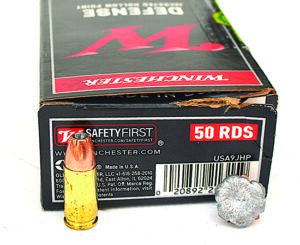
This is another load with a long lineage. It appears to be an unplated Winchester Silvertip. However, the last 115-grain Silvertip tested was much faster. Feed reliability is flawless and its recoil is modest, about middle of the road for the test. The load is available in a 50-round box and seems for sale about everywhere. Cost per round is 56 cents, lowest in the test. There were 20 boxes or more on the shelf at the box store where we purchased our test samples. The closest performance comparison in the test is the Federal Train & Protect. Interestingly, performance was close to the Federal load, with velocity greater in the short barrel, but not quite as fast in the long barrel. Velocity was 1118 fps in the SIG’s 3.1-inch barrel and 1143 fps in the Glock 4.02-inch barrel. This is good velocity, all things considered, when you are looking to limit recoil. Penetration was a bit short in the Glock at 11.0 inches on average, with 0.58-inch expansion. In the SIG pistol, we found penetration to be more in the ideal range at 12.0 inches, with 0.56-inch average expansion. This seems to be a considerable difference in penetration and expansion in a short-barrel pistol compared to the longer barrel, with only 25 fps separating the loads, but there it is. Cup-and-core bullets of this design tend to deviate more in velocity than bonded-core bullets. The jacket thickness of the former can vary, leading to changes in velocity.
Our Team Said: We would have liked a better balance of expansion and penetration, so we rated the load down a grade. But for the money, it’s hard to beat, so we gave it a Best Buy rating.
Gun Tests Grade: B (Best Buy)
9mm Luger Performance Data
| Bullet Weight (Grains) | Test Gun: SIG Sauer P365, 3.1-inch barrel Cartridge Manufacturer, Brand, And Product Number | Standard Deviation (fps) | Muzzle Energy (foot-pounds) | IPSC Power Factor | Average Accuracy (inches) | Expanded Width (inches) | Retained Weight (grains) | Retained Weight (percentage) | Penetration In Gelatin (inches) | Cost Per Round (cents) | Gun Tests Grade | |
|---|---|---|---|---|---|---|---|---|---|---|---|---|
| 115 | Federal Train & Protect TP9VHP1 | 1100 | 7 | 309 | 127 | 1.2 | 0.62 | 115 | 100% | 12 | 70 | B |
| 115 | Fort Scott Munitions TUI SCS | 1138 | 16 | 331 | 131 | 1.7 | 0.35 | 115 | 100% | 20 | 145 | C |
| 115 | Hornady Critical Defense FTX 90250 | 1090 | 19 | 303 | 125 | 1.3 | 0.5 | 115 | 100% | 12 | 108 | B |
| 115 | SIG Sauer 365 V-Crown JHP E9MMA1-365-20 | 1070 | 19 | 292 | 123 | 1.8 | 0.55 | 115 | 100% | 14 | 110 | B |
| 115 | Winchester W Defense USA9JHP | 1118 | 23 | 319 | 129 | 1.4 | 0.56 | 115 | 100% | 12 | 56 | B |
| 124 | Federal Tactical HST JHP P9HST1 | 1111 | 14 | 340 | 138 | 1.5 | 0.64 | 124 | 100% | 16 | 80 | A |
| 124 | Fiocchi CovertX JHP 9CCWB | 1055 | 12 | 306 | 131 | 1.5 | 0.64 | 124 | 100% | 14 | 105 | A |
| Bullet Weight (Grains) | Test Gun: Glock 19, 4.02-inch barrel Cartridge Manufacturer, Brand, And Product Number | Average Velocity (fps) | Standard Deviation (fps) | Muzzle Energy (foot-pounds) | IPSC Power Factor | Average Accuracy (inches) | Expanded Width (inches) | Retained Weight (grains) | Retained Weight (percentage) | Penetration In Gelatin (inches) | Cost Per Round (cents) | Gun Tests Grade |
| 115 | Federal Train & Protect TP9VHP1 | 1145 | 11 | 335 | 132 | 1 | 0.64 | 115 | 100% | 12 | 70 | B |
| 115 | Fort Scott Munitions TUI SCS | 1199 | 26 | 367 | 138 | 1.6 | 0.36 | 115 | 100% | 22 | 145 | C |
| 115 | Hornady Critical Defense FTX 90250 | 1120 | 29 | 320 | 129 | 1 | 0.5 | 115 | 100% | 12 | 108 | B |
| 115 | SIG Sauer 365 V-Crown JHP E9MMA1-365-20 | 1098 | 18 | 303 | 126 | 1.3 | 0.55 | 115 | 100% | 14 | 110 | B |
| 115 | Winchester W Defense USA9JHP | 1143 | 17 | 334 | 131 | 1.1 | 0.58 | 115 | 100% | 11 | 56 | B |
| 124 | Federal Tactical HST JHP P9HST1 | 1159 | 15 | 370 | 144 | 1.3 | 0.65 | 124 | 100% | 17 | 80 | A |
| 124 | Fiocchi CovertX JHP 9CCWB | 1114 | 17 | 342 | 138 | 1 | 0.64 | 124 | 100% | 14 | 105 | A |
Notes: Average Velocity and Standard Deviation readings were obtained by firing 20 rounds over a Competition Electronics Pro Chrono. Ambient temperature: 90 degrees. Elevation: 815 feet above sea level. ● The accuracy figures are the average of three five-shot groups. For accuracy, we fired the test gun from a benchrest at a 25-yard target. ● To calculate IPSC power factor, multiply bullet weight in grains by the velocity in fps, then divide by 1000.
Written and photographed by Robert Campbell, using evaluations from Gun Tests Team members. GT




Since these tests were done with Ballistic gell it would have been nice to see how the Honey Badger and the other fluted projectile bullets stacked up. Since wound channel diameter, depth of wound channels and tissue disruption are the primary objectives of defensive rounds. I’m curious as to why so many tests avoid these types of projectiles?