











When you consider buying a pistol for home or personal defense, you face the initial costs that are pretty steep — the pistol, holster, replacements sights, and so on. But if you stay in practice with your favorite sidearms, the recurring costs of ammunition will quickly eclipse your total gun and accessory bill and extend into the future.
So it’s good to know which of the less-expensive ammos you can purchase to cut your costs month to month. We don’t recommend skimping on your actual carry loads, but you can still shoot the right bullet styles (hollow points for self defense) to ensure reliable function in your trusted sidearm and not break the bank.
So here’s the truth about the five best budget choices in 9mm hollow points that we’ve tested and which you can likely find in your local big-box store or sporting-goods establishment for well less than $1 a round.
Federal Premium Tactical 124-grain HST JHP P9HST1 9mm Luger
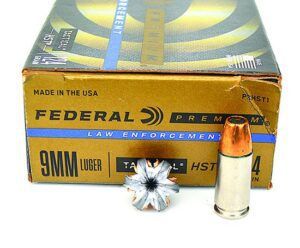
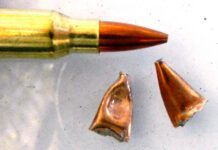
The HST is a bit pricier at 80 cents a round than the Train & Protect. Still, it’s a defense load, not a practice round. You will need to fire enough ammunition in your chosen pistol to confirm reliability. If a modern 9mm handgun doesn’t feed this load — a standard-pressure 124-grain JHP — then the gun is probably defective in some way. Velocities ran 1159 fps in the Glock and 1111 fps in the SIG. We noticed more kick with this than the 115-grain load. We were surprised, but there it is. The power factor rating is the highest of the test, so our perception of recoil is borne out. On the other hand, energy is also the highest of the test. This load tunneled a full 16 inches in gelatin when fired from the SIG and 17 inches from the Glock. Each bullet was uniform and practically indistinguishable from the other. Expansion was a uniform 0.65 inches in five bullets and 0.63 in one of the six fired, with accuracy being very good as well. Weight retention is 100%. The Federal HST is a popular service load, and rightly so. It is affordable, clean burning, and accurate.
Gun Tests Grade: A
Norma MHP 108-Grain Monolithic Hollow Point 299740020 9mm Luger
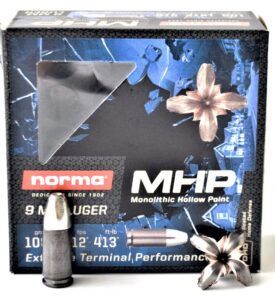
Monolithic simply means the projectile is manufactured from a single piece of copper. This was the lightest projectile tested at 108 grains. The company claims more than 1300 fps velocity. Actual recorded velocity was 1198 fps average. The Norma load was accurate enough, but it was not the most accurate load in the test. Felt recoil was subjectively lightest of the test. Penetration was adequate at 16 inches. Expansion was the greatest at 0.95 inch. We were impressed by the Norma 108-Grain Monolithic Hollow Point’s performance. It offers a combination of light recoil, acceptable accuracy, and a fast-opening bullet for 78 cents a shot.
Gun Tests Grade: A
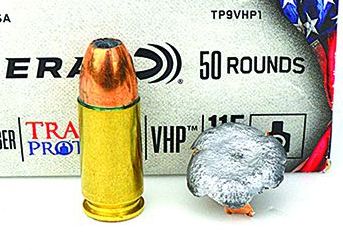
Federal Train & Protect 115-grain VHP TP9VHP1 9mm Luger
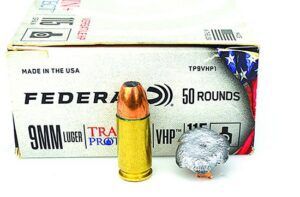
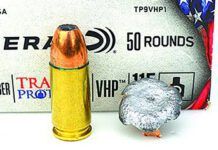
This is a 50-round box, making it one of the more affordable loads tested here at 70 cents a round. The load uses a brass case and standard cup-and-core jacketed hollow-point bullet. This is not a bonded-core type. This load appears to be the latest version of the Federal 9B hollow point, a good all-round choice and among the first factory hollow points that performed reliably. This load exhibited modest muzzle signature with a warm orange glow in some dim-light conditions in the SIG P365, but the signature was not at all noticeable in the Glock 19. Accuracy was the best of the test, a good showing for an economy load. This tracks because the 9B once had a reputation as a match-grade-accurate round. Velocity was barely 1100 fps in the SIG and 1145 fps in the Glock. Expansion showed a flat mushroom of 0.62 inch out of the SIG and 0.64 inch from the Glock. Penetration was an average of 12 inches out of each gun, but one of the test loads went only 11.5 inches out of the Glock. We found the Federal Protect & Defend to be a viable choice. Recoil was a gentle push despite good velocity. We rated it down a grade on penetration.
Gun Tests Grade: B
Winchester W Defense 115-grain JHP USA9JHP
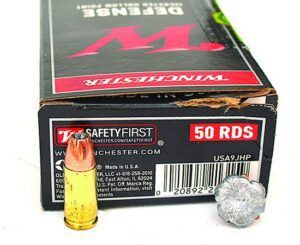
This is another load with a long lineage. It appears to be an unplated Winchester Silvertip. However, the last 115-grain Silvertip tested was much faster. Feed reliability is flawless and its recoil is modest, about middle of the road for the test. The load is available in a 50-round box and seems for sale about everywhere. Cost per round is 56 cents. There were 20 boxes or more on the shelf at the box store where we purchased our test samples. The closest performance comparison in the test is the Federal Train & Protect. Interestingly, performance was close to the Federal load, with velocity greater in the short barrel, but not quite as fast in the long barrel. Velocity was 1118 fps in the SIG’s 3.1-inch barrel and 1143 fps in the Glock 4.02-inch barrel. This is good velocity, all things considered, when you are looking to limit recoil. Penetration was a bit short in the Glock at 11.0 inches on average, with 0.58-inch expansion. In the SIG pistol, we found penetration to be more in the ideal range at 12.0 inches, with 0.56-inch average expansion. This seems to be a considerable difference in penetration and expansion in a short-barrel pistol compared to the longer barrel, with only 25 fps separating the loads, but there it is. Cup-and-core bullets of this design tend to deviate more in velocity than bonded-core bullets. The jacket thickness of the former can vary, leading to changes in velocity. We would have liked a better balance of expansion and penetration, so we rated the load down a grade. But for the money, it’s hard to beat, so we gave it a Best Buy rating.
Gun Tests Grade: B (Best Buy)
Sierra Sports Master 115-Grain Jacketed Hollow Point A81100120 9mm Luger
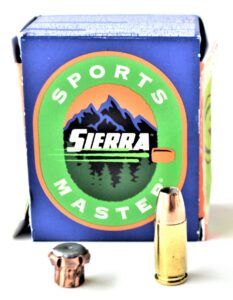
The big selling point of this round is its low cost — 50 cents a shot is nothing to sneeze at. Though we think there are better choices as a carry round, as a pure practice round, this is worth looking for. Felt recoil was light due to a velocity of only 1114 fps. Expansion was a modest 0.52 inch. This load was reliable and accurate, but it was below the curve in energy and expansion.
Gun Tests Grade: B-
If you don’t mind shooting ball, then you can find plenty of options that cost much less these choices, but you won’t get the same insights as far as function goes as with hollow points.