


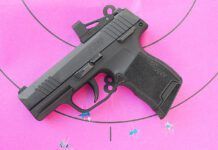



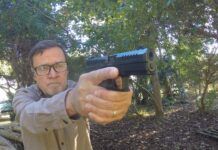



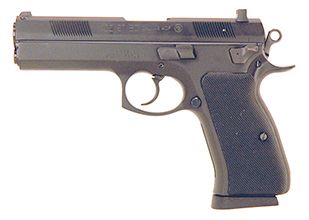
The CZ 97BD is the decocker version of the model 97B. The 97 series was based on the CZ75 design which, like the Browning 1911, is a classic in its own right. The primary difference between the model 97B and the 97BD is that the decocker lever on the 97BD allows the shooter to lower the hammer to a half-cock position without having to physically manipulate the hammer and the trigger.
To review, once a round was chambered in the model 97B, the pistol could be made safe in one of two ways, by raising the thumb safeties or by lowering the hammer manually. This meant holding on to the hammer while pressing the trigger. We think most people will agree that using a decocker would be the safer option.
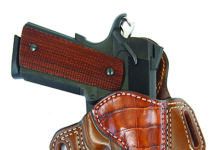
Besides the decocker (left side only), the 97BD also comes standard with self-illuminating tritium night sights. The front sight was fit into the slide from the front. The rear unit, which we found vastly superior in definition compared to the standard unit, was dovetailed in from the sides. Another new feature was the pop-up loaded-chamber indicator. Until we touched the grip of the 97BD, we had no idea the panels were rubber. Visually, they melted into the frame, offering full checkering and a flat profile that we liked. Two double-column 10-round magazines were supplied.
We found the 97BD to be very controllable. Of our three test pistols, we think it shot our test rounds with the least amount of felt recoil. The barrel was supported at the muzzle end by a bushing that screwed into the slide. Slide-to-frame fit also ran from one end of the slide to the other. The CZ design features frame rails that embraced the slide by reaching upward and over the slide. The rails were not exposed except during the act of cycling or when the slide was locked back.
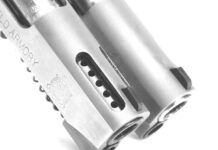
Removing the top end requires moving the slide less than a half inch to the rear and pushing out the slide stop pin from right to left, using the basepad of a magazine. A tight slide stop pin does play a role in lockup and to some degree the accuracy of this design. Stripping out the barrel starts with removing the recoil spring and the capture bushing below the muzzle, referred to in the owner’s manual as the recoil spring housing. Then the barrel bushing can be unscrewed. A wrench for this purpose is supplied but will likely never be used. That is because the barrel bushing is backed off from the full lock position when it is properly installed. The recoil housing acts as a stop, locking into one of six cutouts found on the outer ring of the barrel bushing. We liked this design because two stress points (the barrel bushing and the slide stop pin) can be easily replaced or refit to restore or improve performance.
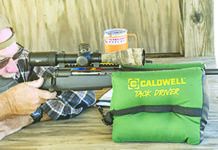
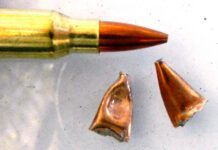
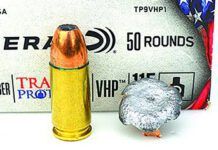
From the bench our handloaded target rounds brought us groups measuring about 1.25 inches across on average. We thought this performance was satisfactory, but we were more interested in how our CZ97BD would handle our choice of defensive ammunition. The difference in accuracy was impressive. Shooting the 200-grain Hornady Custom XTP ammunition, group size broke the 1.0-inch barrier, varying in diameter as little as between 0.8 inch to 1.0 inches across. We don’t always find the optimum bullet, bullet weight or the most accurate load, but we think we did in this case.
In the action test of the model 97B, we addressed the issue of which way was faster to shoot a CZ pistol: Beginning with the hammer back and thumb safety on (single action), or with the hammer lowered to half-cock (double action first shot transitioning to single action). We found that only shooters with larger hands were able to manipulate the thumb safety and fire a string of single-action shots quickly and accurately. But the fastest times we shot with the 97B were actually achieved firing the first-shot double action. The reason for this was that with the hammer in half-cock, both the trigger and the hammer had only a short distance to travel. Nor was there any need to reposition the hand for a better control in the single-action mode. Therefore, without the option of single-action-only operation, we would not expect the 97BD to lose any of its effectiveness when compared to the original model 97B pistol. After decocking, we measured the double-action trigger to present about 13.5 pounds of resistance. This was heavier than the trigger on our model 97B. There wasn’t any grit in the trigger, but we think expert polishing without changing any springs would probably improve this trigger without threatening reliability.
The single-action trigger weighed in at about 5.5 pounds. In just a few practice runs with the CZ 97BD, we were able to drop our elapsed times below the 2-second mark. All shots fit neatly into the center mass A-zone and only one shot printed above the B-zone. Our fastest run lasted 1.78 seconds. On average, our elapsed time computed to about 1.98 seconds.
Our Team Said: For only $845, CZ USA has improved the 97BD’s surface coating. Together with grips that blend perfectly, we credit these features with making an intimidating gun look pleasing, too. Decocking to a position that gives the action a head start on the first shot makes this one of the best TDA guns ever, we thought. The night sights add cost, but even in daylight they provide a much better index than the standard notch and post.





Hasn’t this pistol been discontinued?