




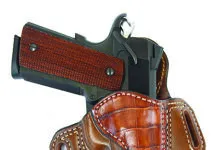
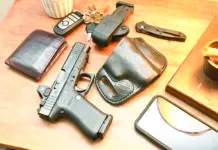



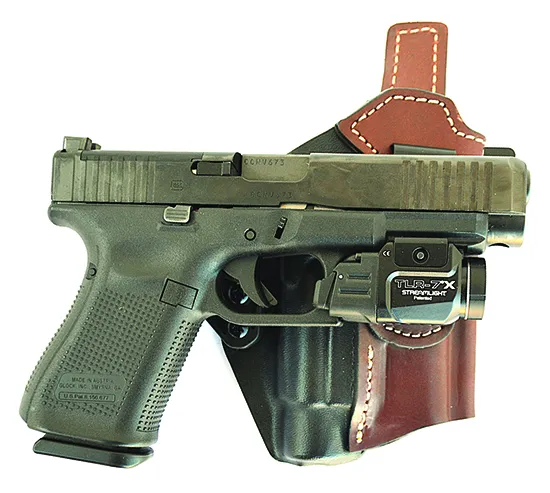
The Glock 17 and Glock 19 are among the most popular concealed-carry and home-defense handguns on the market. In this report, we examine some of the newer choices and best picks in holsters for these pistols.
Selecting a concealed-carry holster is crucial for personal safety. With no shortage of manufacturers and retailers, purchasing this essential everyday-carry item can be daunting. Finding a gun holster and finding the right concealed-carry holster are two different things. You’ll need to know more than your firearm’s model number when holster shopping. We’ll simplify the process by explaining what makes an effective concealed-carry holster, exploring different holster types, and providing guidance on choosing the best one for your needs — whether you’re a new gun owner or an experienced shooter updating your gear.
Holster Ins and Outs
It’s important to understand where and how a firearm is worn concealed. A handgun is most often carried behind the strong-side hip. The draw angle must allow for a rapid, natural presentation. To choose a holster with the right draw angle, it helps to understand cant, rake, drop, and two common acronyms used in the CCW world.
Cant is the angle at which the holster positions the grip. A very tall person may prefer a neutral cant, but most shooters benefit from a 15-degree forward cant that tilts the grip into the draw hand.
Rake also refers to angle: a forward rake means the muzzle is ahead of the grip centerline, while a rearward rake — the more popular option — means the muzzle is positioned behind the grip.
Drop (sometimes called ride) indicates where the holster sits relative to the beltline. A high-ride holster positions the gun higher on the belt for concealment, keeping it from protruding below the hem of a jacket. For inside-the-waistband carry, a lower drop aids concealment, while a higher ride aids a fast presentation.
An IWB (inside-the-waistband) holster is highly effective for concealed carry. The IWB becomes an AIWB (appendix inside-the-waistband) with a few design modifications, positioning the gun in front of the hip rather than behind it. OWB (outside-the-waistband) holsters ride on the belt and require a covering garment for concealment. Here’s how they performed:
Blackhawk Serpa Sportster Paddle,
$37
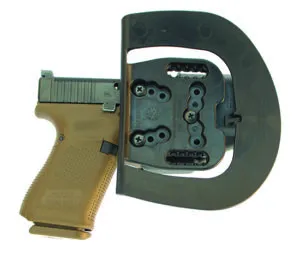
The Serpa was selected by one of our left-handed testers as his primary test holster for the Glock 17. He also tested the DeSantis Variable in its left-hand configuration. This large, secure paddle offers a range of drop and cant adjustment — we experimented with several settings without exhausting the possibilities.
The holster is minimalist in profile. The slide is partially exposed, and the optics cut is generously wide. The Serpa’s retention device engages firmly when the handgun is holstered. On the draw, the trigger finger naturally extends in proper safety position, then presses a release button to disengage the lock before the pistol clears the holster.
This is where our concerns arose. Although we used an unloaded firearm throughout, our primary tester halted testing because, after pressing the release button, his finger tended to ride into the trigger guard during the draw stroke. The finger remains somewhat tensioned after depressing the release, and that tension can carry the fingertip toward the trigger guard as the gun clears the holster — directly contrary to safe trigger-finger discipline. This inclination was difficult to consistently overcome.
The lock itself also adds measurable time to the draw. After two testers evaluated the holster, our consensus was that the Serpa system is far from ideal for concealed carry.
For duty use with extensive, dedicated training, it may be considered — but we cannot recommend it for most civilian carry applications. Our concerns were grave enough that we want to be clear — we wouldn’t buy this holster. See it at Blackhawk.com.
GUN TESTS GRADE: D
DeSantis Persuader AIWB/IWB,
$120
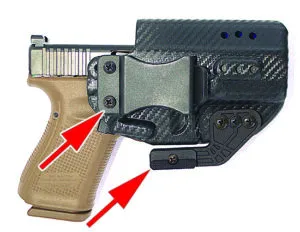
We ordered the package with the attached spare magazine carrier. For standard IWB carry, we’d recommend a separate magazine holder on the opposite side; for AIWB carry, the integrated carrier makes good sense.
The DeSantis Persuader model is a thermomolded carbon-fiber holster designed primarily for AIWB wear. An Anti-Rotation Wedge (ARW) combats forward rollout in the appendix position; it works as designed and can be easily removed for conventional IWB carry. The belt attachment is a large, flat clip with some drop adjustment. There is a molded sight track and an optics cut. Fit is good throughout, and the slide guide functions as intended.
The Persuader works well in both AIWB and IWB carry — with the rollout device removed for the latter. Our one reservation is construction thickness; we would have preferred slightly heavier material. That said, a thinner IWB can be effective where a thin OWB would not be, because body compression contributes to retention. See it at DeSantisHolsters.com.
GUN TESTS GRADE: A-
DeSantis Variable GRD Ambidextrous OWB,
$100
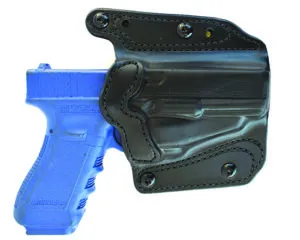
The Variable’s headline feature is the Gunhide Retaining Device (GRD), a Kydex hook that snaps around the trigger guard with an audible click as the handgun is holstered. This makes the gun impervious to a rearward grab — the handgun must be pulled straight up to draw. The device worked very well with Glock pistols, providing real security.
Draw speed depends heavily on the user’s willingness to practice. One of our testers worked with the Variable over two days and achieved a sharp, consistent draw once the correct angle was learned. We believe the GRD is a retention feature worth serious consideration.
We attempted to test retention with a training gun, but the GRD did not engage as positively as it does with an actual Glock — the dimensions are close but not identical — so we did that portion of testing with an unloaded but functional firearm.
Beyond retention, the Variable is ambidextrous: simply swap the belt loops for left- or right-hand carry. The holster also features a reinforced holster mouth (holstering welt) that prevents collapse after the pistol is drawn. The ambidextrous design does preclude a slide guard, making this something of a specialist’s holster. Its end user must understand and commit to the training it requires. Check the Variable out at DeSantisHolsters.com.
GUN TESTS GRADE: A
Don Hume Leather Goods 720 Paddle,
$78
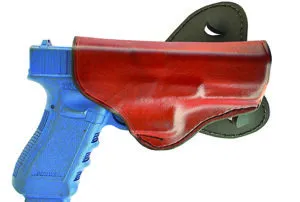
This is a traditional leather paddle holster with excellent fit and finish. Edging and blocking are cleanly executed. The paddle itself is a large Kydex form covered in leather, firmly attached to the holster body. The suede-covered paddle is comfortable and provides good retention via two retention cuts. While there is no cant adjustment, the holster incorporates the FBI tilt — a 15-degree rake. The ride is high and draw speed is excellent.
There’s an additional design feature worth noting: the paddle is removable. A Velcro cover conceals the mounting screws; remove them and the holster can be worn as a high-ride belt holster using an integrated tunnel loop built into the holster body. This dual-carry capability makes the 720 an uncommonly versatile buy. Draw speed is excellent thanks to the paddle’s body offset, and reholstering is straightforward. A thumb break adds $19 to the cost. Find out more at DonHume.com.
GUN TESTS GRADE: A
Falco Talon A911L IWB/AIWB Holster,
$134
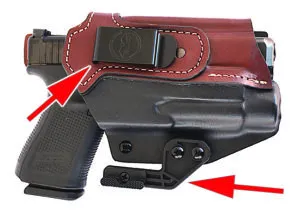
The Talon was designed to solve a specific problem: comfortable IWB carry for a pistol. Appendix capability was added as a secondary goal, hence the optional “foot.” The result is a purpose-built holster — not an adaptation of an existing design — and it shows. The Talon features Italian leather and U.S.-made Kydex, per Falco’s specifications. The leather component houses the sight track, the belt clip, and the integrated slide guard/sweat guard. The shell is Kydex, blended neatly into the leather body. Rather than simply extending the existing design, Falco angled the junction between leather and Kydex to account for a Glock 17’s slide length.
We ordered the optional appendix foot to fully evaluate that carry mode. The draw is sharp and smooth; reholstering is secure. The hybrid construction introduces a slight flex that improves all-day comfort. This is a well-executed and thoughtful design. See it at FalcoHolsters.com.
GUN TESTS GRADE: A
Falco Timeless A634T IWB,
$114
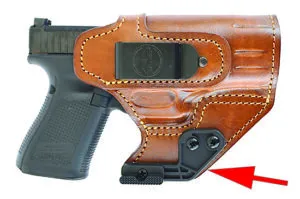
The A634T is an evolution of Falco’s long-running A604 design. The A604, averaging around $80, lacks a slide guard and the optional “foot.” The A634T as we ordered it includes the standard slide guard/sweat guard and an optional appendix foot — a Kydex anti-rollout device.
One thing to understand before ordering: the Falco IWB may require a break-in period. Tanning and stitching are very well executed, with double stitching in all load-bearing areas. The slide guard and belt clip are attached via a single strap of leather aggressively stitched to the holster body. The metal belt clip is tight, requiring a deliberate effort to clip onto the belt — which translates to a very secure hold.
After break-in, the draw is sharp and the reholster intuitive. A significant advantage over many light-bearing holsters: the Falco fits well even without a light attached. Overall impression is one of high quality — heavier leather than most, superior belt attachment. Learn more at FalcoHolsters.com.
GUN TESTS GRADE: A
Galco Corvus OWB/IWB,
$86
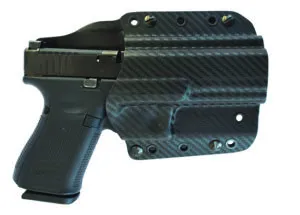
We found the Corvus priced as low as $73 and as high as $106, with an average around $86. The holster is Kydex construction with a finish that offers more visual appeal than plain Kydex gear. It features adjustable cant and ride via 11 positioning holes, and it has a raised sweat guard — a feature we prefer on nearly any holster. The Corvus ships with hardware for both OWB and IWB carry, and the shell is cut for optics.
Retention is firm, with the tightest contact at the trigger guard. A slow tug requires real effort; a quick, committed draw is fast — very fast with practice. As an IWB holster, the Corvus offers a clean draw and easy reholstering by tracking the slide guard with the muzzle (trigger finger off the trigger). As a belt holster, it provides good security with rapid presentation. We awarded the Corvus a Best Buy based on its versatility as both an IWB and OWB holster. Find it at GalcoHol-sters.com.
GUN TESTS GRADE: A
Best Buy
High Noon Slide Guard OWB,
$119
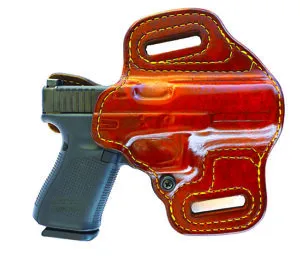
High Noon offers the Slide Guard for a range of handguns. We ordered one fit for the Glock 17 that also accommodates the slightly shorter Glock 19. High Noon uses full-grain leather, and the grain texture is clearly visible. The leather is thick enough that the holster will maintain its shape through years of use, and the interior is fully lined.
When a holster shell is cut, the process resembles a dress pattern. The two halves are then sewn and glued in a process called edging. On the High Noon, the edging is so clean you’d barely know the halves had been joined. Double stitching on high-stress areas is neatly executed in white nylon thread. A retention screw allows the user to adjust draw tension to taste.
The Slide Guard is an evolution of High Noon’s Topless design. Its defining feature is a tall slide guard that shields the body from the pistol’s sharp edges, protects the gun from perspiration and body oils, and helps keep the muzzle indexed inward during holstering. Fit is excellent. The pistol seats securely and requires a deliberate tug to draw — the ideal balance of retention and speed. With practice, draw speed is very good. The High Noon Slide Guard is a step above in quality. Check it out at HighNoonHolsters.com.
GUN TESTS GRADE: A
JM4 Tactical Relic Series “Preacher” IWB/AIWB,
$100
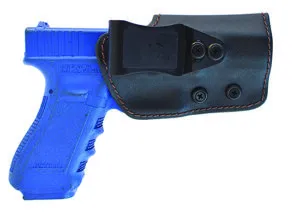
The Preacher is designed for inside-the-waistband carry, appendix carry, or tucked under a shirt. The shell is Bolatron with a steerhide interior lining that is neatly stitched. The holster offers some draw-angle adjustment, and its construction lives up to JM4’s claims of quiet operation — the draw and reholster are notably silent, our testers found.
The synthetic belt clip takes a firm, confident bite of the belt. The draw angle is well executed, and the sweat guard guides the pistol smoothly back into the holster on reholstering. The clip rides low and offset, which is ideal for AIWB and tuckable carry but results in a higher-than-typical ride in standard IWB. That said, the Preacher does exactly what it was designed to do: offer a good fit, an excellent balance of speed and retention, and genuine versatility. Draw speed was the fastest of any IWB holster in this test without sacrificing retention. Learn more about it at JM4Tactical.com.
GUN TESTS GRADE: A
Mission First Tactical TLR-1-Compatible Ambidextrous OWB Holster,
$65
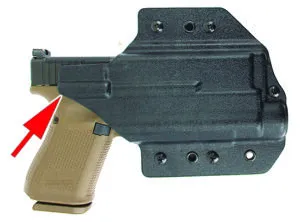
affordable and ambidextrous. The slide guard (arrows) is a good feature.
The MFT holster demonstrates what Kydex makes possible that leather cannot: a fully ambidex-trous design with genuinely innovative geometry. We ordered the holster for the Glock 17.
Our testers found a good balance of speed and retention, with a sharp draw. When a weapon light is attached, retention increases as the light contacts additional holster surface — be sure to practice your draw with the light installed. The holster functions reliably for right-handed, left-handed, and ambidextrous shooters. A mid-length slide guard/sweat guard runs on both sides of the body without interfering with the draw from either side.
We liked this holster. The construction could be slightly heavier, but that would likely be reflected in the price. As with all light-bearing holsters, fit is loose without the light. For more, check MissionFirstTactical.com.
GUN TESTS GRADE: A-
Muddy River Tactical Paddle Holster,
$70
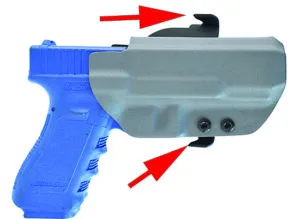
One of our testers has long felt that the paddle holster is underutilized by concealed-carry permit holders, dismissed as a “cop’s holster.” The paddle design was originally developed as an easy-on, easy-off solution for officers required to remove their firearms before entering prisons or certain federal buildings. The traditional criticism of early paddle designs was that they could be torqued free by a determined attacker or simply by contact with a chair or car seat.
Muddy River Tactical’s paddle holster offers good fit and an optics cut. Its offset design provides a clean draw, though it may slightly impede concealment. It rides closer to the body than most paddle designs, and retention hooks on the paddle address the torque problem effectively. We found it viable for concealed carry. We deducted half a grade for it having more play in the paddle than we’d like, and another half grade for a paddle we felt could be slightly larger. See it at MuddyRiverTactical.com.
GUN TESTS GRADE: B
Safariland Incog X AIWB/IWB,
$99
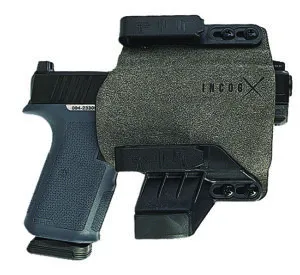
The IncogX may be accessorized with a magazine carrier.
The Incog X is designed for appendix carry but performs equally well as a standard IWB holster. It is both light-ready and optics-cut. The Bolatron body is covered in suede for comfort, while the interior remains unlined for a cleaner fit. Molding and blocking are excellent.
The belt clips attach upward onto the belt, providing a secure hold. On the left side of the holster (facing the body) is a screwed-on anti-rollout device that prevents the holster from tilting forward, gun-butt-first — a common problem in appendix carry. The sweat guard is relatively short but very rigid. The Incog X offers a good mix of speed and retention, and its suede backing makes it more comfortable than most appendix holsters. An optional magazine caddy is $36. Check it out at Safariland.com.
GUN TESTS GRADE: A-
Safariland Species IWB,
$50
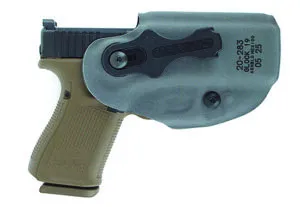
The Species is available in seven colors; we ordered ours in Wolf Gray. It is molded from Safariland’s proprietary Safarilaminate. The outer shell is not quite as refined as the Incog X’s, but it compares favorably to most holsters tested at any price. The interior is suede-lined at key contact points — a thoughtful touch at this price. A built-in sight track and an adjustable tension device for customizing draw tension round out the feature set.
The single J-hook belt loop grips the belt securely and is adjustable for both drop/ride and cant — a flexible system. The Species is comfortable, well-adjustable, and delivers a fast, clean draw. It is not light-compatible but is cut for optics. It’s available in right-hand configuration only. We deducted half a grade for the absence of a left-hand option; otherwise, this is a superior holster that easily justifies its price. See more at Safariland.com.
GUN TESTS GRADE: A-
Tagua PD3-310 Paddle Holster for the Glock 19,
$39
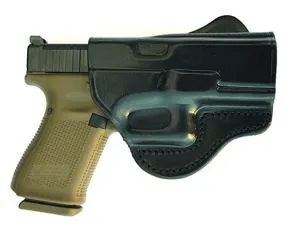
The Tagua line covers a range of handguns and is commonly found on the racks at gun shops and pawn shops. We wanted to include at least a few holsters under $50, and the Tagua fits that role.
The holster consists of a leather shell attached to a Kydex paddle. Fit is good — snug, in fact, as we holstered the Glock 19 — and the draw is acceptable. However, there were several demerits. The design lacks a sweat guard. The paddle features two small protrusions intended to aid reten-tion, but they are rounded and contribute little to stability. There was noticeable flex between the holster body and the paddle, and retention could be compromised when seated. The price is right, but the Tagua paddle falls short in too many areas for serious concealed carry. It would serve adequately as a range holster. Find this at TaguaGunleather.com.
GUN TESTS GRADE: B-
Written and photographed by Robert Campbell, using evaluations from Gun Tests
Team members. GT



WHILE MANY FIREARM OWNERS HAVE SWITCHED TO KYDEX HYBRID HOLSTERS, I AM INTO ALL-LEATHER OWB HOLSTERS WITH A LEATHER STRAP OVER THE BACK STRAP OF THE F/A. I HOPE YOU TEST LEATHER HOLSTERS IN THE FUTURE, FOR TRADITIONALISTS LIKE ME.
Prefer a leather OWB thumb break holster…