




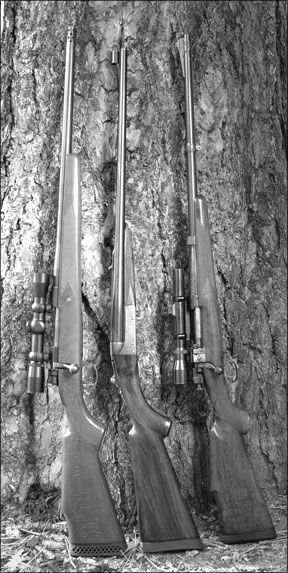
Those who choose to hunt the worlds most dangerous game in the old way, relying on their own rifle and their own shooting (however you may be able to do that), must have reliable rifles. It matters not that your rifle can put all its shots into a single hole at a thousand yards if-only once-it ever fails to work. Failure generally comes when youre tackling something that can kill you. One of our staff had that happen in Africa. The cocking piece came loose when he chambered a round in a custom rifle that had fired a thousand rounds with zero problems. It never happened before, nor since. Of course, most people never hunt dangerous game without a guide along. But what about the guides rifle?
The finest rifles for hunting dangerous game are those that can reliably shoot time and again with no problems, and of all rifles, the fine English-made double rifle has the reputation of having no peer in this field. In this test we were privileged to have the loan of just such a rifle, a Churchill double 470 that is currently for sale at $40,000. But do you really need a rifle that costly? Cant you do just as well with a good 458 bolt-action rifle, especially a custom one that might cost more than, say, a Remington or Ruger, but has the advantages of custom fitting and best-quality setup? To evaluate custom 458s we acquired the loan of two custom rifles. One is based on a Czech VZ-24 action, and is valued at $1500. The other is based on a Springfield 1903, and is a more serious endeavor. It seemed to have it all, custom fitting, engraving, extensive action work, rust bluing, etc. It is valued at $15,000. We evaluated them first as dangerous-game rifles, but we also took a look at what else they offer the sportsman in search of a versatile big rifle.
Besides utter reliability, what must a dangerous-game rifle have? Smoothness and silence of operation are mandatory. Ejectors on double rifles can be deactivated if necessary, but they are godsends-if noisy-in some situations. Excellent triggers are mandatory, but they must not be too light. A non-glare finish is called for on stock and metal. Of course the rifle has to have a good recoil pad and a large area on the stock where it touches your shoulder. The rifle must fit you, so you can shoot quickly. Iron sights are mandatory, we believe. Much dangerous-game hunting is done in marginal light where a scope might be nice, but its also usually close-range shooting. A scope may be valuable for non-dangerous game and other such uses, but it can get badly in the way when youre 20 feet from your target.
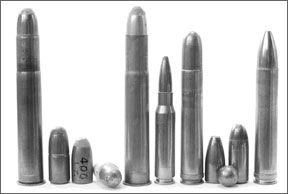
We shot our test rifles with factory ammo and handloads, wanting to experience the 458 with both 350-grain Barnes X and 500-grain Hornady steel-jacket solids, plus some lighter loads. We have some of the newest 458 factory ammunition coming, with claimed velocities over 2200 fps for 500-grain bullets, but it did not arrive in time. The 458 handloads we used are thoroughly tested over many years, and meet or exceed the velocities obtained with most older factory ammo. Commercial ammunition for these big rifles is not cheap. Current list price for ten rounds of Norma 470 ammunition is $212, or $21 a round. A case of 200 rounds of Federal 470 ammo is available discounted at $3000. Winchester 458 Magnum ammo is not that bad at $6 to $8 per shot, or from $120 to $160 list price for a box of 20.
The argument might well be made that no one really needs an elephant rifle. However, they are very much fun to shoot, as any owner can tell you. Theres also the hidden reward of mastering all that power, which in turn makes lesser rifles easier to handle, which makes you a better shot, which directly benefits the game you hunt. Also, generally overlooked in the gun press, theres the fact that big rifles are always far more versatile than smaller rifles. With a 458 you can slay an elephant, or you can handload it with round balls and hunt rabbits. Cant load down a 470, you say? The owner of our 470 has developed loads for 400-grain bullets that regulate well in the big rifle and cut recoil a bunch.
So for the most bang for the buck, build your own loads if you have a big rifle. Youll be well rewarded. Some very fine 470 bullets cost $2 apiece, but there are cheaper ways, including paper-patched cast lead, so save your brass. Handloading the 458 with cast bullets can cut ammo costs to less than that of store-bought 223. So which is better, bolt-action or double rifle? Heres what we found.
VZ-24 Custom 458, About $1500
The VZ-24 action is one of the finest of the Mauser 98 genre, well worthy of becoming a 458. Our rifles Czechoslovakian action had had its bolt face opened, and a replacement bolt handle welded on. The action and barrel had been polished and blued to a matte finish, but the bluing was poorly done. The rifle had a moderately tapered 22-inch barrel with an integral muzzle brake. The trigger
guard was the military version. The floorplate had a glossy polish that was out of place. The stock was decent walnut that needed shortening, we thought, which would give room to put the front sling stud onto the barrel. The checkering was plain but adequate, and the stock finish was excellent but shiny. The Monte-Carlo stock ended in a useful trestle-style recoil pad.
The bedding had problems. There were uneven gaps between the barrel and the forend, and a sliver of wood was added at the right-rear corner of the action. We took the metal out of the stock, and there we found horrors. The forend was reasonably inletted, but there was no finish whatsoever on the wood. Worse, there was no reinforcing done to the stock, and no second recoil lug. There was only the one standard Mauser recoil lug on the action, which mated to a square cross bolt passing through the stock. Thats woefully inadequate to prevent the destruction of this stock by the 458s recoil. The rifle desperately needed a second recoil lug sweated to the barrel and inletted into the forend, Brownells Steel Bed applied appropriately, and a cross bolt inletted ahead of the trigger. Without those, wed bet this rifle will break the stock within a hundred rounds.
The next horror was the military trigger. It gave a good pull, but it has the unacceptable ability to fire the gun by pressing it forward instead of backward. Finally we found some severe corrosion under the action rail, which normally would not be at all important, but this was visible from the outside. We found more of the same elsewhere, all of it visible from above. It might be possible to fill those holes with the newest Steel Bed, which has a black die. This action, we thought, should never have been used for a custom rifle.
The rifle was fitted with a Weaver R4 scope. We suspect the R4 is for rimfires, but it worked well in our limited testing. The scope was attached by means of the Weaver bases we use for much of our rifle testing, but which we think are inadequate over time on a hard-kicking rifle.
On the range we found recoil to be moderate, thanks to the muzzle brake, but we all hated that brake. It threw an enormous cloud of gas, grass, dust and dirt into the air with each shot. The noise was horrific. The dust cloud would telegraph your position to anything out there that wanted to hurt you. (However, the mighty noise might slow em down.) The dust and dirt could get into your eyes at a bad time. With all loads tried, the rifle was capable of 3-inch or better accuracy at 100 yards.
Though accurate enough, the rifle had unacceptably rough feeding. We got a jam with the second round, and the bolt stopped cold. The cause was sharp edges on the extractor. All rounds that did feed properly tried desperately to stop when they got halfway into the chamber. Were they trying to tell us something? The VZ-24 lacked iron sights. For most people with reasonably normal vision, a scope is probably unnecessary on a 458. The targets are usually not small. There are shooters who like to use big rifles for other purposes, and for them a scope might make sense. In the light under which we examined these rifles, this one needed a ton of work.
Springfield Custom Engraved 458, about $15,000
This rifle had classic English lines with its short forend, wrap-around checkering, detachable low-power scope, and rust bluing. It felt more lively than the VZ-24. This rifle had been barreled in 458 Win. Mag. before it came to its present owner. It didnt feed reliably, so he went to work on the metal beneath the feed rails. This was a long, slow process, he told us, that involving grinding, cleaning, testing, and grinding some more until the feeding was perfect. Then he lapped the bolt to the action, gently polishing the sliding surfaces and making it all even slicker. The owner told us he spent many weeks working on the action and its rails until he was satisfied. The result must be experienced to be fully appreciated. This was simply the slickest bolt-action rifle weve ever handled, here in Idaho. There was almost no felt resistance to the bolt as it went forward, no matter the type of ammo put into the magazine. The rifle would hold and feed any one of its three rounds as fast or as slowly as youd care to move the bolt, with the rifle upside down, sideways, or held normally. It would do the same thing with empty cases.
Not satisfied with the original stock configuration, its owner modified it and turned it into what you see. He shortened the forend, reshaped the butt stock, installed the current pad, finished the wood in best oil, and checkered it in English-style bordered panels that wrap the forend and pistol grip. The barrel has a second recoil lug and two hidden cross bolts set in Steel Bed.
Once the owner had it feeding, stocked, and shooting to his satisfaction, he engraved the rifle. This was the first firearm he ever engraved, and he dedicated it to his Alaskan friends, pictured on the rifle. These include a squirrel, a chickadee, two gray jays, a woodpecker, a pine grosbeak, a mouse, an ear-less cat, and the highlight of the rifle, a fox on the floorplate. He told us all these animals used to come to his call, and would eat out of his hands. There is also a Cape buffalo at the rear of the barrel, which explains the title engraved on the rifle, “Amigos + 1.”
The bluing looked splendid in the sunlight, with the fine engraving highlighted by muted sparkles of light. The rifle was rust blued in the old fashion, and it looked really good to us. Its trigger pull was two-stage, breaking clean and crisp at 3.7 pounds. The metalwork was superb, as was the rust bluing. The woodworking was also excellent.
On the range the Springfield delivered excellent accuracy with both 350- and 500-grain loads. There were no problems at all. Best accuracy of the test was three 350-grain Barnes X-bullets into 1.2 inches at 50 yards. We believe the rifle is capable of more than that. This was a versatile rifle that was a lot of fun to shoot.
Churchill 470 Double Ejector, $40,000
What makes this so expensive? Scarcity, excellence of manufacture during the golden era of British gunmaking (1925), condition, accuracy, and in the case of this particular rifle, its reputation and history. Also, the 470 cartridge is the most popular of the double-rifle cartridges, still readily available. Double rifles have always been expensive, but this one is nowhere near the top of the price chain. A new Holland & Holland double rifle today sells for $170,000. H&H sells as many as it can make, which isnt a large number.
The description of this Churchill 470 is straightforward. Its a fully engraved, cased, best boxlock double ejector with dolls-head third bite. It has 24-inch barrels, a splinter forend with grip fastener, Silvers pad, cast off, and has a gold inlaid “470” beneath the action. It has gold-inlaid “safe” on the top tang, and a gold oval in the stock engraved with the owners initials. The rifle has a quarter rib, caterpillar front-sight base with dust cover, swamped barrels, and a single standard rear sight with V. The front-sight bead is gold. The barrels are “chopper lump,” meaning the barrel lump is forged integrally with each barrel. The safety is non-automatic, and the tang extends along the top of the butt stock halfway to the recoil pad to add strength to the rifle. The action still shows much of its case coloring, though its faded with time. The rifle is tight on the face, and still bears about 99 percent of its original bluing. The bores shine like new, and the proof marks verify the story.
If you cant decipher all that, rest assured serious collectors eat that stuff up like potato chips at a barbecue. What it all means is this rifle was exceptionally well made during the heyday of British rifle making, and exhibits the superb workmanship of that period in every detail.
The cartridge is commonly loaded with 500-grain soft-nose or solid bullets at 2125 fps. Though the 470 case is a lot larger than the 458 Win. Mag., it throws the same-weight bullets just a bit faster than commonly achieved by the 458. The difference is the 470 was designed to work at low pressure. This makes sense in the extreme heat of the tropics, for which the cartridge was designed. Bullet diameter is 0.475 inch. Case length is 3.25 inches. This cartridge is also called the 470 Nitro, but there was never a black-powder version, so the Nitro name is superfluous.
The overall appearance of this rifle was one of simplicity. There was nothing sticking out, no levers to operate. Because of the action design, the rifle was compact despite its 24-inch barrels. The bluing was superb. In bright light it still looked marvelous, despite its 80-year age. The red recoil pad was still relatively soft, and the wood finish was outstanding. We noted the rifle had quite a lot of drop to its stock, something not every shooter would want. Its owner said the sights align perfectly with his eye when he shoulders the rifle. We noted there was an optical effect from the modestly wide V rear sight. It made the small front bead clearer to our eyes, much like peering through an aperture sight.
On the range we first shot the rifle from standing. It was loud, but recoil was entirely tolerable. We then commenced bench testing at 50 yards, and got decent groups with everything tried. This rifle was somewhat punishing, and we longed for a standing-type bench, which would permit a steady hold yet allow us to move backward instead of taking the full force while sitting.
After the empties zinged over our shoulder, we noted an extra force was needed to close the rifle and cock the ejectors. But with the ejector springs removed there is no added force needed to close the rifle. The cocking of the locks is done on opening. One thing was made clear in our evaluation. If we had a pocket filled with 470 ammo, we could shoot them in the double faster than shooting a similar bunch of cartridges in a bolt-action rifle. Once the bolts magazine is empty, it becomes a clumsy single shot. We also got some instruction in double-rifle handling. Weve all seen photos of the two spare cartridges clipped in the fingers of the supporting hand being dunked clumsily into the chambers by that hand. Thats not how its done. The forward hand never leaves the forend. The firing hand reaches forward and grabs whats needed, brings it back to the breech and reloads by feel, with the eyes kept on target. We noted the recoil of the 400-grain “light” load was still important, but much diminished from the full charge. We also noted the fine balance of the double increased handling speed from standing.
Another myth was dispelled for us. Good double rifles never have their shots cross at any range. The bullets from each barrel fly a path parallel to each other a fraction of an inch apart from here to infinity. And of course you never fire both barrels of a double rifle at the same time, no matter what the emergency. It does no good to have emptied the rifle in such an emergency. Instead, the second barrel is always kept in readiness for subsequent action.
Which Do You Choose?
So, which is better, magazine or double? For the man with a hearty pocketbook and the desire to have the absolute finest in a dangerous-game rifle there is no question. Get a best-quality double rifle. It will do the best job, we feel, of protecting you in a tight spot. You have essentially two rifles on one stock: two locks, two triggers, two barrels. There are no levers to pull to get that second shot, and no scope nor bolt handle to foul on brush. Yes, itll cost big money, but about every ten years, with an intelligent purchase, you can expect the rifle to double in value. (That might be the true meaning of “double” rifle.) A custom bolt-action will seldom hold its value as well, unless its by a famous maker, and of the quality-particularly with engraving-of the Springfield. But the bolt rifle has greater overall versatility, especially with light loads. It wont cost anywhere near as much as a double, and most of us dont have money to burn. Bottom line: How much money is your life worth?
1008-ACCURACY-HUNTING-RIFLES.pdf
1008-SPRINGFIELD-CUSTOM-458.pdf
1008-HUNTING-RIFLES-REPORT-CARD.pdf