










For the Cowboy Action Shooting competitor, a tuned six-shooter can offer better reliability, more speed, and improved shooting comfort — no small matter with about 100 rounds typically being fired in a cowboy-style match. But a tuned shootin’ iron can also appeal to the recreational shooter, who simply wants a better gun than what he or she might buy untried over the counter.
Since Single Action Army (SAA) revolvers were first built, there have been kitchen-table gunsmiths tweaking the design to lighten the trigger pull and enable the revolvers to be fired faster and more accurately. Today, there are revolvers that are tuned at the factory that enhance the performance of the classic single-action revolver without having to pay for custom gun work.
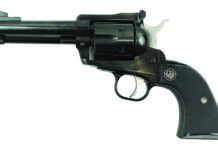
Three of these factory-tuned 38 Specials include the Uberti El Patron Competition, Taylor’s & Company Short Stroke Gunfighter, and Ruger’s SASS Vaquero. These are all SAA-style six-shot revolvers chambered in 357 Magnum but which also fire 38 Special more comfortably and more cheaply. Barrel lengths were 4.6, 4.7, or 5.5 inches, and all had fixed sights. The Ruger SASS is a matched pair of revolvers packaged to appeal to weekend gunslingers participating in Cowboy Action Shooting (CAS) or those who just want a matched pair of revolvers.
These performance six-shooters were reviewed for accuracy, point-of-aim regulation to point of impact, trigger weight, ease of use, and sights. Just a side note on accuracy for Cowboy Action Shooting matches. Pistol stages are typically at 7 to 10 yards and targets are large, measuring 16 by 16 inches. Despite these large targets, CAS revolvers are often capable of excellent accuracy.
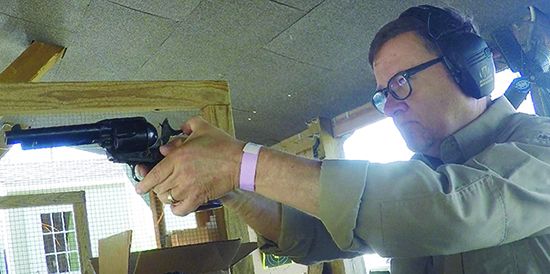
We opted to try ammo loaded for Cowboy Action Shooting and traditional target ammo in 38 Special as well as 357 Magnum, because these revolvers can also be used to defend the homestead. Cowboy fodder consisted of Blazer aluminum case loaded with a 158-grain lead round-nose bullet and Magtech with a 158-grain lead flat-point projectile. Traditional target ammo was Defender loaded with a 148-grain wadcutter bullet that punched perfectly round holes in paper. The defense load was Hornady Custom Critical Defense 357 Magnum with a 125-grain FTX bullet. We tested accuracy at 15 yards and fast shooting at 7 yards at a tombstone-style target. At 7 yards, we fired both two handed using our support-hand thumb to cock the revolvers and one handed using our firing-hand thumb to cock the revolvers.
A preliminary cylinder gap test showed the Uberti and both Rugers were in spec between 0.003 and 0.005 inches, while the Taylor’s was a very tight 0.012 inch. Would the Gunfighter bind up with continuous lead bullets shot through it? We would find out.
These are fun revolvers to shoot. The devil is in the details, as they say, and here’s what we liked about these tuned six-shooters.
Taylor’s & Company Short Stroke Gunfighter RC1/556209DE 357 Magnum,
$990
Gun Tests grade: A-
The Short Stroke Gunfighter allows the user to fire the revolver very quickly. The traditional hammer does not slow this gun down because of the long and skinny Colt 1860 Army-style grip. Accuracy was good.
| Action Type | Single action |
|---|---|
| Overall Length | 11.1 in. |
| Barrel Length | 5.5 in. |
| Barrel Rifling Twist Rate | 1:16 in. |
| Sight Radius | 6.5 in. |
| Overall Height | 5.4 in. |
| Maximum Width | 1.6 in. |
| Weight Unloaded | 40 oz. |
| Weight Loaded | 42.8 oz. |
| Cylinder Gap | 0.012 in. |
| Capacity | 6 |
| Frame | Case hardened steel |
| Barrel | Blued steel |
| Cylinder | Blued steel |
| Frame Front Strap Height | 2.6 in. |
| Frame Back Strap Height | 4.1 in. |
| Grip | Checkered walnut |
| Grip Thickness (Maximum) | 1.5 in. |
| Grip Circumference (Maximum) | 6.2 in. |
| Front Sight | Blade |
| Rear Sight | Integral notch |
| Trigger Pull Weight | 2.1 lbs. |
| Trigger Span | 2.8 in. |
| Safety | Retractable firing pin |
| Warranty | 1 year |
| Telephone | (540) 722-2017 |
| Website | TaylorsFirearms.com |
| Made In | Italy (Uberti) |
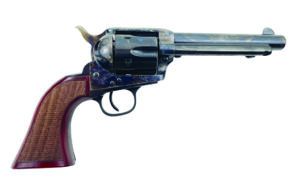
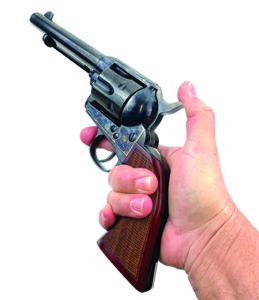
The Taylor’s is the most modified of the guns tested. The Gunfighter models attach the grip of an 1860 Army revolver to the frame of a Single Action Army. This grip is longer and thinner than a traditional SAA and changes the balance. The balance is still good, but it doesn’t feel like a typical SAA. Because the grip is narrow where it attaches to the frame, you can grasp the revolver higher and reach the hammer more easily. The Taylor’s also features a short-stroke hammer, which reduces the length of hammer travel and allows the user to increase speed. The action of the Taylor’s is also tuned with a silky-smooth cocking action and a trigger pull that measures a light 2.1 pounds.
The Taylor’s has a blued grip frame, barrel, and cylinder. The frame is a vivid casehardening color. The grip is thin, and the walnut stock is checkered.
The hammer is a traditional SAA style with a narrow and high hammer spur. The hammer cocks backward noticeably less than a traditional hammer, and for shooters with large hands, there is no concern the hammer will pinch the web of your hand. It took a few tries to get used to the short stroke because we have years of experience with traditional SAA revolvers. Once we became acclimated, we could easily see the short-stroke hammer offered a real edge in speed. The Taylor’s uses a floating firing pin, and the trigger needs to be fully pressed to fire the revolver, so in theory the Taylor’s can be safely carried with all the chambers loaded. The hammer needs to be at half cock to open the gate for loading and unloading the chambers. If you accidentally rotated the cylinder a little past a chamber, the cylinder could be rotated counter-clockwise to get back to the chamber.
The sights were very usable. The front blade is thick, and the rear sight groove has a nice, wide notch, so it is easy to pick up and aim.
The crescent-shaped ejector head rotates away from the barrel and potentially singed finger tips. We only needed to kick out a few empties because most dropped out with gravity’s help.
The base pin is finely serrated and was easy to remove even after extensive shooting.
Starting with the tombstone target at 7 yards, if we thought the Ruger was fast and the Uberti a bit faster, the Taylor’s blew the saloon doors off with its speed. We could fire shots almost as fast as a semi-auto if we paid attention. With the two-hand hold, the grip shape allowed easy access to the taller hammer spur, and the short cocking stroke allowed us to slip off the hammer fast and get off the shot. At 7 yards, we blasted one large hole from all the shots. It shot to point of aim.
For accuracy shooting, the best five-shot group at 15 yards was with Defender wadcutters and measured 1.56 inches; average was 1.75 inches. Of the cowboy loads, the Magtechs made a best group that measured 1.71 inches and averaged 1.95 inches. The Blazer opened up to a best of 2.22 inches and average of 2.33 inches. Hornady Critical Defense in 357 Magnum had a best of 2.30 inches and an average of 2.35 inches. We did have four soft primer hits on Magtechs using the Taylor’s during accuracy testing, but we did not have any issues with the Magtech ammo in fast-fire testing or with any other gun.
Our Team Said: The short-stroke hammer and tuned action allow the Taylor’s to blaze through targets. Accuracy was good. The longer 1860 Army grip gives this single action a different feel and balance and allowing use to shoot really fast. Pick this if you want a full-out competition-style six-shooter.
| 38 SPECIAL RANGE DATA | ||||
|---|---|---|---|---|
| Defender 148-grain Wadcutter | Ruger SASS Vaquero (#3) | Ruger SASS Vaquero (#4) | Uberti El Patron Competition | Taylor’s & Co. Short Stroke Gunfighter |
| Average Velocity | 785 fps | 821 fps | 798 fps | 808 fps |
| Muzzle Energy | 203 ft.-lbs. | 221 ft.-lbs. | 209 ft.-lbs. | 214 ft.-lbs. |
| Smallest Group | 1.04 in. | 1.69 in. | 0.71 in. | 1.56 in. |
| Average Group | 1.07 in. | 1.88 in. | 0.80 in. | 1.75 in. |
| Blazer 158-grain LRN | Ruger SASS Vaquero (#3) | Ruger SASS Vaquero (#4) | Uberti El Patron Competition | Taylor’s & Co. Short Stroke Gunfighter |
| Average Velocity | 740 fps | 767 fps | 689 fps | 725 fps |
| Muzzle Energy | 192 ft.-lbs. | 206 ft.-lbs. | 166 ft.-lbs. | 184 ft.-lbs. |
| Smallest Group | 2.11 in. | 2.50 in. | 2.07 in. | 2.22 in. |
| Average Group | 2.23 in. | 2.52 in. | 2.24 in. | 2.33 in. |
| Magtech 158-grain LFP | Ruger SASS Vaquero (#3) | Ruger SASS Vaquero (#4) | Uberti El Patron Competition | Taylor’s & Co. Short Stroke Gunfighter |
| Average Velocity | 709 fps | 758 fps | 700 fps | 628 fps |
| Muzzle Energy | 176 ft.-lbs. | 201 ft.-lbs. | 172 ft.-lbs. | 138 ft.-lbs. |
| Smallest Group | 0.83 in. | 1.92 in. | 1.77 in. | 1.71 in. |
| Average Group | 0.84 in. | 1.98 in. | 1.96 in. | 1.95 in. |
| 357 MAGNUM RANGE DATA | ||||
|---|---|---|---|---|
| Hornady Critical Def. 125-grain FTX | Ruger SASS Vaquero (#3) | Ruger SASS Vaquero (#4) | Uberti El Patron Competition | Taylor’s & Co. Short Stroke Gunfighter |
| Average Velocity | 1350 fps | 1310 fps | 1334 fps | 1341 fps |
| Muzzle Energy | 505 ft.-lbs. | 476 ft.-lbs. | 494 ft.-lbs. | 499 ft.-lbs. |
| Smallest Group | 0.82 in. | 0.81 in. | 2.17 in. | 2.30 in. |
| Average Group | 0.87 in. | 0.87 in. | 2.22 in. | 2.35 in. |
To collect accuracy data, we fired five-shot groups from a bench using a rest. Distance: 15 yards with open sights. Velocities and energies were recorded using a Garmin Xero C1 Pro chronograph. The Blazer ammunition has aluminum cases. LRN = lead round nose. LFP = lead flat point. FTX = Flex Tip Expanding.
Written and photographed by Robert Sadowski, using evaluations from Gun Tests Team members. GT