












An important consideration in defense of yourself and your family in an apartment or condo, which are marked by shared walls, limited space, and more people around, including in your own space, is the prospect of the penetration of a wall by an errant projectile. The primary objective in a defensive situation is to stop an adversary and not endanger anyone else, so adjusting your choices of firearms for defense need to do enough, but not too much.
Renting places to live are at their highest levels since the mid-1960s, so there are a lot of home defenders in an apartment or condo or other high-density living area than ever before. They all strive to strike a target that’s threatening them, and they understand that letting go with a round when you do not have a reasonable expectation of hitting the target isn’t responsible. Still, being human, we may miss, so it’s wise to know what projectiles to choose to minimize risks to others.
Most people will choose a handgun for apartment self defense because they have handling advantages in tight spaces. To find out how handgun projectiles reacted to impacts on various materials, we first fabricated wall segments with commonly found wallboard and pine boards. At the end, we came up with common-sense recommendations that can solve the problem of overpenetrating handgun bullets that might be used in home defense.
Test Media
Wallboard. It should be no surprise that bullets, slugs, and buckshot go through wallboard — it’s just paper and clay. Other generic names are plasterboard and gypsum board. Common product names are Sheetrock and Gyproc. As one of the raters noted, there is no magic bullet that will not penetrate this material in the home and relieve you of the responsibility of aiming straight. We used half-inch-thick wallboard arranged in sections five sheets deep. There was a 1-inch gap between each set of wallboard stacks. Total penetration depth was measured for each round of loads.
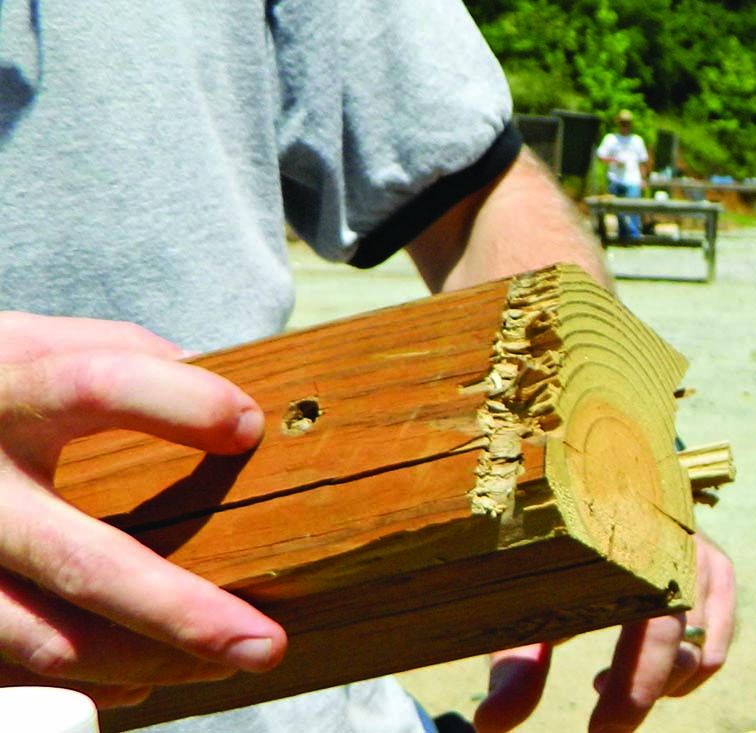
Pine Boards. These were once a universal testing medium, and they only measured penetration. One rater noted that the studs in a wall will be facing rather than length wise. The 4-by-4 posts were spaced 1 inch apart to allow dust and shavings to fall away from the projectile. One of the raters noted that all boards are not the same and that a quarter-sawed board would be denser and tougher. Besides gauging their effectiveness as a barrier in walls, our pine-board penetration results can also stand in for how bullets would do on solid-wood doors, but not lightweight interior hollow-core doors.
Overpenetration
The fear of a bullet carrying far past the area of a gun battle is real. Wounds received by innocent persons who happen to be in the wrong place at the wrong time are not uncommon. However, most of these occur in the open or on the street and are a result of missed shots, rather than overpenetration. Also, the great majority of gunshots are the result of criminals shooting victims and other criminals, rather than honest citizens protecting themselves.
So, incidents involving apartment dwellers and condo owners firing through walls and a bullet exiting the living space and causing damage, injury, or death are rare. The same is true for injuries caused inside the apartment. We believe this is because the vast majority of armed citizens are mature, conscientious individuals.
We looked at the whole picture and tested ammunition from several angles. We tested common personal defense ammunition that we had given good ratings to in the past and learned how they might fare in penetration testing against home materials. At this point, allow us to re-emphasize that carefully placing a bullet in an assailant allows the projectile to expand properly — and there will be no overpenetration problem. Working on marksmanship skills is the soundest advice we can give.
Beyond Marksmanship
Next, knowing the distance between one occupied structure and the next nearest one is helpful, because distance robs errant shots of power and trajectory, because we usually fire at an angled attitude, slightly up or slightly down and seldom perpendicular to the target. Thus, chances are the bullet will come to rest in something before it reaches another occupied apartment. The bullet may strike the ceiling, or it may dig into the floor.
Also, it’s important to realize how ridiculous cinema depictions of gun-battle participants using a chair or mattress for cover really are. Bullets zip right through these constructs. Some furniture may be heavy enough to turn a bullet, and the pine-board results are a good way to estimate those effects without having to shoot up the walnut dining-room table.
As for the difficulty of creating realistic test media, we noted that every test program we read in the popular press was inconsistent, with every author having a different idea of how to gauge the risks of overpenetration. As an example, one of the considerations never mentioned in the popular press is the existence of firewalls between walls in apartment complexes. Building and structural firewalls in North America are usually made of concrete, concrete blocks, or reinforced concrete. These structures are very good at stopping or slowing down bullets.
Pistol Cartridge Notes
Based on our results in this test, we would advise against using round-nose lead or full-metal-jacketed bullets for apartment defense, where overpenetration is always a worry. RNLs and FMJs are effective in the big bores, but the JHPs are more effective and ricochet is less of a concern. We noticed that RNL bullets sometimes bounced when fired into hard wood. Avoid these bullet designs except for cheap practice.
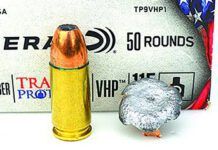
One point we want to advise you to consider is the choice of bonded bullets. As an example, a wide-mouth hollow point such as the 115-grain JHP used in Buffalo Bore’s +P 9mm load breaks up rather quickly when fired against cinder block and doesn’t penetrate as much in wood as the slightly different Buffalo Bore +P+ load. The +P+ load uses a bonded bullet design, which stays together, as is the intent. Regarding bonded-core bullets then, we need to carefully appraise our choices. For apartment defense, do we really need a bullet with high penetration against intruders behind wallboard? Generally speaking, what we found was that bullets on the short end in water testing are the least offensive in apartment-wall penetration. It is clear than the bonded bullets are designed for penetration of sheet metal and window glass and perform as designed.
We were also curious about how tougher materials, such as cinder blocks, would defeat bullet passage.These are most often found in a single layer attached to the outside wall of a frame building. Then wall studs, plywood, and insulation form the interior walls. We shot the blocks stacked in groups of four or more.
Another consideration is that when the bricks are in sections, mortar holds them together, and the support of the structure keeps them resilient. We also shot some exterior facing bricks, but didn’t record penetration data for either of these because it wasn’t measurable like the wallboard and pine boards were. However, we did collect our visual impressions of what various projectiles did to bricks.
The calibers below 38 Special only made small pock marks in the bricks. Beginning with the 38s, we saw damage. The 9mm and 45 ACP damaged bricks, but hardly enough to go through. After two to four shots, the bricks cracked. A single 357 Magnum took a large chunk out of a brick and often broke it. We found that one to two rounds in the same spot often broke the brick up and crumbled it. In the case of cinder blocks, the 45 ACP JHPs just made a pock mark and only part of the bullet penetrated on the first shot. The fast-stepping 9mms were much the same.
The 357 Magnum 110-grain loads did no more. The Remington 125-grain Golden Saber 357 Magnum struck the block three or four times without great effect, but it did well in previous water testing. The 158-grain Speer JHP 357 Magnum load made a large cavity in the block with the first shot and an opening into the hollow between the two sides of the block with the second shot, and sometimes with the first shot. The third shot with the Speer busted the block. This Magnum is just too much with heavyweight loads. The Winchester 230-grain FMJ 45 ACP also broke the blocks up with very few shots.
Our Team Said
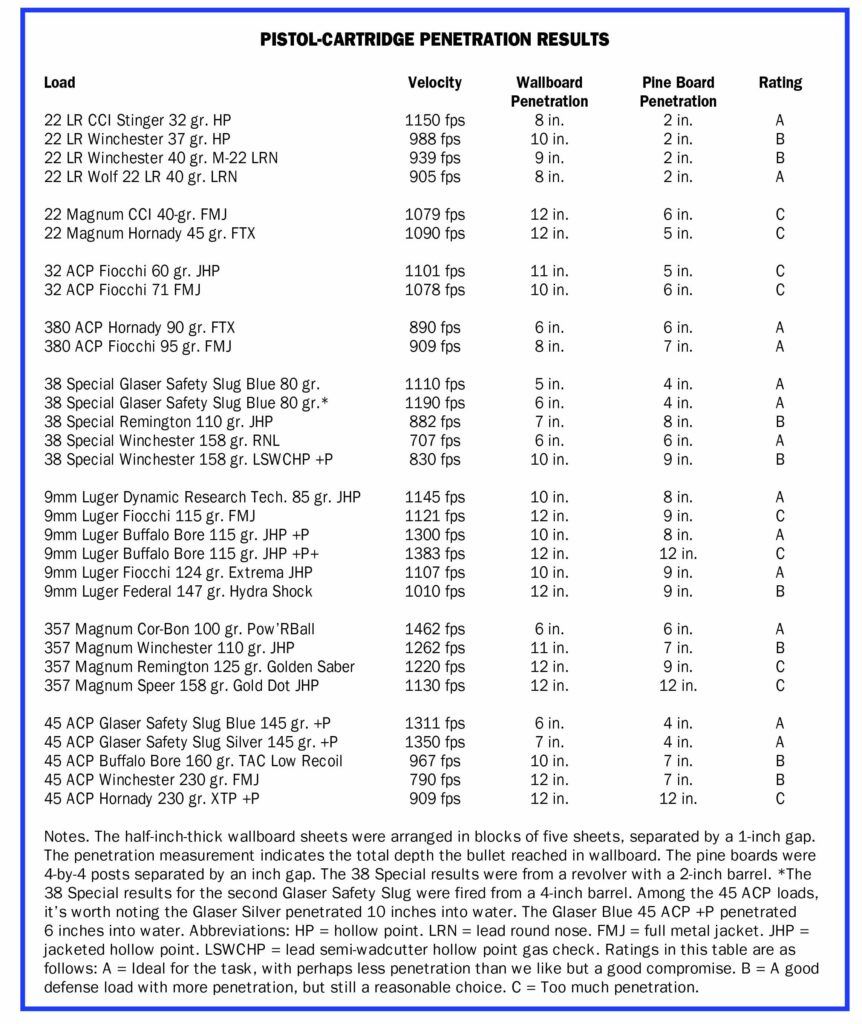
Most of the handgun loads proved capable of penetrating several house walls, as noted in the accompanying table. Since we’ve all been conditioned to think of penetration as the do-all and be-all of bullet performance, it’s hard to think backwards when penetration must be limited. Among the 22 LR rounds, we don’t recommend any for apartment self defense. But if your pistol of choice happens to be a 22 and you want to reduce your risk of overpenetration, we’d pick the CCI Stinger 32-grain hollow point. A better choice for an apartment-defense cartridge might be either of the 380 ACPs, the Hornady 90-gr. FTX and Fiocchi 95-gr. FMJ. There are good selections from the 38 Specials. The Glaser Safety Slug in 80-grain weight offered plenty of velocity but not as much penetration. The Winchester 158-grain lead roundnose is a similar performer in a more traditional form. The DRT 85-grain would likely be our first pick from the 9mm Lugers, but the Buffalo Bore 115-grain JHP and Fiocchi 124-grain Extrema JHP would be good choices as well. If you shoot the big 357 Magnum wheelgun, your lowest-penetration choice would be the Cor-Bon 100-grain Pow’RBall. Among the 45 ACPs, the Glaser Safety Slugs stand out.
If you choose a handgun for defense in your apartment or condo, we recommend getting competent training with it and practice shooting on a regular basis, including basic manipulation drills (racking, loading, safety manipulation, and so on), plus low-light shooting if it’s available to you. Also, we recommend getting instruction on the legal issues associated with lethal self defense. Training and practice will help you be better prepared to handle your gun safely and correctly if you’re ever required to use it.






I have been receiving your magazine for decades. I think I have every copy going back decades and I have used them as reference on several occasions. So I wanted you to know how much I appreciate your publication.
Thank you and keep up the great work.
Interesting and enlightening article. Thanks for doing this careful work. I have an oddball question regarding what some consider an oddball cartridge: the 7.62 x 25 mm Tokarev. The cartridge is flat shooting, accurate and powerful, and the pistol itself is slim, flat, and reliable, so quite a few are sold for self and home defense. The standard bottle-neck, pointy full metal jacket moves at close to 1,800 feet per second and has overpenetration concerns. However it is also available with jacketed hollow points. Might you do a penetration comparison between Tokarev FMJ, Tokarev JHP, and a common 9 mm?
Thanks! I live for the arrival of each issue. Unfortunately after two days I’ve read it all and have to wait for the next. That’s okay, it builds anticipation.
Interesting topic and very useful raw results, but I’m unclear on how your A, B, C ratings tie to your listed penetration results. Note the .32 ACP listing, for example: both loads rate a C for penetration numbers which are met or exceeded by numerous loads in the heavier calibers, whose higher numbers earn a B or even A rating.
Similarly, a 10 wallboard/ 8 pine board or a 10/9 value both earn an A rating in 9mm, but 10/9 or even 7/8 rates a B in .38 SPL. Within 9mm, 12/9 is rated as a B in one instance, C in another, and it’s a C in .357 Mag. The .22 Mag loads at 12/5 and 12/6 both rate C, but 12/7 is a B in .45 ACP (as noted, even 12/9 is a B in 9mm, except when it’s a C).
To me, your raw penetration values are very useful information. Your A, B, C ratings seem confusing.