









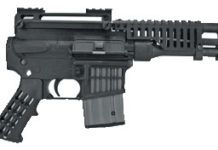
Olympic Arms OA 98 223 Rem
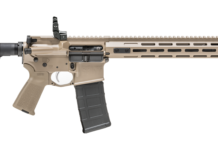
The design of the OA series of AR-15 type rifles connects to the OA 98 pistol. To accommodate a folding stock, Olympic Arms developed an upper that eliminated the need for a buffer tube. However, due to subsequent legal restrictions, folding-stock models such as the OA 93 and its cousins now feature fixed stocks, but these rifles still benefit from their minimal design and lighter weight. If you look at an OA-built AR-15 and imagine it without a stock, it is easy to visualize how the OA 98 pistol came into being.
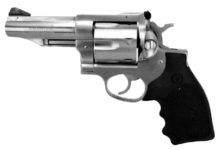
Ruger Redhawk KRH-444
Rugers $780 KRH-444 Redhawk was our top pick among three 4-inch .44 Magnum revolvers. Heres why. When Ruger engineers sought to make a more compact revolver, they did so by shortening the barrel and introducing a new grip. They left the frame alone. This meant the gun was plenty strong to take any punishment we could dish out.
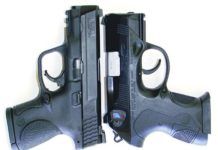
Smith & Wesson M&P40c Vs. Berettas Storm Compact Forty
What is there to say about two 40-caliber handguns that never stuttered? A lot. There are significant differences between the handguns that lead us to believe one is the superior defensive handgun, at least for our testers. When faced with an attack by a psychopath with no sense of the moral dimension of his crime, we wish to be as well armed as possible. Unfortunately, society frowns on an individual walking around with a shotgun slung over the shoulder. Or, a full-size service pistol may become a drag on the hip. This means that the compact handgun is a popular compromise. Among the most popular concealed-carry types is the compact 40 S&W pistol.
The term subcompact is applied to those handguns with both a short barrel and slide and a shortened grip, both of which have significant downsides. The shorter barrel generates less velocity. The shorter grip prevents an ideal firing grip. The smaller grip helps some shooters, but it depends upon the individual's hands and determination in practice. So to see how these and other performance factors are handled, we looked at a pair of subcompact handguns: The Smith & Wesson Military & Police Compact M&P40c 109203 40 S&W, which lists for $569, but which we found at CheaperThanDirt.com for $480. The Beretta Px4 Storm SubCompact JXS4F20FC 40 S&W was $511, also from CTD, with a list price of $582.
The primary difference between the two was their actions. The Smith & Wesson is a double action only. The trigger press is reset by the slide, and it is the same press for each trigger pull. The Storm features a double-action-first-shot trigger. A long press of the trigger fires the first shot. The slide cocks the hammer in recoil and the following shots are single action. Notably, the person using a double-action-first-shot handgun must learn two trigger actions. In our view, it takes less training time to master the DAO trigger, but there is an argument for the superior accuracy of the single-action trigger press.
Also notable, these 40-caliber handguns demonstrate more recoil than their 9mm counterparts, due to them expelling more bullet weight and bullet energy. In a self-defense scenario, we always want more energy on the target, if the shooter can put the bullet on the target. However, we recommend that anyone considering the 40-caliber compact handgun should take time to master the 9mm first. We found these handguns are significantly more difficult to use than 9mm compacts we've previously tested.
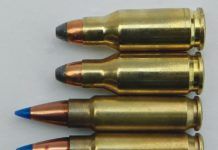
22-Caliber Centerfire Self-Loader Shoot-out: FNH Vs. Rock Island
In an intriguing and extensive match-up, we pitted two handguns chambered for hot 22-caliber bottlenecks against each other. The 22 TCM and the 5.7x28mm cartridges are interesting on many levels, but also are not the most common or easily obtained rounds. Both handguns have a military heritage, but the Rock Island 1911 is pretty far removed from its 1911A1 45 ACP ancestor.
The Fabrique Nationale Herstal FiveseveN IOM (hereafter 5.7) pistol was designed as a personal defense weapon (PDW) for military use. The 5.7x28mm cartridge was designed with the ability to penetrate light armor. Good accuracy and low recoil were important attributes. Comparatively, the original 1911 was designed to stop a man or a horse. The 1911 was designed as an all-out fighting handgun in close quarters. One gets the impression the 5.7 was intended for use at a greater standoff distance. The adaptation of the 22 TCM cartridge to the 1911 gives shooters longing for a hot 22-caliber centerfire something to use in a familiar platform.
In this test we asked lots of questions, including what are the goals of a shooter purchasing either firearm. The handguns were tested for reliability, accuracy, and fit and finish. Which system is the most controllable and accurate? Finally, which is the more practical, better buy?
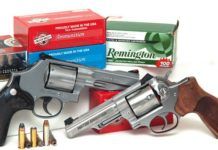
IDPA Revolvers: Rugers Match Champion, S&Ws Pro 686 SSR
If you believe the revolver is obsolete, think again. The double-action revolver is now more relevant than ever. Haven't you noticed the trend toward hinged triggers working the action of semi-automatic pistols? Based on developing trigger control, a double-action revolver may now be a more appropriate training device than the typical single-action-only rimfire pistols so often used to introduce beginners to shooting a handgun. The vast majority of double-action revolvers can also be fired single action simply by thumbing back the hammer. This accommodates the arthritic or partially disabled. In addition, you can utilize the same revolver to develop trigger control for single action as well as double action only and double action/single action handguns. Revolvers employ fixed barrels, making them inherently more accurate than semi-automatic pistols wherein the barrel and slide (including the sights) move in and out of position with every shot.
You can leave a revolver loaded for the life of the ammunition and, unlike a magazine-fed pistol, its ability to cycle rounds will not be affected by magazine-spring fatigue. Nor will the outline or shape of the bullets interfere with chambering. You can safely load frangible rounds, such as rat shot or snake-shot, without malfunction and even load a mix of both high-velocity and low-velocity ammunition, again without malfunction.
But our motivation for testing the Ruger GP100 Match Champion and Smith & Wesson Pro Series 686 SSR 357 Magnum revolvers is more exciting than any of the arguments above. These guns were designed to compete in the Stock Service Revolver division of International Defensive Pistol Association or, IDPA. Both revolvers meet the physical requirements to be eligible for SSR competition — a maximum barrel length of 4.2 inches or less and a maximum unloaded weight of 43 ounces or less. Stock Service Revolvers may have the capability to chamber additional rounds, but in competition, no more than six rounds may be loaded at any time.
Whereas these guns are recognized as 357 Magnum revolvers, their versatility allows them to fire 38 Special ammunition as well. And IDPA rules allow for the shooter to choose either caliber for competition. For our tests, we chose two rounds of 38 Special and one variety of 357 Magnum. Our 38 Special rounds were Remington 125-grain +P semi-jacketed hollowpoints and Black Hills 148-grain hollow-based wadcutter rounds. The Remingtons are an intermediate-power defense load, and the lead wadcutters are a popular target load commonly used in competitions that demand accuracy, such as NRA Action Pistol, PPC, and Bullseye. Our choice of magnum rounds was Federal 130-grain Hydra-Shok Personal Defense Low Recoil hollowpoint ammunition. To assess accuracy, we fired a series of five-shot groups single action only from a sandbag rest. Test distance was 25 yards. To determine average velocity, we fired shots from all six chambers across an Oehler Research Model 35P printing chronograph.

9mms: New Beretta 92 Compact Versus Used SIG Sauer P228
Two pistol makers that have knocked heads in police and military competitions for more than 30 years are SIG Sauer and Beretta. The Beretta 92 and the SIG P226 engaged in a hotly contested and much debated U.S. Military trial. After the dust settled, Beretta won that lucrative contract. However, the Navy did not accept the Beretta and instead adopted the SIG. American police agencies have used both in large numbers, with the SIG often hampered by a higher price. Recently, the French Army and police forces gave SIG the largest single peacetime order for handguns in history. Certainly, both makes enjoy enviable reputations. But at Gun Tests, all makers start on the same footing, reputation or not.
The raters were led toward this test by external factors. In one case, a family member was looking for a good, clean SIG P228 as a carry gun. Since the P228 is out of production, replaced by the heavier P229 or M11 A1, the SIG P228 would have to be a used gun. (Occasionally, a new-in-the-box P228 is seen at a premium.) The other instigator was an e-mail from Afghanistan. A young soldier told her father-in-law, I want a Beretta for my own when I get home! After two tours in Iraq and the tour in Afghanistan, this well-trained soldier had great respect for the Beretta. However, she did ask if there were a shorter, lighter version of the pistol.There is a compact version of the 92FS, but it is seldom seen. The question was, would the self-defense shooter be better off with the new Beretta or the used SIG, if each could be found within a few dollars of the other?
This would be a tough contest. Among our raters, one has over 20 years of police experience, including training several agencies on the SIG. Another is a military intelligence officer who has deployed the Beretta from Europe to the Pacific and just returned from 14 months with the Beretta as a daily companion. Other raters had experience with both pistols. So the deck wasnt stacked in favor of either handgun.
Common aspects of the guns include aluminum frames and steel slides. Each features a double-action first-shot trigger. Each features a 13-round magazine. Beyond those areas, lock-up differs. The SIG uses angled camming surfaces to unlock, and the barrel hood butts into the slide. The Beretta locks and unlocks via an oscillating wedge. There are differences in the decockers, and handling feels very different. Heres how our shooters rated them when the pistols were shot head to head:

(Shooters Bible Guide to Extreme Iron tip #1) – The .44 S & W...
Having been instrumental in the development of the .357 S & W Magnum, Elmer Keith once again turned the handgun world on it ear by playing a key role in development of the .44 Remington Magnum. His idea for the new cartridge emerged from his experiments with the .44 Smith & Wesson Special, which had been developed in 1907 as a replacement for the then-popular .44 Russian.
Although the earlier offering had a reputation for fine accuracy as a black-powder cartridge, its limited powder capacity was deemed unsuitable for the bulky smokeless powder available then. As a result, the .44 Special was designed with a significantly greater case capacity and stronger cartridge case.
Unfortunately, factory ammo merely duplicated that of the earlier cartridge, so it languished and never achieved much acceptance until it caught Keith's eye. Taking advantage of the larger and stronger case, Keith began stretching the .44 Special's pressure boundaries and achieved impressive results.
Armed with his .44 Special test data, Keith approached Smith & Wesson about offering a commercial version of his high-pressure loads along with revolvers chambered for it. Smith & Wesson eventually was persuaded and collaborated with Remington to develop a new cartridge based on the .44 Special.
As with the earlier .357 Magnum, the new cartridge named .44 Remington Magnum, was designed to be slightly longer than the parent round to prevent it being loaded in revolvers chambered for the .44 Special.
The first Smith & Wesson .44 Remington Magnum revolver was built in December 1955 and publicly announced in January 1956. Meanwhile Sturm, Ruger & Co. was not asleep at the switch. After a Ruger employee had found discarded, fired .44 Mag brass, the company did a bit of research and quickly adapted their Blackhawk revolver to the new round and put it into production. As a result, Ruger Blackhawk .44 Magnum revolvers actually reached dealer shelves a few weeks before Smith & Wesson's new .44.
For the rest of the story of .44 Magnums as well as other hand cannons, purchase Shooter's Bible Guide to Extreme Iron from Gun Tests.
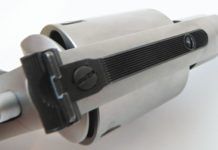
Big-Bore Snubnose Revolvers In 44 Magnum and 41 Magnum
To make an S&W N-Frame revolver into a compact carry gun means reducing the revolvers barrel length and grip. Whats left is still a large frame and cylinder that holds six cartridges. It is big metal, compared to an S&W J-frame, Ruger, or Taurus compact revolver normally used for concealed carry. The N-frame is renowned for its strength and has three safety features built into the mechanism: a hammer block, rebounding hammer, and hammer stop. All three safety features work unseen inside the frame and under the sideplate and make the revolvers very safe, guarding against accidental discharge from being dropped on a hard surface or a hammer slipping out from under a thumb. All of the N-frames tested were derived from the classic S&W Model 29.
The Model 29, along with the 44 Magnum cartridge, debuted in 1955 due to Elmer Keith arm twisting and convincing Smith & Wesson that shooters needed a more powerful revolver cartridge. Keith was a gun writer, outdoorsman, and big-bore revolver aficionado who hand-loaded the 44 Special to its maximum potential. His theory was to push heavy bullets at high velocity. Bullets designed by Keith, often referred to as Keith-style semi-wadcutters, feature a wide nose and convex sides. They also allow more powder to be loaded into the case. These bullets, when loaded properly, are a benchmark in power and penetration. We actually tested some Keith-style bullets loaded by Buffalo Bore for this report.
Keith had tremendous input on developing magnum cartridges for revolvers and also had his hands in the development of the 41 Magnum, which was introduced in 1963 as a cartridge to bridge the gap between the 357 Magnum and 44 Magnum. The 41 Magnum has more power than the 357 and less recoil than the 44 and was designed with law enforcement in mind, though it did not have a big impact on the LE market. Hunters, however, found the cartridge was plenty powerful for medium-size game, including black bear. The 41 Magnum is similar to the 16-gauge shotgun in terms of compromising power and recoil as well as popularity. Both have strong but small followings, and in the 41 Magnum we can see why from our range sessions.
Since its introduction, the Model 29 has gone through numerous design changes that are reflected in the - model names found in these variants model numbers. Stainless-steel models have a 6 prefix in the model number; those built from scandium alloy have a 3 prefix in the model number.
If carrying around a huge revolver for everyday concealed carry literally sounds like a pain in the hip, consider this: For everyday carry, Keith wore a Model 29 with a 4- or 5-inch barrel. He was a man of small stature but great influence. Before Hollywood discovered the Model 29 and made Clint Eastwoods Dirty Harry character synonymous with the big bore, long barrel revolver, Keith lived it. Eastwood played it.
To live it means to carry it, and that is what we did with the four revolvers in this test. They are all six-shooters, have 2- or 3-inch barrels, small compact grips - except for one model - and are chambered in bone-bashing 44 Magnum or 41 Magnum. Real power, real recoil. Not for the faint of heart nor faint of recoil. If Elmer and Harry can carry around long-barrel variants, we figured these compact versions would be easier and more convenient for concealed carry. After shooting, with hand palms aching and lots of big holes in the targets, the team felt one model would really make your day, offering a good combination of features in a big-bore compact revolver for daily concealed carry.
Prior to testing, we ran Brownells revolver range rods (080-617-044WB, Rod Combo for .44/44 Mag., $40; 080-617-041WB, Rod Combo for .41, $40) down the bore of each revolver to check chamber alignment. We checked the gap between rear of cylinder with Brownells Go/No Go 60/68 Cylinder Gauge (080-633-668WB, $36). We assumed that since these were new or LNIB, they would pass and they did.
(Gunsmithing Pistols and Revolvers #3) – Keep it Clean
Do you want to know the best-kept secret of the professional gunsmith? No deep learning, no years of practice, just one little thing to keep in mind: Ninety percent of the handguns that show up for work simply need a good thorough cleaning and proper lubrication, and their "problems" were solved. And the rest of the problems? Most of them could have been avoided with one good cleaning each year after hunting season. In fact, it was the lack of cleaning on the part of hunters that drove me out of general commercial gunsmithing. It got to the point where I just couldn't stand the thought of another season spent hosing the gunk out of an endless parade of Remington 1100s and 742s. At that time I was working on nearly a thousand firearms a year, and I could count on seeing a couple of hundred 742/7400 and 1100/11-87 Remingtons in each pre-season rush. Yes, the money was good, but not if it drove me to drink. I now clean only my own firearms, and am much happier for it.
Rusted surface that requires re-bluing? Cleaning it after the rainstorm the last day of hunting season should have prevented that.
Broken extractor? Maybe, if the chamber hadn't gotten so crusty that the extractor was stressed, it never would have broken.
Failure to feed in an auto? Groups getting so large that scores are dropping off? Scrub out the pistol, keep the bore clean and these problems won't occur.
For the author's advice and instruction on the best way to clean your pistols and revolvers, purchase Gunsmithing Pistols and Revolvers from Gun Tests.
(Gunsmithing #2) Using a Mill to Adjust Your Sights
A neat trick you can do with a mill is to adjust front and non-adjustable rear sights. Say your pistol is hitting low and you want to adjust it. The calculation involves four figures: the amount you need the bullet moved on the target, the distance to the target, the sight radius of your handgun, and the amount of correction of the sight blade. The ratio of the bullet correction to the distance to the target is equal to the ratio of the sight correction to the sight radius. An example: a pistol with a sight radius of 6 inches is hitting two inches low at 25 yards. Convert the yards to inches, and we have 2/900 = C/6, where C is the correction to the front sight. Multiply both sides by 6, and we get 6 X 2/900 = C. Thus we find that our correction will be to mill 0.013 inches off of the top of the front sight.
Another way to the same thing is what a friend of mine does: he checks all handgun sight-in at 28 yards. Why 28 yards? Because it is close enough to 1,000 inches (1008 to be precise) to make the math easy. Simple, any error on the target, in inches, times the weight radius, is his correction on the weights. A one-inch error at 28 yards, on a six-inch sight radius means .006 inch of correction.
How to make the correction: Clamp the slide in your mill vise, level it, and then dust off the top of the front sight by the calculated amount. De-burr, old blue and you are done.
If you are hitting too high, and your fixed rear sight has enough metal, you can do the same thing to the rear sight with one extra step. After you have dusted off the top of the rear sight with your end mill, switch to another end mill the same size as rear sight notch (usually .125 inch) and deepen the notch by the same amount you had just lowered the top of the rear blade. If you didnt do this the notch in your rear sight would be shallower than it was before you stated. When you de-burr the edges of the rear sight, be sure to slightly round the corners on the outside, so you wont cut your hands handling the pistol. Cold blue the exposed steel, and you are done.
You can do the same job with a file, but you must be very careful. Even the slightest tip in your angle of filing will leave the front sight top angled. A visible angle on the top of the sight makes aiming difficult. If you plan to file, file to a depth short of the required depth. Then carefully, and with the finest file you have, file down to the required depth. Check your work regularly, to make sure you are filing evenly.
For more detailed advice on adjusting your pistols and revolvers, purchase Gunsmithing Pistols and Revolvers from Gun Tests.
The Long and Short of Removing Metal
Just as pencils have erasers to remove excess letters and words, so the pistolsmith must have something to remove excess metal. The bench grinder and mill are your large erasers. Using power tools you can remove large amounts of metal readily, or small amounts quickly. The mill also allows you to remove exactly-known amounts. Files, stones and emery cloth are your small erasers for fitting parts, smoothing engagement surfaces or polishing. They can be found in every gunsmithing shop as well as other machine shops in the country.
If you already have these had tools at home, they are likely to be of the common household variety. The file is coarse and usually rusty. The sandpaper is rough and made for sanding wood. Most stones I have seen around friends houses are worn, uneven and clogged with gunk. Suitable perhaps for sharpening a hunting knife (but often not even that) and entirely unsuited to the task of stoning a firearms part.
Files for your handgun must be much finer than the files intended for sharpening the lawnmower blade. Pistolsmithing files are precision tools. As such, you should treat them kindly, and never loan them. You will find that files and rasps intended for cabinet making, stock making and other woodworking tasks are too coarse. The finest-cut common wood file is too coarse for mch use on metal. However, if you buy files that are too fine, youll have to do more work (each pass will remove less metal than a coarser file would) but on the plus side you will be hard-pressed to file too much metal. At a bare minimum you will need two large files, one minimum file and a set of small ones. First, purchase an extra narrow pillar file in the Swiss #2 cut. This file, 8 inches long and just over -inch wide, is narrow enough to maneuver into and around your work, large enough to hold comfortably, and cuts smoothly enough that with the right touch will produce a near-finished or finished surface. If you cannot find them at a tool store in your hometown, Brownells carries them. I have used so many and been so pleased with each of them that I refer to it as the perfect file. It does have a drawback, and that is its flexibility. It will bend while you work with it and you have to watch out for unwanted rounding of your cut surface because of this flex.
For more detailed advice on files and other tools and techniques for smithing your pistols and revolvers,purchase Gunsmithing Pistols and Revolvers from Gun Tests.
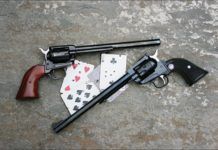
22 Buntlines: Heritage Rough Rider and Ruger NM Single-Six
A Buntline is commonly known as a Single Action Army (SAA) revolver with a barrel of 12 inches or more. They are mostly associated with Wyatt Earp of the gunfight at O.K. Corral fame and Ned Buntline, where the revolver gets its name. Buntline was a dime novelist who penned Western sagas about cowboys, outlaws, and other gunfighters. It is agreed that much of Buntlines writing was more fiction than fact, so if Ned could take some poetic license, so did we calling these long-barrel rimfires Buntlines. The Heritage Manufacturing Rough Rider and Ruger New Model Single-Six Convertible are scaled down Buntlines with 9-inch barrels - the Ruger actually has a 9.5-inch barrel. After the team stopped yukking it up about the odd-looking long-barreled revolvers and saying things like: You need to tie a red warning flag to the end of the barrel or You need to move the target out a few more yards, the muzzle keeps hitting it or Were going to need a longer range rod, we all got back to our senses and found a lot to like in these long-barreled rimfires.
Both revolvers are blued, single action and came with two cylinders, one for 22 LR and one for 22 WMR. One thing to be aware of with a 22 rimfire convertible revolver is that the bore diameter for a 22 LR and a 22 WMR are different. Nominal dimensions are .220 for the 22 WMR, and .217 for 22 LR. Generally speaking, the 22 LR is more accurate than the 22 WMR, and there tends to be more consistent velocity and pressure on the LR rounds.