


















Lever-action rifles are part of Americana, with many qualifying as American icons. From The Rifleman on television to the Wild West shows of Buffalo Bill, lever-action rifles are instantly recognizable. While most shooters probably think of the lever gun as a 30-30 Winchester chambering, rimfire variations on the theme are also very popular. Many rimfire leverguns feature traditional wood stocks, blued finishes, and barley-corn open sights, but a newer breed of lever-action rimfires feature synthetic stocks and modern sights, even Picatinny rails. Manual safeties and large-loop cocking levers are also common.
In this shoot-out, we test two of the most recent introductions in the lever-action rimfire world. The Rock Island Armory TM22-LA-20, $300, is a modern-looking rifle with synthetic stock and Picatinny optics rail, as well as a detachable-box magazine. The Savage Revel Classic 46000, $400, is a traditional rifle with a nice glossy stock and deep blued finish, but it’s made with modern manufacturing techniques.
We fired both with a variety of 22 Long Rifle ammunition, including Winchester Super Speed HP 37-grain hollow points, CCI Standard Velocity 40-grain LRN rounds, and Federal’s Auto Match 40-grain LRN cartridges. Here’s what we thought:
Rock Island Armory TM22-LA-20 22 LR
$300
Gun Tests grade: B
The Rock Island proved accurate, reliable, and easy to handle. Sights could be adjusted for elevation, but not windage. It easily accepts an optic. The rifle is more accurate than the Savage, indeed more accurate than most rimfire rifles in the price range. The 10-round detachable magazines are easily loaded. We were ambivalent concerning the safety system, but in the end, it was not the impediment we thought it would be.
| Action Type | Lever, exposed hammer |
|---|---|
| Overall Length | 38.5 in. |
| Barrel Length | 20.0 in. |
| Barrel Twist Rate | 1:16 |
| Overall Height | 4.5 in. |
| Weight Unloaded | 6.5 lbs. |
| Weight Loaded | 7.1 lbs. |
| Receiver | Matte-black anodized aluminum alloy |
| Barrel | Matte-black Parkerized carbon steel, threaded muzzle |
| Magazine Capacity | 10 |
| Magazine Type | (2) Detachable box |
| Magazine Price | $27, optional 25-round |
| Stock | Synthetic |
| Stock Buttplate | Rubberized |
| Stock Length of Pull | Adj., 13.25 to 13.75 in. |
| Front Sight | Post with bead |
| Rear Sight | Adjustable ramp |
| Sight Radius | 17.75 in. |
| Trigger Type | Single action, curved |
| Pull Weight | 5.25 lbs. |
| Manual Safety | No manual safety |
| Warranty | Limited lifetime |
| Telephone | (775) 537-1444 |
| Website | Armscor.com |
| Made In | Turkey |
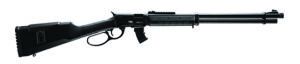
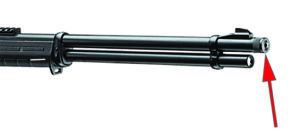
This rimfire is a lever action with modern features. As its name suggests, the TM22-LA-20 features a 20-inch barrel. The muzzle is threaded for a suppressor. This is an advantage over the Savage. While the Rock Island rifle’s 1.5-inch-longer barrel may provide greater velocity with some loads, the difference isn’t significant — between 4 fps and 23 fps on our chronograph.
The RIA has a 10-round detachable magazine. A 25-round magazine is offered as an aftermarket accessory. A fake tubular magazine is part of the Rock Island design to maintain its (slightly) traditional appearance. While it isn’t functionally necessary, all the testers agreed the rifle would look odd without it. The fore end is a black-polymer tactical type with three pebbled inserts on each side. The fore end treatment offers plenty of adhesion and abrasion for any firing drill. Sling loops are molded in front and rear to the fore end and stock. The forward sling loop is synthetic, and a metal sling loop sits at the rear. A traditional barrel band is used just in front of the fore end.
The front-post sight is removable and is held in place by a single screw. The post features a tiny brass insert that was easily seen in bright light. While tiny and sometimes unnoticed indoors, this shooting aid was a definite advantage during outdoors use. The rear sight is adjustable for elevation. A single set screw allows cranking the rear sight up and down for elevation adjustment. More important, the RIA features a Picatinny rail. Everyone mounts optics these days, and the RIA accommodates a range of red-dot sights.
The rear portion of the stock is nicely designed with a pebbled, roughened surface above the cocking lever and a credibly designed butt pad. This recoil pad was the subject of some discussion. One tester likened it to a truck-tire tread, while another said it resembles a climbing-boot sole. For certain, the tread isn’t going to allow the butt plate to slide off the shoulder. Another excellent feature is an adjustable cheek riser. Most lever guns have a stock designed for iron-sight use. This riser allows the shooter to adjust the stock’s height for better optical-sight use. There is also a stock spacer that can be removed by taking out a screw from the butt plate. We did not remove the stock extension because the testers are adults; however, it may be beneficial to some shooters. If removed, the spacer shortens the length of pull by about a half inch.
lever actions.
Either rifle is fine for left-hand use. The rifles eject to the right, but we never had cases in our faces when firing with the left hand because the ejection port is far forward. The Rock Island rifle may be classed as the more left-hand-friendly overall because the Savage Revel’s safety is seemingly intended for right-handed shooters. Still, a left-handed tester simply broke his firing grip to manipulate the Revel safety without difficulty. But firing left-handed, we had no difficulty with the RIA by using the right hand to break the fore end grip and operate the magazine release. Right or left hand, the RIA demanded the shooter’s firing grip be broken to manipulate the magazine release.
Moving to the action, we found a conventional lever rifle. The bolt is enclosed in the receiver in Marlin style, rather than a Winchester open-bolt style. Like most rifles of this type, lever throw is quite short and rapid. The lever isn’t a large-loop type, but neither is it the conventional lever-action cocking handle. We thought it was just large enough to be handy for most uses.
The first bone of contention in the test arose over the RIA safety system. There is no manual safety, which the testers liked just fine. Simply manipulate the lever, lower the hammer by grasping the serrated hammer spur with the thumb, then press the trigger while lowering the hammer. There is also a spring-loaded plunger-type lever safety in the lower tang just behind the trigger. The trigger is blocked until the lever is fully pressed into place. If dropped, the safety lever would prevent the trigger from bouncing and releasing the hammer. Some of the testers did not like this safety at all. They felt it prevented easy shooting. On the other hand, another tester fired off 10 cartridges in rapid fire and never missed a shot, while occasionally some of our testers would not fully close the lever and could not fire the rifle. This did not occur in live fire after we got used to the gun. It is a worthwhile feature on a rimfire rifle. The trigger is a curved type typical of lever-action rifles. Trigger press is a fairly clean, but too heavy, 5.25 pounds. Reset is clean and audible.
The magazine system is different than most other rimfire lever-action rifles. The rifle is supplied with two polymer 10-round magazines. (We noticed at this point that the company’s specifications for the TM22-LA-20 noted that the rifle had aluminum magazines and a flat trigger.) These magazines proved easy to load to full capacity. The slide-lever-type magazine release is positive in operation. The end of the magazine release closest to the trigger is pressed inward to release the magazine. The magazine prevents the bolt from moving forward after the last round is fired. It was perhaps a bit more difficult to shoot from the bench rest, but this is a consideration with any box-magazine-fed rifle.
We fired the rifles as quickly as possible during several range shooting sessions. The RIA had no failures to feed, chamber, fire, or eject. We never failed to fully depress the safety lever after the initial try. It wasn’t difficult to get used to because the lever action invites snapping the lever closed.
At the range, we noted the rifle was dead on for windage, which was great because there wasn’t a means to adjust it, other than holding left or right. Elevation was high from the factory, but this was easy to adjust by running the elevation screw down. We plinked at range debris and dirt clods in informal shooting from 15 to 50 yards. The testers confirmed the rifle would be useful for popping pests and taking predators well past 50 yards.
We fired both rifles for accuracy in two steps. First, we shot the RIA from a solid benchrest at 25 yards using the Winchester 37-grain hollow points, Federal Auto Match loads, and CCI 40-grain rounds into five-shot groups. Most of the groups were under an inch, with some groups as small as 0.55 inch. The rifle was about twice as accurate as the Savage with two loads, despite the heavier trigger action of the TM22-LA-20. Then at 50 yards, because we could see the Rock Island Armory rifle’s sights much better than the Savage’s, the RIA was between 0.75 and 1.85 inches more accurate than the Revel. Most of the RIA’s groups were smaller still, but we shot a single flyer each time that was almost certainly caused by the heavy trigger. Most groups were in the 3-inch range. This is still useful, but many 22 rimfire rifles are easily in the 2-inch range for five shots at 50 yards.
Our Team Said: When you look at the whole picture, the Rock Island Armory TM22-LA-20 lever action has certainly been modernized above the Savage’s feature set. The RIA offers a modern black-tactical appearance and practical utility with magazines, a threaded barrel, a Picatinny rail for easy optics mounting, and a modern stock with good adjustment, including a cheek rest. Its accuracy was also superior to the Savage Revel’s. However, we also rated the RIA down based on accuracy that was not on par with other rifles we have tested, and we didn’t like the heavy trigger.
| 22 LR RANGE DATA | ||
|---|---|---|
| CCI Standard Velocity 40-grain Lead Round Nose #35 | Rock Island Armory TM22-LA-20 | Savage Revel Classic |
| Average Velocity | 1222 fps | 1202 fps |
| Muzzle Energy | 133 ft.-lbs. | 128 ft.-lbs. |
| Small Group @ 25 Yards | 0.6 in. | 1.2 in. |
| Average Group @ 25 Yards | 0.8 in. | 1.6 in. |
| Average Group @ 50 Yards | 3.0 in. | 4.25 in. |
| Winchester Super-X Super Speed HP 37-grain Copper-Plated Hollow Point X22LRHSS1 | Rock Island Armory TM22-LA-20 | Savage Revel Classic |
| Average Velocity | 1244 fps | 1221 fps |
| Muzzle Energy | 127 ft.-lbs. | 122 ft.-lbs. |
| Small Group @ 25 Yards | 0.65 in. | 1.25 in. |
| Average Group @ 25 Yards | 1.25 in. | 2.25 in. |
| Average Group @ 50 Yards | 2.75 in. | 4.6 in. |
| Federal Auto Match 40-grain LRN AM22 | Rock Island Armory TM22-LA-20 | Savage Revel Classic |
| Average Velocity | 1119 fps | 1115 fps |
| Muzzle Energy | 111 ft.-lbs. | 110 ft.-lbs. |
| Small Group @ 25 Yards | 0.55 in. | 1.2 in. |
| Average Group @ 25 Yards | 1.3 in. | 2.0 in. |
| Average Group @ 50 Yards | 3.25 in. | 4.0 in. |
To collect accuracy data, we fired three-shot groups from a bench using an MTM Case-Gard K-Zone rest. Distances: 25 and 50 yards. We measured velocities with a Competition Electronics Pro Chrony, with the first screen 10 feet from the muzzles.
Written and photographed by Bob Campbell, using evaluations from Gun Tests Team members. GT