








Lever-action repeating rifles were originally designed to shoot cartridges with flat-nose bullets because those rifles used tubular magazines. Because cartridges rest on each other from bullet tip to primer, flat- and round-nose bullets are safe in a tubular magazine. Metallic spitzer or pointed bullets in a magazine tube are not safe. For this reason, tubular-magazine lever-action rifles were long hamstrung by the rounds they were chambered in, until the advent of soft-tipped spitzers. But much earlier, Winchester and Savage innovated the lever-action design in 1895 with the Model 1895 and Model 95, respectively, designing rifles capable of shooting spitzer cartridges using a fixed box magazine in lieu of the standard tubular magazine.
Browning brought the concept to different level in 1971 when the BLR (Browning Lever-action Rifle) was introduced. The BLR was designed to fire many short- or long-action hunting cartridges from 22-250 Remington up to 300 Winchester Magnum. So nearly any hunting cartridge available in a bolt-action rifle was also available in the BLR. Then, in 2016, Henry Repeating Arms debuted the Long Ranger, a rifle similar to the BLR, and chambered in four popular hunting chamberings ranging from 223 Remington up to 308 Winchester. And this is where our latest lever-action match up begins, pitting a Browning BLR against the Henry Long Ranger in rifles chambered in 243 Winchester. Both feature a detachable box magazine, straight-grip wood stock, use a rack-and-pinion-geared lever and bolt design, sport a 20-inch barrel with iron sights, and are drilled and tapped for an optic. They weigh in at about 6.5 to 7 pounds without an optic.
We reviewed these lever actions for accuracy at 100 yards and fired them off hand to see how fast we could deliver a follow-up shot using a variety of hunting ammo, with bullets weights ranging from 90 to 100 grains. Ammo consisted of Sierra GameChanger with a 90-grain GameKing bullet, Remington Core-Lokt with a 95-grain Core-Lokt tipped bullet, and a 100-grain Power Point bullet from Winchester Super X. We wanted to see if we could reverse some of the pontificating from some bolt-action-rifle hunters who say that lever-action rifles are not nearly as accurate as bolt-action rifles. We’ll concede that a lever-action rifle is stretching its envelope of accuracy at 200 yards, but most deer, pig, and black-bear hunters typically harvest animals within 100 yards or less. You don’t need a tack-driver at that range, when minute-of-deer accuracy is sufficient. The accuracy we found with both the Browning and Henry, however, were surprises. Some groups showed sub-minute-of-angle accuracy, less than a 1-inch group at 100 yards. Would we feel undergunned with the Henry or Browning in a tree stand on opening day? Not a chance. In fact, we know we could deliver a follow-up lever shot faster than any hunter cranking a bolt-action rifle, and that is venison in the freezer. These rifles are excellent short-to-medium-range hunting rifles. While we liked both, we did notice differences between the two rifles. One offered eyebrow-raising accuracy, and one had a trigger that gave us the creeps. Here are the details.
Browning BLR Lightweight ‘81 034006111 243 Winchester,
$1020
Gun Tests grade: B+
The BLR is a classic lever action with modern features like an integrated trigger and lever. The trigger pull could have felt less creepy and should be lighter.
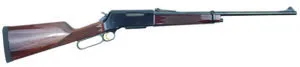
| Action Type | Lever, exposed hammer |
|---|---|
| Action Length | Short |
| Overall Length | 40.0 in. |
| Barrel | 20.0 in. long, 1:10 twist |
| Weight Unloaded | 6.5 lbs. |
| Weight Loaded | 6.63 lbs. |
| Magazine | 4-rd. capacity, detachable |
| Action | Polished blued aluminum alloy |
| Barrel | Polished blued steel |
| Stock | Glossy black walnut, straight grip 18-lpi cut checkering, barrel band |
| Stock Length of Pull | 13.7 in. |
| Stock Drop at Comb | 1.7 in. |
| Stock Drop at Heel | 2.5 in. |
| Stock Buttplate | Textured rubber |
| Sight Radius | 18.2 in. |
| Sight Front | Post |
| Sight Rear | Adjustable |
| Scope Mount Provision | Drilled and tapped receiver |
| Trigger Pull Weight | 7.9 lbs. |
| Safety | Folding hammer |
| Warranty | None stated |
| Telephone | (800) 333-3288 |
| Website | Browning.com |
| Made In | Japan |
The BLR has been in constant production since 1971 and has a reputation as a smooth-cycling lever action compatible with a range of hunting calibers. It uses a rack-and-pinion geared lever and bolt design with a rotating bolt that locks into the barrel, making the design robust for powerful centerfire cartridges. It also makes the lever easy and smooth to cycle. It feels and handles differently than a traditional lever action. Unique to the BLR design is the trigger, which is built into the lever and travels with the lever, eliminating the risk of pinching your finger against the trigger while cycling the lever. The BLR cycled nicely and would not jam, even when we cycled the lever slowly. The lever throw is about a 50-degree arc, so it is quick to operate from the shoulder for a fast follow-up shot. The trigger pull, in our opinion, was the weak spot in an otherwise nice set up. Talk about a creepy trigger. It took 7.8 pounds of effort to fire the BLR. That is really unacceptable to us, especially in a rifle that costs more than $1,000. But let’s first talk about what we liked about the BLR and then get into the range data.
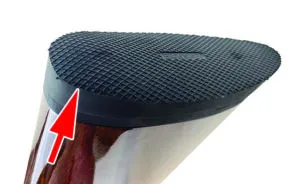
The BLR wore a nice piece of wood with a shiny gloss finish typical of many Browning rifles. The metal finish was a polished blue. The trigger was gold plated, and the trigger guard on the lever was engraved with a gold-filled Buckmark logo. It was a nice-looking rifle, and there was no doubt it has a Browning pedigree. A polymer barrel band around the barrel and the fore end gives the BLR a traditional look of a lever action. The recoil pad was rubber and was mostly snag-free on clothing when shouldering the rifle.
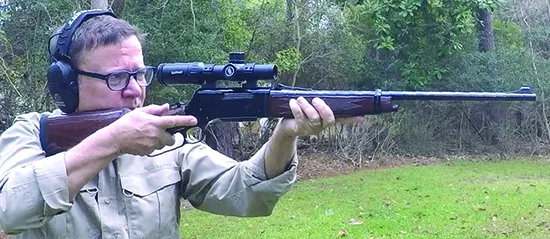
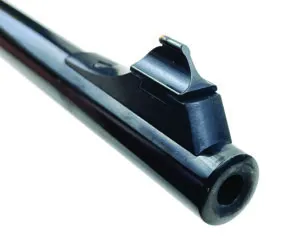
The barrel is fitted with iron sights, but we opted to mount an optic. We put on a Bushnell R5 1-6x24mm scope ($220) using Browning 30mm medium-height integrated scope mounts ($55). The Bushnell is a low-powered-variable-optic scope with half-minute click values and a second focal plane reticle that allows for fast engagement with both eyes open as well as more-deliberate precision shots. The recipe is combination of a German No. 4 reticle and an illuminated segmented circle-dot. The illuminated segmented circle allows you to quickly range distance. It’s glass is clear, and the picture is sharp. Not as sharp as higher-price-point scopes, but decent for the price. It comes with flip-up caps. A throw lever was the only thing missing.
Back on the rifle, the hammer has three positions: fully forward, half cock, and full cock. In the half-cock position, a manual safety feature is built in, allowing the top of the hammer to be rotated forward so that the front of the hammer cannot contact the rear of the firing pin. That’s the only manual safety built into the BLR.
The box magazine fit nearly flush with the bottom of the receiver. The release is located forward of the magazine well in a generously cutout area that is glove friendly. When operating the mag release, your hand is under the magazine, so the magazine drops in your hand when pressed. In 243 Winchester, the magazine holds four cartridges. The magazine inserted easily into the magwell. You can also drop a round through the ejection port on an empty magazine and rack it into the chamber. Ejection was strong, and there were no issues encountered.
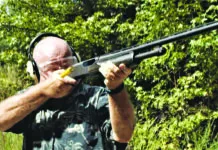
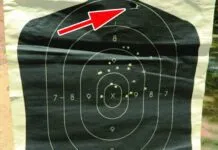
At 100 yards, the smallest three-shot group measured 1 inch, and this was with Remington 95-grain Core-Lokt ammo. Average was 1.40 inches. Coincidentally, the 100-grain Winchester and 90-grain Sierra ammo had best groups that both measured 1.40 inches. The average with the Winchester ammo measured 1.70 inches, and the average with the Sierra measured 1.68 inches. Not bad for a lever-action rifle. We blame some of the accuracy issue on the creepy trigger. The barrel is not free floated on the BLR, though some owners have glass-bedded the barrel in the fore end for better accuracy. The barrel was allowed to cool between strings, but the fourth and fifth shots started to drift away from the cluster of the first three shots as the barrel started to heat up. Three shots is plenty when deer hunting, and accuracy was fine for hunting. The 243 Winchester is a soft-recoiling round especially in the 6.5-pound rifle. Firing the BLR off hand, we found the rifle to be lightning fast on a follow-up shot at an 8-inch paper plate at 50 yards. There is no fear of jamming your trigger finger, and at 1x power, we easily reacquired the reticle and the target. The hammer spur is wide, making it easy and safe to cock and uncock the hammer, even with the scope eyepiece above it.
Our Team Said: The BLR is an iconic Browning rifle with a smooth-cycling lever. We like that the trigger travels with the lever as well as the short throw of the lever. We did not like the creepy trigger, which soured many team members on the BLR. Still, the accuracy we obtained with the BLR means we would fill our tags come hunting season.
| 243 WINCHESTER RANGE DATA | ||
|---|---|---|
| Remington Core-Lokt 95-grain Core-Lokt Tipped | Browning BLR | Henry Long Ranger |
| Average Velocity | 2922 fps | 2934 fps |
| Muzzle Energy | 1801 ft.-lbs. | 1815 ft.-lbs. |
| Smallest Group Size | 1.00 in. | 0.90 in. |
| Average Group Size | 1.40 in. | 1.24 in. |
| Winchester Super X 100-grain Power Point | Browning BLR | Henry Long Ranger |
| Average Velocity | 2713 fps | 2966 fps |
| Muzzle Energy | 1635 ft.-lbs. | 1953 ft.-lbs. |
| Smallest Group Size | 1.40 in. | 0.83 in. |
| Average Group Size | 1.70 in. | 0.92 in. |
| Sierra GameChanger 90-grain GameKing | Browning BLR | Henry Long Ranger |
| Average Velocity | 3087 fps | 3051 fps |
| Muzzle Energy | 1905 ft.-lbs. | 1860 ft.-lbs. |
| Smallest Group Size | 1.40 in. | 0.50 in. |
| Average Group Size | 1.68 in. | 0.64 in. |
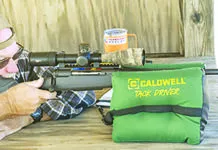
To collect accuracy data, we fired three-shot groups from a bench using a rest. Distance: 100 yards with an optic. Velocities and energies were recorded using a Garmin Xero C1 Pro chronograph.
Written and photographed by Robert Sadowski, using evaluations from Gun Tests Team members. GT