





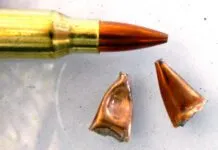




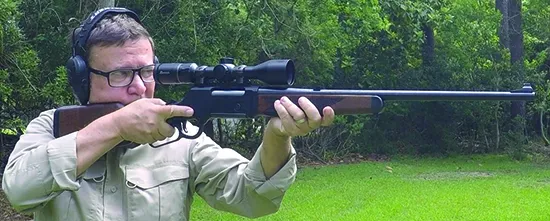
Lever-action repeating rifles were originally designed to shoot cartridges with flat-nose bullets because those rifles used tubular magazines. Because cartridges rest on each other from bullet tip to primer, flat- and round-nose bullets are safe in a tubular magazine. Metallic spitzer or pointed bullets in a magazine tube are not safe. For this reason, tubular-magazine lever-action rifles were long hamstrung by the rounds they were chambered in, until the advent of soft-tipped spitzers. But much earlier, Winchester and Savage innovated the lever-action design in 1895 with the Model 1895 and Model 95, respectively, designing rifles capable of shooting spitzer cartridges using a fixed box magazine in lieu of the standard tubular magazine.
Browning brought the concept to different level in 1971 when the BLR (Browning Lever-action Rifle) was introduced. The BLR was designed to fire many short- or long-action hunting cartridges from 22-250 Remington up to 300 Winchester Magnum. So nearly any hunting cartridge available in a bolt-action rifle was also available in the BLR. Then, in 2016, Henry Repeating Arms debuted the Long Ranger, a rifle similar to the BLR, and chambered in four popular hunting chamberings ranging from 223 Remington up to 308 Winchester. And this is where our latest lever-action match up begins, pitting a Browning BLR against the Henry Long Ranger in rifles chambered in 243 Winchester. Both feature a detachable box magazine, straight-grip wood stock, use a rack-and-pinion-geared lever and bolt design, sport a 20-inch barrel with iron sights, and are drilled and tapped for an optic. They weigh in at about 6.5 to 7 pounds without an optic.
We reviewed these lever actions for accuracy at 100 yards and fired them off hand to see how fast we could deliver a follow-up shot using a variety of hunting ammo, with bullets weights ranging from 90 to 100 grains. Ammo consisted of Sierra GameChanger with a 90-grain GameKing bullet, Remington Core-Lokt with a 95-grain Core-Lokt tipped bullet, and a 100-grain Power Point bullet from Winchester Super X. We wanted to see if we could reverse some of the pontificating from some bolt-action-rifle hunters who say that lever-action rifles are not nearly as accurate as bolt-action rifles. We’ll concede that a lever-action rifle is stretching its envelope of accuracy at 200 yards, but most deer, pig, and black-bear hunters typically harvest animals within 100 yards or less. You don’t need a tack-driver at that range, when minute-of-deer accuracy is sufficient. The accuracy we found with both the Browning and Henry, however, were surprises. Some groups showed sub-minute-of-angle accuracy, less than a 1-inch group at 100 yards. Would we feel undergunned with the Henry or Browning in a tree stand on opening day? Not a chance. In fact, we know we could deliver a follow-up lever shot faster than any hunter cranking a bolt-action rifle, and that is venison in the freezer. These rifles are excellent short-to-medium-range hunting rifles. While we liked both, we did notice differences between the two rifles. One offered eyebrow-raising accuracy, and one had a trigger that gave us the creeps. Here are the details.
Henry Repeating Arms Long Ranger H014S-243 243 Winchester,
$1089
Gun Tests grade: A- [our pick]
The Long Ranger is a slick-operating lever action. Accuracy is very good with certain bullet weights. We would not feel undergunned with this in a deer blind.
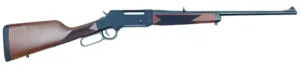
| Action Type | Lever, exposed hammer |
|---|---|
| Action Length | Short |
| Overall Length | 40.5 in. |
| Barrel | 20.0 in. long, 1:10 twist |
| Weight Unloaded | 7.0 lbs. |
| Weight Loaded | 7.2 lbs. |
| Magazine | 4-rd. capacity, detachable |
| Action | Hard-anodized-black aluminum alloy |
| Barrel | Blued steel |
| Stock | American walnut, straight grip, checkered, swivel studs |
| Stock Length of Pull | 14.0 in. |
| Stock Drop at Comb | 1.3 in. |
| Stock Drop at Heel | 1.4 in. |
| Stock Buttplate | Textured rubber pad |
| Sight Radius | 14.7 in. |
| Sight Front | Ramp, 0.062-in. ivory bead |
| Sight Rear | Adjustable |
| Scope Mount Provision | Drilled and tapped receiver, Weaver 63B mount pattern |
| Trigger Pull Weight | 2.5 lbs. |
| Safety | Transfer bar |
| Warranty | Lifetime |
| Telephone | (866) 200-2354 |
| Website | HenryUSA.com |
| Made In | U.S. |
The Long Ranger, like the BLR, uses a similar rack-and-pinion-gear design with a six-lug rotating bolt that locks into the barrel. Cycling the lever was smooth and comfortable. While the Henry and the Browning use a similar action, the Henry is different. The magazine sits flush in the magwell, so carrying the rifle at that spot is comfortable. The magazine-release button is large, round, and flush with the side of the receiver. We found the button fairly easy to press with our support hand, so the magazine releases into the palm of our trigger hand. If the button protruded, that could pose a liability, such as an accidental magazine dump, when carrying the rifle. It is a smart design. Magazine capacity is four rounds in 243 Winchester.
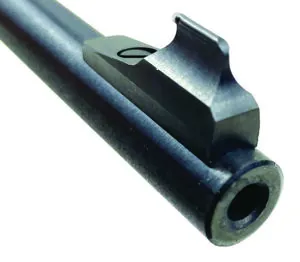
The 20-inch barrel can be equipped with or without sights. Our variant had an adjustable rear sight that also folded to clear the objective of a large scope. The receiver top is drilled and tapped. We mounted a Burris Fullfield IV 2.5-10x42mm scope ($189) on the rifle using a Talley Picatinny rail ($57) and Weaver Lever Lok top-mount QD rings ($42). The FullField series of low-cost scopes have been around for decades, and the IV is the latest version, offering good clarity, capped turrets with ¼-inch-minute-of-angle clicks that you can feel and hear, and an SFP reticle. Our scope featured a simple and uncluttered Plex reticle. The Plex strata allow quick ranging. This is a no-nonsense meat-and-potatoes scope built to be hunted with.
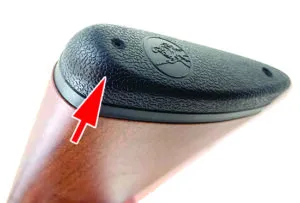
The receiver on the Long Ranger is finished matte black with a blued barrel. The stock is a nicely checkered piece of walnut in a traditional pattern and satin finish. The Henry has a very traditional look. The fit of the soft-rubber recoil pad to the wood stock was decent. The pad features rounded edges so it is fast and snag free when shouldered. The fore end has a metal cap. Sling studs are included, an item missing from the BLR. Under the fore end is an aluminum stud that the fore end attaches to, allowing the barrel to free float.
The hammer has two positions: cocked (fully back) and fired (fully forward). A transfer bar is built into the hammer, which requires the hammer to be fully cocked and the trigger pressed to fire the rifle. We found our thumb jammed up between the hammer spur and the scope’s eye piece. Henry packs a hammer extension with iron-sight models to avoid this. The trigger broke at 2.5 pounds and was crisp and clean. We liked this trigger. Between the free-floated barrel and trigger, we thought the Long Ranger had a lot going for it, and the range sessions proved us right.
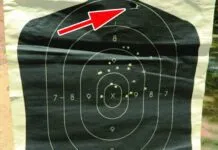
At 100 yards, the Henry dropped three 90-grain Sierra GameChanger bullets in a 0.50-inch group. That was a surprise. Then, the Sierra ammo averaged a 0.64-inch group, which was even more of a surprise. As the barrel heated up, we did see fourth and fifth shots drift away to create a larger pattern. The barrel was cooled between five-shot strings. The next-best group was with 100-grain Winchester Super-X that measured 0.83 inch with an average group of 0.92 inch. Remington Core-Lokt had a best group of 0.90 inch and averaged 1.24 inches. Sub-moa accuracy out of a lever action indeed. Recoil was mild. Slow-cycling the Henry did not faze it in the least. We had no issues. You can also load a single round by dropping it through the ejection port onto the empty magazine and closing the lever to drive the cartridge into the chamber. Ejection was strong, even when slowly working the lever.
For the speed-shooting exercise, we fired at an 8-inch paper plate at 50 yards with the magnification dialed back to 2.5x and proceeded to easily place all shots well within the target. Need a fast second shot? The Henry could accommodate that.
Our Team Said: The Long Ranger is equipped with features that help wring out excellent accuracy, like the crisp 2.5-pound trigger and free-floated barrel. The hammer extension and sling studs are those overlooked features that make using the rifle that much easier. The Henry is slightly more money than the Browning, but it is Our Pick.
| 243 WINCHESTER RANGE DATA | ||
|---|---|---|
| Remington Core-Lokt 95-grain Core-Lokt Tipped | Browning BLR | Henry Long Ranger |
| Average Velocity | 2922 fps | 2934 fps |
| Muzzle Energy | 1801 ft.-lbs. | 1815 ft.-lbs. |
| Smallest Group Size | 1.00 in. | 0.90 in. |
| Average Group Size | 1.40 in. | 1.24 in. |
| Winchester Super X 100-grain Power Point | Browning BLR | Henry Long Ranger |
| Average Velocity | 2713 fps | 2966 fps |
| Muzzle Energy | 1635 ft.-lbs. | 1953 ft.-lbs. |
| Smallest Group Size | 1.40 in. | 0.83 in. |
| Average Group Size | 1.70 in. | 0.92 in. |
| Sierra GameChanger 90-grain GameKing | Browning BLR | Henry Long Ranger |
| Average Velocity | 3087 fps | 3051 fps |
| Muzzle Energy | 1905 ft.-lbs. | 1860 ft.-lbs. |
| Smallest Group Size | 1.40 in. | 0.50 in. |
| Average Group Size | 1.68 in. | 0.64 in. |
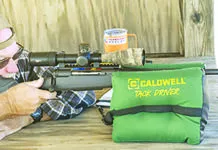
To collect accuracy data, we fired three-shot groups from a bench using a rest. Distance: 100 yards with an optic. Velocities and energies were recorded using a Garmin Xero C1 Pro chronograph.
Written and photographed by Robert Sadowski, using evaluations from Gun Tests Team members. GT