












Few firearms offer as much pure fun as a good 22 LR. Recoil is almost nonexistent, and the noise level is greatly reduced. Then there is that budget thing. Even in today’s economy, a good box of 22 LR is much less expensive than even cheap 9mm. And always remember that the skills the shooter needs to master to run a HiCap Master Blaster 9mm can be practiced with a good 22 LR pistol with less damage to the wallet or to the wrists and elbows. So, we decided to take a look at three of the best affordable 22 LR pistols available right now.
The first is the Browning Buck Mark Field Target Model 051528490, $448. Ours sports a 5.5-inch bull barrel with a full-length Picatinny rail on top and gorgeous rosewood-colored laminate grips. Our second gun is a Ruger Mark IV 40101, $499. Ruger recently took a great pistol and modernized it with a new, much simpler to operate, barrel latch system, new safety, and new slide stop. Our third handgun is a Smith & Wesson SW22 Victory Model 10201, $434, which comes with a 5.5-inch barrel that includes a half-length sight bar. The rear sight is removable to allow access to the top of the action, which is already drilled and tapped to accept a Picatinny rail. Here’s what we liked and didn’t like about each gun in more detail.
Ruger Mark IV Target 40101 22 LR,
$499
Gun Tests grade: B+
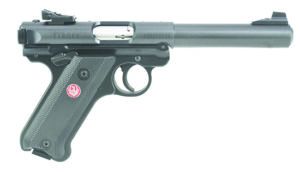
While third in the accuracy tests, the Ruger was only 0.23 inch, on average, behind the winner. We liked the new controls and takedown features.
| Action Type | Semi auto, hammer fired |
|---|---|
| Overall Length | 9.5 in. |
| Overall Height | 5.6 in. |
| Maximum Width | 1.21 in. |
| Weight Unloaded | 2.09 lbs. |
| Weight Loaded | 2.27 lbs. |
| Slide Material | Steel |
| Slide Retraction Effort | 7.4 lbs. |
| Receiver Material | Aluminum |
| Finish | Blue |
| Front Strap Height | 3.25 in. |
| Back Strap Height | 3.25 in. |
| Barrel Length | 5.5 in. |
| Grip Thickness (Maximum) | 1.21 in. |
| Grip Circumference | 5.1 in. |
| Magazines | Two 10 round |
| Rear Sight | Adjustable black |
| Front Sight | Fixed target black |
| Sight Radius | 8.0 in. |
| Trigger Pull Weight | 3.5 lbs. |
| Trigger Span | 2.9 in. |
| Safety | Manual thumb and magazine disconnect |
| Warranty | None written |
| Telephone | (336) 949-5200 |
| Website | Ruger.com |
| Made In | U.S. |
First produced in 1949, with target versions appearing in the late 1950s, the Ruger 22 pistol literally launched the Ruger brand and is reported to be the top-selling 22 LR pistol of all time. The Standard Model evolved through Marks I, II, III, and IV, with the most-recent Mark hitting the market in 2016. Our Mark IV takes it a step past that, and we like the latest changes.
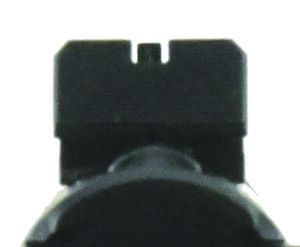
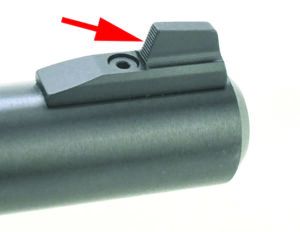
The Mark IV uses a tubular barrel mated to a tubular receiver. The result is great for easy production and great for those at the shooting line. The 5.5-inch barrel measures to about 0.875 inch along the entire length. Not quite as thick as the Browning Buck Mark, it still helps reduce recoil in rapid fire or accuracy strings. The front sight is about 0.125 inch wide and has a slanted, serrated leading edge. Add that to a fully adjustable rear sight, and we found a very visible and usable sight picture. If that is not enough for you, Ruger drilled and tapped the top of the receiver for the addition of a Picatinny rail.
Ruger markets its 22 LR pistols with two different frames. The second to appear comes on models designated as the 22/45 and mimics the grip angle of the 1911-style pistol. The original version is still available and sports a grip much more reminiscent of the German P-08 Luger. Online sources tell us that Bill Ruger was influenced by the shape of a Japanese Nambu, which is very similar in shape to the Luger. Regardless, the angle has been increased dramatically in comparison to the 1911 style. You’ll have to decide which you prefer.
Our Mark IV Target sports the original grip with a much more rakish angle on a solid aluminum frame. The trigger is wide, curved, and serrated. Requiring about 3.5 pounds of compression for activation, this Mark IV trigger had a little take-up and showed a short amount of creep before the sear broke. The magazine release is left side only, and the frame uses removable synthetic checkered grip panels. The pistol ships with two 10-round magazines, and, like it or not, there is a magazine disconnect safety.
The rest of the controls have changed for the better. On earlier versions we’ve owned, the slide release and the thumb safety were small buttons that could be described as vestigial at best. This latest version replaces those with two tabs that are much easier to operate. The slide release is forward on the left side of the receiver and is large enough to provide the leverage needed to drop the bolt easily. The manual thumb safety is also much larger than previous models. Much easier to locate and operate, we found that the forward-mounted base pin rotated the safety in such a way that the safety described an arc that pushed it down into larger hands. Not quite as easy to work as the safety on a 1911, it is still a very real improvement.
Ruger also updated some of the design in a way that is a real game changer for us. Reassembling the older versions sometimes caused great wailing and gnashing of teeth. Disassembly on this one was easy — operate a lever on the backstrap of the pistol, pull it and the attached crossbolt straight down, whereupon the slide could be bumped forward and the bolt removed. The bolt is simplicity itself and only required that a recoil spring and guide rod be lifted out of a track. That bolt, unlike the ones on the Browning and the Smith & Wesson, is almost totally enclosed within the receiver and doesn’t provide much to grab onto. But, like the other two pistols in this test, the rear of the bolt is slightly flared and serrated, providing sufficient purchase for operation.
Reassembly was a different story. Put the bolt back together and reinsert in the rear of the action. Slide the action onto the tabs on the frame and tap it to the rear. Then the bad words started. The mainspring housing had to be reinserted, and several things had to line up or nothing worked. The shooter had to insert the housing in such a way that the hammer strut fit into the housing, and that was more difficult than it sounds.
Still, the new system is light years past the old. Disassembly requires that the magazine be removed and the safety lifted to the Safe position. There is now a takedown button located just below the rear of the bolt that must be depressed. Upon activation, the whole top end pivots on a pin at the front of the frame and lifts off. To reassemble, hook the top end back over the front pin and push the rear down until it latches. Way to go Ruger!
The Ruger Mark IV had the first round hang up on the feed ramp, then worked perfectly from there on. Coming in third place in the accuracy testing, it still posted an average of 1.03-inch groups at 15 yards. The Ruger did not like the Eley Tenex, posting a 1.36-inch average with that fodder. The SK Match and Eley Match results were 0.92 and 0.81 inches respectively — very nice. It provided a second-place finish on the plate rack, averaging about 0.1 second behind the Buck Mark.
Our Team Said: Like with the Browning Buck Mark, the Mark IV Target suffered in comparison to the Victory’s results, but the differences were marginal. If you’re familiar with this line of Ruger handguns, you’ll probably want this one, too.
| DRILL NO. 1 DATA | |||
|---|---|---|---|
| Pistol | First Shot | Split Average | Total Time |
| Browning Buck Mark | 1.093 | 0.308 | 2.323 |
| Ruger Mark IV | 1.18 | 0.312 | 2.427 |
| S&W Victory | 1.24 | 0.33 | 2.56 |
From low ready, fire five shots at 4-inch plates at 9 yards. Averages are for three repetitions.
Our speed tests are not designed to show how fast a firearm can be fired, but to use the same test on multiple guns fired by the same person to look for differences in the guns’ capabilities. We employed a CED7000 timer (Amazon.com, $140) for the speed tests.
| 22 LR RANGE DATA | |||
|---|---|---|---|
| SK Match 40-grain LRN | Browning Buck Mark | Ruger Mark IV | Smith & Wesson SW22 Victory |
| Average Velocity | 846 fps | 904 fps | 902 fps |
| Muzzle Energy | 64 ft.-lbs. | 73 ft.-lbs. | 72 ft.-lbs. |
| Best Group | 0.84 in. | 0.70 in. | 0.55 in. |
| Average Group | 0.94 in. | 0.92 in. | 0.82 in. |
| Eley Match 40-grain LRN | Browning Buck Mark | Ruger Mark IV | Smith & Wesson SW22 Victory |
| Average Velocity | 955 fps | 981 fps | 994 fps |
| Muzzle Energy | 81 ft.-lbs. | 86 ft.-lbs. | 88 ft.-lbs. |
| Best Group | 0.86 in. | 0.45 in. | 0.48 in. |
| Average Group | 0.98 in. | 0.81 in. | 0.55 in. |
| Eley Tenex 40-grain LRN | Browning Buck Mark | Ruger Mark IV | Smith & Wesson SW22 Victory |
| Average Velocity | 934 fps | 954 fps | 970 fps |
| Muzzle Energy | 78 ft.-lbs. | 81 ft.-lbs. | 84 ft.-lbs. |
| Best Group | 0.70 in. | 1.12 in. | 0.98 in. |
| Average Group | 0.80 in. | 1.36 in. | 0.99 in. |
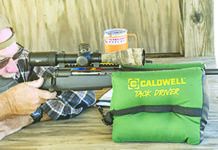
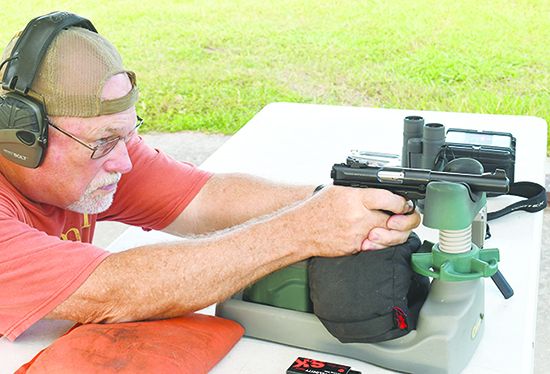
We tested at American Shooting Centers in west Houston. We fired for accuracy at 15 yards by shooting multiple five-shot groups from a well-sandbagged Caldwell Pistolero Shooting Rest (MidwayUSA.com 517357, $28) assisted by a Mini DRC Fortune Cookie from Wiebad.com (MINIFC, $75). We used a Garmin Xero C1 Pro Chronograph (Amazon, $600) to measure velocities.
Written and photographed by Joe Woolley, using evaluations from Gun Tests Team members. GT