












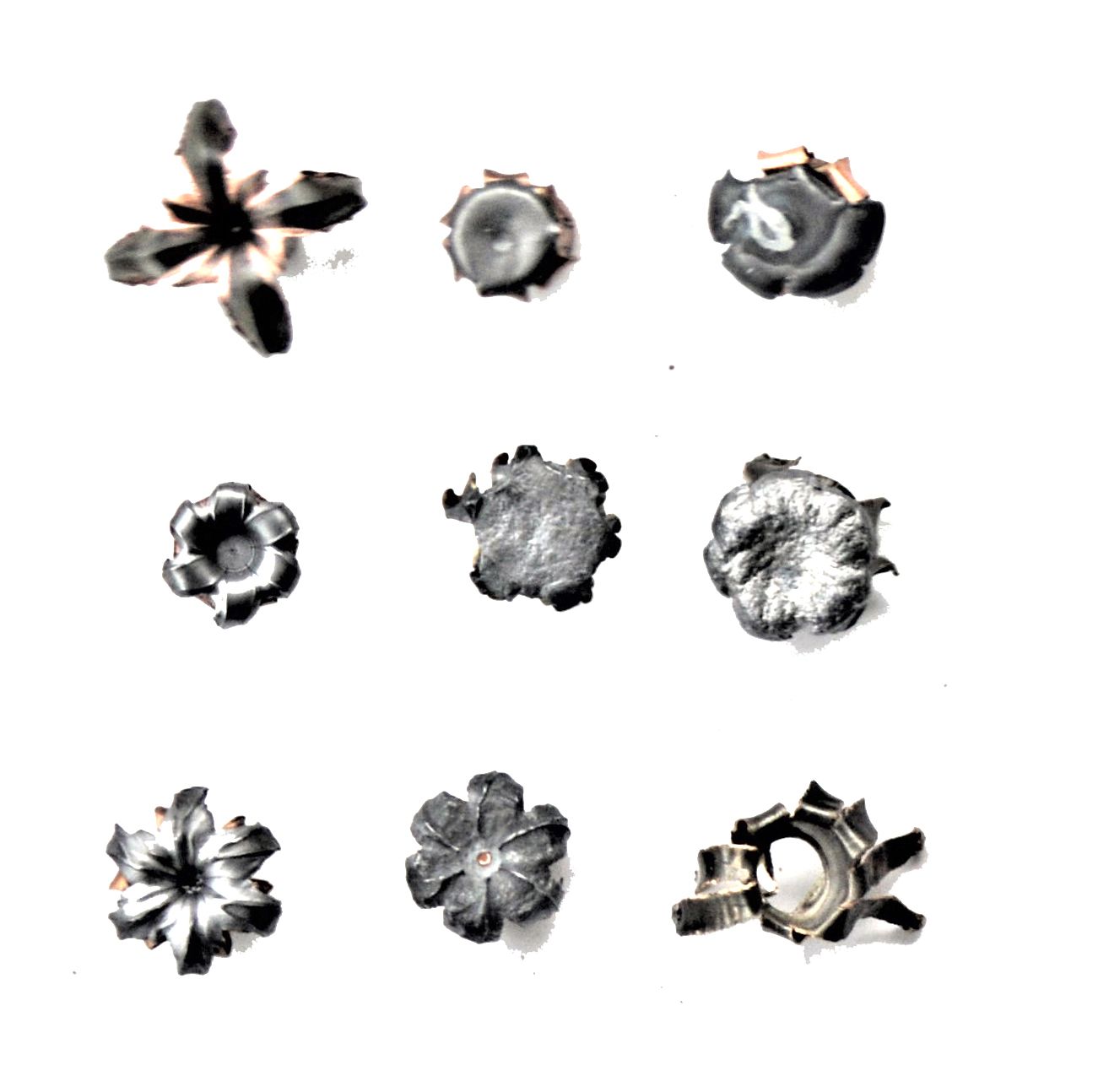
Gun Tests Magazine has been testing ammunition for 25 years, with a broader reach of considerations to look at and more samples tested head to head, out of the same guns and by the same shooters at the same time. When all is said and done, we recommend ammunition in this listicle that is put together with care and craftsmanship; that is functionally reliable in our test guns; that generate consistent velocities; and that is accurate and controllable as well. Penetration, expansion, and weight retention data on such loads is provided for your information in the original articles, which you can locate by doing a search on the website for the loads you’re interested in. Here are our top picks in 9mm Luger.
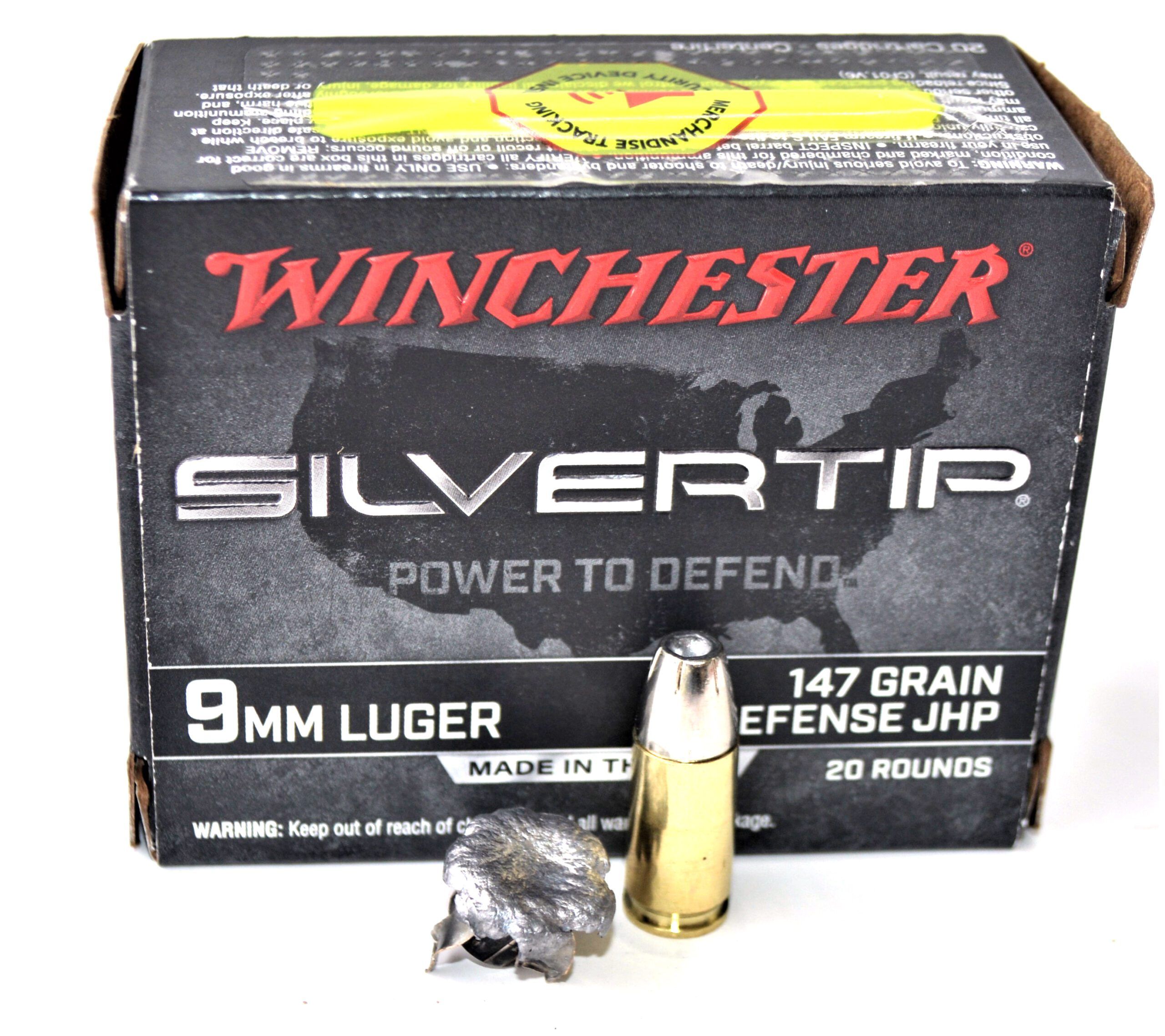
Winchester’s 115-grain Silvertip has been a staple for personal defense for decades. The 147-grain version is intended to offer more penetration and offer an alternative to bonded-core police-type loads. Velocity was 980 fps, penetration 18 inches, and expansion 0.61 inches. For a heavyweight bullet, we feel the Silvertip offers good performance. Compared to the Golden Saber from Remington, the Silvertip expands slightly more and penetrates slightly less. We would be pleased with either.
Gun Tests Grade: A
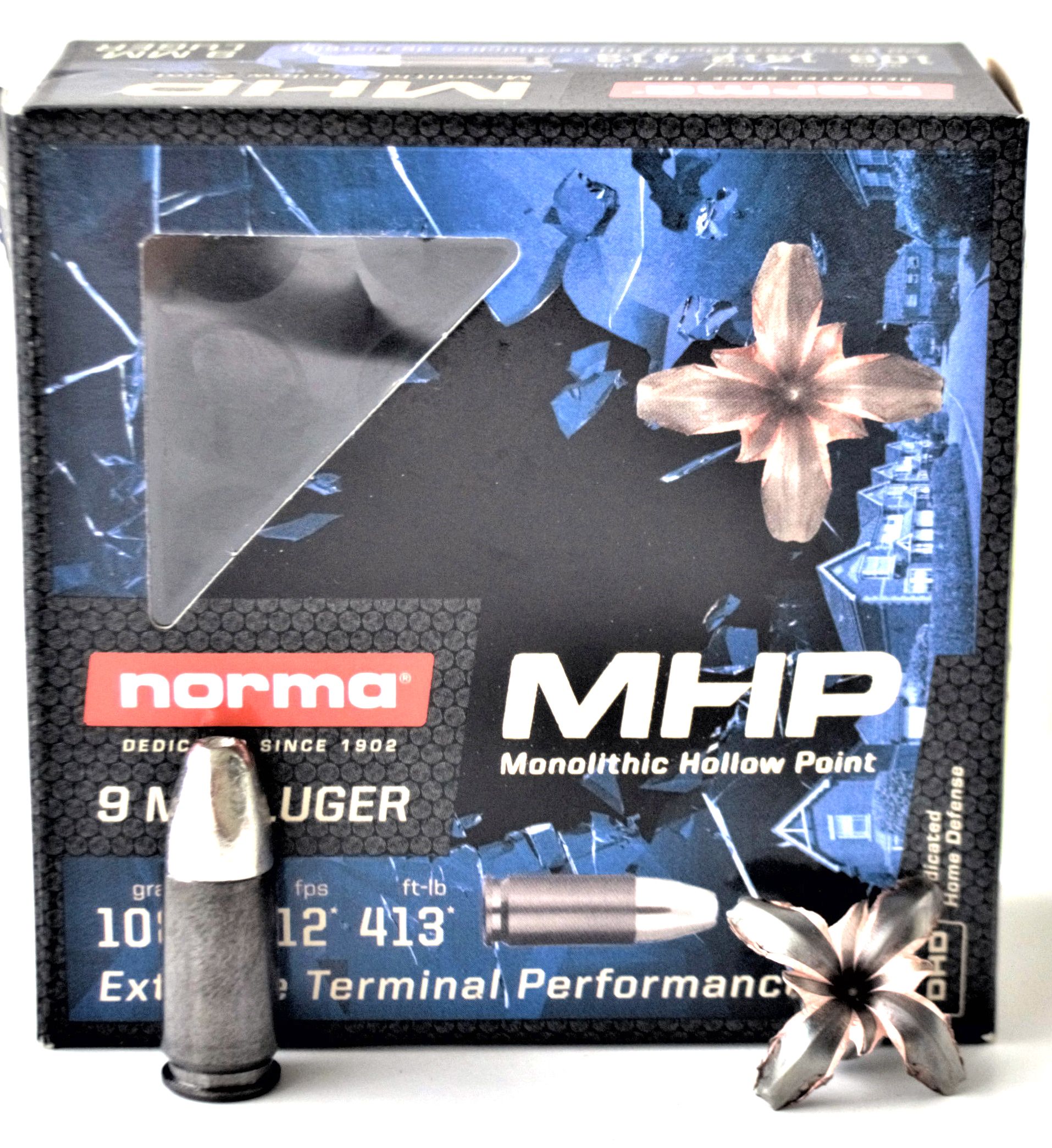
Monolithic simply means the projectile is manufactured from a single piece of copper. This was the lightest projectile tested at 108 grains. The company claims more than 1300 fps velocity. Actual recorded velocity was 1198 fps average. The Norma load was accurate enough, but it was not the most accurate load in the test. Felt recoil was subjectively lightest of the test. Penetration was adequate at 16 inches. Expansion was the greatest at 0.95 inch. We were impressed by the Norma 108-Grain Monolithic Hollow Point’s performance. It offers a combination of light recoil, acceptable accuracy, and a fast-opening bullet.
Gun Tests Grade: A
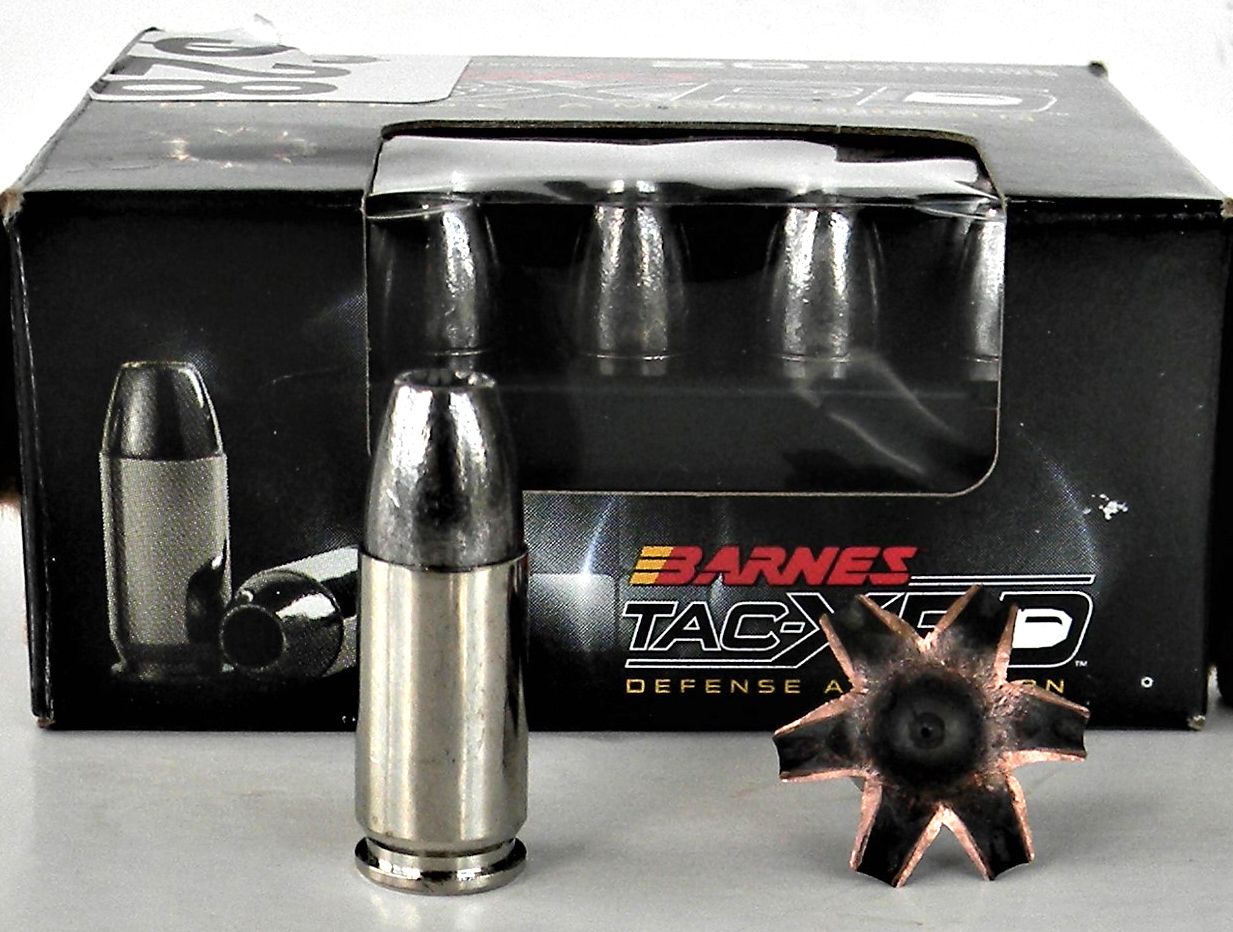
The Barnes all-copper hollow point was once pricey compared to other loads. Now it is in line with what other 20-round boxes cost. The all-copper bullet is long for the bullet weight and cannot be loaded as hot as a conventional cup-and-core bullet because the bullet base extends further into the cartridge case. Just the same, the velocity of 1143 fps makes for easy control. This bullet offers very consistent penetration of 18 inches in water and expands to 0.73 inch.
Gun Tests Grade: A
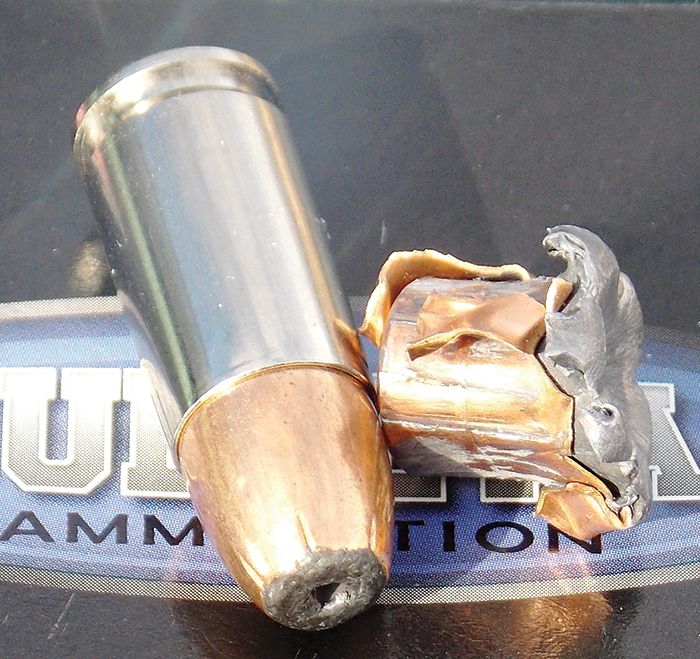
This is the fastest load tested in this issue at 1121 fps. That is 38 Super category. Yet, there were no adverse pressure signs in the spent cases. The 147-grain JHP penetrated 22 inches of water and expanded to 0.55 inch. We did not recognize the bullet used, but it appears to be a design intended to limit early penetration. We do not think it is a bonded design, although the jacket and bullet stayed together. This load certainly caused a ruckus in the water jugs. We think that a combination of careful powder selection and long-loading the bullet allowed the company to achieve this velocity. This load is worth considering, but it should be fired in a service pistol such as the Glock 19X, not a compact handgun, to maximize its effects.
Gun Tests Grade: A
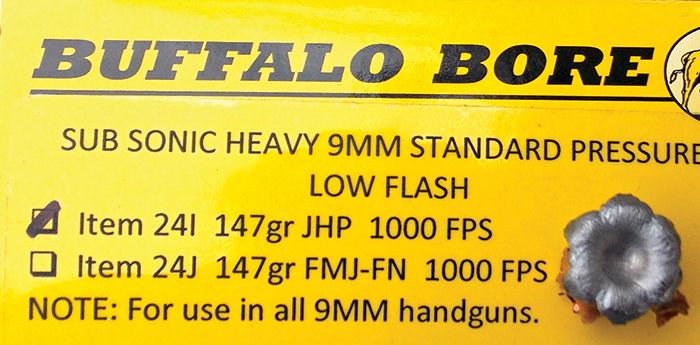
This is a standard-pressure-rated load with plenty of momentum. Velocity is 998 fps. Accuracy is good. For some reason control was no more difficult than the slower loads, perhaps because of fast-burning powder, but most likely the 9mm’s general pleasant firing characteristics. While the Fiocchi and Winchester loads had less recoil, we did not find the Buffalo Bore load daunting at all. The question is, do you believe in one hard hit or two or three softer hits and use a +P load? Only the shooter may answer that question, and it depends upon personal ability. The Buffalo Bore load is controllable by those who practice, and it offers good penetration and expansion without +P pressure. Penetration was 21 inches of water. The jacket comprised part of the expanded diameter at an impressive 0.75 inch.
Gun Tests Grade: A
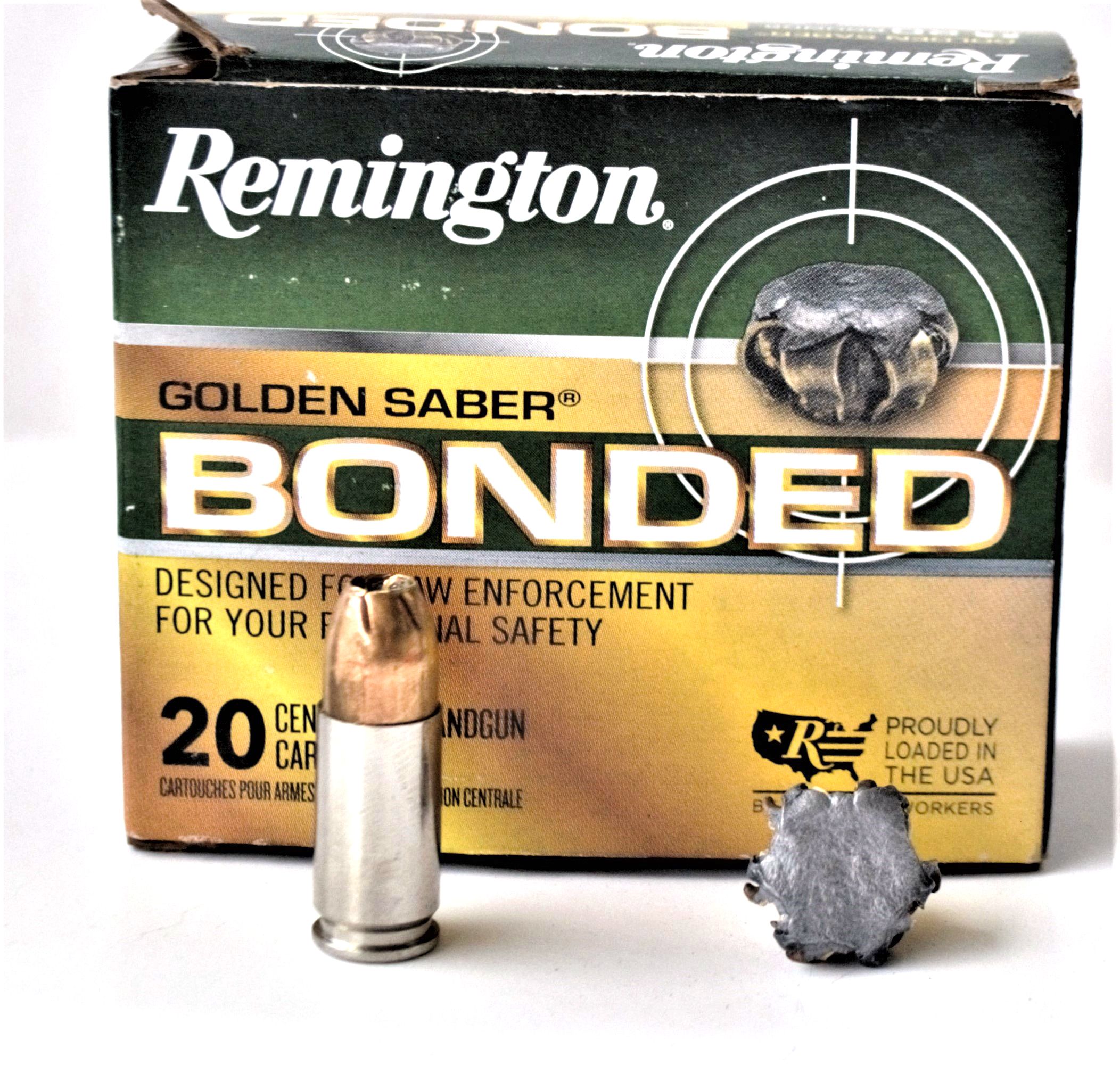
This bullet doesn’t quite look like the Golden Saber bullets tested in the past. These bullets used more of the bullet jacket as a wounding mechanism. The bane of 147-grain loads has been low velocity and expansion. The Remington bonded load breaks a solid 1012 fps, marginally faster than the 147-grain Winchester load. Penetration was 20 inches, and expansion was an average of 0.58 inch. If you need deeper penetration and prefer a 147-grain bullet, Remington has provided an answer.
Gun Tests Grade: A
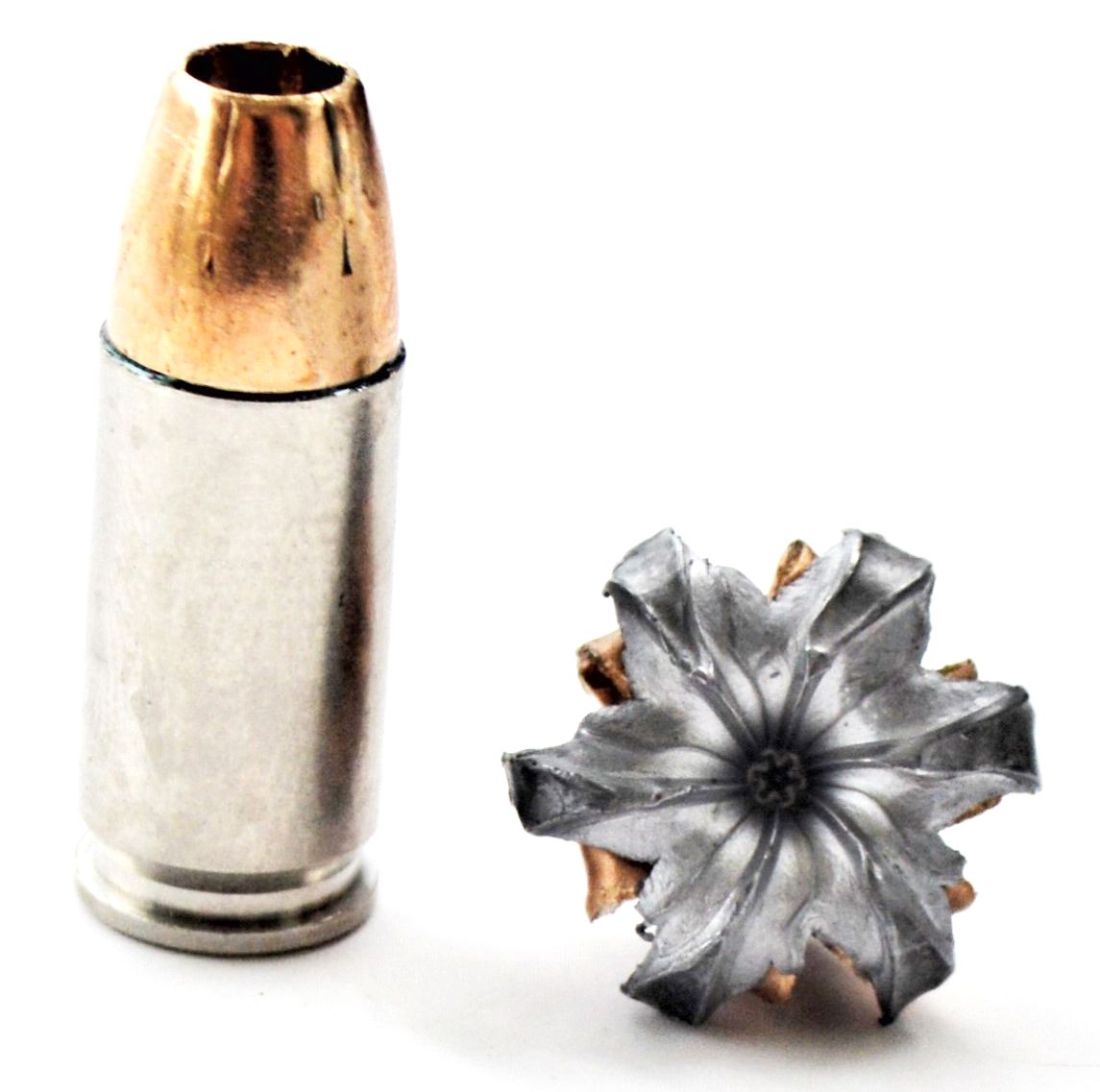
The HST bullet is a modern development that offers a choice over the Hydra-Shok. There is no center post in the HST, and its expansion is different. Velocity was 1153 fps. Penetration was 17 inches in water and expansion 0.65 inches. Recovered weight was 124 grains. The HST offers slightly better performance than the Hydra-Shok. We would take either.
Gun Tests Grade: A
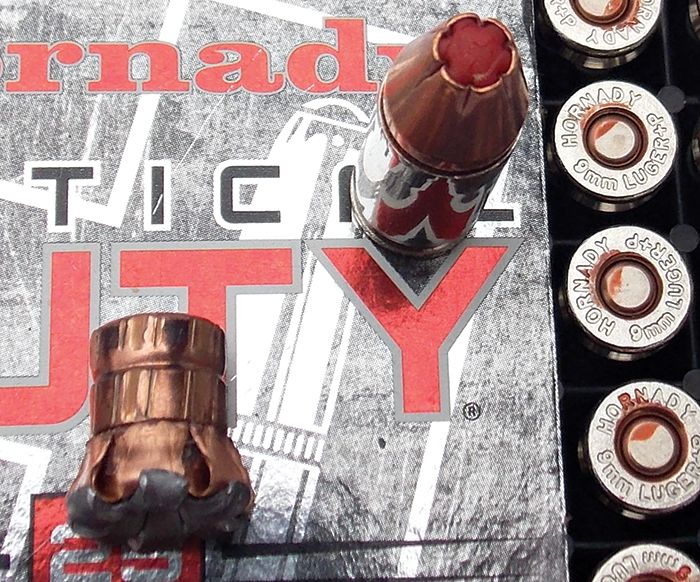
This load offers excellent barrier penetration, according to Hornady and agency testing. Our water test showed a bullet that drove to 24 inches in water testing and expanded consistently to 0.48 inch. (Bullet #2 made a dent in the fifth jug; #3 was stuck in the #4 jug’s outer jacket.) Every bullet looked exactly the same, with the most consistent expansion of the test. The Hornady bullet offered excellent accuracy as well, tying the Fiocchi loading for most accurate and only in second place for accuracy by splitting hairs. The Hornady bullet has plenty of penetration, and we feel that this load is a serious contender for law-enforcement use. If traveling in country inhabited by big cats and feral dogs, this is a good choice. The needs of law enforcement and the needs of home-defense shooters may be different, but this is an outstanding loading for either group.
Gun Tests Grade: A
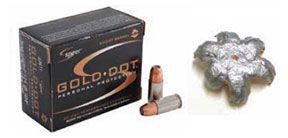
The Gold Dot design is tweaked for extra performance in the short-barrel gun. The +P rating increases velocity over the standard Gold Dot, and the bullet features a softer core. Expansion and penetration were excellent. This is a solid choice for all-around use. This load is specifically intended for short-barrel use, and as a result of careful development and quality manufacture, it was the overall pick of our raters.
Gun Tests Grade: A+
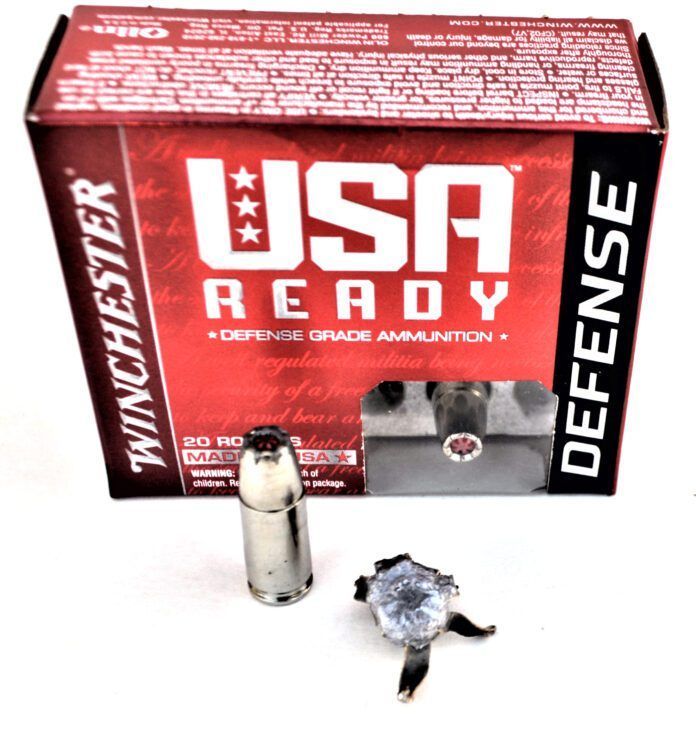
This new loading uses something called Hex-Vent technology. A polymer ball in the nose instigates expansion. This load breaks 1207 fps, making it the most energetic 124-grain load tested. The bullet stayed together and expanded well as it penetrated 16 inches of water. We measured the lead mushroom at a healthy, plump 0.76 inch of expansion. Had we included in the expansion measurement the single piece of jacket that was attached to the center, the reading would have been well over an inch. One of the bullets of three tested in water slipped its jacket, a mark of a high-velocity bullets. This is outstanding performance by any standard.
Gun Tests Grade: A+
OTHER TESTED LOADS
Federal Premium Tactical 124-grain HST JHP P9HST1 9mm Luger, $40/50
The HST is a bit pricier at 80 cents a round than the Train & Protect. Still, it’s a defense load, not a practice round. You will need to fire enough ammunition in your chosen pistol to confirm reliability. If a modern 9mm handgun doesn’t feed this load — a standard-pressure 124-grain JHP — then the gun is probably defective in some way. Velocities ran 1159 fps in the Glock and 1111 fps in the SIG. We noticed more kick with this than the 115-grain load. We were surprised, but there it is. The power factor rating is the highest of the test, so our perception of recoil is borne out. On the other hand, energy is also the highest of the test. This load tunneled a full 16 inches in gelatin when fired from the SIG and 17 inches from the Glock. Each bullet was uniform and practically indistinguishable from the other. Expansion was a uniform 0.65 inches in five bullets and 0.63 in one of the six fired, with accuracy being very good as well. Weight retention is 100%. The Federal HST is a popular service load, and rightly so. It is affordable, clean burning, and accurate.
Gun Tests Grade: A
Speer Gold Dot 124-Grain JHP 9mm Luger 23618GD
The Gold Dot is designed to offer excellent light cover and barrier penetration. This means a great deal in law enforcement, but not so much in civilian personal defense. The Gold Dot bullet breaks 1124 fps out of the Walther PDP. Penetration in water was 18 inches, and expansion was a solid 0.64 inch. We like the accuracy and reliable expansion of this loading.
Gun Tests Grade: A
Federal Premium Law Enforcement 124-Grain Hydra-Shok Jacketed Hollow Point 9mm Luger P9HS1G1
In testing, the load clocked 1104 fps. Penetration was 16.5 inches of water. Expansion was 0.59 inch, with weight retention of 122.5 grains. Interestingly, decade-old testing of this round shows 1090 fps average velocity, the same penetration, and 0.55 inch expansion. The modern Hydra-Shok is an improved cartridge and one with a proven track record.
Gun Tests Grade: A
Federal Premium Hydra-Shok Deep 135-Grain PD9HS5H 9mm Luger
This loading isn’t the same as the previous 135-grain Low Recoil Federal cartridge. The bullet design is optimized for penetration, and in our test, we got an average of 22 inches of penetration. The Hydra-Shok bullet features a fold-over crimp on the jacket, which we believe is designed to keep the bullet jacket from opening too soon. Velocity is higher than expected at 1035 fps. Total expansion was the greatest of any load tested at 0.79 inch; however, this was due to a part of the jacket extending from the 0.59-inch mushroom. That shard would still be effective regardless.
Gun Tests Grade: A
Federal Premium HST 147-Grain P9HST2 9mm Luger
The 147-grain bullet features the popular HST design, which is intended as an improvement over the Hydra-Shok. The HST offers an advantage in barrier penetration. We do not test barrier penetration, but expansion in water was very good and so was penetration. This load proved accurate and exhibited a clean powder burn. We felt that the HST provided optimum performance. This is a load that would convince shooters to adopt the 147-grain load over the 124-grain JHP. At 1006 fps with 22 inches of penetration and 0.68-inch recovered diameter, this is a good choice.
Gun Tests Grade: A
Federal Premium HST +P 147-grain P9HST4 9mm Luger
This appears to be the same bullet used in the standard-pressure loading. The HST +P is an answer to those looking for increased velocity and performance in the 147-grain weight. However, the standard-pressure load is faster than almost all standard-pressure 147-grain loads anyway, which usually average 930 to 980 fps, so Federal did something there. On average, the 147-grain HST +P is 24 fps faster than the standard-pressure loading. This may not seem worthwhile, but we did not expect bullet performance to be as different as it was. Two inches less penetration was achieved with a bullet that expands to .70 versus .68. For civilian versus law-enforcement shooters, this performance might be a better choice, but when a non +P load offers good performance, there is little incentive to add pressure. No increase in recoil was noted.
Gun Tests Grade: A
Winchester PDX1 Defender 147-Grain S9MMPDB1 9mm Luger
The Winchester PDX Defender is a bonded-core design like the rest of the loads tested. The Winchester load breaks 940 fps and offers good control. Accuracy is good, and the powder burn is clean. Muzzle flash is limited. In other words, this is a service-grade loading. Penetration is optimal, and the bullet expands to 0.57 inch reliably. The Winchester load is a viable choice with good performance.
Gun Tests Grade: A
Remington HD Ultimate Defense 147-Grain Brass-Jacketed HP 28946 9mm Luger
The Golden Saber used a brass jacket over a lead bullet. The jacket is actually designed to be part of the wound mechanism. It is designed for the rigors of law enforcement, but non-LE shooters can buy it. The Golden Saber expanded to .70 inch, excellent results. Velocity was 940 fps and penetration a deep 24 inches. The Golden Saber is accurate and fired a total of 50 trouble-free rounds.
Gun Tests Grade: A
Buffalo Bore Outdoorsman Hard Cast Lead Flat Nose 147-Grain 24L/20 9mm Luger
This isn’t a jacketed-bullet load, but is rather a hard-cast flat-nose bullet intended for defensive use against larger animals. Many folks use the 9mm for personal defense, and rather than purchase a Magnum revolver for occasional use in the wild, they might find it handy to load the 9mm with high-penetration bullets. FMJ loads typically cut a small wound path, but the Flat Point should create more damage. We found the Buffalo Bore load is a strong choice at a solid 1060 fps average. We cannot tell you the true water penetration because we gave up at 48 inches. We tried to capture the bullet in 42 inches of water, or seven jugs, and it sailed through. Next, we tried eight jugs at 48 inches, the limit of the fixtures we use for holding the water jugs. It sailed through. The exit hole was more ragged than we have seen with FMJ loads. We felt that this is more than adequate penetration. We are not rating this loading compared to the others because it is unique, but it certainly fits in with the deep-penetrating 9mm line of this report. In an urban situation, it’s probably not the right choice because it might strike a person beyond your target. Penetration is at least in 357 Magnum territory.
Gun Tests Grade: A
SIG Sauer Elite V-Crown 147-Grain E9MMA3-20 9mm Luger
The 147-grain V-Crown averaged 962 fps, right in the league with several other loads with practically identical velocity. The V-Crown was also a good performer, with penetration of 20 inches and expansion to 0.57 inch. The loading exhibited a clean powder burn and good accuracy.
Gun Tests Grade: A
Hornady Custom XTP 147-Grain 90282 9mm Luger
The Extreme Terminal Performance (XTP) bullet features a good balance of expansion and penetration, with penetration considered the more vital component. The 147-grain XTP is well balanced and often shows good accuracy at long range. In this case, the XTP clocked 955 fps. Penetration in water was a very uniform 24 inches. Expansion was 0.52 inch. This loading is also accurate, and controlling it isn’t difficult.
Gun Tests Grade: A
Fiocchi CovertX 124-grain JHP 9CCWB, $21/20
This load comes in a 20-round box, making the cost per round $1.05, some of which is likely due to the nickel-plated cartridge cases. The burn is clean, something we liked a lot. There isn’t any unburned powder to speak of. Muzzle signature is muted. This CovertX load exhibits good accuracy. We feel that Fiocchi paid a lot of attention to internal and external ballistics. Velocity was 1115 fps in the Glock and 1055 fps in the shorter-barrel SIG. Recoil is modest, a little less than the faster 124-grain HST. The Fiocchi CovertX penetrates 14 inches of Clear Ballistics gel and expands to a plump 0.64 inch. This is a very consistent loading. Fiocchi has used outsourced bullets in their previous loads, including the Extrema line, using primarily the Hornady XTP. The CovertX loading meets the company’s stated goal of offering better expansion in short-barrel guns and a faster-opening hollow point. This is a defense load that isn’t geared toward service use, where more penetration is needed. The CovertX load is accurate, clean burning, relatively low recoil, and offers good expansion. We’d buy 40 to 60 rounds to shoot in our primary carry gun and see how it did. If it cycles, then load the balance, carry it, and replenish with more 20-round boxes as needed.
Gun Tests Grade: A
Hornady Critical Duty 135-Grain FlexLock 9mm Luger +P 90226
This is the load that won the FBI contract. Barrier penetration and reliability is unquestioned. The Hornady 135-grain load breaks 1055 fps out of the Walther PDP pistol. Penetration was a long 24 inches in water. The bullet expanded to 0.52 inch. Most civilian shooters do not need this level of penetration. If you do, this is a fine load and the most accurate of the test.
Gun Tests Grade: A-
Federal Premium Micro HST 150-Grain P9HST5S 9mm Luger
It is a specialty load intended for use in compact handguns. It is less difficult to get a heavy bullet to consistently perform well with cycle reliability at velocity below 1000 fps versus a low-recoil lower-energy 115-grain bullet. Federal managed to set the velocity at 870 fps and maintain good function, and this bullet is designed to open at modest velocity. Barrier penetration was not a consideration in the design. The bullet expands to 0.60-inch caliber while penetrating to 20 inches. The 150-grain HST cannot be faulted on the basis of expansion. Recoil is low. For personal-defense in smaller handguns, this load makes the grade. We rated it down a half grade because its energy is low compared to the other offerings.
Gun Tests Grade: A-
Fiocchi 147-Grain JHP 9APDHP 9mm Luger
This is an affordable loading in a 50-round box and a fair price in the 20-round box. Even if you choose another load to wear out in public, this one strikes to the same point of impact as other 147-grain loads and offers a good price point for practice. The Fiocchi load at 952 fps average is pleasant to fire and is the most accurate loading tested. The Fiocchi JHP heavyweight offers what many are looking for, a balance of expansion and penetration that favors penetration. Penetration is a long 24 inches, stopping in the skin of the fourth water jug consistently. Expansion is 0.46 inch. If this load is your choice, you’ll have an emphasis on control, accuracy as well as penetration. While we prefer more expansion, this load does what a 147-grain JHP is designed to do. We rated it down a half grade based on expansion, but we can’t overlook that this loading costs less for 50 rounds than 20 of most of the competing loads.
Gun Tests Grade: A-
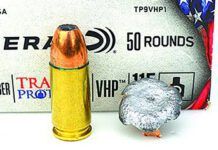
Federal Train & Protect 115-grain VHP TP9VHP1 9mm Luger, $35/50
This is a 50-round box, making it one of the more affordable loads tested here at 70 cents a round. The load uses a brass case and standard cup-and-core jacketed hollow-point bullet. This is not a bonded-core type. This load appears to be the latest version of the Federal 9B hollow point, a good all-round choice and among the first factory hollow points that performed reliably. This load exhibited modest muzzle signature with a warm orange glow in some dim-light conditions in the SIG P365, but the signature was not at all noticeable in the Glock 19. Accuracy was the best of the test, a good showing for an economy load. This tracks because the 9B once had a reputation as a match-grade-accurate round. Velocity was barely 1100 fps in the SIG and 1145 fps in the Glock. Expansion showed a flat mushroom of 0.62 inch out of the SIG and 0.64 inch from the Glock. Penetration was an average of 12 inches out of each gun, but one of the test loads went only 11.5 inches out of the Glock. We found the Federal Protect & Defend to be a viable choice. Recoil was a gentle push despite good velocity. We rated it down a grade on penetration.
Gun Tests Grade: B
DoubleTap 165-grain JHP 9mm Luger
This is an unusual load, a 115-grain JHP over a 50-grain solid disk. DoubleTap offers these in the Equalizer line. Velocity would necessarily be low due to the heavyweight combination, we thought. The 115-grain JHP isn’t going to expand as much at low velocity and should penetrate more deeply, we felt, and the testing bore some of this out. The load clocked 965 fps, which is plenty fast considering this is the heaviest bullet tested. The 115-grain JHP penetrated to 23 inches and expanded to 0.54 inch while losing the jacket. The 0.355-inch disk penetrated to 16, 16, and 18 inches in our testing. Multiple-projectile loads are not intended to be super-accurate, and we saw that is SOP for this design. The projectiles were a finger-width apart at 7 yards, and, surprisingly, at 10 yards, they were perhaps two finger widths apart. At 20 yards, the story was different, with the two projectiles 4 to 6 inches apart and neither striking to the point of aim. We wanted to be fair and consider the potential of this loading despite its drawbacks. With the slower velocity than usually posted with a 115-grain JHP, this bullet penetrated deeper, expanded less, and lost its jacket. The disk penetrated to 17 inches on average. The problem would be this isn’t a load for hostage rescue or precision shooting, but then personal defense or home defense seldom is. A multiple-projectile load would exhibit a five-shot group of perhaps 10 inches, which is outside our acceptable range, but then the load met its design parameter.
Gun Tests Grade: B
Winchester W Defense 115-grain JHP USA9JHP, $28/50
This is another load with a long lineage. It appears to be an unplated Winchester Silvertip. However, the last 115-grain Silvertip tested was much faster. Feed reliability is flawless and its recoil is modest, about middle of the road for the test. The load is available in a 50-round box and seems for sale about everywhere. Cost per round is 56 cents, lowest in the test. There were 20 boxes or more on the shelf at the box store where we purchased our test samples. The closest performance comparison in the test is the Federal Train & Protect. Interestingly, performance was close to the Federal load, with velocity greater in the short barrel, but not quite as fast in the long barrel. Velocity was 1118 fps in the SIG’s 3.1-inch barrel and 1143 fps in the Glock 4.02-inch barrel. This is good velocity, all things considered, when you are looking to limit recoil. Penetration was a bit short in the Glock at 11.0 inches on average, with 0.58-inch expansion. In the SIG pistol, we found penetration to be more in the ideal range at 12.0 inches, with 0.56-inch average expansion. This seems to be a considerable difference in penetration and expansion in a short-barrel pistol compared to the longer barrel, with only 25 fps separating the loads, but there it is. Cup-and-core bullets of this design tend to deviate more in velocity than bonded-core bullets. The jacket thickness of the former can vary, leading to changes in velocity. We would have liked a better balance of expansion and penetration, so we rated the load down a grade. But for the money, it’s hard to beat.
Gun Tests Grade: B
SIG SAUER 365 115-grain V-Crown JHP E9MMA1-365-20, $22/20
The SIG Sauer 365 load is designed to offer a suitable, even specialized, load for SIG’s compact P365 9mm handgun. The loads run $1.10 a shot for a 20-round box. While such things are subjective — muzzle blast affects your perception of recoil — this load was rated to be the lightest kicker. IPSC Power Factor figures (123/126) back us up on this. The SIG 365 load also has the least energy, coming in at less than 300 foot-pounds in the shorter barrel and just over 300 foot-pounds in the Glock 19’s 4.01-inch barrel. But then, none of the loads are +P rated, and none are hard kickers. The SIG 365 load offers modest recoil and a good practical accuracy with fast follow-up shots. Velocity is good, but not outstanding, at 1089 fps in the Glock and 1070 fps in the SIG pistol. This isn’t much deviation between the two barrel lengths, indicating the SIG load is maximized in the short barrel, per its marketing. Penetration in the Clear Ballistics gelatin block was 13.5 to 14.5 inches and consistent with slightly greater penetration in the short-barrel gun. Expansion was a reliable 0.55 inch in each pistol. This SIG Sauer load accomplishes what it was designed to do, offer reasonable performance and modest recoil in a short barrel. Despite this, we rated it down a grade on expansion.
Gun Tests Grade: B
Hornady Critical Defense 115-grain FTX 90250, $27/25
Note that the Critical Defense is a true half box, with 25 cartridges, which makes its cost per round $1.08. The Critical Defense rounds use a special polymer insert in the nose to instigate expansion at low velocity or when meeting some type of barrier. We think this results in very consistent expansion. The load breaks 1090 fps in the SIG and 1120 fps in the Glock 19. Accuracy is excellent. This is a consistently good performer in accuracy testing. Muzzle flash is muted, practically non-existent. Recoil is modest, even in comparison to loads with less velocity. In ballistic testing, the Critical Defense delivered good short-barrel performance. The FTX bullet may be counted on to penetrate 12 to 12.25 inches. Expansion is modest at 0.50 inch, but very consistent. The red polymer plug either adhered to the bullet during its travel or was found beside the projectile in gelatin. In the Glock pistol, velocity was greater, but the results were consistent, with the Critical Defense penetrating 11.25 to 11.5 inches, and expansion remaining solid at 0.50 inch. We would have liked more expansion and also more penetration, but the load is comparable to the other 115-grain loads in most regards.
Gun Tests Grade: B
Sierra Sports Master 115-Grain Jacketed Hollow Point 9mm Luger A81100120 (May 2023)
Felt recoil was light due to a velocity of only 1114 fps. Expansion was a modest 0.52 inch. This load was reliable and accurate, but it was below the curve in energy and expansion.
Gun Tests Grade: B-
Fort Scott Munitions 115-grain Solid Copper Spun Tumble Upon Impact (TUI) SCS Bullet 9mm-LUGER-TUI, $29/20
These loads feature a bullet that is designed to tumble on impact, according to Fort Scott. This is an unusual mechanism. Some military rifle loads break at the cannelure in the bullet, and we have tested 45 Colt 255-grain bullets that actually tumble. The TUI load doesn’t tumble enough to amount to anything, in our opinion. Firing into the gelatin block, we could see no tumbling. There may be a modest yaw toward the end neck of penetration, but the bullets were recovered nose first. Velocity is good, more than the advertised 1140 fps. The Glock 19 breaks 1199 fps, and the SIG P365 1138 fps. Accuracy is fair, not outstanding. The penetration channel is indistinguishable from a full-metal-jacketed bullet. However, there is something going on we cannot qualify because the bullet only penetrates 20 inches — a true FMJ bullet may penetrate more than 30 inches in gelatin. This load is accurate enough and fed reliably. Terminal ballistics offer no advantage over an FMJ, according to our tests. At $1.45 a round, this is by far the most expensive load in the test, and we can’t see a compelling reason to buy it. We rated the Fort Scott Munitions load down for its overpenetration and a failure to tumble, per its marketing, or expand, per our recovered bullets.
Gun Tests Grade: C




Good review and real world tests on the 9mm Luger.
I don’t remember if there has been a recent and similar review of .380 ammunition.
A lot of bullets that expand in water jugs , fail to pass the FBI test with 4 layers of denim etc in front of the gel block. They often plug up and act like an FMJ with no expansion at all. I would recommend looking up these bullets on YouTube to find performance reviews using the FBI style tests.
The ‘https://www.youtube.com/@ToolsandTargets’ channel would be a good start. There are many others as well.
No sense paying top dollar for bullets that fail to deliver in realistic scenarios.
I love Gun Tests firearm reviews, but almost any bullet will expand in water jugs. Lucky Gunner and the late Paul Harrell tested the Remington High Terminal Performance 9mm in FBI gel and a meat target respectively and got identical results – no expansion. It did expand in water jugs.
Just a curiosity if you’ve ever looked at or tried the G9 External HPs ?? Made in various calibers and two configurations … Woodsman load also. Thanks