









Not-so-well-known cartridges tend to be shot from not-so-easily-found firearms, and such has been the case for us in trying to fulfill some reader requests for tests of traditional rounds. With our initial goal being to test a couple of samples chambered in 257 Roberts, we had our work cut out for us. Ruger still makes the Model 77 Hawkeye No. 37115, $950, in 257 Roberts, and we grabbed one of those quickly. With true controlled-round feeding, a three-position wing safety and a very nice walnut stock, the Hawkeye takes us back to the days of sporting stocks on nice Mauser-style actions.
Our second test rifle was a great deal harder to find and was substantially more expensive. We managed to locate a little piece of history, a Remington Model 700 Special. Essentially a Remington 700 CDL Stainless Fluted, our sample is a 75th anniversary model with a floorplate suitably engraved to commemorate that event. With a serial number that dates the rifle to 2009, our rifle is 1 of 200 produced, and the $1900 price tag represents its collector’s value. We had this rifle in mind from the beginning, and it took us several failed bids on Gunbroker.com and months to obtain.
Optics
The Houston Gun Tests group uses a number of quality optics to help us test rifles. We tend to stay with several Leupold and Vortex scopes that have performed well and consistently for us over the years. Every now and then we slip in a new piece of glass to see how it will do, and that was the case with this test.
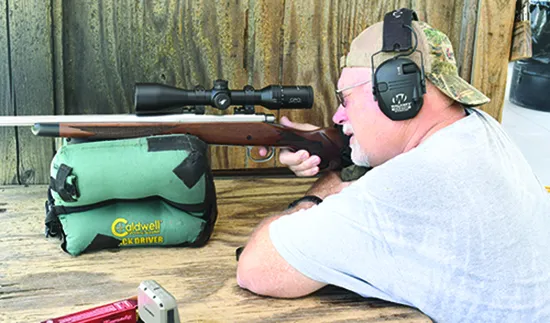
We tried out a German Precision Optics (GPO) Spectra 6x 2-12×50 and liked what we saw. Mounting it on great deer-hunting rifles, we wanted a good deer-hunting scope. The magnification range was 2-12x — perfect for most anything in our world. The low-end magnification works well in heavy timber and low light, while the 12x would allow us to reach out and touch more-distant targets. The 50mm objective lens allowed in a great deal of light for early or late hunts as well as a very nice field of view. This GPO Spectra uses a second focal plane G4i Fiber reticle, which consists of a good duplex crosshair along with a very visible center red dot. All the images were clean and crisp, as were the adjustments. Street price is right around $825, and it weighs less than 21 ounces. We think we may have to pay more attention to this brand in the future.
The 257 Roberts was developed by Ned Roberts in the 1920s. Modified slightly from the original form; Remington legitimized the wildcat round and chambered it for their rifles starting in 1934. Essentially a 7×57 Mauser necked down to 25 caliber, the load was accurate and fairly hard hitting, especially for the powders available at the time. Not every rifle so chambered or converted to chamber this round was as strong as what we might expect today, and allowable pressures were adjusted accordingly. Standard-pressure rounds, designed to work well in the weaker firearms, were limited to 54,000 psi, though most of the loading data we’ve seen tops those loads out at about 45,000 psi.
Later, a higher-pressure load (+P) was designed for more strongly built rifles that could handle 58,000 psi. The resulting increase, at least in our testing, could add 400 to 500 foot-pounds to the downrange energy. Both of our test samples are modern production and can handle either pressure ceiling. For this test, we used a Hornady Superformance 117-grain SST load that is rated for a factory muzzle velocity of 2946 fps and muzzle energy of 2255 foot-pounds. The round maintains minimum whitetail energy past 400 yards (1102 foot-pounds at that range), according to the factory specs. Our second round was a jacketed soft point, a 117-grain Remington Core-Lokt, with a factory muzzle velocity of 2650 fps and muzzle energy of 1824 foot-pounds. It carries minimum whitetail energy only out to 200 yards (998 foot-pounds at that range), according to the factory specs. Here’s how the rounds performed in our test rifles.
Remington Model 700 Special 257 Roberts,
$1900
Gun Tests grade: B+ [our pick]
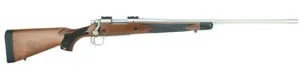
This Model 700 CDL variant showed beautiful lines and grain in the stock, which highlighted the stainless-steel parts. Function was perfect, and accuracy was pretty good. We’ve been spoiled with the most modern designs that shoot sub-inch straight out of the box. This one did not, but because we are also handloaders, the fun is just beginning.
| Action Type | Bolt |
|---|---|
| Overall Length | 43.5 in. |
| Barrel Length/Twist | 24 in., 1:10 |
| Overall Height w/o Scope Mount | 6.7 in. |
| Weight Unloaded | 6.95 lbs. |
| Weight Loaded | 7.19 lbs. |
| Sight Radius | No sights |
| Action Finish | Stainless steel |
| Barrel Finish | Stainless steel |
| Magazine Capacity | 5 rounds |
| Magazine Type | Internal box |
| Stock | Black walnut |
| Stock Drop at Comb | 0.6 in. |
| Stock Drop at Heel | 1.0 in. |
| Stock Bedding | None |
| Stock Buttplate | Soft rubber |
| Stock Length of Pull | 13.5 in. |
| Receiver Scope-Base Pattern | Remington 700 |
| Trigger Pull Weight | 2.2 lbs. |
| Safety | Two-position thumb |
| Warranty | None |
| Telephone | None |
| Website | None |
| Made In | U.S. |
The Remington 700 was introduced with much fanfare in 1962. It was initially offered in two models, the ADL and the BDL. The ADL had a blind magazine and a hooded front sight. The BDL sported fleur-de-lis-style checkering, black fore end piece, and white spacers along with sling swivel studs and a higher-grade metal finish than the ADL. Over the years, Remington chambered the Model 700 in at least 35 different calibers and maybe as many as 50 — sources disagree. Research mentions that the ADL stood for “Average Deluxe” and BDL for “Better Deluxe.” We can’t imagine any marketing VP today naming a new product average and slightly better than average, but we digress.
Our sample is the CDL (Classic Deluxe) version that brings upgraded wood and smooth, traditional lines to the rifle. The inner workings are all virtually the same. Remington decided to spruce things up a bit more with fancier wood and stainless-steel parts. Our Anniversary Model is fitted with a 24-inch barrel with a 1-in-10-inch twist, and therein lies some of the problems. In 1934, ballisticians still had a lot to learn about long, sleek, high-ballistic-coefficient bullets and the fast twist rates they require to stabilize properly. The new 25 Creedmoor rifles we’ve been testing recently use heavier, very aerodynamic bullets shot from 1:7.5- or 1:8-twist barrels.
We also noted that the Remington’s specifications for the legacy 257 Roberts chamberings all wrap around a long bullet (not too heavy — about 117 grains max), brass with a long neck, and only allows a very short ogive and then a lot of leade in the chamber. Our Hornady 110 ELD-X bullets, for example, hit the rifling at 2.994 inches. Seating the bullet out could be a solution, except that Remington uses a short action for this caliber and the magazine box won’t allow the bullets to be seated much past the recommended factory length of 2.82 inches. The result, unless we really want to crank up the pressure, is a very deer worthy cartridge/rifle combination with relatively mild recoil — making the 257 Roberts a pretty good choice for the beginner or the recoil sensitive. We decided that, while modern 25-caliber rounds can generate more energy, we didn’t have a problem with the 257 Roberts just as it was.
Being a CDL model, our Remington 700 has had several aesthetic enhancements. The action and barrel, as mentioned, are stainless steel. The barrel is fluted, and the crown is well recessed to protect the muzzle. The Monte Carlo stock is made of higher-grade walnut than normal. The grain that shows through the precisely cut checkering is very pretty and is accented by the black caps on the tip of the fore end and the pistol grip. The aluminum floorplate is engraved with “257 Roberts – 75th Anniversary – Limited” and the bolt, as just about all have been since 1969, has been jeweled.
The action is what we would expect from a Remington 700. It still uses the “Three Rings of Steel” concept as originally marketed, whereby the cartridge is supported by the nose of the bolt, the barrel, and the action. The bolt is also the conventional Remington push-feed design with a spring-loaded, plunger-style ejector. The extractor is still the pressed-in ring we pick at, and perhaps we shouldn’t. We’ve owned a number of Remington 700s over the years, and none of us has ever had a problem with this extractor design, but there are certainly others available that are much stronger. The bolt operates smoothly in the raceway and cycled well for us. But, here as well, there are much newer designs available. Should you decide to disassemble your R700 bolt for cleaning, you are probably going to have to talk to Brownells.com for a couple of special tools first. Many newer models (like the Weatherby Range XP we recently tested) can be disassembled by hand with very little effort and few muttered expletives.
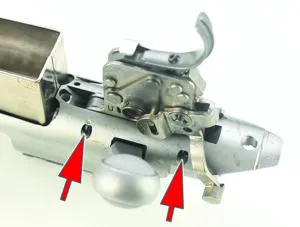
The second place we normally pick on Remingtons is with the trigger. Ours is equipped with the X-Mark Pro. Even though it had a very respectable 2.27-pound pull, we thought it was a bit mushy on the break. We lightened the adjustment screw as much as possible — to the point where it protruded from the face of the trigger and we could feel it with our index finger. The Remington trigger also contains the bolt release in a design we think is more fragile than it should be. That release is then connected to a bolt stop that can also be fragile. The average hunter using this design will probably never experience a problem with any of these gripes, but please note that the latest Remington 700s (from Remarms.com) are being shipped with a redesigned trigger from Timney.
The stock, which we thought was sleek and elegant, also reminded us of older concepts that might not be in favor anymore. Everything was well inletted with metal-to-wood fit being very good. The design provides sling swivel studs fore and after with a very good recoil pad on the back end.
The surprise was the raised pad in the barrel channel to maintain contact with the barrel. Current school of thought preaches that barrels should be free-floated (not in contact with the wood or any other surface) so it can vibrate freely for maximum accuracy. Some think the pads were used to properly stabilize barrels in cheaper, or less well-fit, stocks, though that is not the case here.
Our Remington 700 fed and fired everything perfectly. Recoil is mild and energy is good. Accuracy was okay. Factory 257 Roberts ammunition is somewhat hard to come by, and we were testing with a Remington standard-pressure load along with a Hornady +P load. The normal pressure load (117-grain JSP bullet at about 2670 fps) did well, averaging just under 1.25 inches for three-shot groups. The +P Hornady load generated substantially more energy with its more than 300 fps advantage in bullet muzzle velocity. We also had more trouble getting the factory ammo as well as various reloads pushing that kind of speed to group well. The Hornady 117-grain SST loads produced groups more in the 1.5-inch range, and some of our reloads were well over 2 inches.
Our Team Said: If this were not a semi-collector’s item, we would probably do some surgery on the stock to free-float the barrel and glass-bed the action. Since it is 1 of 200, we are going to leave it as is and work on reloads some more. There’s bound to be a combination out there this rifle loves.
| 257 ROBERTS RANGE DATA | ||
|---|---|---|
| Hornady Superformance 117-grain SST 81353 | Remington M700 CDL | Ruger M77 Hawkeye |
| Average Velocity | 3001 fps | 2941 fps |
| Muzzle Energy | 2340 ft.-lbs. | 2248 ft.-lbs. |
| Best Group Size | 1.08 in. | 2.41 in. |
| Average Group Size | 1.48 in. | 2.62 in. |
| Remington Core-Lokt 117-grain JSP 28335 | Remington M700 CDL | Ruger M77 Hawkeye |
| Average Velocity | 2671 fps | 2631 fps |
| Muzzle Energy | 1854 ft.-lbs. | 1799 ft.-lbs. |
| Best Group Size | 0.98 in. | 1.53 in. |
| Average Group Size | 1.22 in. | 1.78 in. |
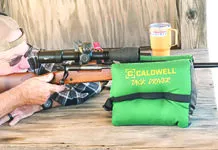
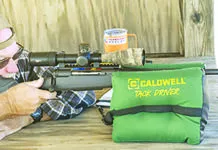
We fired three-round groups at 100 yards. All rifles were well-sandbagged in a Caldwell TackDriver Pro (Brownells 100-027-023, $49), further supported by a large rear bag, heavy from Tab Gear (TabGear.com, $34). Velocities were measured by Garmin Xero C1 Pro (Garmin.com, $600).
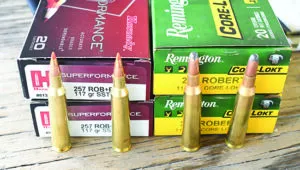
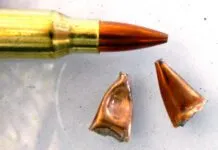
Factory ammo is somewhat limited for the 257 Roberts, but there is a substantial selection of .257-diameter bullets and suitable powders for the reloader. We tested with the Hornady 117-grain SST +P load (left) along with the 117-grain jacketed soft-point load (standard pressure) from Remington.
Written and photographed by Joe Woolley, using evaluations from Gun Tests Team members. GT