











Not-so-well-known cartridges tend to be shot from not-so-easily-found firearms, and such has been the case for us in trying to fulfill some reader requests for tests of traditional rounds. With our initial goal being to test a couple of samples chambered in 257 Roberts, we had our work cut out for us. Ruger still makes the Model 77 Hawkeye No. 37115, $950, in 257 Roberts, and we grabbed one of those quickly. With true controlled-round feeding, a three-position wing safety and a very nice walnut stock, the Hawkeye takes us back to the days of sporting stocks on nice Mauser-style actions.
Our second test rifle was a great deal harder to find and was substantially more expensive. We managed to locate a little piece of history, a Remington Model 700 Special. Essentially a Remington 700 CDL Stainless Fluted, our sample is a 75th anniversary model with a floorplate suitably engraved to commemorate that event. With a serial number that dates the rifle to 2009, our rifle is 1 of 200 produced, and the $1900 price tag represents its collector’s value. We had this rifle in mind from the beginning, and it took us several failed bids on Gunbroker.com and months to obtain.
Optics
The Houston Gun Tests group uses a number of quality optics to help us test rifles. We tend to stay with several Leupold and Vortex scopes that have performed well and consistently for us over the years. Every now and then we slip in a new piece of glass to see how it will do, and that was the case with this test.
We tried out a German Precision Optics (GPO) Spectra 6x 2-12×50 and liked what we saw. Mounting it on great deer-hunting rifles, we wanted a good deer-hunting scope. The magnification range was 2-12x — perfect for most anything in our world. The low-end magnification works well in heavy timber and low light, while the 12x would allow us to reach out and touch more-distant targets. The 50mm objective lens allowed in a great deal of light for early or late hunts as well as a very nice field of view. This GPO Spectra uses a second focal plane G4i Fiber reticle, which consists of a good duplex crosshair along with a very visible center red dot. All the images were clean and crisp, as were the adjustments. Street price is right around $825, and it weighs less than 21 ounces. We think we may have to pay more attention to this brand in the future.
The 257 Roberts was developed by Ned Roberts in the 1920s. Modified slightly from the original form; Remington legitimized the wildcat round and chambered it for their rifles starting in 1934. Essentially a 7×57 Mauser necked down to 25 caliber, the load was accurate and fairly hard hitting, especially for the powders available at the time. Not every rifle so chambered or converted to chamber this round was as strong as what we might expect today, and allowable pressures were adjusted accordingly. Standard-pressure rounds, designed to work well in the weaker firearms, were limited to 54,000 psi, though most of the loading data we’ve seen tops those loads out at about 45,000 psi.
Later, a higher-pressure load (+P) was designed for more strongly built rifles that could handle 58,000 psi. The resulting increase, at least in our testing, could add 400 to 500 foot-pounds to the downrange energy. Both of our test samples are modern production and can handle either pressure ceiling. For this test, we used a Hornady Superformance 117-grain SST load that is rated for a factory muzzle velocity of 2946 fps and muzzle energy of 2255 foot-pounds. The round maintains minimum whitetail energy past 400 yards (1102 foot-pounds at that range), according to the factory specs. Our second round was a jacketed soft point, a 117-grain Remington Core-Lokt, with a factory muzzle velocity of 2650 fps and muzzle energy of 1824 foot-pounds. It carries minimum whitetail energy only out to 200 yards (998 foot-pounds at that range), according to the factory specs. Here’s how the rounds performed in our test rifles.
Ruger Model 77 Hawkeye 37115 257 Roberts,
$950
Gun Tests grade: B
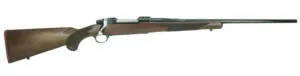
Sturdy and smooth, also bringing great wood and classic lines, we had a bit more trouble getting the Ruger to group well. It averaged 2.2 inches for three-shot strings. This Ruger Hawkeye is also much easier to find and a lot cheaper to buy, and there were a couple of other features we liked as well.
| Action Type | Bolt |
|---|---|
| Overall Length | 42.75 in. |
| Barrel Length/Twist | 22 in., 1:10 in. |
| Overall Height w/o Scope Mount | 6.5 in. |
| Weight Unloaded | 7.28 lbs. |
| Weight Loaded | 7.51 lbs. |
| Sight Radius | No sights |
| Action Finish | Satin blue |
| Barrel Finish | Satin blue |
| Magazine Capacity | 4 rounds |
| Magazine Type | Internal box |
| Stock | Walnut |
| Stock Drop at Comb | 0.5 in. |
| Stock Drop at Heel | 1.0 in. |
| Stock Bedding | None |
| Stock Buttplate | Rubber |
| Stock Length of Pull | 13.75 in. |
| Receiver Scope-Base Pattern | Ruger |
| Trigger Pull Weight | 3.53 lbs. |
| Safety | 3-position wing |
| Warranty | None written |
| Telephone | (336) 949-5200 |
| Website | Ruger.com |
| Made In | U.S. |
It somehow seems fitting that the second unit we used to test a round developed from the 7×57 Mauser cartridge is one that can trace many of its features back to a Mauser-designed rifle. But that isn’t the way it started. The original Model 77 had a claw extractor much like the original Mauser and early Winchester Model 70s, but it was a push-feed type. In a true controlled-round feed system, a claw extractor (which was on the early Model 77s) sits above the rim of the cartridge as it rises out of the magazine. It slides over the case rim and guides (controls) the case the entire way from the magazine into the chamber. We understand that those who hunt dangerous game greatly prefer that system because there is less chance for a misfeed in an adrenaline-packed moment. Pre-64 Winchesters used a controlled-round feed and had quite the following. At least they did until they revamped their product line to make it cheap enough to compete against the Remington Model 700.
While the first Model 77s were, in effect, an updated Mauser, there were still significant differences. Bill Ruger wanted to use investment casting instead of a forged receiver to save money and machining. His first offerings mounted a simpler plunger-type ejector a la the Remington along with a tang safety. This variant (and others very similar) lasted until 1991 when Ruger introduced the Mark II. Barrels on the new model were hammer forged in house; the safety, bolt, and trigger were significantly reworked; and they moved to a true controlled-round feed. This Hawkeye was introduced in 2006 and includes yet more improvements.
Our Hawkeye uses a 22-inch barrel (versus the 24-inch barrel for the Remington) while it sports the same 1-in-10 twist. This means it has the same limitations on stabilizing heavy bullets the Remington 700 does. But it offers something the Remington doesn’t. The Model 700 is a short-action rifle, limiting cartridges that can be chambered to about 2.85 inches in overall length. This Ruger Hawkeye uses a long action, thus allowing longer cases to be used. That is a moot point as long as the shooter is willing (and most will be perfectly happy to do so) to use a standard 257 Roberts cartridge.
But what if the shooter wants to experiment? Or reload? There are a number of high-BC bullets on the market now for 25-caliber rifles. What if the shooter wants to run a 128-grain or 134-grain bullet in his 257 Roberts rifle? Not gonna happen. It won’t fit, and then the slower rifling won’t stabilize the longer bullet. The solution is a new barrel with a longer throat in the chamber and fast-enough spin to stabilize the bullet.
There might be an even better solution in a cartridge case reworked to Ackley Improved (AI) status. In a concept conceived (and executed many times) by P.O. Ackley, the barrel is rechambered with a slightly different reamer that allows the brass to reformed. In his designs, taper in the case walls is blown out to where they are almost straight, then the shoulder is moved forward, thus increasing the powder capacity and potential velocity. BTW, his process improves the chamber but does so in a way that factory brass can still be fired without any problems. The Remington 700 with the short-action chamber does not lend itself to this option. The Ruger, with the 257 Roberts version chambered in a long-action receiver, does. This obviously isn’t for everyone, but there are any number of old cartridges that can be magnumized versions of the original with corresponding increases in energy and range.
Slab-sided and flat-bottomed, the Ruger Hawkeye action may be a bit more difficult to machine than the tubular Remington, but it allows Ruger to do some interesting things in securing the action to the wood. First, the sharp edges mate solidly with a well-inletted stock. The net effect is to secure the action in the stock so that it doesn’t torque under recoil. Ruger has also designed a different way to attach the stock to the action. The front action screw is angled and, when tightened, draws the action down into firm contact with the stock. Once again, Ruger is trying to make its rifles as solid and consistent as possible. The company even machines dovetails for proprietary scope rings directly into the receiver to eliminate one more place where a screw could come loose.
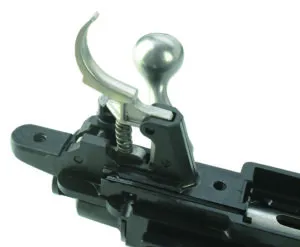
The rest of the action and attached parts are just as solid. The bolt body is a single piece of stainless steel. The ejector is a flat blade that protrudes through the face of the bolt when drawn fully to the rear. The result is very positive ejection. The bolt release is a spring-loaded lever on the left side of the receiver. The safety is a three-position lever that rotates around the bolt shroud. Fully forward is Fire. The middle position locks the sear but not the bolt, and the rear bolt locks everything. Note the center position allows the bolt to be worked — unloading a round if necessary — while the rest of the mechanism is locked down and safe. The trigger was pretty crisp and, while heavy for our tastes at 3.53 pounds average pull weight, measured on our Lyman digital scale. That might be perfect for you.
The Hawkeye’s floorplate also sports the Ruger logo with some elegant engraving. Be careful when you reassemble your Hawkeye — if you get the torque wrong on the action screws, it makes the floorplate difficult to close. Trust us here.
The Hawkeye’s wooden stock doesn’t quite match the limited edition Remington, but it doesn’t miss it by much. Made out of black walnut, it shows some very nice grain and checkering where it needs to be. The patterns looked good, but the execution was a little off, with several areas showing cross checkering. Our Hawkeye sports two sling-swivel studs where we would expect them to be. The bottom of the pistol grip shows a nice black cap with the Ruger logo. The recoil pad is thin, pink, and not all that soft, but the 257 Roberts doesn’t require a great deal of padding.
Our Team Said: Everything fed and functioned smoothly in the Ruger, as we would have expected. That said, the rifle wasn’t as accurate as we would have liked. Once again, the Hornady 117-grain SST +P loads shot the largest groups, averaging 2.62 inches for three shots. The Remington 117 JSP came in at 1.78 inches. That could easily mean that we just haven’t found the perfect load for either of these rifles, but we would probably pass on the Ruger in 257 Roberts unless we were willing to experiment until we found a load it liked.
| 257 ROBERTS RANGE DATA | ||
|---|---|---|
| Hornady Superformance 117-grain SST 81353 | Remington M700 CDL | Ruger M77 Hawkeye |
| Average Velocity | 3001 fps | 2941 fps |
| Muzzle Energy | 2340 ft.-lbs. | 2248 ft.-lbs. |
| Best Group Size | 1.08 in. | 2.41 in. |
| Average Group Size | 1.48 in. | 2.62 in. |
| Remington Core-Lokt 117-grain JSP 28335 | Remington M700 CDL | Ruger M77 Hawkeye |
| Average Velocity | 2671 fps | 2631 fps |
| Muzzle Energy | 1854 ft.-lbs. | 1799 ft.-lbs. |
| Best Group Size | 0.98 in. | 1.53 in. |
| Average Group Size | 1.22 in. | 1.78 in. |
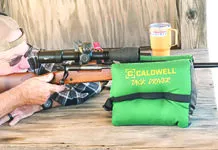
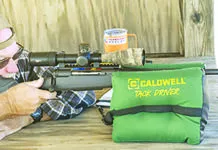
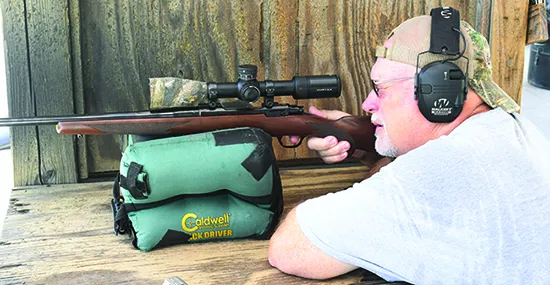
We fired three-round groups at 100 yards. All rifles were well-sandbagged in a Caldwell TackDriver Pro (Brownells 100-027-023, $49), further supported by a large rear bag, heavy from Tab Gear (TabGear.com, $34). Velocities were measured by Garmin Xero C1 Pro (Garmin.com, $600)
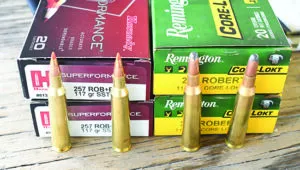
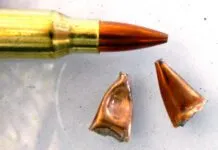
Factory ammo is somewhat limited for the 257 Roberts, but there is a substantial selection of .257-diameter bullets and suitable powders for the reloader. We tested with the Hornady 117-grain SST +P load (left) along with the 117-grain jacketed soft-point load (standard pressure) from Remington.
Written and photographed by Joe Woolley, using evaluations from Gun Tests Team members. GT