







Convertible six-shooters offer the ability to fire multiple cartridges in one gun with just a swap of the cylinder. These are practical revolvers for a variety of users, from preppers and hunters to target shooters and those wanting to protect the homestead. Because they have the ability to fire whatever ammo is available at your local gun shop or online, they are versatile. The most common centerfire convertible combination is a cylinder chambered in 357 Magnum/38 Special and another cylinder chambered in 9mm.
Two 357 Magnum/9mm convertible revolvers we acquired were a Taylor’s & Company Cattleman and Ruger’s New Model Blackhawk Convertible. Both are Single Action Army–style six-shot revolvers chambered in 357 Magnum/38 Special and include an additional cylinder in 9mm. The chambers in the 9mm cylinders are stepped so the rimless 9mm case mouth headspaces on the step. In the 357 Magnum cylinders, the cartridges headspace on the rims. You can’t load 9mm cartridges into the 357 Magnum cylinder chambers, and a 357 Magnum/38 Special cartridge bottoms out on the headspace for the 9mm. So there is no worry about loading the wrong cartridge into the wrong cylinder. From that point, the details differ between the two revolvers, which we’ll get into.
This combination of cartridges allows a user to train with inexpensive 9mm, while keeping the more powerful and more expensive 357 Magnum ammo for defense or hunting. A recent look on LuckyGunner.com had 9mm ammo averaging 22 to 25 cents a round, 38 Special averaged 37 to 46 cents, and 50 to 68 cents a round for 357 Magnum, on average. Because these three cartridges are popular, there should be no problem finding ammo to feed your convertible revolver. That’s the upside with these two revolvers.
On the downside, we all know 38 Special and 357 Magnum have a different point of impact using the same point of aim. With three different cartridges in the mix, shooters may need to use a bit of Kentucky elevation. Barrel-twist rate in these revolvers is also generic in the sense that the rifling needs to be compatible with 9mm, 357 Magnum, and 38 Special. Typical 9mm twist rates are 1:10 inches or 1:16 inches, while 357 Magnum rifling can be 1:14, 1:16, or 1:18, depending on the revolver manufacturer. Standard twist rate for 38 Special revolvers is typically 1:18.75 inches, though there are some manufacturers that use 1:16.5 inches.
Bullet diameters also differ between 9mm Luger, 357 Magnum, and 38 Special. The diameter of 9mm Luger bullets is 0.355 inch and 357 Magnum/38 Special bullets have a diameter of 0.370. What this all means is the convertible revolver twist rate is not optimal for all three cartridges. Because these guns are not used for target shooting, the difference we found is moot, but you will need to test different bullet weights to understand what your revolver shoots best.
We tested the differences in point of aim and point of impact between the three cartridges at 15 yards by using the same point of aim, the 6 o’clock position on a 3-inch bullseye. The good news is that when all the ammo was tested head to head, we did not have dramatic differences in point of impact. This difference is due to the velocity of the rounds. Slower 38 Special bullets take longer to exit the barrel as the revolver is flipping up during recoil, hence the reason 38 Special rounds print higher than 357 Magnum hits. The 357 Magnum is coming out of the barrel faster, so is the 9mm.
We opted to try two different loads in each cartridge, an inexpensive training round and a defensive load. In 9mm we chose Remington 115-grain FMJ training ammo and Federal 124-grain Hydra-Shok JHPs. In 38 Special, we used a Hornady +P Critical Defense load with a 110-grain FTX bullet and Blazer aluminum cases with 158-grain lead round-nose bullets. For 357 Magnum ammo, we fired Winchester White Box with a 110-grain JHP and Blazer Brass with 158-grain JHPs.
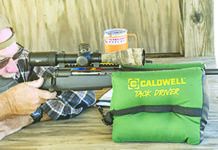
We tested for accuracy and the difference in point of impact at 15 yards and fired a speed drill at 7 yards shooting NRA D-1 tombstone-style targets. Here is our take on these two convertible single-action revolvers.
Ruger New Model Blackhawk Convertible 0308 357 Magnum/9mm,
$736
Gun Tests grade: A-
The Blackhawk Convertible has excellent sights and good accuracy across all cartridges. Point of impact changed slightly between cylinders. The trigger-pull weight was decent. Swapping cylinders was tricky at times.
| Action Type | Single-action revolver |
|---|---|
| Overall Length | 10.5 in. |
| Barrel | 4.6 in. long, 1:16-in. RH twist |
| Sight Radius | 6.0 in. |
| Overall Height | 5.3 in. |
| Maximum Width | 1.7 in. |
| Weight Unloaded | 42.0 oz. |
| Weight Loaded (357 Magnum) | 44.8 oz. |
| Cylinder Gap (357 Magnum) | 0.007 in. |
| Cylinder Gap (9mm Luger) | 0.005 in. |
| Capacity | 6 |
| Frame | Blued steel |
| Barrel | Blued steel |
| Cylinder | Blued steel |
| Frame Front Strap Height | 2.3 in. |
| Frame Back Strap Height | 3.5 in. |
| Grip | Black checkered plastic |
| Grip Thickness (Maximum) | 1.3 in. |
| Grip Circumference (Maximum) | 6.0 in. |
| Front Sight | Ramp |
| Rear Sight | Adjustable |
| Trigger Pull Weight | 3.1 lbs. |
| Trigger Span | 2.9 in. |
| Safety | Transfer bar |
| Warranty | None written |
| Telephone | (336) 949-5200 |
| Website | Ruger.com |
| Made In | U.S. |
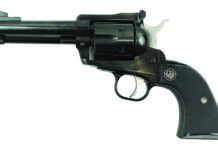
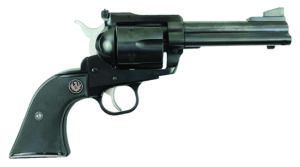
The New Model Blackhawk Convertible was introduced in 1973 and quickly become the benchmark in modern SAA revolvers as well as convertible revolvers. Our sample wore a well-executed blue finish and checkered plastic grips. The trigger and hammer is a bright stainless finish that contrasts nicely with the blue. It featured a 4.6-inch barrel. The twist rate in the Blackhawk is 1:16 inch.
The ramp front sight is a good match with the adjustable notch rear sight. These sights are large and offer a good sight picture. The front-sight ramp is serrated and the rear-sight notch is recessed to reduce sun glare. There is plenty of daylight on the sides of the front blade when aiming.
The New Model Blackhawk’s trigger is wide and smooth, while the hammer spur is coarsely serrated for plenty of traction when cocking the hammer.
In hand, the Ruger feels heavier than a traditional SAA and has slightly different balance. It has been said the Blackhawk revolvers are overbuilt compared to traditional SAAs.
The Ruger offers simplicity when loading and unloading. The Blackhawk does not have a reverse indexing pawl like Ruger’s Vaquero single-actions, and we missed that in the Blackhawk. Spin the cylinder too far, and you need to make a full rotation to get back to that chamber. Loading the Ruger is different from loading a traditional SAA. With the hammer and trigger fully forward, open the gate to expose the chambers, and then load. The front edge of cylinder has a slight bevel to ease reholstering. All six chambers can be loaded because the Blackhawk has a transfer-bar safety system. No worries if the revolver is accidentally dropped on the hammer.
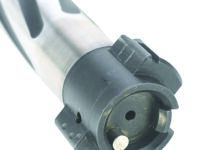
The ejector head is a small round tab that does not pivot away from the barrel, but we didn’t sear a finger tip ejecting cases after extensive firing.
Removing the cylinder to swap cartridges requires the loading gate to be opened. Press the base-pin latch to pull out the base pin. There is plenty of gripping texture on the base pin grooves to pull it free. The base pin is captured by the ejector tab, so it can’t be accidentally lost while in the field or under your work bench. The cylinder then rolls out the loading-gate side of the frame. Swapping cylinders required a bit of finesse to align the cylinder and re-insert the base pin. The more we swapped cylinders, the faster we became. We wished there was an easier way to tell the difference between the cylinders.
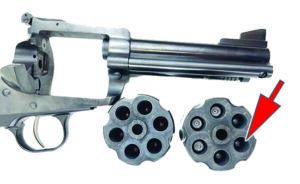
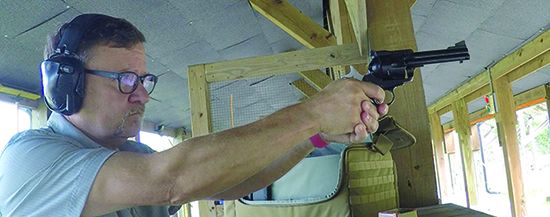
Going hot at 7 yards on the tombstones, we found the Blackhawk’s sights were fast to acquire. The wide trigger had a clean, consistent break at 3.1 pounds. Using a two-hand grip, we cocked the Ruger with the thumb of our support hand and held back the trigger. We could get off shots fast. Recoil with 357 Magnum was comfortable because the pistol curls up in the grip. Recoil for 38 Special and 9mm was mild. The 9mm cartridges need to be pressed fully into the chambers to ensure they are seated. If we didn’t seat the cartridges, the cartridge base bound up cylinder rotation. The 357 Magnum and 38 Special cartridges dropped into the chambers. Initially, a few of the 9mm Remington UMC cases stuck inside the cylinder, and we had to forcibly use the ejector rod to remove them from the cylinder. As we continued to fire 9mm, there were fewer sticky cases.
Changing to accuracy testing, the Blackhawk shot its best groups with 357 Magnum, which was with Blazer Brass and measured 1.14 inches. The average was 1.24 inches. The Winchester 357 Magnum ammo had a best group of 1.96 inches and averaged 2.07 inches. The 38 Special ammo printed higher, and the best group measured 1.30 inches with Blazer 158-grain lead round-nose bullets, with the average being 1.33 inches. The best 9mm group was with Federal Hydra-Shok that measured 1.61 inches. Remington UMC had a best of 1.95 inches and an average of 1.97 inches. The deviation among the three cartridges from point of aim to point of impact averaged 4.70 inches, which means a slight bit of Kentucky elevation is required when swapping cartridges.
Our Team Said: The Blackhawk was the more accurate revolver in the test, and we attribute that to the sights and a fairly good trigger, which allowed us to shoot under 2 inches at 15 yards with all cartridges. The stuck 9mm cases at times were a pain, but that did relieve itself as the gun was used. The cylinder fit was tight and needed to be finessed when reassembling the revolver during a cylinder swap. Loading and unloading the Blackhawk is easy and intuitive for those not acquainted with traditional SAA revolvers. The Blackhawk preferred 357 Magnum Ammo, and we would opt for this revolver if hunting and self defense were its main purposes. The 9mm option is nice to have and makes for inexpensive plinking.
| 357 MAGNUM RANGE DATA | ||
|---|---|---|
| Winchester White Box 110-grain JHP | Ruger New Model Blackhawk | Taylor’s & Co. Cattleman |
| Average Velocity | 1303 fps | 1395 fps |
| Muzzle Energy | 432 ft.-lbs. | 476 ft.-lbs. |
| Smallest Group | 1.96 in. | 1.72 in. |
| Average Group | 2.07 in. | 1.93 in. |
| Blazer Brass 158-grain JHP | Ruger New Model Blackhawk | Taylor’s & Co. Cattleman |
| Average Velocity | 1280 fps | 1290 fps |
| Muzzle Energy | 575 ft.-lbs. | 584 ft.-lbs. |
| Smallest Group | 1.14 in. | 1.98 in. |
| Average Group | 1.24 in. | 2.05 in. |
| 38 SPECIAL RANGE DATA | ||
|---|---|---|
| Hornady Critical Defense* 110-grain FTX | Ruger New Model Blackhawk | Taylor’s & Co. Cattleman |
| Average Velocity | 1092 fps | 1099 fps |
| Muzzle Energy | 291 ft.-lbs. | 295 ft.-lbs. |
| Smallest Group | 2.11 in. | 1.80 in. |
| Average Group | 2.15 in. | 1.96 in. |
| Blazer (aluminum case) 158-grain LRN | Ruger New Model Blackhawk | Taylor’s & Co. Cattleman |
| Average Velocity | 781 fps | 768 fps |
| Muzzle Energy | 214 ft.-lbs. | 207 ft.-lbs. |
| Smallest Group | 1.30 in. | 1.93 in. |
| Average Group | 1.33 in. | 2.01 in. |
| 9MM LUGER RANGE DATA | ||
|---|---|---|
| Federal Hydra-Shok 124-grain JHP | Ruger New Model Blackhawk | Taylor’s & Co. Cattleman |
| Average Velocity | 1181 fps | 1095 fps |
| Muzzle Energy | 384 ft.-lbs. | 330 ft.-lbs. |
| Smallest Group | 1.61 in. | 1.65 in. |
| Average Group | 1.73 in. | 2.06 in. |
| Remington UMC 115-grain FMJ | Ruger New Model Blackhawk | Taylor’s & Co. Cattleman |
| Average Velocity | 1265 fps | 1180 fps |
| Muzzle Energy | 408 ft.-lbs. | 355 ft.-lbs. |
| Smallest Group | 1.95 in. | 1.41 in. |
| Average Group | 1.97 in. | 1.46 in. |
*+P load. To collect accuracy data, we fired five-shot groups from a bench using a rest. Distance: 15 yards with open sights. Velocities and energies were recorded using a Garmin Xero C1 Pro chronograph.
Written and photographed by Robert Sadowski, using evaluations from Gun Tests Team members. GT