

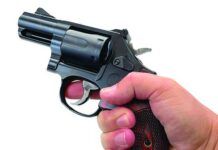






Convertible six-shooters offer the ability to fire multiple cartridges in one gun with just a swap of the cylinder. These are practical revolvers for a variety of users, from preppers and hunters to target shooters and those wanting to protect the homestead. Because they have the ability to fire whatever ammo is available at your local gun shop or online, they are versatile. The most common centerfire convertible combination is a cylinder chambered in 357 Magnum/38 Special and another cylinder chambered in 9mm.
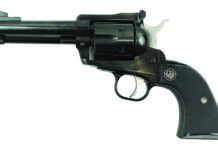
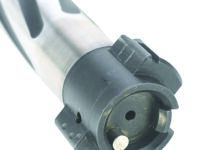
Two 357 Magnum/9mm convertible revolvers we acquired were a Taylor’s & Company Cattleman and Ruger’s New Model Blackhawk Convertible. Both are Single Action Army–style six-shot revolvers chambered in 357 Magnum/38 Special and include an additional cylinder in 9mm. The chambers in the 9mm cylinders are stepped so the rimless 9mm case mouth headspaces on the step. In the 357 Magnum cylinders, the cartridges headspace on the rims. You can’t load 9mm cartridges into the 357 Magnum cylinder chambers, and a 357 Magnum/38 Special cartridge bottoms out on the headspace for the 9mm. So there is no worry about loading the wrong cartridge into the wrong cylinder. From that point, the details differ between the two revolvers, which we’ll get into.
This combination of cartridges allows a user to train with inexpensive 9mm, while keeping the more powerful and more expensive 357 Magnum ammo for defense or hunting. A recent look on LuckyGunner.com had 9mm ammo averaging 22 to 25 cents a round, 38 Special averaged 37 to 46 cents, and 50 to 68 cents a round for 357 Magnum, on average. Because these three cartridges are popular, there should be no problem finding ammo to feed your convertible revolver. That’s the upside with these two revolvers.
On the downside, we all know 38 Special and 357 Magnum have a different point of impact using the same point of aim. With three different cartridges in the mix, shooters may need to use a bit of Kentucky elevation. Barrel-twist rate in these revolvers is also generic in the sense that the rifling needs to be compatible with 9mm, 357 Magnum, and 38 Special. Typical 9mm twist rates are 1:10 inches or 1:16 inches, while 357 Magnum rifling can be 1:14, 1:16, or 1:18, depending on the revolver manufacturer. Standard twist rate for 38 Special revolvers is typically 1:18.75 inches, though there are some manufacturers that use 1:16.5 inches.
Bullet diameters also differ between 9mm Luger, 357 Magnum, and 38 Special. The diameter of 9mm Luger bullets is 0.355 inch and 357 Magnum/38 Special bullets have a diameter of 0.370. What this all means is the convertible revolver twist rate is not optimal for all three cartridges. Because these guns are not used for target shooting, the difference we found is moot, but you will need to test different bullet weights to understand what your revolver shoots best.
We tested the differences in point of aim and point of impact between the three cartridges at 15 yards by using the same point of aim, the 6 o’clock position on a 3-inch bullseye. The good news is that when all the ammo was tested head to head, we did not have dramatic differences in point of impact. This difference is due to the velocity of the rounds. Slower 38 Special bullets take longer to exit the barrel as the revolver is flipping up during recoil, hence the reason 38 Special rounds print higher than 357 Magnum hits. The 357 Magnum is coming out of the barrel faster, so is the 9mm.
We opted to try two different loads in each cartridge, an inexpensive training round and a defensive load. In 9mm we chose Remington 115-grain FMJ training ammo and Federal 124-grain Hydra-Shok JHPs. In 38 Special, we used a Hornady +P Critical Defense load with a 110-grain FTX bullet and Blazer aluminum cases with 158-grain lead round-nose bullets. For 357 Magnum ammo, we fired Winchester White Box with a 110-grain JHP and Blazer Brass with 158-grain JHPs.
We tested for accuracy and the difference in point of impact at 15 yards and fired a speed drill at 7 yards shooting NRA D-1 tombstone-style targets. Here is our take on these two convertible single-action revolvers.
Taylor’s & Company Cattleman 5.5-Inch RC1/551019DE 357 Magnum/9mm Luger
$965
Gun Tests grade: A-
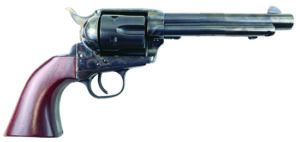
The Uberti-made Cattleman pistol is a classically styled Single Action Army design with a light trigger pull. Accuracy at the range was good. This single action was faster to shoot. Swapping cylinders was a breeze.
| Action Type | Single-action revolver |
|---|---|
| Overall Length | 11.1 in. |
| Barrel | 5.5 in. long, 1:18.75 in. twist rate |
| Sight Radius | 6.3 in. |
| Overall Height | 5.0 in. |
| Maximum Width | 1.6 in. |
| Weight Unloaded | 40 oz. |
| Weight Loaded (357 Magnum) | 42.8 oz. |
| Cylinder Gap (357 Magnum) | 0.005 in. |
| Cylinder Gap (9mm Luger) | .0.005 in. |
| Capacity | 6 |
| Frame | Case hardened steel |
| Barrel | Blued steel |
| Cylinder | Blued steel |
| Frame Front Strap Height | 2.2 in. |
| Frame Back Strap Height | 3.5 in. |
| Grip | Smooth walnut |
| Grip Thickness (Maximum) | 1.5 in. |
| Grip Circumference (Maximum) | 6.2 in. |
| Front Sight | Blade |
| Rear Sight | Integral notch |
| Trigger Pull Weight | 2.8 lbs. |
| Trigger Span | 2.8 in. |
| Safety | Retractable firing pin |
| Warranty | 1 Year |
| Telephone | (540) 722-2017 |
| Website | TaylorsFirearms.com |
| Made In | Italy (Uberti) |
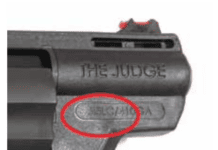
The Cattleman is a traditionally styled SAA with a 5.5-inch barrel, a 1:18.75 twist rate, and fixed sights. The fame and hammer wear a beautiful case-hardened finish, while the barrel, cylinder, and grip frame are blued. The side of the barrel is roll-marked “MOD.1873 9 mm Luger,” which we thought was odd. We thought it should have been marked “357 Magnum.” Taylor’s does make a dedicated 9mm SAA, so perhaps they are adding 357 Magnum cylinders to their 9mm models. A smooth one-piece walnut grip was well fitted to the frame, with no sharp edges overlapping the frame, which can irritate your hand in recoil.
The front-blade sight is wide and easy to align in the notch milled in the top strap. The Ruger’s sights were much easier to acquire and aim, we thought.
The trigger is the traditional skinny SAA trigger. We like the 2.8-pound pull weight that was clean and crisp with no creep — just like a SAA trigger should be. The hammer spur has a nice patch of checkering so there is no slipping when cocking it. The floating firing pin in the hammer is a safety feature unique to Taylor’s and many Uberti-built SAA revolvers. To fire the pistol, the trigger must be pulled fully to the rear to engage the firing pin. This system allows the Cattleman to be safely carried loaded with six rounds. Still, out of an abundance of caution, our recommendation is to load five and have the hammer rest on an empty chamber.
The 357 Magnum cylinder has a removable bushing, which traditional SAAs incorporated when black-powder cartridges were high tech. The 9mm cylinder does not have a removable bushing. We don’t think anyone will be reloading 9mm with black powder anyway. The front edges of the cylinders have a decent chamfer for ease in reholstering. Other than the bushing, the 357 Magnum cylinder is discreetly marked “357 MAG.” on the rear of the cylinder. We wish there was a more conspicuous way the cylinders could be marked to easily tell them apart, especially when they are installed. Perhaps a milled ring on the outside or maybe an unfluted cylinder or a cylinder with longer flutes. Swapping cylinders follows the traditional SAA procedure: Place the hammer at half cock, flip open the loading gate, press the base pin button and pull out the base pin, then roll the cylinder out the via the loading gate. The base pin comes completely out. Swapping cylinders was much easier and quicker with the Taylor’s.
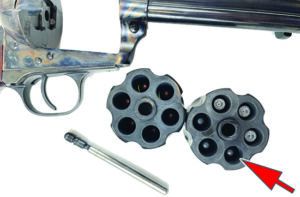
The ejector head is crest shaped and large, plus it rotates away from the barrel when shucking empty cases from the chambers. We prefer this style of ejector because the shooter’s finger tip is not near the hot barrel. To load, place the hammer at half cock and open the loading gate. Load one chamber, skip one, then load the rest for a total of five rounds. This is the safe way to carry a traditional SAA.
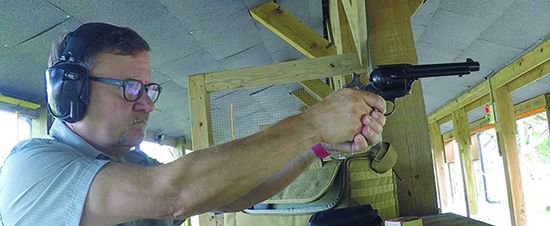
At 7 yards, the Cattleman allowed us to do fast, accurate work. We cocked the hammer with our support-hand thumb and held back the trigger. Texture on the hammer spur was just the right amount to let the support-hand thumb slip off and fire the shot. All 357 Magnum/38 Special cases fell from the chambers, even the aluminum-case Blazers. Most of the 9mm empties fell free, too, but some needed a light prodding from the ejector rod.
The best five-shot group was with the 9mm Remington at 1.41 inches. The average was 1.47 inches. Next best was Federal Hydra-Shok 9mms, with a best group of 1.65 inches and an average of 2.06 inches. The different twist rate in the Taylor’s favored 9mm ammo. Now we know why 9mm is roll marked on the barrel. The next-best group was with Winchester White Box 357 Magnum, which produced best group size of 1.72 inches and an average of 1.93 inches. Blazer Brass had a best of 1.98 inches and an average of 2.05 inches. The 38 Special Loads had similar accuracy to the 357 Magnums. The best with 38 Special was the hot Hornady Critical Defense, with a 1.80-inch group and an average of 1.96 inches. The aluminum-case Blazers had a best of 1.93 inches and an average of 2.01 inches. The deviation between all three cartridges measured 5.25 inches at 15 yards. Again, a slight bit of Kentucky elevation is required when shooting different cartridges.
We had no issues with the Taylor’s. Cartridges were easy to chamber, and stuck empties took no effort to eject when we needed to use the ejector rod.
Our Team Said: The Taylor’s offers a traditionally-styled SAA built for 9mm yet is capable of firing 357 Magnums and 38 Special rounds with good accuracy. We liked this revolver. This is your option if you want a more classically styled SAA.
| 357 MAGNUM RANGE DATA | ||
|---|---|---|
| Winchester White Box 110-grain JHP | Ruger New Model Blackhawk | Taylor’s & Co. Cattleman |
| Average Velocity | 1303 fps | 1395 fps |
| Muzzle Energy | 432 ft.-lbs. | 476 ft.-lbs. |
| Smallest Group | 1.96 in. | 1.72 in. |
| Average Group | 2.07 in. | 1.93 in. |
| Blazer Brass 158-grain JHP | Ruger New Model Blackhawk | Taylor’s & Co. Cattleman |
| Average Velocity | 1280 fps | 1290 fps |
| Muzzle Energy | 575 ft.-lbs. | 584 ft.-lbs. |
| Smallest Group | 1.14 in. | 1.98 in. |
| Average Group | 1.24 in. | 2.05 in. |
| 38 SPECIAL RANGE DATA | ||
|---|---|---|
| Hornady Critical Defense* 110-grain FTX | Ruger New Model Blackhawk | Taylor’s & Co. Cattleman |
| Average Velocity | 1092 fps | 1099 fps |
| Muzzle Energy | 291 ft.-lbs. | 295 ft.-lbs. |
| Smallest Group | 2.11 in. | 1.80 in. |
| Average Group | 2.15 in. | 1.96 in. |
| Blazer (aluminum case) 158-grain LRN | Ruger New Model Blackhawk | Taylor’s & Co. Cattleman |
| Average Velocity | 781 fps | 768 fps |
| Muzzle Energy | 214 ft.-lbs. | 207 ft.-lbs. |
| Smallest Group | 1.30 in. | 1.93 in. |
| Average Group | 1.33 in. | 2.01 in. |
| 9MM LUGER RANGE DATA | ||
|---|---|---|
| Federal Hydra-Shok 124-grain JHP | Ruger New Model Blackhawk | Taylor’s & Co. Cattleman |
| Average Velocity | 1181 fps | 1095 fps |
| Muzzle Energy | 384 ft.-lbs. | 330 ft.-lbs. |
| Smallest Group | 1.61 in. | 1.65 in. |
| Average Group | 1.73 in. | 2.06 in. |
| Remington UMC 115-grain FMJ | Ruger New Model Blackhawk | Taylor’s & Co. Cattleman |
| Average Velocity | 1265 fps | 1180 fps |
| Muzzle Energy | 408 ft.-lbs. | 355 ft.-lbs. |
| Smallest Group | 1.95 in. | 1.41 in. |
| Average Group | 1.97 in. | 1.46 in. |
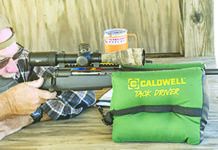
*+P load. To collect accuracy data, we fired five-shot groups from a bench using a rest. Distance: 15 yards with open sights. Velocities and energies were recorded using a Garmin Xero C1 Pro chronograph.
Written and photographed by Robert Sadowski, using evaluations from Gun Tests Team members. GT