









We decided to call this match-up 9mm target pistols in lieu of 9mm match-ready pistols because a true competition pistol is a specialized and expensive piece of equipment designed to take full advantage of a particular shooting discipline’s rules. Many gun brands modify a standard-size duty pistol and rebrand it as a “competition” pistol. In some cases, like we experienced in this match up, one brand just added a longer barrel to a standard-size frame. In this review, we looked at these target pistols through the lens of someone wanting to try out competitive shooting with something out of the box that would not hamstring them or make them feel under-gunned at the range. Or guns that would fit someone who just wants a fast-shooting range blaster, more target pistol than duty pistol. Features we looked for in this trio included good accuracy, a decent trigger, easy-to-use sights, smooth cycling, plenty of extra magazines, and controls that make the pistol easy to operate.
We looked at three out-of-the-box solutions: the Glock G17L Gen5, Heckler & Koch VP9 Match OR, and the Smith & Wesson Performance Center M&P9 M2.0 Competitor. All of these pistols are built from standard-duty models but have features advantageous for shooting cardboard and steel targets fast.
One of these pistols sort of delivered on the goods, one didn’t, and one fell apart.
The common denominators are longer barrels than a typical full-size service pistol, 9mm chamberings, striker-fire trigger actions, open sights and optics-ready slide cuts, and modular grips. The Glock and the HK have polymer frames, and the S&W has an aluminum frame.
We used open sights on all the guns, though all the pistols came optics ready, because this match-up is an out-of-the-box test. Numerous aftermarket sights are available for all three guns, too.
We used target ammo as well as training ammo to get a feel of how these pistols would run with light target loads and inexpensive training ammo. These are the types of fodder you would use in a local gun-club competition, for bragging rights at the public range, or at the dirt bank in your country house’s backyard. Training ammo included Remington UMC 115-grain and Panther Ammunition 124-grain rounds, both of which fire full-metal-jacket bullets. Target ammo came from Atlanta Arms and included the company’s Elite Steel Challenge round with a 115-grain FMJ and Classic Match with a 147-grain FMJ. The Classic Match is loaded to a muzzle velocity of about 900 fps, depending on the gun and barrel length. It is designed to have an IDPA 130 Power Factor, so it is soft shooting. The Elite Steel Challenge ammo was developed specifically for Steel Challenge competition shooting, and it, too, is soft recoiling, with a factory muzzle velocity of about 1070 fps, depending on the pistol.
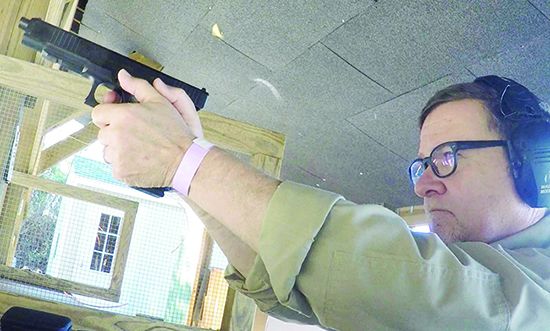
We tested accuracy at 15 yards using a rest and found the HK was stellar, closely followed by the S&W. The Glock was left in the dust. For speed shooting, we set D-1 NRA tombstone targets at 10 yards and fired modified Bill Drills at them. At 7 yards, we shot the Bauer Standard Drill. For those of you not familiar with the Bauer drill, it is simple. You perform it with a holstered pistol or at low ready. The target is two rectangles with a small circle between them. The idea is to shoot five rounds in one of the boxes, transition to the next box with another five rounds, conduct an empty-gun reload, and finish with three rounds in the circle. This drill helps with speed shooting, trigger press, recoil recovery, transitioning between targets, magazine reloads, and accuracy. It is a lot of fun, and if you are using a timer, 9 seconds or less is a passing grade, but you don’t need a timer. This drill also gives you a good sense of how you and the pistol will perform under pressure. The weather was humid during this review, which also gave us better insights on the grip textures. After the brass cooled, two guns showed better features and usability, but one fell apart when we field stripped it. It was ugly. The third lagged behind and seemed dated. Here are the details.
Glock G17L MOS Gen5 9mm
$550
Gun Tests grade: C+
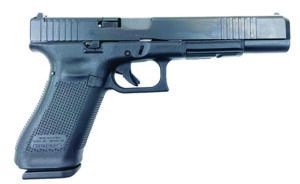
This was just a long-slide Glock with no real enhancements to make it a target pistol, other than the longer barrel. The G17L MOS Gen5 did not run on light target loads.
| Action Type | Semi-auto, short recoil, locked breech, tilting barrel |
|---|---|
| Trigger | Striker fired |
| Overall Length | 9.4 in. |
| Overall Height | 5.4 in. |
| Maximum Width | 1.3 in. |
| Weight Unloaded | 25.4 oz. |
| Weight Loaded | 32.4 oz. |
| Barrel Length | 6.0 in. |
| Slide | Steel |
| Slide Retraction Effort | 15.1 lbs. |
| Frame | Polymer |
| Frame Front Strap Height | 2.7 in. |
| Frame Back Strap Height | 3.5 in. |
| Grip | Checkered black polymer |
| Grip Thickness (Maximum) | 1.2 in. |
| Grip Circumference (Maximum) | 5.7 in. |
| Front Sight | Post white dot |
| Rear Sight | Outlined notch, optic ready |
| Trigger Pull Weight | 5.2 lbs. |
| Trigger Span | 2.7 in. |
| Magazines | (3) 17-rd. polymer |
| Safety | Trigger safety |
| Warranty | 1 year |
| Telephone | (770) 432-1202 |
| Website | US.Glock.com |
| Made In | Austria |
The G17L uses the frame of a G17 mated to a long slide and 6-inch barrel. The gun was first introduced in the 1980s and made a big splash in action-pistol shooting competitions. The competitions changed the rules, and the long-slide Glock was booted from matches, and that’s when the Glock G34 was developed to takes its place. The G17L has since been one of the least-popular Glock guns and is rarely in production in Glock’s line up. It was made in Gen1, Gen2, and Gen3 configurations, skipped Gen4, and returned with Fifth Generation guns. In our opinion, the latest version of the G17L falls in the shadow of earlier generations.
The G17L Gen5 comes in the typical Glock clamshell box with three 17-round magazines, modular grip straps, a magazine reloader, and Glock’s MOS optic-plate system to add a red dot. The pistol featured all the Gen5 items, like an improved trigger, which is one of the best Glock factory triggers, but is not a competition trigger. It broke at 5.2 pounds. Other features include front slide serrations, a flared magazine well, Glock Marksman barrel, ambidextrous slide-stop levers, flat front grip strap, and enlarged magazine floor plates.
The flat-front grip strap was comfortable for users with all sizes of fingers. The undercut trigger guard and Gen5 grip strap allow for better control. The front slide serrations made doing a press check easier. The Gen5 trigger was noticeably better than older generation triggers’ short, mushy take-up followed by a wall, and then the break at 5.7 pounds. Reset was long. This is a good trigger for a service pistol or concealed carry, but not on a pistol designed for competition. The sights — typical rear-outline notch and white dot front — were typical Glock, good for service and defense, but lacking for competition use. The rear grip straps help custom-fit the trigger reach, but they do nothing to fill the gap between the palm and grip.
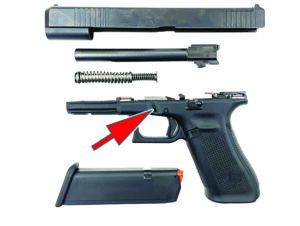
Going hot with the modified Bill Drill, the Glock choked on the light Atlanta Arms and the Panther training ammos. The muzzle-velocity data for this ammunition ranged from 866 fps up to 1100 fps. It would not cycle. We lubed the pistol and tried again, only to have consistent failures to extract (FTE) — classic stovepipe jams. Moving to the Remington ammo, the G17L cycled perfectly with no issues. The recoil had less snap due to the longer barrel. The slide cycle seemed like it took longer, but that was just the extra length of slide and barrel making its way back and forth. We decided to move on to accuracy testing to see if the G17L just needed a little breaking in. The best five-shot bench group at 15 yards was with the 115-grain Atlanta Arms Steel Elite Challenge rounds, which measured 1.25 inches and averaged 1.45 inches. That was good accuracy, especially with the service-issue trigger. We had hope the G17L would redeem itself. Next best was Remington UMC with a best of 1.96 inches and average 2.07 inches. The Classic Match 147-grain Atlanta Arms load had a best of 2 inches and an average of 2.17 inches. The Panther’s best was 2.19 inches, and it averaged 2.24 inches. Overall accuracy was good for a service gun. We just wanted more from an entry competition pistol. Plus, we experienced multiple FTE and FTF (failure to feed) jams using the Atlanta Arms and Panther ammunition.
Moving to the Bauer Standard Drill, we started with the Remington ammo, which we knew would run in the G17L, and we found that we needed to slow down and concentrate on the grip and trigger press to achieve perfect hits. When we tried to run the G17L faster, it was harder to control because the grip slipped as we sped up shots. The sights were easy to track. Reload speed was on par with any full-size Gen5 Glock. The G17L had no features to speed up the process or smooth the shooting out more. Magazines were easy to load, with the last few rounds being thumb busters.
Our Team Said: There was not much difference running the G17L compared to any Gen5 full-size 9mm Glock. Accuracy was good, but the trigger could have been better. We wonder why Glock didn’t factory install the Glock Performance Trigger on the G17L, which seems like a no-brainer to enhance the G17L’s match ability. We are also not sure what formal shooting competitions allow the G17L, so in the end we were left with a range blaster that choked on soft-recoiling ammo and had performance on par with a service pistol. We felt the Glock G17L was a let down, and we wouldn’t buy it.
| 9MM LUGER RANGE DATA | |||
|---|---|---|---|
| Remington UMC 115-grain FMJ | Glock G17L Gen5 | Heckler & Koch VP9 Match OR | S&W Performance Center. M&P9 M 2.0 Competitor 2 Tone |
| Average Velocity | 1303 fps | 1228 fps | 1158 fps |
| Muzzle Energy | 432 ft.-lbs. | 385 ft.-lbs. | 342 ft.-lbs. |
| Smallest Group | 1.96 in. | 0.69 in. | 1.26 in. |
| Average Group | 2.07 in. | 0.77 in. | 1.30 in. |
| Atlanta Arms Steel Challenge 115-grain FMJ | Glock G17L Gen5 | Heckler & Koch VP9 Match OR | S&W Performance Center M&P9 M 2.0 Competitor 2 Tone |
| Average Velocity | 1071 fps | 1122 fps | 1013 fps |
| Muzzle Energy | 293 ft.-lbs. | 321 ft.-lbs. | 262 ft.-lbs. |
| Smallest Group | 1.25 in. | 0.99 in. | 1.14 in. |
| Average Group | 1.45 in. | 1.00 in. | 1.19 in. |
| Panther Ammunition 124-grain FMJ | Glock G17L Gen5 | Heckler & Koch VP9 Match OR | S&W Performance Center M&P9 M 2.0 Competitor 2 Tone |
| Average Velocity | 1100 fps | 1132 fps | 1104 fps |
| Muzzle Energy | 333 ft.-lbs. | 353 ft.-lbs. | 335 ft.-lbs. |
| Smallest Group | 2.19 in. | 0.97 in. | 1.68 in. |
| Average Group | 2.24 in. | 1.09 in. | 1.74 in. |
| Atlanta Arms Classic Match 147-grain FMJ | Glock G17L Gen5 | Heckler & Koch VP9 Match OR | S&W Performance Center M&P9 M 2.0 Competitor 2 Tone |
| Average Velocity | 866 fps | 933 fps | 839 fps |
| Muzzle Energy | 245 ft.-lbs. | 284 ft.-lbs. | 229 ft.-lbs. |
| Smallest Group | 2.00 in. | 0.89 in. | 1.66 in. |
| Average Group | 2.17 in. | 0.91 in. | 1.71 in. |
To collect accuracy data, we fired five-shot groups from a bench using a rest. Distance: 15 yards with open sights. Velocities and energies were recorded using a Garmin Xero C1 Pro chronograph.
Written and photographed by Robert Sadowski, using evaluations from Gun Tests Team members. GT