










We decided to call this match-up 9mm target pistols in lieu of 9mm match-ready pistols because a true competition pistol is a specialized and expensive piece of equipment designed to take full advantage of a particular shooting discipline’s rules. Many gun brands modify a standard-size duty pistol and rebrand it as a “competition” pistol. In some cases, like we experienced in this match up, one brand just added a longer barrel to a standard-size frame. In this review, we looked at these target pistols through the lens of someone wanting to try out competitive shooting with something out of the box that would not hamstring them or make them feel under-gunned at the range. Or guns that would fit someone who just wants a fast-shooting range blaster, more target pistol than duty pistol. Features we looked for in this trio included good accuracy, a decent trigger, easy-to-use sights, smooth cycling, plenty of extra magazines, and controls that make the pistol easy to operate.
We looked at three out-of-the-box solutions: the Glock G17L Gen5, Heckler & Koch VP9 Match OR, and the Smith & Wesson Performance Center M&P9 M2.0 Competitor. All of these pistols are built from standard-duty models but have features advantageous for shooting cardboard and steel targets fast.
One of these pistols sort of delivered on the goods, one didn’t, and one fell apart.
The common denominators are longer barrels than a typical full-size service pistol, 9mm chamberings, striker-fire trigger actions, open sights and optics-ready slide cuts, and modular grips. The Glock and the HK have polymer frames, and the S&W has an aluminum frame.
We used open sights on all the guns, though all the pistols came optics ready, because this match-up is an out-of-the-box test. Numerous aftermarket sights are available for all three guns, too.
We used target ammo as well as training ammo to get a feel of how these pistols would run with light target loads and inexpensive training ammo. These are the types of fodder you would use in a local gun-club competition, for bragging rights at the public range, or at the dirt bank in your country house’s backyard. Training ammo included Remington UMC 115-grain and Panther Ammunition 124-grain rounds, both of which fire full-metal-jacket bullets. Target ammo came from Atlanta Arms and included the company’s Elite Steel Challenge round with a 115-grain FMJ and Classic Match with a 147-grain FMJ. The Classic Match is loaded to a muzzle velocity of about 900 fps, depending on the gun and barrel length. It is designed to have an IDPA 130 Power Factor, so it is soft shooting. The Elite Steel Challenge ammo was developed specifically for Steel Challenge competition shooting, and it, too, is soft recoiling, with a factory muzzle velocity of about 1070 fps, depending on the pistol.
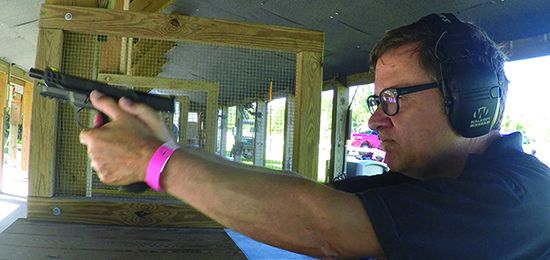
We tested accuracy at 15 yards using a rest and found the HK was stellar, closely followed by the S&W. The Glock was left in the dust. For speed shooting, we set D-1 NRA tombstone targets at 10 yards and fired modified Bill Drills at them. At 7 yards, we shot the Bauer Standard Drill. For those of you not familiar with the Bauer drill, it is simple. You perform it with a holstered pistol or at low ready. The target is two rectangles with a small circle between them. The idea is to shoot five rounds in one of the boxes, transition to the next box with another five rounds, conduct an empty-gun reload, and finish with three rounds in the circle. This drill helps with speed shooting, trigger press, recoil recovery, transitioning between targets, magazine reloads, and accuracy. It is a lot of fun, and if you are using a timer, 9 seconds or less is a passing grade, but you don’t need a timer. This drill also gives you a good sense of how you and the pistol will perform under pressure. The weather was humid during this review, which also gave us better insights on the grip textures. After the brass cooled, two guns showed better features and usability, but one fell apart when we field stripped it. It was ugly. The third lagged behind and seemed dated. Here are the details.
Smith & Wesson Performance Center M&P9 M2.0 Competitor 13718 9mm Luger
$950
Gun Tests grade: F/A-
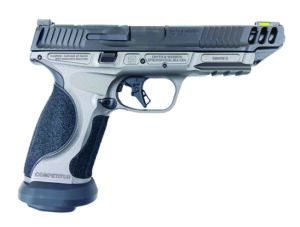
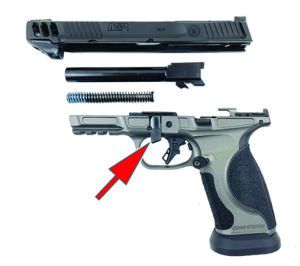
The crisp trigger and grip on the S&W Competitor offers a lot of control. Accuracy is good, and the oversized mag release and mag funnel smooth up reloads. Then the sear release lever fell out of the pistol during field stripping, which was an automatic F. We returned the gun to the manufacturer under warranty and got it back in a timely manner, and on the company’s nickel.
| Action Type | Semi-auto, short recoil, locked breech, tilting barrel |
|---|---|
| Trigger | Striker fired |
| Overall Length | 8.2 in. |
| Overall Height | 5.5 in. |
| Maximum Width | 1.3 in. |
| Weight Unloaded | 29.0 oz. |
| Weight Loaded | 36.3 oz. |
| Barrel Length | 5.0 in. |
| Slide | Steel |
| Slide Retraction Effort | 17 lbs. |
| Frame | Aluminum alloy |
| Frame Front Strap Height | 2.4 in. |
| Frame Back Strap Height | 3.6 in. |
| Grip | Textured black polymer, adjustable |
| Grip Thickness (Maximum) | 1.3 in. |
| Grip Circumference (Maximum) | 5.7 in. |
| Front Sight | Green fiber optic |
| Rear Sight | Fixed notch rear |
| Trigger Pull Weight | 4.5 lbs. |
| Trigger Span | 2.8 in. |
| Magazines | (4) 17-rd. steel |
| Safety | Trigger safety |
| Warranty | Limited |
| Telephone | (800) 331-0852 |
| Website | Smith-Wesson.com |
| Made In | U.S. |
This M&P9 M2.0 first appeared out of S&W’s Performance Shop in 2023 and was unique for the M&P series because it featured an aluminum frame. The frame adds a bit of weight to the pistol, and, unlike polymer frames that have some flex in them during recoil, metal frames transfer more recoil energy to the shooter.
Out of the box, the Competitor looked sharp. Our sample was the two-tone variant with a gray Cerakote frame and an Armornite black-finish slide. In the extra-large plastic case were four backstrap modules, four steel-body 17-round magazines with extended polymer base pads, five polymer optic plates to mount a red dot, a standard-size magazine release, and a standard-size backstrap retainer to use without the magazine well.
In hand, the Competitor felt great, with nice balance. The metal frame and longer barrel weigh 29 ounces, the same as a polymer-version M&P with a 4.25-inch barrel. Competition guns are typically heavier than duty guns to help mitigate recoil and get back on target faster. Inside the frame is a polymer buffer piece that the slide impacts in the back of the frame.
Four polymer back straps offer custom fitting. We really like the sandpaper texture that is not too abrasive, yet ensures your grip stays put on the pistol. There is a polymer insert in the front strap that also wears the texture, and it wiggled a little in the metal frame. We didn’t notice any movement when gripping and firing the pistol. These backstrap modular pieces also feature a palm swell, so your palm has full contact with the grip. There are smooth sections in the grip that funnel the trigger finger to the trigger. Some testers felt there should have been some texture there as well so the support hand has optimum traction.
The Smith & Wesson’s magwell is removable. You almost hear a slurping sound when inserting a fresh magazine. It is slick and smooth. A standard-size backstrap retainer pin is included if you wish to use the Competitor sans the magwell. One thing to note: Standard polymer-frame M&P magazines are not compatible with the magwell.
The ambidextrous slide stop has also been enhanced compared to the polymer-frame 2.0 M&Ps. It is small and sticks out from the frame, but is still low-profile enough not to accidentally press and interrupt slide lock. The magazine release is different from the polymer-frame M&P mag release. It is built like a 1911 mag release with a spring. It is also an oversized paddle and reversible. S&W includes a standard-size slide release in case you prefer the smaller profile. We found the paddle easy to operate with our shooting-hand thumb.
The slide has eight lightening cuts to reduce slide mass. Gone are the scalloped slide serrations, replaced with angled grooves that offer a good grasp. The rear serrations are milled deeper to provide ears at the rear of slide that give the user leverage to rack the slide when an optic is mounted. Sights consist of a HiViz tritium H3 front sight that really pops, and the rear is a black notch with serrations. Simple sights that are fast to use. The side has an optics plate cover in front of the rear sight. S&W shipped the pistol with a variety of plates to mount a range of optics. At the muzzle end, there is an angled Butler Cut in the slide that gives the gun its rakish good looks and eases re-holstering.
The trigger is a big improvement over the older hinged M&P triggers. The new trigger bar operates the trigger on the top, which changed the pivot point on the trigger so the trigger pull is reduced and feels more tactile. Reset is also faster. Trigger-pull weight on our sample averaged 4.5 pounds. It is very crisp and a very nice trigger.
Starting with the modified Bill Drill, the S&W offered the texture needed in humid conditions. The pistol stayed put in our grip with no abrasion, and we were able to shoot faster and push the envelope for speed. We did have a few initial FTF and FTE jams, and we attributed this to the gun needing a break-in period.
Moving to accuracy testing at 15 yards, the best five-shot group was with Atlanta Arms Elite Steel Challenge 115 grains at 1.14 inches and an average of 1.19 inches. Second-best group was with Remington UMC 115-grain bullets that measured 1.26 inches and averaged 1.30 inches. Third best was Atlanta Arms Classic Match 147 grainers with 1.66 inches and an average of 1.71 inches. Panther Ammunition with the 124-grain bullets had a best group, and that measured 1.68 inches, and it averaged 1.74 inches. We thought this was good accuracy, which we attributed to the 4.5-pound trigger pull and easy-to-use sights.
During accuracy testing, the S&W ran perfectly, and we thought the Competitor was good to go. Then, in the Bauer Standard Drill, the S&W smashed the Glock and HK. Perfect scores were easy to achieve due to the grip texture, trigger, and sights. We could shoot the S&W faster and more accurately than the Glock or the HK.
Then we found a nit — the extended base pads on the S&W are hollow. Too bad S&W didn’t use the space to add two or more rounds. We noted that the first round loaded into the magazine was difficult to feed, as were the final few rounds.
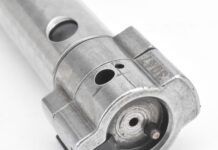
We ran into real issues when we field-stripped the S&W. M&P’s have a sear-release lever that is rotated toward the muzzle using a small tool, like the backstrap retainer tool that allows the M&P to be field-stripped without pressing the trigger. When we moved the sear release lever, it fell into the magwell. That was surprising. What if that had happened at the range and we didn’t notice, would the gun have fired?
Our Team Said: The Competitor was the clear winner in this match-up until the sear-release lever dropped out of the pistol. We graded it an F, then we telephoned S&W. After being on hold for ages, we spoke with a helpful person in the service department.
He asked us for the serial number and asked what was the problem with the pistol, which we explained. After the call, we received an email with a FedEx shipping label, RMA number, and instructions on how to pack the pistol. We included a note inside of the factory box with our name, shipping address, daytime phone number, and the reason why we were returning the firearm. The sear block was taped to the grip so it could easily be found.
We shipped the pistol on June 20, and on June 24, S&W acknowledged receiving the item in a generic email and our specific RMA number. We were told the turnaround would be four to six weeks. On July 18, we received a notification from FedEx that a package was arriving that needed an adult signature. The shipper was “SAW,” which we quickly realized was S&W. When the pistol arrived, it was in a generic padded, cardboard box. There was no explanation as to the work done to the pistol, nor was a test target included. We would have appreciated an explanation of what done to the pistol, instead of being left in the dark.
Next, we field-stripped the pistol without incident. Returning to the range, we tested accuracy at 15 yards, ran a few Failure Drills and a few Bauer Standard Drills. After running 100 rounds through it, we had zero issues with the pistol. We then field-stripped the pistol again without any issues.
We are happy that S&W stood behind its product and repaired it on their dime. We would have liked an explanation on how it happened or at least a follow-up on what was done to the pistol. Returning to the range, the S&W performed like nothing ever happened, so we bumped up the F rating to an A- grade.
| 9MM LUGER RANGE DATA | |||
|---|---|---|---|
| Remington UMC 115-grain FMJ | Glock G17L Gen5 | Heckler & Koch VP9 Match OR | S&W Performance Center. M&P9 M 2.0 Competitor 2 Tone |
| Average Velocity | 1303 fps | 1228 fps | 1158 fps |
| Muzzle Energy | 432 ft.-lbs. | 385 ft.-lbs. | 342 ft.-lbs. |
| Smallest Group | 1.96 in. | 0.69 in. | 1.26 in. |
| Average Group | 2.07 in. | 0.77 in. | 1.30 in. |
| Atlanta Arms Steel Challenge 115-grain FMJ | Glock G17L Gen5 | Heckler & Koch VP9 Match OR | S&W Performance Center M&P9 M 2.0 Competitor 2 Tone |
| Average Velocity | 1071 fps | 1122 fps | 1013 fps |
| Muzzle Energy | 293 ft.-lbs. | 321 ft.-lbs. | 262 ft.-lbs. |
| Smallest Group | 1.25 in. | 0.99 in. | 1.14 in. |
| Average Group | 1.45 in. | 1.00 in. | 1.19 in. |
| Panther Ammunition 124-grain FMJ | Glock G17L Gen5 | Heckler & Koch VP9 Match OR | S&W Performance Center M&P9 M 2.0 Competitor 2 Tone |
| Average Velocity | 1100 fps | 1132 fps | 1104 fps |
| Muzzle Energy | 333 ft.-lbs. | 353 ft.-lbs. | 335 ft.-lbs. |
| Smallest Group | 2.19 in. | 0.97 in. | 1.68 in. |
| Average Group | 2.24 in. | 1.09 in. | 1.74 in. |
| Atlanta Arms Classic Match 147-grain FMJ | Glock G17L Gen5 | Heckler & Koch VP9 Match OR | S&W Performance Center M&P9 M 2.0 Competitor 2 Tone |
| Average Velocity | 866 fps | 933 fps | 839 fps |
| Muzzle Energy | 245 ft.-lbs. | 284 ft.-lbs. | 229 ft.-lbs. |
| Smallest Group | 2.00 in. | 0.89 in. | 1.66 in. |
| Average Group | 2.17 in. | 0.91 in. | 1.71 in. |
To collect accuracy data, we fired five-shot groups from a bench using a rest. Distance: 15 yards with open sights. Velocities and energies were recorded using a Garmin Xero C1 Pro chronograph.
Written and photographed by Robert Sadowski, using evaluations from Gun Tests Team members. GT