







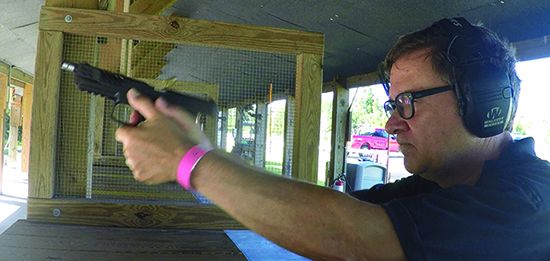
We decided to call this match-up 9mm target pistols in lieu of 9mm match-ready pistols because a true competition pistol is a specialized and expensive piece of equipment designed to take full advantage of a particular shooting discipline’s rules. Many gun brands modify a standard-size duty pistol and rebrand it as a “competition” pistol. In some cases, like we experienced in this match up, one brand just added a longer barrel to a standard-size frame. In this review, we looked at these target pistols through the lens of someone wanting to try out competitive shooting with something out of the box that would not hamstring them or make them feel under-gunned at the range. Or guns that would fit someone who just wants a fast-shooting range blaster, more target pistol than duty pistol. Features we looked for in this trio included good accuracy, a decent trigger, easy-to-use sights, smooth cycling, plenty of extra magazines, and controls that make the pistol easy to operate.
We looked at three out-of-the-box solutions: the Glock G17L Gen5, Heckler & Koch VP9 Match OR, and the Smith & Wesson Performance Center M&P9 M2.0 Competitor. All of these pistols are built from standard-duty models but have features advantageous for shooting cardboard and steel targets fast.
One of these pistols sort of delivered on the goods, one didn’t, and one fell apart.
The common denominators are longer barrels than a typical full-size service pistol, 9mm chamberings, striker-fire trigger actions, open sights and optics-ready slide cuts, and modular grips. The Glock and the HK have polymer frames, and the S&W has an aluminum frame.
We used open sights on all the guns, though all the pistols came optics ready, because this match-up is an out-of-the-box test. Numerous aftermarket sights are available for all three guns, too.
We used target ammo as well as training ammo to get a feel of how these pistols would run with light target loads and inexpensive training ammo. These are the types of fodder you would use in a local gun-club competition, for bragging rights at the public range, or at the dirt bank in your country house’s backyard. Training ammo included Remington UMC 115-grain and Panther Ammunition 124-grain rounds, both of which fire full-metal-jacket bullets. Target ammo came from Atlanta Arms and included the company’s Elite Steel Challenge round with a 115-grain FMJ and Classic Match with a 147-grain FMJ. The Classic Match is loaded to a muzzle velocity of about 900 fps, depending on the gun and barrel length. It is designed to have an IDPA 130 Power Factor, so it is soft shooting. The Elite Steel Challenge ammo was developed specifically for Steel Challenge competition shooting, and it, too, is soft recoiling, with a factory muzzle velocity of about 1070 fps, depending on the pistol.
We tested accuracy at 15 yards using a rest and found the HK was stellar, closely followed by the S&W. The Glock was left in the dust. For speed shooting, we set D-1 NRA tombstone targets at 10 yards and fired modified Bill Drills at them. At 7 yards, we shot the Bauer Standard Drill. For those of you not familiar with the Bauer drill, it is simple. You perform it with a holstered pistol or at low ready. The target is two rectangles with a small circle between them. The idea is to shoot five rounds in one of the boxes, transition to the next box with another five rounds, conduct an empty-gun reload, and finish with three rounds in the circle. This drill helps with speed shooting, trigger press, recoil recovery, transitioning between targets, magazine reloads, and accuracy. It is a lot of fun, and if you are using a timer, 9 seconds or less is a passing grade, but you don’t need a timer. This drill also gives you a good sense of how you and the pistol will perform under pressure. The weather was humid during this review, which also gave us better insights on the grip textures. After the brass cooled, two guns showed better features and usability, but one fell apart when we field stripped it. It was ugly. The third lagged behind and seemed dated. Here are the details.
Heckler & Koch VP9 Match OR 81000553 9mm
$1030
Gun Tests grade: A- (Our Pick)
The VP9 Match has a good trigger with a short reset, and it cycles smoothly. Accuracy was excellent. The grips are too slick for competition work, but that’s easily resolved.
| Action Type | Semi-auto, short recoil, locked breech, tilting barrel |
|---|---|
| Trigger | Striker fired |
| Overall Length | 8.7 in. |
| Overall Height | 6.2 in. |
| Maximum Width | 1.3 in. |
| Weight Unloaded | 28.0 oz. |
| Weight Loaded | 36.6 oz. |
| Barrel Length | 5.5 in. |
| Slide | Steel |
| Slide Retraction Effort (Red Spring) | 16 lbs. |
| Slide Retraction Effort (Blue Spring) | 14 lbs. |
| Frame | Polymer |
| Frame Front Strap Height | 2.4 in. |
| Frame Back Strap Height | 3.6 in. |
| Grip | Textured black polymer, adjustable |
| Grip Thickness (Maximum) | 1.3 in. |
| Grip Circumference (Maximum) | 5.8 in. |
| Front Sight | Luminous dot |
| Rear Sight | Two-dot notch, optic ready |
| Trigger Pull Weight | 5.1 lbs. |
| Trigger Span | 2.8 in. |
| Magazines | (4) 20-rd. steel |
| Safety | Trigger safety |
| Warranty | Limited lifetime |
| Telephone | (706) 568-1906 |
| Website | HK-USA.com |
| Made In | Germany |
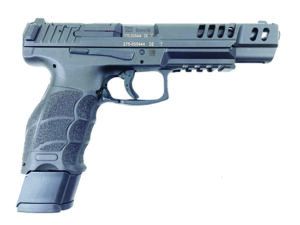
The VP9 Match OR (Optic Ready) is built on a full-size VP9 frame with a longer slide and 5.5-inch barrel. In the hard case are four 20-round steel-body magazines with extended polymer floor plates, three sets of back straps inserts, three sets of grip panel inserts, a magazine loader, rubber O-rings, and two recoil spring assemblies. One is painted blue, which is lighter, and the red one is the standard VP9 spring.
Our sample is equipped with the European ambidextrous paddle-style magazine release, which seems to weird out American shooters. The B version has the magazine button release.
The slide has five cuts on each side and one on the top. The side slots function as front slide serrations, while all together, the slots lighten the weight of the slide as it cycles. The rear of the slide has two polymer ears that are low profile and make racking the slide easier to grasp, especially with an optic attached. The rear sight is fixed, with two luminous dots, and the front sight also has a luminous dot. The sights are dovetailed in place. The slide is also optics ready to mount a red dot, but mounting plates ($52/each, US.HKWebShop.com) are sold separately. Unique to the VP9 Match barrel is a polished section toward the muzzle that includes a rubber O-ring that serves as a bushing between the barrel and barrel hole in the slide. This set up ensures precise slide-to-barrel lockup to aid accuracy. In our opinion, it does just that. The rear of the slide includes an indicator pin that shows a red dot when the pistol is cocked.
The frame is the same one used on the standard VP9, which is noteworthy for its ability to be customized. Three sizes of back straps and three sets of side grip panels are included, which allow for up to 27 different grip options. This a sophisticated grip system, and we liked it, but in practice, the texture should be more grippy.
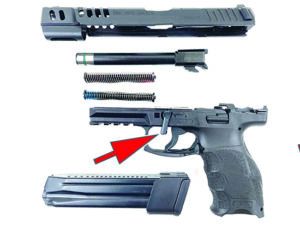
The slide release is long and ambidextrous. We wanted it a bit smaller for a right-handed shooter because some testers, when gripping the pistol, also gripped the slide release, causing the slide not to lock back on the last shot fired. This is fixed with a different grip technique.
Elsewhere, the trigger is nice. It is a bladed safety trigger with a slight curve. You hardly notice the blade as you press it to manage the initial take up, which is just more than 0.25 inch, then it hits the wall. The trigger broke at 5.1 pounds, but it is very smooth and feels much less. The break is crisp and consistent, with the reset being a little more than 0.25 inch. We found this trigger consistent and easy to manage.
Starting with the modified Bill Drill, the HK trigger allowed us to do good work; however, in humid weather, the grip slipped and we found ourselves managing our grip after every shot. If we owned this pistol, we would apply Talon Grips stick-on grip tape ($20 to $25 depending on texture; TalonGunGrips.com) to custom fit the pistol’s grip. Or if we went the DIY route, we’d use non-abrasive CatTongue tape ($20; Amazon.com). There was some muzzle flip, but the HK cycled smoothly. There were zero issues with the VP9 Match cycling ammo.
Moving to the accuracy test, we found the HK had game. The best five-shot group at 15 yards was with Remington UMC at 0.69 inch; average was 0.77 inch. Next best was Atlanta Arms Classic Match 147-grain ammo at 0.89 inch and an average of 0.91 inch. Panther ranked third with a best of 0.97 inch and average of 1.09 inches. Atlanta Arms Elite Steel Challenge had a best of 0.99 inch and an average of 1.00 inch. This was impressive accuracy. Many groups were one large hole with an outlier.
The magazines were easy to load, though getting the 20th round in requires thumb pressure. One thing to note about the magazines is that the extended floor plate can’t be used in some competitions because they don’t fit in the box. You would need to buy standard flush-fit 17-round magazines.
Moving to the Bauer Standard Drill, the grip slipped when firing fast in the two rectangles. We needed to slow down to ensure a perfect hits. The surgical shots to the small circle were also hard to accomplish. Magazine reloads were smooth, and we found we needed to change our grip on the pistol to dump the magazine with the paddle release. Not a deal breaker, but it did cost time and effort. The magwell is not oversized, but it didn’t hamper smooth, quick reloads. The slide cut-outs worked well as serrations for press checks, and the rear slide ears provided leverage even in humid conditions to pinch and pull the slide to rack it.
Field-stripping the HK VP9 Match is easily accomplished by rotating the takedown lever when the slide is locked back, removing the slide from the frame, and taking the rest of the parts off.
Our Team Said: The VP9 Match offers a lot of great features out of the box that give it game. Accuracy is amazing. The smooth trigger was easy to master. The large slide release for right-handed shooting needed to be managed for some shooters. The grip texture is the only complaint we have with the pistol.
| 9MM LUGER RANGE DATA | |||
|---|---|---|---|
| Remington UMC 115-grain FMJ | Glock G17L Gen5 | Heckler & Koch VP9 Match OR | S&W Performance Center. M&P9 M 2.0 Competitor 2 Tone |
| Average Velocity | 1303 fps | 1228 fps | 1158 fps |
| Muzzle Energy | 432 ft.-lbs. | 385 ft.-lbs. | 342 ft.-lbs. |
| Smallest Group | 1.96 in. | 0.69 in. | 1.26 in. |
| Average Group | 2.07 in. | 0.77 in. | 1.30 in. |
| Atlanta Arms Steel Challenge 115-grain FMJ | Glock G17L Gen5 | Heckler & Koch VP9 Match OR | S&W Performance Center M&P9 M 2.0 Competitor 2 Tone |
| Average Velocity | 1071 fps | 1122 fps | 1013 fps |
| Muzzle Energy | 293 ft.-lbs. | 321 ft.-lbs. | 262 ft.-lbs. |
| Smallest Group | 1.25 in. | 0.99 in. | 1.14 in. |
| Average Group | 1.45 in. | 1.00 in. | 1.19 in. |
| Panther Ammunition 124-grain FMJ | Glock G17L Gen5 | Heckler & Koch VP9 Match OR | S&W Performance Center M&P9 M 2.0 Competitor 2 Tone |
| Average Velocity | 1100 fps | 1132 fps | 1104 fps |
| Muzzle Energy | 333 ft.-lbs. | 353 ft.-lbs. | 335 ft.-lbs. |
| Smallest Group | 2.19 in. | 0.97 in. | 1.68 in. |
| Average Group | 2.24 in. | 1.09 in. | 1.74 in. |
| Atlanta Arms Classic Match 147-grain FMJ | Glock G17L Gen5 | Heckler & Koch VP9 Match OR | S&W Performance Center M&P9 M 2.0 Competitor 2 Tone |
| Average Velocity | 866 fps | 933 fps | 839 fps |
| Muzzle Energy | 245 ft.-lbs. | 284 ft.-lbs. | 229 ft.-lbs. |
| Smallest Group | 2.00 in. | 0.89 in. | 1.66 in. |
| Average Group | 2.17 in. | 0.91 in. | 1.71 in. |
To collect accuracy data, we fired five-shot groups from a bench using a rest. Distance: 15 yards with open sights. Velocities and energies were recorded using a Garmin Xero C1 Pro chronograph.
Written and photographed by Robert Sadowski, using evaluations from Gun Tests Team members. GT