










Auction Arms and GunReports.Com Form Gun News Alliance
(GunReports.com) -- Auction Arms, the official auction site of the NRA, and GunReports.Com have announced a letter of intent to establish the Auction Arms News Bureau, a weekly E-Letter that will deliver gun news, pricing trends and other information for the serious shooter.

Gun Tests Magazine Partners with Auction Arms for Current Pricing Cites
(GunReports.com) -- Gun Tests Magazine, the 23-year-old consumer resource for the serious shooter, will partner with Auction Arms to collect and report up-to-the-minute, accurate firearms pricing.

Ruger Displays First and 25 Millionth Firearm at SHOT Show
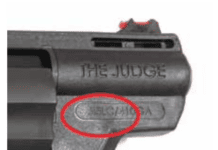
Taurus Introduces Raging Judge in 28 Ga.
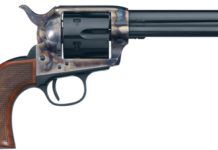
SHOT Show Special Report: Uberti El Patrón
Tucson Tragedy Used to Beat the Drums for More Gun Control
California Division of Parole Selects Smith & Wesson M&P40 Pistol
CCRKBA Deplores Arizona Shooting, Subsequent Exploitation
Gun Owners of America issues statement on Arizona shooting
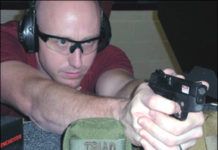
Pocket-Sized 380 ACP Pistols: S&W, Taurus, and Diamondback
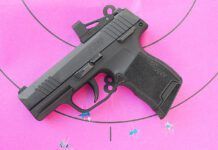
In this test we'll take a look at three 6+1 380 Auto pistols that Gun Tests readers have been asking us to test: the $430 Diamondback DB380, the $575 Smith & Wesson Bodyguard 380, and the $336 Taurus Model 738B.
The Diamondback DB series pistols are manufactured by a relatively new company in Cocoa Beach, Florida. Diamondback lays claim to "a FEA (Fine Element Analysis) designed slide and barrel that is stronger than any comparable firearm, resulting in durability with less felt recoil…." Some of the finer points we liked were the steel magazine catch and the taper at the lower corner of the trigger guard to ease holstering or other means of retention. The slide had cocking serrations that were both functional and visually appealing. There was also a helpful beavertail to aide recoil control and protect larger hands from contact with the slide as it moved forward and back. Only one six round magazine was supplied. True to each of our 380 test guns, the Diamondback magazine was fashioned from sheet metal with a polymer follower, and it had a removable basepad for cleaning or replacement of the spring.
Including our 738B, there are a total of six Model 738 pistols with different color frames and stainless slides on the taurususa.com website. The most expensive model costs as little as $352. Our stealth-black Taurus 738B arrived in a black ballistic-nylon belt pouch measuring about 5.5 inches long by 4.0 inches high. The pouch was deep enough to carry a second six-round magazine, supplied, and the full-length flap was secured by two magnetic snaps. Belt contact was by belt loop or a steel clip. This product, the Tetron Ambi Cell Phone holster, was designed for "mini 380s" and can be found online in a variety of colors for about $19, at bulldogcases.com.
There was a great deal of technology in each of our test guns, but the Smith & Wesson Bodyguard 380 makes use of many modern advancements. Each of our guns utilized a narrow synthetic frame, and, in addition, the Bodyguard 380 was fit with a two-stage laser built in to the dust cover, and it had a slide stop and a thumb-operated safety. The receiver of the Bodyguard 380 was rock hard, and the front side of the grip offered a finger groove directly below the trigger guard. Only one magazine was supplied, but it was fit with a base pad that added one additional finger groove. Smith & Wesson shipped the Bodyguard in a black zippered case that suggested the pistol can be carried concealed in what appeared to be a daily planner. A flat basepad was also supplied, which was intended to make this pistol even more concealable.
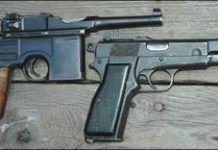
Shoulder-Stocked Oldie Pistols: Hi-Power and Broomhandle
Long ago someone put a shoulder stock on a handgun so he could do a better job of shooting it without becoming a skilled pistolero. The shoulder stock holds the gun steadier than the hands alone can hold it, thus some immediate handgunning success was possible. Some early examples were the shoulder-stocked Third Model Colt Dragoons and 1860 Army Colts of the Civil War era, and there were some earlier uses. We've seen examples of percussion firearms dating to the mid 1830s, and would bet a nickel there exist examples of shoulder-stocked flintlock pistols going back a hundred years earlier.
For this test report we looked at two guns from the early 20th century, both of which types saw plenty of wartime and civilian use. Our test guns are by Mauser and by Browning/Inglis. Both were supplied to us by Collectors Firearms in Houston (www.collectorsfirearms.com). The Mauser was a C96 Model 1921 "Bolo" with short barrel ($2395 plus $395 for the stock at Collectors), and the Browning was a Hi-Power made by Inglis in Canada ($1650 with stock, also Collectors's counter price). Both handguns had walnut stocks, and both had tangent sights with a narrow V-notch combined with a sharpened post front blade, which gave relatively poor sight pictures. We tested the 30 Mauser with Serbian Prvi Partizan FMJ ammo, and the 9mm Hi-Power with Black Hills 147-gr and Winchester BEB 115-gr ammunition. Here is what we found.
Springfield Armory XDM 3.8 XDM9389BHC 9mm, $697
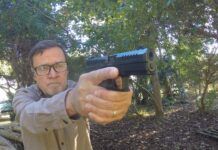
The first test gun we chose was the $697 XDM 3.8 from Springfield Armory. Since the first XD pistol to hit our shores from Croatia was the Four-inch Service Model, we were tempted to refer to the XDM 3.8 as belonging to a 'sub-service' category. The XDM 3.8 utilized the trigger to release the striker after rearward movement of the slide had loaded the striker spring nearly to full strength. Pressing the trigger on the XD series pistols tops off the compression of the striker spring and releases the trigger.