








We ran a Taurus 44 Magnum, a 460 S&W Magnum, and a 500 S&W Magnum side by side at the range, and our shooters said they would go afield with the Performance Center 460XVR over the others.
Our test team has years of hunting experience with 44 Magnum wheelguns and single-shot pistols. This is a very versatile round with plenty of hunting-cartridge options to choose from, plus it also allows the user to fire 44 Special rounds, which greatly reduces felt recoil and allows for more pre-hunt training. The 500 S&W Magnum and 460 S&W Magnum are relatively new cartridges compared to the 44 Magnum, being introduced in 2003 and 2005, respectively. They have been in the field for well over 10 years, so we wanted to use the established 44 Magnum as a baseline to see what the newer cartridges could do. With that in mind, we procured a Taurus Raging Hunter in 44 Magnum, a S&W Performance Center Model 460XVR in 460 S&W Magnum, and an S&W Model S&W500 in 500 S&W Magnum so we could shoot them side by side.
Not a lot of people have shot the 500 S&W Magnum and 460 S&W Magnum, and there are several reasons for that. There are not many handguns chambered in the cartridges, and the ones that are chambered in the rounds are pricey. The high cost of ammo and tales of vicious recoil round out the rest of reasons why there are not a lot of 460 and 500 shooters.
The 500 S&W Magnum and 460 S&W Magnum are only chambered in a few revolvers made by S&W and Magnum Research BFR single-action revolvers. The T/C Encore and Pro Hunter single-shot pistols also have barrels chambered in 460 and 500. The cost per cartridge averages from $1 to $3.20 a round, depending on the brand of ammo and the bullet loaded. And then there is the recoil, which if you believe everything you read online, is like taking hold of the devil’s tail. In our opinion, the recoil is very tolerable. Kudos to S&W for producing revolvers with such powerful cartridges that are relatively easy to shoot. We have fired lightweight 44 Magnum revolvers that are much more punishing. Do not get us wrong, these revolvers are not for neophyte shooters. There is a proper way to grip and fire these revolvers without accidentally shooting a hole in the ceiling during recoil or knocking a dent in your forehead, which are some of the online rumors. Stuff happens, so be aware and grip accordingly.
There is a correct way to hold these revolvers. The X-frame offers a lot of surface area to grasp, but do not grip anything but the grip. The flash from a fired shot emitted from the gap between the front of the cylinder and forcing cone has the cutting power of a plasma torch. Look at the photo of the rag we used to cover the shooting rest bag. It is blackened and torn to shreds due to the blast. The two S&W revolvers are especially heavy — 71.4 ounces for the 500 and 84.2 ounces for the 460 sans optic and rings — and have long barrels. You need some sort of support to wring out the best accuracy from them. The Raging Hunter is much easier to handle and is easily fired with two hands. Maybe Thor could hold the S&Ws with two hands and hit an elk at 100 yards, but we would use shooting sticks. In fact, shooting sticks make shooting all of these revolvers easier and more accurate.
Revolvers by design have a center of bore axis above the shooter’s grip. This causes the revolver’s muzzle to flip back during recoil. To reduce muzzle flip, you need to grasp the grip as high up as you can. Our small-to-average-size-hand testers found this was a bit uncomfortable with the S&W grips compared to the Taurus grip. The higher the grip, the closer you are the barrel bore’s center axis. You also need to keep your arms extended using an isosceles stance rather than a Weaver stance. With this grip and stance, big-bore handguns are much easier to control during recoil. With that said, most testers maxed out at two full cylinders of the 460 and 500. Savor the recoil, we say, because these revolvers can produce some excellent accuracy and downrange power.
How We Tested
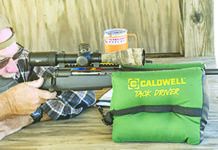
We tested for accuracy using a rest to support the barrels just forward of the cylinder and a sand bag under the grip. This set up allowed a solid platform and allowed us to grasp high on the grip. To simulate hunting scenarios, we used a Primos Gen 3 Trigger Stick tripod shooting rest ($150; MidwayUSA.com). We really liked the Primos Trigger Stick because it allows the user to smoothly pan down range and is fast to open and set up using the trigger feature. It is outfitted with a rubberized V-yoke on which to silently rest a rifle or handgun. It also comes with a camera mount. The legs are aluminum with rubber gripping feet. We also tested a Bog-Pod RLD-3 ($70; MidwayUSA.com) tripod, which has rubber feet, adjustable legs with adjustment marks, and rubber V-yoke. It, too, can be used standing, kneeling, or sitting. It came with a carry case. We recommend you invest in shooting sticks, like the Primos, when handgun hunting because they offer a rock-solid rest and rapidly adjust to standing, kneeling, or sitting positions. We accuracy tested at 25 yards, but we also tested at 100 yards. The reality is, the 460 and 500 are flat shooting and quite capable of long-range accuracy without making the shooter do a lot of work.
Cartridge Comparison
The 44 Magnum was introduced in 1955 and for decades was the world’s most powerful cartridge. It also become iconic thanks to the Dirty Harry movies. Bullet weights are available from 160 to 340 grains, with 240-grain bullets being the sweet spot for this cartridge. There is an embarrassment of riches in the variety of 44 Magnum ammo choices that range in a per-round cost of 78 cents a round (Prvi Partizan; MidwayUSA.com) to $2.05 a round (Underwood; MidwayUSA.com). The cartridge is also compatible with less powerful, reduced-recoil 44 Special ammo for more trigger time. Remember when using compatible ammo, the zero will change. Our suggestion is to zero the revolver to the cartridge to be used in the field and use Kentucky elevation with the less-powerful ammo. We tested the Taurus using 44 Magnum ammo from Black Hills (240-grain jacketed hollow point), Grizzly (300-grain wide flat nose gas check, or WFNGC), Hornady Custom (240-grain XTP), and SIG V-Crown 240-grain JHP. The 44 Special ammo we used was Hornady’s Critical Defense 165-grain FTX. On average, all of the 240-grain 44 Magnum ammo had a muzzle velocity of 1300 fps and muzzle energy of about 850 foot-pounds. With a zero at 25 yards, a 240-grain bullet will drop about 7 inches at 100 yards.
The 460 S&W Magnum is a versatile cartridge and has the title of the fastest production revolver chambering. It is based on the 454 Casull cartridge and uses a case that is 0.417 inches longer. Bullet weights are available from 200 to 360 grains, with 275-grain bullets being the sweet spot. There are a number of ammo brands producing the load, with a cost per round of $1.49 (Hornady Custom; MidwayUSA.com) to $3.75 a round (Buffalo Bore; MidwayUSA.com). The rounds we tested included Federal Premium 275-grain Barnes Expander and Grizzly 460-grain WLNGC (wide long nose gas check). There are many more 460 cartridge options available. Both the Federal and Grizzly loads clock at the muzzle with 1800 fps and 1980 foot-pounds of energy. Compared to the 44 Magnum, that’s more than 200 fps faster and 80% more energy. What makes the 460 S&W Magnum so versatile is it is also compatible with other cartridges, such as the 45 Schofield, 45 Long Colt, and 454 Casull. To see how these other compatible loads worked out, we also tested the 460 with 45 Long Colt from Grizzly in +P and 335-grain WLNGC and SIG V-Crown 230-grain JHPs. We also tested Grizzly 454 Casull 265-grain WFNGC ammo. With a zero at 25 yards, a 460 S&W Magnum 275-grain bullet drops about 3 inches at 100 yards. That’s less than half the drop of the 44 Magnum, and it is using a heavier bullet.
For 500 S&W Magnum ammo, bullet weights range from 275 to 700 grains, with 325-grain bullets generally considered to be the favorite. The cost per round ranges from $1.73 (Federal Fusion; MidwayUSA.com) to $4 round (Buffalo Bore; MidwayUSA.com). We used Federal Premium loaded with 275-grain Barnes Expander bullets, Federal’s 325-grain with a Swift A-Frame bullet, and Grizzly loaded with a 440-grain WFNGC. These cartridges ranged in muzzle velocity from 1550 fps to 1800 fps and energy ranged from 1680 foot-pounds to 2340 foot-pounds. That’s easily a 200-fps gain in speed over the 44 Magnum with larger and heavier bullets, and similar speed as the 460, but with 17% more energy. There is also a 500 S&W Special load that is a less powerful round and sort of a reverse evolution from the 500 S&W mag. The more powerful round came before the less powerful round, unlike the 44 Special evolving into the 44 Mag. We could not find 500 S&W Special loads to test. With a zero at 25 yards with 325-grain bullets, it drops about 2.5 inches at 100 yards. As you can see, the speed and power increases exponentially from the 44 Magnum to the 460 and to the 500. You can also see in the data table the velocity of the 460 and 500. With either of these cartridges you can hold dead center from 0 to 100 yards with little impact of trajectory on accuracy. In other words, no hold over required.
Iron sights are appropriate for the Raging Hunter in 44 Magnum due to the cartridge’s range limitation and the size of the Raging Hunter. Iron sights on the 460XVR and S&W500 almost seemed superfluous, much like sights on a bolt-action centerfire hunting rifle. Running these revolvers without an optic is like test driving a Ferrari in a parking garage. An optic allows the user to get the most out of these guns. We mounted a Crimson Trace red dot on the Taurus and used Weaver variable-power scopes on the two S&W revolvers, then took them to the range. Here’s what we found.
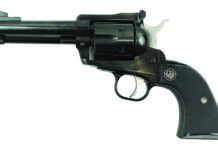
Taurus Raging Hunter Model 2-440085RH
44 Magnum, $683
This was a recent price at CheaperThanDirt.com. The Raging Hunter is basically a Raging Bull with the vent rib replaced with a Picatinny rail. This makes the Raging Hunter much more versatile for the user who plans on mounting an optic. Our sample came in a cardboard box with a manual and lock. It had a two-tone matte finish that was well executed. The barrel, cylinder, trigger, hammer, and sights were black and the frame was stainless. The grips are Taurus’ excellent semi-finger-groove rubber models with the red cushion insert at the backstrap. These grips fit a wide number of hand sizes and do a good job of filling the area behind the trigger guard, helping to absorb recoil.
To cut down on weight, Taurus uses a steel barrel with an alloy sleeve that fits over the barrel. This gives the Taurus great balance. The barrel also features a ported chamber at the muzzle — like all Taurus 44 Magnum revolvers — which help with recoil and muzzle flip. We found this feature does reduce muzzle flip and recoil. A Picatinny rail is machined into the top of the slab-sided barrel and allows mounting options for a variety of optics.
We put on a Crimson Trace CTS-1300 red dot reflex sight ($199; CrimsonTrace.com), which comes with a low-profile Picatinny rail mount. This sight uses a 3.5-minute-of-angle round aiming dot with seven levels of brightness adjustment. We liked the externally accessible battery tray and ease of mounting it on the Taurus. Two buttons labeled with up and down arrows allow the user to adjust dot brightness. It is made of aluminum and comes with a cover. The red dot did not affect the balance of the revolver and was an excellent addition.
The sights on the Raging Bull featured a pinned front sight and an adjustable rear. The rear-facing surface of the sight was smooth and shiny, and we would prefer a serrated surface to cut glare. The black-on-black sights are traditional, but a fiber-optic front sight would be better, in our opinion.
The weight allows the user to tote it in a hip or shoulder holster. Plus, the Raging Hunter felt more like a handgun compared to the S&W pistols. The Raging Hunter incorporates two cylinder latches, one on the side of the frame and one on the cylinder crane. The two latches seem like over engineering, but they ensure the crane is snuggly mated to the frame and locked. The lock up was tight. We found we could open the cylinder with two hands, using our thumbs to operate the cylinder latches. Rounds fed and ejected easily from the chambers.
The trigger was crunchy, not as smooth as the triggers on S&W revolvers. Still, the Taurus trigger was serviceable, and for hunting situations, single action would mostly be used. Shooting distance with optics and using a double-action trigger is not a recipe for accuracy.
Going hot with the Taurus, we found the recoil easy to cope with, even if the weight of the revolver was shaved down to 55 ounces without the red dot. The red dot brought the weight up to 58 ounces, or 3.6 pounds. We could adjust the red dot from the size of a pin prick to a small tick. We used 44 Special loads to zero in the red dot at 25 yards, then moved to the 44 Magnum ammo. Groups averaged 2.25 inches across all ammo. With Hornady Custom 240-grain XTP loads, we shot a best group that measured 0.87 inches. With Black Hills and SIG 240-grain JHPs, we fired best groups of 1.6 and 1.4 inches, respectively. The bonecrushing 300-grain lead Grizzly bullets had a best group that measured 1.96 inches. Overall, we were quite impressed with the accuracy results. Moving to 100 yards, our groups opened up to 3.5 to 4 inches, and we think if far range is in your scenario, a scope would be better than a red dot. Still, this is good accuracy for the price.
Our Team Said: The Raging Hunter is made to hunt, with all the right features. The 44 Magnum cartridge is easy to find and offers a variety of options. If you want to get into handgun hunting, the Taurus is an excellent choice. Revolver and optic cost less than either of the S&W revolvers. For hunting whitetails and black bears from tree stands or pigs from a blind, this is a great choice.
Smith & Wesson Model S&W500 163500
500 S&W Magnum, $1082
This was a recent price at BudsGunShop.com. The S&W500 is touted as the most powerful production revolver in the world, and looking at the range data we would agree. This revolver ushered in the massive S&W X-Frame revolver. Everything about the 500 is supersized, except the grip. The grip retains the same proportions as K- and L-Frame revolvers. Like all other S&W revolvers, the 500 uses a hammer block internal safety to prevent the revolver from firing if accidentally dropped.
The cylinder latch is similar to other S&W revolvers and is pushed forward to open the cylinder. We also found a ball detent built into the frame that fits into a spot in the crane for a tight lock up. We needed to push the massive cylinder out of the frame because the ball detent kept the cylinder in place, even when the cylinder latch was disengaged.
The S&W500 looks like many other S&W stainless revolvers. It uses a full under lug under the barrel for more weight, and because of the cartridge, you want that extra weight to absorb recoil. There are decorative serrations on the top of the barrel, and the model name is engraved on the right side of the frame, just in case you forget you are holding a 50-caliber pistol.
The front post sight is black and pinned so you can replace it with a fiber-optic post if you plan to use open sights. The rear sight is adjustable for windage and elevation. The rear-facing part of the sight is serrated to stifle sun glare. The muzzle device is a slotted compensator that directs gas up to counteract muzzle flip. We think it does a great job of that.
The cylinder is fluted and massive. The five chambers look like they want more chambers for company, but the steel between the chambers ensures it defeats the pressure the 500 S&W Magnum round produces.
The trigger in DA mode was smooth, but we doubt we would use it unless a grizzly bear was running toward us. Single-action mode is best for hunting and accuracy, which we found this hand cannon offered.
Loading the 500 S&W Magnum rounds into the chamber was like loading rifle cartridges. The rounds are long and heavy and slid into the chambers with ease. To unload, point the muzzle up and push down on the extractor rod. The cylinder will easily regurgitate the empties. We did not encounter any stuck cases.
We removed the rear sight and installed a Weigand model SSWHPMNTS mount ($70; JackWeigand.com) and used three Weigand model 3MRNG1S scope rings ($69). The mount fit like a glove in the machined groove on the top of the X-Frame. Three screws locked it to the frame. The mount is a mini-Picatinny. The rings were packaged with friction stickers to keep the scope in place. We used blue Loctite on the base screws. In the rings, we mounted a Weaver Classic 2.5-8x28mm handgun scope ($387; WeaverOptics.com). It has a matte-black finish, covered turrets, and a Dual-X reticle. Parallax is set at 50 yards. The magnification ring was easy to turn. Eye relief is 24.5 to 16.5 inches, which is plenty of space between you and the scope’s eyepiece. You need that distance to avoid scope bite. We liked this scope for its simplicity. Mounting was simple and fast. The total cost of gun, optic, and mount was $1608.
Going hot with the 500, we did encounter muzzle flip. By grasping up on the grip, we were able to reduce flip and better manage recoil. We also found the finger-groove grips were not as comfortable to hold since some testers’ fingers were not in the grooves. We prefer a grip with no finger grooves so we could easily and comfortably position our hands.
The Federal Barnes 275-grain bullets clocked at 1747 fps had plenty of recoil, and when we moved onto the Federal Swift pushing a 325-grain bullet at 1821 fps, recoil became snappier. The Grizzly 440-grain bullets at 1555 fps were also stout. At 25 yards, the Federal Barnes averaged 1.26-inch groups, and the Federal Swift and Grizzly rounds were even at 2.25-inch groups. Moving to 100 yards, the nice single-action trigger and rest helped us squeeze out 2.5-inch groups with the Federal Barnes and 3-inch groups with the other ammo.
Our Team Said: If you need to have the most powerful revolver in production, then this is your option, and in our opinion, it is a pretty good choice. The weight and crisp single-action trigger make it easy to shoot. The grip forced the user to hold it in a specific way; we’d like a grip that allows us to grasp higher up. You need a harness holster to tote this beast because it weighs 5.2 pounds.
Smith & Wesson Performance Center Model
460XVR 170262 460 S&W Magnum, $1369
This is a recent price from BudsGunShop.com. The 460XVR revolver came in a soft nylon case with a sling and swivels. At 5.25 pounds with an optic, this is a heavy revolver, hence the sling. The barrel has a matte-stainless finish, and the cylinder and frame have a slightly more polished look. The grip is a Hogue rubber finger groove with palm swells.
The trigger was exceptionally smooth, with the single-action mode being crisp. Thumbing back the hammer did not take a lot of effort, even with the massive cylinder.
The frame has a ball detent built in so the front and rear of the cylinder are locked in place. Opening the cylinder was easy, and extraction of empties required a gravity assist to dislodge the long empty cases.
The metal in the X-Frame and cylinder is heat treated differently than the S&W500 X-Frame due to the pressures of the 460 cartridge. Each of the five chambers is separated by nearly 0.25 inches of steel, and the chambers are designed to use spitzer-style bullets, which are typically used in rifles, offer a better ballistic coefficient than typical pistol bullets. The cylinder has a diameter of 1.9 inches. It is massive.
To gain the fastest production revolver title, the barrel needs to be long and a minimum of 8.375 inches. Our sample is 10.5 inches in length. What is interesting about the bore is the rifling. It has five groove, gain-twist rifling. Since the bullet is coming out of the cylinder at 2300 fps and shoved into the forcing cone with tremendous force, typical rifling cannot stabilize the bullet, so accuracy is affected. Gain twist rifling starts out with 1:100 inch twist rate to stabilize the bullet and quickly changes to 1:20-inch twist rate.
The barrel on our sample has a multiport muzzle brake. It was loud when fired. The Performance Center sculpts the barrel with a taper and milled a Picatinny rail on the top. A sling swivel can be attached under the barrel. We like this set up because there was no need to buy a scope mount. The rear sight is fully adjustable, and the front is a fiber optic. These are the best sights out of all three revolvers tested. However, to wring out the real accuracy and range on this revolver, you need an optic.
We mounted the same scope we mounted onto the S&W500, a Weaver Classic 2.5-8x28mm handgun scope and used Weaver solid-steel Grand Slam extra high rings. This is a nice set-up for this revolver. We half expected either the 500 or the 460 cartridge would knock the snot out of the scope, but that was not the case. These Weaver scopes are very rugged. Total setup cost was $1756.
We sighted in with SIG V-Crown 230-grain JHP and found recoil and accuracy to be quite acceptable. Moving to Grizzly 45 LC +P loads and 335-grain slugs, we fired a best group that measured 0.80 inches and noticed an increase in recoil. Farther up the power ladder, the 454 Casull loads from Grizzly with 265-grain bullets were snappy with plenty of recoil. The 460 cartridges offered even more snappier recoil. The velocity of the 275-grain Barnes bullet in Federal ammo had similar velocity as 360-grain bullet in the Grizzly ammo, 1890 fps and 1870 fps, respectively. We could feel the difference between the two rounds and see a difference in accuracy. The Federal Barnes grouped, on average, 1.62 inches and the Grizzly 2.28 inches. At 100 yards we were getting 2.25-inch groups with the Federal Barnes load and close to 3.75 inches with the Grizzly load.
Our Team Said: The 460XVR is a stout and snappy shooter with exceptional accuracy. It is also versatile, with the ability to shoot less-powerful cartridges. If you want to get into handgun hunting and cost is not a factor, then we’d buy this revolver.
Written and photographed by
Robert Sadowski, using evaluations
from Gun Tests team testers. GT