











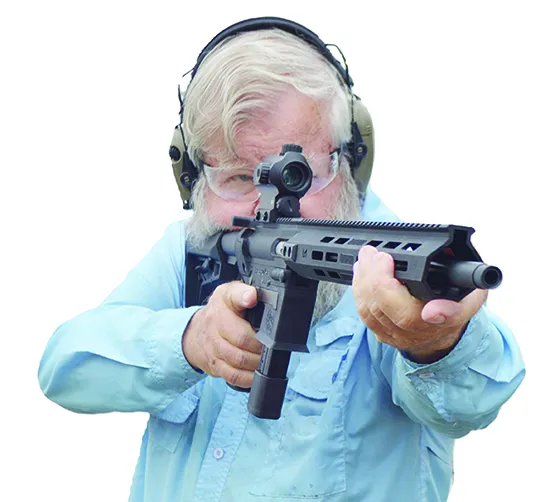
Among the most popular firearms on the modern scene is the pistol-caliber carbine, or PCC for short, and the 9mm Luger PCCs are by far the most popular because of the popularity of handguns in that chambering. These carbines are affordable, much easier to shoot well than a pistol, less expensive to supply than most rifle calibers, and offer utility in competition and defense. We recently tested two 9mm PCCs from Smith & Wesson with an eye toward evaluating them for home-defense, while recognizing they could also be used in specialized competition. There is some crossover, and it is difficult to choose between them until you put one against the other in specific shooting scenarios.
For test purposes, we collected a supply of 9mm Luger ammunition suitable for home defense. During the combat-shooting phase, we fired Tula steel-case 115-grain rounds, Blazer brass-case 115-grain FMJs, and Fiocchi 147-grain FMJs. The bolt was lubricated prior to firing. We fired 50 rounds of each load in the Smith & Wesson carbines, a total of 150 cartridges in each firearm. During the accuracy testing phase, we ran 20 cartridges of Hornady 115-grain Critical Defense, Hornady 124-grain +P American Gunner, and Federal 147-grain HSTs.
We used red-dot sights for shooting the 9mm carbines. The FPC was mounted with a SIG Romeo 5 sight, $150. For the Response shooting, we mounted a TruGlo PR1 red dot, $240. The PR1 features an aiming point etched into the glass and offers a good range of adjustment.
Smith & Wesson Response 13797 9mm Luger
$700
Gun Tests grade: A-
The Response is a fun gun to fire. Folks who like semi-automatic version of SMGs or folding carbines may like the FPC better, and it folds up neatly. The Response is the shooter, and it offers simple but effective handling. Recoil is modest and accuracy good. The Response is a good choice for many pursuits.
| Action Type | Semi auto, blowback |
|---|---|
| Overall Length Collapsed | 32.12 in. |
| Overall Length Extended | 35.4 in. |
| Barrel Length/Twist | 16.5 in., 1:10 |
| Overall Height with Red Dot Sight | 9.8 in. |
| Weight Unloaded | 5.9 lbs. |
| Weight Loaded | 6.1 lbs. |
| Action Finish | Matte black oxide |
| Barrel Finish | Matte black oxide |
| Magazines | (2) 23 rounds |
| Magazine Type | S&W M&P |
| Stock | Black polymer |
| Stock Buttplate | Serrated polymer |
| Stock Length of Pull Adj., | 14.5 in. |
| Receiver Scope Base Pattern | Picatinny rail |
| Trigger Pull Weight | 4.5 lbs. |
| Safety | AR-type lever |
| Warranty | Lifetime |
| Telephone | (800) 331-0852 |
| Website | Smith-Wesson.com |
| Made in | U.S. |
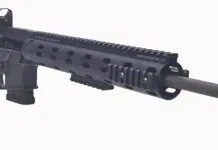
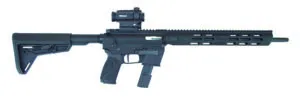
When Smith & Wesson introduced the Response, we wondered, “Why?” After all, the FPC was relatively fresh. But the Response is a much different carbine than the FPC. The Response is almost 2 inches longer than the FPC, and it doesn’t fold. It is just shy of a pound heavier than the FPC, but still light at about 6 pounds. This carbine makes extensive use of polymer to keep weight down. Both the upper and lower receiver are polymer. This is not an AR-15, but it has a similar appearance. There are many good features on the Response, and nothing we did not like.
The Response features a polymer handguard with M-Lok slots. The Response is a straight-blowback-operated carbine, similar to the FPC in operation. The Response safety is on the left side of the receiver along with the bolt release, with the magazine release on the right side. All controls are easily manipulated.
We looked carefully at the FPC’s and Response’s adaptability to left-hand use. The safety of each carbine isn’t left-hand friendly, but the bolt release and magazine release (reversible, so no issue) is okay in each. Cocking either is ambidextrous. The Response, in particular, missed an opportunity to offer a left-hand friendlier carbine. And it isn’t just lefties — all of us need to practice firing with either hand, at least occasionally.
The buttstock is from Magpul. It is the popular telescoping design with six positions. So, the Response can be about 3 inches shorter, but it is not in the league with the FPC folder. The handle isn’t as close to the M&P 9mm pistol as the FPC, but it works well enough and is more comfortable than many other carbine pistol grips. Four included grip inserts are an excellent means of finding your perfect fit. The cocking handle is wide and offers good leverage in racking the bolt. The Response magazine well is angled to the rear, with the magazine base in a rear rake attitude. We found the ability to grasp the magazine and tug it free if needed to be a plus. Another advantage is that the Response features a flexible magazine arrangement called the FlexMag System. The lower part or magazine well of the receiver may be removed and another type affixed to the carbine. The Response is issued with two 23-round Military & Police magazines and a FlexMag housing for Glock magazines. This makes a great deal of sense considering the popularity of Glock pistols and the easy availability of Glock magazines. As an example, the 23-round S&W magazine is $45, while the Glock 19-round magazine is $24, and the famously reliable Glock 9mm 33-round magazine is $38. This makes you appreciate the Glock magazine well even more.

Off the range, one of the testers elected to put the Response carbine into use as a home-defense carbine. This rater owns several Glock 9mm pistols. So, he changed the magazine well to the Glock-compatible set up. Firing a full load from a 33-round Glock magazine with the Tula load and a 19-round Glock magazine with the Hornady Critical defense, the Response functioned without malfunction. As a Glock-compatible carbine, it works well.
When firing either carbine at close range, we kept both eyes open. In firing the Response at 10, 15, and 25 yards with a total of 150 rounds of FMJ ammunition, we noted how different the shooting experience was in contrast to the FPC. While the FPC is a light kicker, recoil was more than the Response. Despite our praise of the easy reloads with the FPC, the Response offered faster, cleaner speed loads. One rater said that if you shoot a pistol more often and shoot your carbine like a pistol, the FPC’s grip and magazine release are better. The slide release is okay on the FPC, but not as fast as the more ergonomic Response. If you are moving from an AR-15, the Response may prove to be faster. It is all muscle memory. Overall, the Response exhibited faster speed loads for our shooters.
During accuracy testing with the Response, we noted velocities for it were very much similar to the FPC. No surprise because they both have 16.5-inch barrels. In bench accuracy, the Response proved superior to the FPC. The advantage was not great, but the Response exhibited groups that were slightly smaller than the FPC.
Our Team Said: Each would be a good home-defense gun. However, even though the FPC is easy to handle, if you are choosing a carbine for extensive range use and 3-Gun competition, the Response comes out ahead because it recoils less and features superior ergonomics. The Response’s accuracy is slightly superior to the FPC and would prove an advantage when shooting is stretched to 100 yards. If taking out coyotes at 50 to 100 yards is part of the chores, the Response is way ahead. The Response is a fine home defender. However, the FPC folds into a neat package, costs less, and is lighter. It simply takes up less space and is supplied with a bag that may make for discreet transport. The FPC is supplied with three magazines, the Response two. The Response may be converted to Glock magazine use with the changing of a magazine well using only an Allen key. In the end, the FPC is our choice for home defense, traveling, and as a truck gun. For heavy training and competition use, we’d pick the Response.
| RANGE DATA | ||
|---|---|---|
| Hornady Critical Defense 115-grain FTX 90250 | Smith & Wesson Folding Pistol Carbine | Smith & Wesson Response |
| Average Velocity | 1255 fps | 1264 fps |
| Muzzle Energy | 402 ft.-lbs. | 408 ft.-lbs. |
| Small Group | 2.9 in. | 2.5 in. |
| Average Group | 3.5 in. | 3.2 in. |
| Hornady American Gunner 124-grain XTP +P 90224 | Smith & Wesson Folding Pistol Carbine | Smith & Wesson Response |
| Average Velocity | 1319 fps | 1303 fps |
| Muzzle Energy | 479 ft.-lbs. | 467 ft.-lbs. |
| Smallest Group | 2.4 in. | 1.6 in. |
| Average Group | 2.8 in. | 2.5 in. |
| Federal Premium HST 147-grain JHP P9HST2 | Smith & Wesson Folding Pistol Carbine | Smith & Wesson Response |
| Average Velocity | 1099 fps | 1087 fps |
| Muzzle Energy | 394 ft.-lbs. | 386 ft.-lbs. |
| Smallest Group | 2.2 in. | 1.9 in. |
| Average Group | 2.7 in. | 2.5 in. |
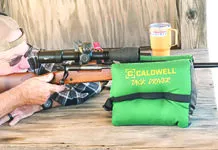
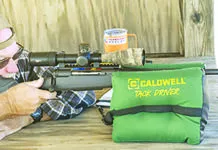
To collect accuracy data, we fired three-shot groups from a bench using an MTM Case-Gard K-Zone rest. Distance: 50 yards. We measured velocities with a Competition Electronics Pro Chrony with the first screen 10 feet from the muzzles
Written and photographed by Robert Campbell, using evaluations from Gun Tests Team members. GT