











Among the most popular firearms on the modern scene is the pistol-caliber carbine, or PCC for short, and the 9mm Luger PCCs are by far the most popular because of the popularity of handguns in that chambering. These carbines are affordable, much easier to shoot well than a pistol, less expensive to supply than most rifle calibers, and offer utility in competition and defense. We recently tested two 9mm PCCs from Smith & Wesson with an eye toward evaluating them for home-defense, while recognizing they could also be used in specialized competition. There is some crossover, and it is difficult to choose between them until you put one against the other in specific shooting scenarios.
For test purposes, we collected a supply of 9mm Luger ammunition suitable for home defense. During the combat-shooting phase, we fired Tula steel-case 115-grain rounds, Blazer brass-case 115-grain FMJs, and Fiocchi 147-grain FMJs. The bolt was lubricated prior to firing. We fired 50 rounds of each load in the Smith & Wesson carbines, a total of 150 cartridges in each firearm. During the accuracy testing phase, we ran 20 cartridges of Hornady 115-grain Critical Defense, Hornady 124-grain +P American Gunner, and Federal 147-grain HSTs.
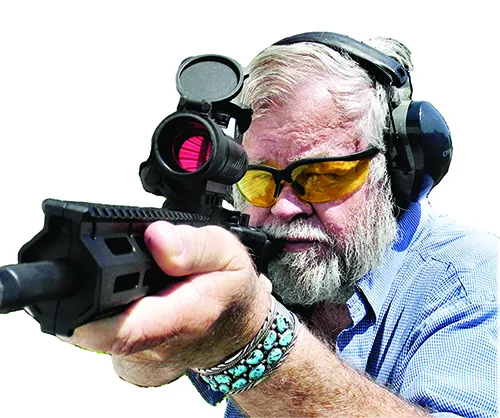
We used red-dot sights for shooting the 9mm carbines. The FPC was mounted with a SIG Romeo 5 sight, $150. For the Response shooting, we mounted a TruGlo PR1 red dot, $240. The PR1 features an aiming point etched into the glass and offers a good range of adjustment.
S&W M&P FPC 12575 9mm Luger
$520
Gun Tests grade: A-
The 9mm FPC is light, easy to carry on trails, and easy to store in a truck or van. It is reliable with a range of ammunition. Some like the Response better in shooting drills. For personal defense, this is the better buy, offering more magazines in the package and a folding option. Both carbines got a half-grade dock because they’re not lefty friendly. If you’re a lefty, then call both B+ guns.
| Action Type | Semi auto, blowback |
|---|---|
| Overall Length Folded | 16.5 in. |
| Overall Length Unfolded | 30.6 in. |
| Barrel Length/Twist | 16.25 in., 1:10 |
| Overall Height with Red Dot Sight | 9.5 in. |
| Weight Unloaded | 5.0 lbs. |
| Weight Loaded | 5.9 lbs. |
| Full Load Out Weight* | 7.5 lbs. |
| Action Finish | Matte black oxide |
| Barrel Finish | Matte black oxide |
| Magazines | (1) 17, (2) 23 rounds |
| Magazine Type | S&W M&P |
| Stock | Black aluminum |
| Stock Buttplate | Serrated polymer |
| Stock Length of Pull | 14.5 in. |
| Receiver Scope Base Pattern | Picatinny rail |
| Trigger Pull Weight | 5.1 lbs. |
| Safety | Crossbolt |
| Warranty | Lifetime |
| Telephone | (800) 331-0852 |
| Website | Smith-Wesson.com |
| Made In | U.S. |
*With three loaded magazines, two in buttstock
When Smith & Wesson announced its first PCC, some of us expected Smith & Wesson would go the easy route and offer a 9mm based on the Smith & Wesson M&P 15. They did not. This carbine, like the Response tested below, is a straight blowback design instead of a gas gun. This is best for 9mm use. We have tested very reliable 9mm carbines and also a gas-operated carbine that gave function problems with certain loads. There just isn’t that much gas in a 9mm cartridge.
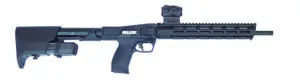
The Smith &Wesson Folding Pistol (caliber) Carbine addresses shortcomings of another popular 9mm carbine, the KelTec Sub2000, in which the FPC allows the carbine to be folded while leaving the red-dot sight mounted by virtue of a twisting forearm. KelTec addressed this advantage of the Smith & Wesson rather quickly with its Generation 3 Sub2000, which we will review another time. The FPC plays up its similarity to the popular S&W Military & Police handgun. The grip is based on the M&P compact and accepts all M&P 9mm magazines from 15 to 23 rounds. The carbine is delivered in a nicely set-up zippered bag with two 23-rounders and one 17-round magazine. The grip is supplied with inserts borrowed from the M&P pistol, unusual in a carbine. So you may tailor the handfit. Shooters with large hands will find the most advantage in swapping out grip inserts.
The FPC also shares the improved grip texture of the M&P pistol, as well as its grip inserts and magazines. The 2.0 version of the trigger is nicely set up and offers a good trigger press. We looked over the four backstraps supplied with the FPC but didn’t change them out. A carbine grip isn’t as critical as a pistol’s because the three-point shooting lock-up (front hand, trigger hand, and shoulder) results in good stability. Just the same, one of our ham-handed raters mentioned that if he kept the FPC 9mm, he would change the grip inserts.
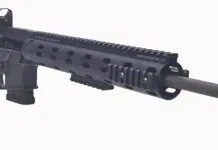
In hand, the first impression is that the FPC is light. It weighs only 5.0 pounds unloaded. Yet there is plenty of room for mounting optics, and the buttstock holds two magazines locked in place. As one rater noted, the piece is backpack friendly. Like many other modern carbines, the 16-inch barrel is threaded for a suppressor. The fore end features M-Lok slots for secure mounting of combat lights.
An advantage of a carbine with a magazine feeding into the grip is that the magazine is easily changed by bringing the hands together, even in the dark. The magazine catch is positive in operation. Because the buttstock is also a magazine carrier, be certain to practice with the paddle-type magazine release on the buttstock. It is secure and rattle free, but it demands some practice for rapid manipulation. You hit the paddle, and it releases the magazine opposite of the lever pressed. This set up allows a huge ammunition reserve to be stored on board.
The safety is a crossbolt type. It is not as easily manipulated as the Response, but it is not that difficult either. To rack the bolt, use the cocking lever located on the bottom of the buttstock tube. Because we recommend a long gun of any type be kept chamber empty in home ready, be certain to practice quickly racking the bolt. It should be second nature in a home-defense situation. The Response is easier to cock and make ready by a small margin. The FPC features dual wings on the cocking lever, making it left- or right-hand friendly in that regard. If left-hand use is a consideration, we’d rate each carbine down a half grade. They’re just not lefty friendly.
We feel a folding carbine that may be made instantly ready for action is superior to a carbine that breaks into two parts for storage. The FPC is easily folded and stored. It is quite simple to make the piece ready for action. An interrupter keeps the piece from firing when the FPC is folded. A robust unlocking lever allows the barrel to be folded over. This is a simple operation, and the hinge seems robust enough to stand up to hard use. To make the FPC 9mm carbine ready for use from the folded position, first grasp the barrel and rotate it into the locked position. Insert a loaded magazine. Rack the bolt, and you are ready to fire.

The FPC is delivered without sights. But the rail offers good opportunities for mounting optics. After the Romeo red-dot sight was mounted, we took time to sight the FPC in with 115-grain ammunition at 25 yards. On the firing line, most raters found it easier to bring the FPC to the shoulder and then rack the bolt straight to the rear with the buttstock tucked firmly in the shoulder. Even our near-70-year-old rater had no trouble racking the bolt. We made the carbine ready and practiced quickly hitting the safety. The safety is easily and quickly pressed in from the right side to make ready, using the trigger finger. Not as fast as the Response, but it worked fine. But then, in chamber empty at ready, the safety doesn’t play into the first few shots, only if you elect to engage in movement with the carbine in a chamber-loaded ready mode. Firing the FPC proved comfortable despite a thin stock and buttplate. The FPC is very fast on target and offers modest recoil. A shooter who has trouble mastering a pistol will do much better with the FPC carbine. If you need a home-defense firearm right now and time to train is limited, the FPC offers good protection. You should, of course, master every firearm with a self-defense role. But we recognize time and demands on finances don’t always result in an ideal situation.
The FPC ran through the steel-cased ammunition without a hiccup. We fired 50 rounds at 10 yards, quickly coming on target, firing five rounds, then lowering the barrel and beginning again. Results were very good. As we kept the crew busy loading magazines, we noted the metal magazines were easily loaded to full capacity. Some of the crew hand-loaded the over-length magazines to 23 rounds; some used a magazine loader after 20 rounds. The magazines are well made of stainless steel. We next moved to 15 yards with the Blazer brass loads and repeated the drill. There was little difference in group size; all the shots were well centered. Finally, we fired the Fiocchi 147-grain loads at 25 yards. The heavy bullet was tested to gauge results with low-velocity, heavy bullets. Recoil was the least of the three loads used in combat firing. At 25 yards, we were well within the sure-stop range with the FPC. Groups were larger than the 15-yard groups, of course, but only slightly. The FPC never failed to feed, chamber, fire, or eject.
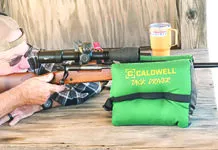
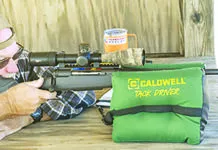
Bench-accuracy testing was for five-shot groups at 50 yards. The Hornady 115-grain Critical Defense, Hornady 124-grain +P American Gunner, and Federal 147-grain HSTs all fed, chambered, fired, and ejected normally. Most groups were inside or just outside of 2 inches, more than acceptable for a carbine.
Our Team Said: For home defense, area defense, and even ridding the property of pests and varmints of the four-legged type, the FPC is a good carbine. We also noted there was little to no difference in point of aim and point of impact with all the bullet weights tested. Muzzle rise simply wasn’t a factor. The FPC is not as accurate as the Response, but it is more than accurate enough for its intended role of personal defense.
| RANGE DATA | ||
|---|---|---|
| Hornady Critical Defense 115-grain FTX 90250 | Smith & Wesson Folding Pistol Carbine | Smith & Wesson Response |
| Average Velocity | 1255 fps | 1264 fps |
| Muzzle Energy | 402 ft.-lbs. | 408 ft.-lbs. |
| Small Group | 2.9 in. | 2.5 in. |
| Average Group | 3.5 in. | 3.2 in. |
| Hornady American Gunner 124-grain XTP +P 90224 | Smith & Wesson Folding Pistol Carbine | Smith & Wesson Response |
| Average Velocity | 1319 fps | 1303 fps |
| Muzzle Energy | 479 ft.-lbs. | 467 ft.-lbs. |
| Smallest Group | 2.4 in. | 1.6 in. |
| Average Group | 2.8 in. | 2.5 in. |
| Federal Premium HST 147-grain JHP P9HST2 | Smith & Wesson Folding Pistol Carbine | Smith & Wesson Response |
| Average Velocity | 1099 fps | 1087 fps |
| Muzzle Energy | 394 ft.-lbs. | 386 ft.-lbs. |
| Smallest Group | 2.2 in. | 1.9 in. |
| Average Group | 2.7 in. | 2.5 in. |
To collect accuracy data, we fired three-shot groups from a bench using an MTM Case-Gard K-Zone rest. Distance: 50 yards. We measured velocities with a Competition Electronics Pro Chrony with the first screen 10 feet from the muzzles
Written and photographed by Robert Campbell, using evaluations from Gun Tests Team members. GT