
















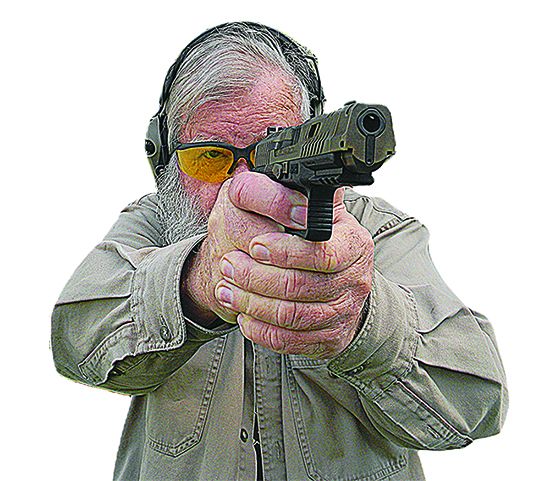
Here we test two handguns suited to Action Pistol competition, one a relatively recent introduction from Canik, the TTI Combat, $900, and the other, Smith & Wesson’s Spec Series V M&P Metal HD, $1500. Both have heavier frames, long barrels, striker-fired mechanisms, and compensators. With all these features, they should make a 9mm handgun a truly enjoyable firing experience. Ramp up the sights and add a good trigger action, and you have a handgun well suited to many types of Action competition.
For the firing tests, we used five different types of 9mm Luger ammunition, a good spread from affordable full metal jackets to match-grade loads and one defense load. These were the Fiocchi Range Dynamics 147-grain FMJs, Blazer 115-grain Brass Case FMJs, Federal Premium Gold Medal Action Pistol 147-grain FMJs, and Winchester Super Suppressed 147-grain subsonic FMJ “encapsulated.” This odd terminology means that Winchester inserts a brass disc under the base of the bullet core to reduce lead fouling in barrels and suppressors. The sole defense load was Black Hills Ammunition’s 124-grain JHP +P. This gave us a wide range of performance. We fired one box each of the four FMJ loads in each handgun, a total of 200 rounds in each gun. We fired 20 rounds of the Black Hills Ammunition +P loads in each gun to gauge reliability. Our shooters fired combat style at torso silhouette targets at 7, 10, 15, and 25 yards and bullseye targets both offhand and from a benchrest. During the test, we had no failures to feed, chamber, or eject. Initially, the Canik had several incidents of failing to set the trigger. One tester called it a failure to go into battery. The Canik’s owners manual recommends a 150-round break-in period, so we didn’t dock it for the failures inside that shot window. Just the same, most guns these days don’t require a break in.
For accuracy testing, we used three loads, the Federal Gold Match 147 grain, Black Hills 124-grain +P, and Blazer 115-grain FMJ.
We considered whether the guns are left-hand friendly. Each has no problem with changing the magazine release to left-hand use. Also, the two pistols feature ambidextrous slide locks. The triggers are not right- or left-hand oriented. In the end, the pistols are as left-hand friendly as possible for a right-ejecting semi-automatic, but even then there wasn’t a problem. Firing left handed with right-hand ejection didn’t cause a problem for our shooters.
In our evaluation, we found one gun would be a suitable entry-level competition piece, while the other would be Our Pick for defensive and service use. Here’s how they performed in our side-by-side shooting evaluation:
Canik TTI Combat HG7854-N 9mm Luger,
$900
Gun Tests grade: B
The TTI Combat is a very capable and competent handgun. However, it stuttered with what we thought were break-in malfunctions, but which lingered after the test. We liked the easily removable and functional compensator.
| Action Type | Single action semi-auto |
|---|---|
| Overall Length | 7.85 in. |
| Overall Height | 5.87 in |
| Maximum Width | 1.41 in. |
| Weight Unloaded | 29.5 oz. |
| Weight Loaded | 35.6 oz. |
| Barrel Length | 4.7 in. |
| Slide | Bronze Cerakote |
| Slide Retraction Effort | 17.5 lbs |
| Receiver | Cerakote Polymer |
| Front Strap Height | 2.6 in. |
| Rear Strap Height | 3.6 in. |
| Grip Thickness | 1.2 in. |
| Grip Circumference | 5.6 in. |
| Magazines | (1) 18 and (1) 18+3 |
| Magazine Price | $32 |
| Rear Sight | Wedge type |
| Front Sight | Fiber optic |
| Trigger Pull Weight | 4.5 lbs. |
| Trigger Span | 2.75 in. |
| Sight Radius | 6.2 in. |
| Safety | No manual safety |
| Warranty | Lifetime |
| Telephone | (800) 527-1252 |
| Website | CanikUSA.com |
| Made In | Turkey |
The Canik line of striker-fired polymer-frame handguns has steadily evolved and made a considerable inroad into America. The pistol is imported by Century Arms but manufactured by Samsun Yurt Savunma (SYS) Industry in Turkey. The pistols have earned a reputation for value. As the company expanded its lines of striker-fired 9mm handguns, Canik has released models that are far from the original budget base and offer upgraded Action Shooting competition features. A reasonably priced match gun is a desirable option for those getting their feet wet in the field. As an example, a quick look at the Taran Tactical site shows that those custom guns start at around $3700. A match-winning gun used by a top competitor will cost even more. So, $900 isn’t a bad price for anyone wishing to own a match gun that is competitive in amateur contests.
Canik’s larger handguns, such as the METE SFX, have achieved some success in competition, and a new 9mm pistol, a cooperative effort with Taran Butler, widely regarded as one of the winningest match shooters of all time, promises even more. Butler founded Taran Tactical Innovations (TTI). The TTI Combat includes some of Taran’s innovations in a mass-produced handgun. The TTI Combat is a polymer-frame striker-fired pistol with a compensator, making it mostly a match to the Smith & Wesson M&P Spec Series V M&P 9 Metal HD. We have previously tested a similar version of the Smith & Wesson with an aluminum frame. Canik also has a metal-frame gun, but it doesn’t have a compensator, so we went with the TTI Combat as the closer match.
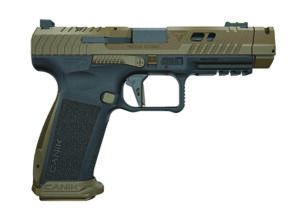
There isn’t a lot of innovation in either gun as far as operating mechanics. Both guns are locked-breech short-recoil striker-fired guns. The Canik, originally based on a Walther action, is a single-action-trigger gun, while the Smith & Wesson is a double-action-only trigger. The Canik pistol features a nitride-finished slide over a polymer frame. We found what Canik calls a bronze Cerakote finish attractive and evenly applied. The finish did not wear noticeably as the test went on for several weeks of firing and drawing from a holster. The slide isn’t an angular section like a Glock, as an example, but features bevels and contours that are functional and handsome. The slide features cuts to lighten the slide. There are well-defined cocking serrations both forward and rear.
The barrel features an external compensator with a twin-port design. We have found that compensators in pistols don’t lower recoil so much as they aid in limiting muzzle flip. This device proved effective in that task. We found the compensator was easily removed for cleaning. The Canik comes with a punch that is used to depress a latch in the compensator for removal. It works well. Remove the slide and press the compensator latch in with the supplied Canik punch, and twist the compensator three-quarters of a turn to remove. While easy to remove, the compensator is tight when returned to lock. We liked this set up a lot. The pistol has a slight barrel port with the compensator removed, but it isn’t a true compensator. The compensator is nicely morphed into the slide, compared to the Smith & Wesson, which hangs off the slide on the muzzle. It doesn’t matter on a competition gun. Each gun may be modified for carry by removing the magazine well and compensator. The Smith & Wesson’s compensator has two screws that hold it on the muzzle threads, one on the top that centers the steel comp body and a side fastener. There were no instructions in the manual about how to remove the Spec’s comp and what the torque specs might be, which seemed like an oversight to us. It would be easy to overtorque these screws. We have seen some owners of this pistol say there was a loose flyer in their cases that described the process of getting the comp off, but our gun didn’t come with that.
For these two guns, we would not bother removing the compensators because they are easily cleaned without going to this trouble, even in the case of the Canik. One of the testers noted that he would probably clean the compensator at 1500 cartridges. The Canik’s compensator doesn’t make that much difference in a holster if you are going to carry the piece concealed.
The Canik’s fixed sights are a wedge-type rear with a serrated face and a green-fiber-optic front. These sights provide clear definition when firing for combat groups or for accuracy. The rear sight is easily adjustable by loosening a screw and then bumping the sight with a brass punch. As delivered, the pistol was properly sighted for 124-grain ammunition. Due to the pistol’s modest muzzle flip, there was little difference in the point of aim and point of impact with 115-, 124-, and 147-grain bullet weights.

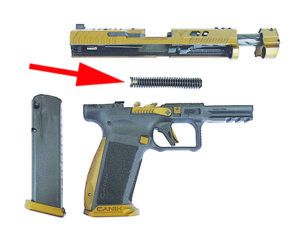
Other features are standard Canik, with a heavy extractor and the red-tipped striker visible from the rear of the slide. The pistol features a steel guide rod and a recoil spring of flat-wire design. Take down is simple. Unload the pistol and pull the dual take-down lever downward to release the slide. This is a simple system we prefer over the Glock style, as an example. The Smith & Wesson uses a single lever to facilitate take down, also a simple system. With either handgun, disassembly and reassembly are easy. However, be certain to consult the Canik’s owner’s manual for reassembly. The slide must be placed over the ejector in the rear of the frame; it doesn’t simply slide on the frame. This isn’t a drawback at all, and one tester found it to be faster than the Smith & Wesson’s system.
While designed primarily for competition, the pistol features a light rail for mounting combat lights. The TTI Combat features a flat-front trigger guard and a flat-face aluminum trigger. The trigger face features a blade-type safety lever to prevent lateral discharge and to stabilize the trigger if the pistol is dropped. The trigger features a relatively short take-up. One of our testers noted that take-up doesn’t matter to him, because he engages the trigger quickly and allows the trigger to reset as he brings the muzzle back on target during a firing string. Just the same, the Canik has a short press. The trigger breaks at a clean 4.5 pounds with a sharp reset. The Smith & Wesson trigger breaks at 3.5 pounds and is very sharp in reset. There was much debate on the trigger action of each pistol. While the Canik is a pound heavier, it is a single-action break, while the S&W is a double action only. Each trigger action is good in its own way and both feel very crisp. The Canik may be the better competition type, while the Smith & Wesson is better suited for carry.
The ambidextrous slide lock is well designed, long but unobtrusive, and easily manipulated. We were concerned we might activate the magazine release during firing due to its size and profile, but none of the testers, with various hand sizes, had any difficulty. The screw holding the right-hand slide lock in place never loosened during the test, an initial concern. The magazine release is reversible for left-hand use. Speed loads were overall faster with the Canik, a finding we determined by combining speed loads with combat firing during the combat shooting course. The grip treatment features a texture that isn’t uncomfortable but offers good adhesion and abrasion during firing runs. The consensus was that the Canik grip treatment was credible and did the job as intended, but it didn’t feel as raspy as the Smith & Wesson. Thus, the Canik is more comfortable in long firing strings. The Smith & Wesson may be held more tightly when firing at a rapid pace. The Canik’s magazine well worked well in funneling tapered magazines into the grip, and the well is removable. Neither magazine well had an advantage over the other.
The Canik’s plastic hard case is thick and heavy. Foam lining is supplied in two tiers, and the box is filled with accessories. The box holds the usual paperwork and manual, as well as a certificate from Taran Tactical captured in the lid, visible in a cut out when the case is opened. The case also holds four optics-mounting plates in three locations in the box, two backstraps, and a surprising little tool kit that looks like a toy pistol or plastic key fob. The magazine well of the toy gun opens to reveal the tools. Also included in the box are a bore brush, gun lock, and a Kydex holster. The holster was surprisingly appropriate for range work, a good design for most uses. The balance of speed and retention were good. We also noted that a spare recoil assembly was included. This spare spring and guide are designed for use with low-pressure/low-velocity loads. During the test, we did not change backstraps, using the pistol as issued. The Canik requires that a pin be forced out to change the backstrap, so we preferred the Smith & Wesson system.
As far as magazines, the box contains two, one 18- and one 21-rounder. The 21-round magazine is an 18-round magazine with a +3 base plate, but we could only stuff 20 rounds into it. The 20-round box magazine was difficult to load throughout the test. We could load eight or nine rounds and then had to tap the magazine back on a hard surface to seat the cartridges in the magazine. Once fully loaded, it never failed to feed, but it also never loosened up.
In offhand shooting, the Canik TTI Combat was comfortable to fire. Recoil is what you would expect with a polymer-frame handgun of this size and weight, and we thought the gun was very comfortable to fire. The pistol is as controllable as any other 9mm polymer-frame pistol we have fired and more so than most. Muzzle flip is muted, and the shooting experience is pleasant. With a compensated gun, we were able to feel the differences in ammunition impulse with sharp definition. The lightest-recoiling and most-accurate load was the Federal Gold Medal 147-grain round. This load is about as light as possible while maintaining function in most handguns. The Blazer 115s, while controllable, were noticeably hotter. The Black Hills +P 124s had noticeably greater recoil but not muzzle flip, a neat trick.
The Canik TTI Combat weighs just a few tenths of an ounce less than 30 ounces unloaded, so it is not a lightweight polymer-frame pistol. Also, a full magazine adds considerable butt balance to the pistol. In combat shooting, we appreciated the grip treatment. It isn’t as aggressive as the S&W’s, but got the job done.
We addressed a target with nine separate silhouette figures, an excellent training target. We took runs at this target with its differing size silhouettes twice with each gun. The Canik virtually tied the Smith & Wesson on one turn and bested it on the other. We fired this drill to get one hit on each target, then repeated the course in reverse order for a total of 18 rounds, a full magazine. At 7 yards, the Canik was slightly behind the Spec, but it was splitting hairs from firing run to firing run. The Smith & Wesson did seem more comfortable due to its heavier weight. When fired off hand at longer range, the Smith & Wesson was the more accurate off hand. The weight was a factor, but the Smith & Wesson’s lighter trigger was also a factor.
When we settled into the benchrest firing test, we noted the Canik pistol exhibited good accuracy. Firing the three accuracy loads, we popped five-shot groups off a solid firing rest at 25 yards. The smallest group with the Federal 147-grain Gold Medals was an impressive 1.5 inch. The average of the loads was closer to 2.5 inches, outstanding for a striker-fired 9mm. The Smith & Wesson was only incrementally more accurate, and the smallest groups with each pistol were exactly the same 1.5 inches.
As mentioned, the Canik pistol seldom failed to feed, chamber, or eject, but it did suffer three break-in malfunctions during the first 40 rounds. A tester thought perhaps it was because of his hand position on the slide lock. The pistol would feed and chamber a cartridge, but the striker was not cocked. Another tester noted that you must release the trigger during the firing cycle or the pistol will not reset. The problem did not continue after the first 40 rounds. We referred back to the 150-round break in demanded by Canik. The Smith & Wesson did not demand a break-in period.
Our Team Said: In the end, we find the Canik TTI Combat to be a credible gun for many reasons. For competition, home defense, or carry use, the Canik seems capable. We would be certain to proof the pistol thoroughly and isolate any malfunctions, as we mention below.
We were conflicted about how to grade the function problems fairly. Normally, such hitches would be a full-grade mark down or more, but they were inside the break-in window outlined in the manual. But the Smith & Wesson did not suffer any malfunctions. So we wound up not docking the gun for the malfunctions, at least initially. We did rate the Canik down a half grade on the +3 magazine, which wouldn’t accept a full load of 21 rounds as advertised.
There was a postscript, however. One of the South Carolina testers adopted the Canik as a personal pistol. The failures to go into battery persisted with some loads. He called Century and asked about any help under warranty. They sent an optional heavy-duty recoil-spring unit, and as far as he can tell, the problem is now solved for good.
Still, the malfunctions continued outside the break-in period, ultimately costing the Canik another half-grade demerit. We praise Canik for its customer service solution, because, if they hadn’t come through, the ongoing malfunctions would have put an F grade on the TTI Combat’s ledger, which would have been a pity.
In sum, the Canik is an affordable entry-level competition 9mm. It also would be well suited to personal defense or home defense, provided its malfunctions are worked out.
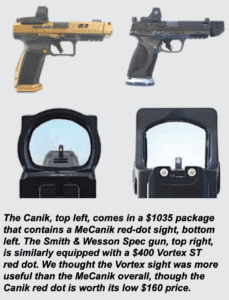
It’s worth noting that there’s a $1035 package Canik out there that contains a MeCanik red-dot sight. That’s a good deal because most Caniks without the red dot sell for around $900, like our test gun reviewed nearby. The red dot alone is usually $160, so the package seems to include a slight discount on the sight. But how is the red dot? We had access to a MeCanik during the test and thought it was well worth the price. The window is large and offers a bold and fast aiming point. It seemed a viable choice for competition, with performance in line with the Holosun 507. If purchased in the package offering with a red dot, the Canik is $465 less than the Smith & Wesson without a dot sight. That would buy a lot of ammunition. To shoot the guns side by side and similarly equipped, we fitted a Vortex ST red dot to the Smith & Wesson during testing. This would have added $400 to the price of the Smith & Wesson, putting that package at $1900, but of course there are red dots that cost more and some that cost less. We thought the Vortex sight was more useful than the MeCanik in overall performance and settings, while the Canik red dot is worth its price. We did not explore the optics option a great deal, but we did enough to find that each pistol was well suited to red-dot use. Left: The MeCanik red dot features a wide window and makes for fast, accurate shooting. As befits the gun’s design, the MeCanik is designed more for competition than concealed carry. Right: The large window of the Vortex ST on the Smith Spec Series is well suited to competition use as well.
| Federal Premium Gold Medal Action Pistol 147-grain FMJ GMAP1 | Smith & Wesson Spec Series V M&P 9 Metal HD | Canik TTI Combat |
|---|---|---|
| Average Velocity | 890 fps | 915 fps |
| Muzzle Energy | 259 ft.-lbs. | 273 ft.-lbs. |
| Small Group | 1.5 in. | 1.5 in. |
| Average Group | 2.0 in. | 2.1 in. |
| Blazer Ammunition 115-grain FMJ 5200 | Smith & Wesson Spec Series V M&P 9 Metal HD | Canik TTI Combat |
| Average Velocity | 1139 fps | 1156 fps |
| Muzzle Energy | 331 ft.-lbs. | 341 ft.-lbs. |
| Small Group | 2.0 in. | 2.4 in. |
| Average Group | 2.5 in. | 2.8 in. |
| Black Hills Ammunition Factory New 124-grain JHP +P | Smith & Wesson Spec Series V M&P 9 Metal HD | Canik TTI Combat |
| Average Velocity | 1199 fps | 1217 fps |
| Muzzle Energy | 396 ft.-lbs. | 408 ft.-lbs. |
| Small Group | 1.6 in. | 2.1 in. |
| Average Group | 2.1 in. | 2.6 in. |
To collect accuracy data, we fired five-shot groups from a bench using an MTM Case-Gard K-Zone rest. Distance: 25 yards. We measured velocities with a Competition Electronics Pro Chrony with the first screen 10 feet from the muzzles.
Written and photographed by Bob Campbell, using evaluations from Gun Tests Team members. GT