







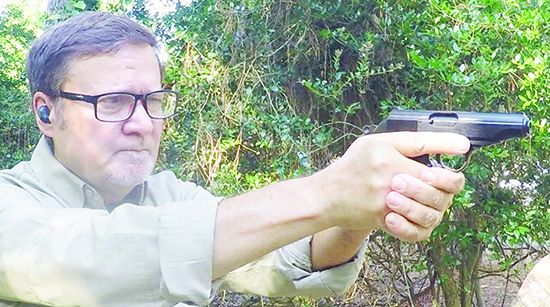
The Walther PP (Police Pistol or Polizeipistole in German) was introduced in 1929 and was designed for the law-enforcement market. It was adopted by police agencies throughout Europe and was embraced by the commercial market prior to WWII. During WWII, the German military issued Walther PP models mainly to Luftwaffe troops, as well as other military organizations. In nearly 100 years of production, it is without doubt one of the most successful semi-automatic pistols ever manufactured. That is because the PP was innovative, with features like an automatic hammer block, a combination safety/decocker, and a loaded chamber indicator. The PP is a safe and reliable pistol that uses a simple blowback mechanism and feeds from a single-stack magazine. It inspired other models like the PPK and PPK/s, which are just as iconic and classic. The design also invited copies from the Eastern Bloc, Turkey, and China. The pistol was licensed in France after WWII by Manurhin. PPK and PPK/s models were built in the U.S. by Ranger Manufacturing in the late 1970s as well as by Smith & Wesson from 2002-2013. In 2024, Walther Arms, Inc. in Fort Smith, Arkansas, reintroduced the model PP to the U.S. market. As of late 2025, Walther announced the suspension of this legacy pistol as well as the PPK and PPK/s models. Walther plans to update the design and reintroduce it at a later date.
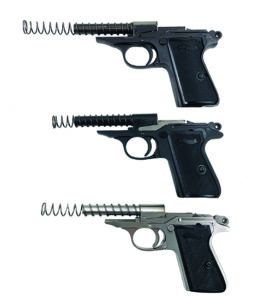
What’s interesting is Walther decided to re-introduce the PP in 380 Auto and 32 Auto. The latter caliber, though extremely popular in the early 20th century, was overshadowed by the 380 Auto. A few companies still manufacture subcompact 32 Auto pistols — Keltec, Beretta, and Seecamp come to mind, but the caliber is not that popular because it is considered anemic when put up against the 380 Auto or 9mm. We wanted to take a look at the new PP models and sourced one in each caliber. We also found a used model in excellent condition in 32 Auto to see if there were any differences between a model imported from Germany a few decades ago to a new American-built model. If the older gun turned out to be better than the newer ones, we’d send you out into the used market with a hearty “good luck” and the assurance that the effort would be worth it.
All three of these pistols share similar features, like the manual thumb safety/decocker. This lever is conveniently located on the slide near the thumb of a right-handed shooter. The gun is on Safe when the safety lever is down and on Fire when the lever is up, exposing a red dot. This is the opposite of the way the safeties on most American pistol designs operate, like the 1911 and thumb safeties on striker-fired pistols. A safety on the slide was popular for decades. Both Beretta and S&W, for example, produced pistols like this until they understood that shooters could rack the slide and accidentally rotate the safety into the Safe position. Part of the experience with vintage designs is understanding the weak spots.
With all three pistols, the safety lever allows the user to safely de-cock the pistols and put the trigger back in double-action mode. This might seem odd for striker-fired pistol users, but a decocker was an innovative feature back in the day of only hammer-fired pistols. With the gun on Safe, the trigger cannot be fully pulled to the rear. An automatic hammer block requires the trigger to be pulled fully rearward to fire the pistol.
The loaded-chamber indicator is a pin that protrudes out of the rear of the slide just under the rear sight. This tells the user there is a round or an empty case in the chamber. The hammer has a groove cut into it so the pin is visible, even when the hammer is fully forward.
All the PPs are natural pointers. With the flush-fit magazine, our small finger barely had any front-grip strap to hang on to. With the finger-rest magazines, the grip felt more secure.
The magazine release looks like a slide stop and seems odd for American shooter who expects the magazine release to be located behind the trigger where the trigger guard meets the front-grip strap. On the PP, the round magazine release is easily accessible with the thumb of a right-handed shooter.
These are the similarities of the Walthers. From here, there are some distinct features that separated the new U.S.-built guns from those manufactured in Germany.
The new U.S.-made PP models were redesigned from the ground up because none of the tooling from the original PPs was in the U.S. They were basically built from scratch. One major design difference is that a drop safety is built into the new U.S.-built models. There is a cut out in the hammer that is designed to accommodate the safety plunger lever. When the hammer falls, the safety plunger lever fits in that slot on the hammer, allowing the safety plunger lever to move out of the way. This is what keeps it drop safe when the hammer is fully back and cocked. The German-built PPs do not have a drop safety, so, in theory, if the pistol is dropped, the firing pin could move forward from the momentum and fire a round.
There’s something important to note about U.S.-built Walther PPK and PPK/S pistols manufactured under license by S&W from March 2002 through February 2009. These pistols are potentially unsafe. The hammer blocks are defective, and the pistol may fire without the trigger being pulled when the manual safety is deactivated, or when the manual safety is used to de-cock the pistol. Go to the S&W web site (Smith-Wesson.com) for details.
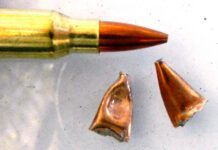
Ammo used consisted of both 380 Auto and 32 Auto selections. For 380 Auto, we used Hornady Critical Defense loaded with a 90-grain FTX bullet, Winchester SilverTip with an 80-grain JHP, and Speer Gold Dot with a 90-grain GDHP bullet. For 32 Auto ammo, we enlisted Buffalo Bore 32 Auto +P with a 75-grain hard-cast flat-nose bullet. Regular-strength 32 Auto consisted of Hornady Critical Defense 60-grain FTX bullets and Aguila ammo with a 71-grain FMJ. Extra magazines in blued or nickel finishes in 32 Auto or 380 Auto are available from Mec-Gar ($33.25 to $39.35; Mec-Gar.com) with the helpful finger rest or without, the flush-fit versions.
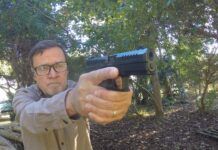
All the PPs exhibited good accuracy at 10 yards using a rest. At 7 yards and performing the Failure Drill, we were able to determine they all could be employed as defense guns, but some were better than others. One thing we noticed with all the Walthers was with our support-hand grip. There is very little frame for the support hand to contact, so you either have to rest your thumb against the slide, and every time the slide cycles reposition your support hand, or you shoot the gun with your support-hand thumb over your firing-hand thumb, like when gripping a revolver. There are other features that differ, which we will get into. The bottom line is these pistols show the age of their design. That doesn’t mean the pistol is incapable of defense use, but there are a few quirks you need to know — like the support-hand thumb rest — to optimally run these pistols. Slide retraction took about 12 pounds of effort on all of the pistols. There are serrations only at the rear, and there is enough texture to do the pinch-and-pull method or the pinch and over-the-slide method to rack the slide. We had no function issues with any of the PP guns, but we did take issue with their tiny sights and heavy trigger pulls, which are a known characteristic of PP pistols, and in our opinion, should have been enhanced in newer guns. Here are the details.
Walther PP 32 Auto Model 4796030,
$1000 (New Production)
Gun Tests grade: B-
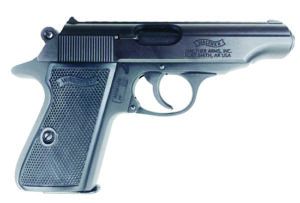
The new PP has a very heavy DA trigger, tiny sights, and great accuracy. The beavertail is longer than the used PP 32 Auto’s, which we liked.
| Action Type | Semi-auto, blowback |
|---|---|
| Trigger | Double action to single action |
| Overall Length | 6.9 in. |
| Overall Height | 4.2 in. |
| Maximum Width | 1.1 in. |
| Weight Unloaded | 16.6 oz. |
| Weight Loaded | 28.8 oz. |
| Barrel Length | 3.9 in. |
| Capacity | 8+1 |
| Slide | Blued steel |
| Slide Retraction Effort | 12.0 lbs. |
| Frame | Blued steel |
| Frame Front Strap Height | 1.9 in. |
| Frame Back Strap Height | 2.6 in. |
| Grip | Checkered black polymer |
| Grip Thickness (Maximum) | 1.1 in. |
| Grip Circumference (Maximum) | 5.5 in. |
| Front Sight | Red dot |
| Rear Sight | Fixed red dot notch |
| Trigger Pull Weight (Double Action) | 19.0 lbs. |
| Trigger Pull Weight (Single Action) | 5.6 lbs. |
| Trigger Span (Double Action) | 2.8 in. |
| Trigger Span (Single Action) | 2.6 in. |
| Magazines | (2) 8-round steel |
| Safety | Manual, decocker |
| Warranty | Limited lifetime |
| Telephone | (479) 242-8500 |
| Website | WaltherArms.com |
| Made In | U.S. |
This PP is newly manufactured in the U.S. under license. It comes in a beautiful blue-velvet case with two magazines, a flush fit and one with a finger rest. The finish is a more blackish semi-gloss blue compared to the German-made gun.
In hand, you can feel the longer beavertail protecting the web of your hand. The rear sight on this new pistol is machined out of the slide, so it is fixed. It also featured a dark red dot on the front sight and a stripe under the notch of the rear. The red color was nearly lost in the deep blue finish and provided no contrast.
The top of the slide had wavy serrations, and the roll marks were an italic font, which gave the gun a more refined, sophisticated look.
The single-action trigger pull measured 5.6 pounds and felt like every ounce of it. Because of this trigger action, we were surprised that the new 32 outshot the older 32. The best five-shot group was with Aguila and measured 0.70 inch for a best group and had an average group size of 0.87 inch. Next best was Buffalo Bore with a best of 1.05 inches and average of 1.13 inches. Hornady had a best of 1.13 inches and average of 1.27 inches.
Where we saw group size erode was when we used the double-action trigger for the first shot in the Failure Drill. There was no accidentally pulling the double-action trigger, especially when it measured 19 pounds. That’s an awful double-action trigger pull, especially on a small gun. Right-handed shooters found their double-action shots were hitting to the left because of the pressure needed to press the trigger. The new 7.65mm PP also shot low, so we had to compensate to hit the target, especially in the head A-zone area. Recoil was mild.
Our Team Said: The new blued PP had the best accuracy, but we disliked the tiny sights and way-too-heavy trigger pulls in both double action and single action. We would have graded this pistol lower, but its accuracy and drop safety saved it. We also think that in 32 Auto, this pistol is appropriate for plinking and target shooting, and maybe as a night-stand gun. We wouldn’t use this gun for concealed carry. There are too many better options, in our view.
| 32 AUTO RANGE DATA | |||
|---|---|---|---|
| Walther PP 1986-1999 (Used) | Hornady Critical Defense 60-grain FTX | Aguila Ammunition 71-grain FMJ | Buffalo Bore 75-grain Hard-Cast FN +P |
| Average Velocity | 888 fps | 909 fps | 895 fps |
| Muzzle Energy | 105 ft.-lbs. | 130 ft.-lbs. | 133 ft.-lbs. |
| Smallest Group | 1.75 in. | 0.77 in. | 1.41 in. |
| Average Group | 1.92 in. | 0.94 in. | 1.45 in. |
| Walther PP 4796030 (New) | Hornady Critical Defense 60-grain FTX | Aguila Ammunition 71-grain FMJ | Buffalo Bore 75-grain Hard-Cast FN +P |
| Average Velocity | 890 fps | 865 fps | 890 fps |
| Muzzle Energy | 105 ft.-lbs. | 118 ft.-lbs. | 131 ft.-lbs. |
| Smallest Group | 1.13 in. | 0.70 in. | 1.05 in. |
| Average Group | 1.27 in. | 0.87 in. | 1.13 in. |
| 380 AUTO RANGE DATA | |||
|---|---|---|---|
| Walther PP 4796027 (New) | Speer Gold Dot 90-grain GDHP | Winchester SilverTip 85-grain JHP | Hornady Critical Defense 90-grain FTX |
| Average Velocity | 935 fps | 969 fps | 986 fps |
| Muzzle Energy | 175 ft.-lbs. | 177 ft.-lbs. | 194 ft.-lbs. |
| Smallest Group | 1.69 in. | 1.04 in. | 1.23 in. |
| Average Group | 1.88 in. | 1.12 in. | 1.36 in. |
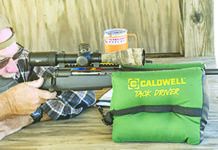
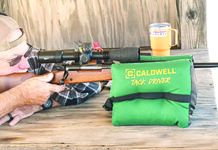
To collect accuracy data, we fired five-shot groups from a bench using a rest. Distance: 10 yards with open sights. Velocities and energies were recorded using a Garmin Xero C1 Pro chronograph.
Written and photographed by Robert Sadowski, using evaluations from Gun Tests Team members. GT