






A revolver chambered in 45 Long Colt is the subject of this test. The 45 Long Colt was introduced in 1873 for the Colt Peacemaker, and its most popular vehicle is still the single-action revolver. In 45 Long Colt, ammunition is loaded with bullets weighing from 225 to 255 grains. Lighter bullets usually have a muzzle velocity of around 900 fps, and heavier bullets are good for around 800 fps. This cartridge is suitable for hunting and self-defense.
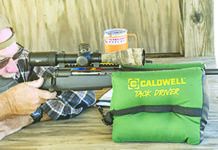
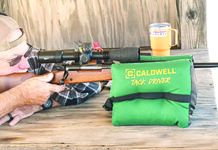
In this test, we fed two kinds of 45 Colt ammunition into a Colt Anaconda for a total of 300 rounds of hard-banging in-hand power. For accuracy testing, we used a sandbag rest on an indoor range. Here’s what we thought of this handgun:
Colt Anaconda 45 Colt, $612
Gun Tests grade: A-
This Anaconda would make a good self-defense gun. But we would not use it for hunting without a scope.
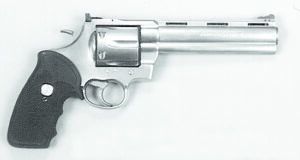
| Finish | Stainless |
|---|---|
| Weight (unloaded) | 53 oz. |
| Overall Length | 11.38 in. |
| Overall Height | 5.5 in. |
| Barrel Length | 6.0 in. |
| Sight Radius | 8.0 in. |
| Capacity | 6 |
| Grip Composition | Rubber |
| Grip Length | 4.00 in. |
| Grip Width | 1.22 in. |
| Grip Depth | 1.91 in. |
| Warranty | 1 Year |
The Anaconda is Colt’s only large-frame double-action revolver. Although it was designed for the 44 Magnum, the gun’s size also made it a natural choice for a big-bore non-magnum cartridge bearing the manufacturer’s name — the 45 Colt, also called the 45 Long Colt (LC) to eliminate confusion with the 45 ACP (Automatic Colt Pistol), which is often called 45 Colt informally.
In this chambering, the stainless-steel Anaconda features a 6- or 8-inch barrel with a ventilated rib and a full-length underlug. Its styling is similar to that of Colt’s ever-popular Python 357 Magnum, but the gun’s internal works are different. All versions of this six-shooter come with a combat-style grip and adjustable sights.
Our test gun’s matte-silver finish wasn’t perfect. We noted three nicks on the trigger guard’s right edge, and the walls of the cylinder window were covered with shallow tool marks. Moving parts, such as the hammer and trigger, had a moderate amount of play. However, the frame’s sideplate and pins were very closely fitted, and the barrel-to-cylinder gap measured a tight 0.005 inch. The two-piece thermoplastic grip was cleanly molded. Although its top edges didn’t lay flat against the frame, grip-to-metal mating was satisfactory.
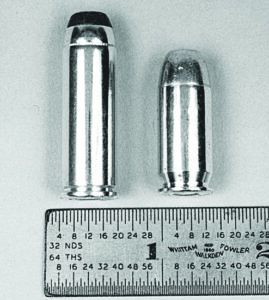
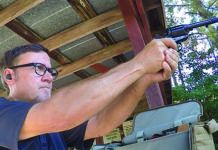
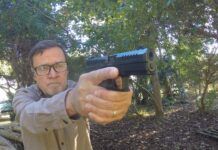
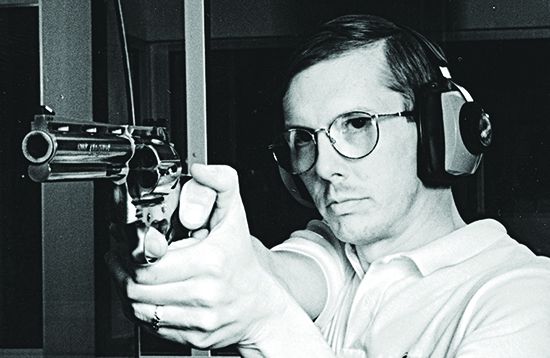
This revolver’s moderately-muzzle-heavy balance provided good stability when we were firing offhand. Target acquisition wasn’t what we would call fast, but the gun pointed well enough. The grip’s average width and depth were about what we expected, but due mainly to its shallower finger grooves, shooters with small hands said the grip was too bulky. Managing the muzzle during recoil wasn’t overly difficult, though the gun did kick enough to make the firing hand sore after about 150 rounds.
Function was reliable. The cylinder release, located on the left side of the frame, readily unlatched the cylinder when the latch was pushed rearward. Live rounds slid freely into all of the chambers, and extraction of spent brass was positive. This revolver’s passive transfer-bar safety prevented firing when the trigger wasn’t fully pulled.
We considered the grooved trigger to be average. In single-action mode, it had no slack, and let-off came at 4.25 pounds. The double-action pull had about an eighth of an inch of take-up, became progressively heavier, and hesitated just before releasing at 12.5 pounds.
The Anaconda’s sighting system consisted of a ramp front with a reddish-orange plastic insert, which was pinned to the barrel, and a fully-click-adjustable rear sight with a white-outline square notch. The coloring made the sights easy to find but degraded the clarity of its sight picture.
No special provision is provided on this gun for installing an optical sight, but there are a couple of no-gunsmithing scope mounts available that clamp onto its barrel rib.
In our opinion, this Colt’s accuracy was average. From a sandbag rest, it produced five-shot groups that usually measured around 3.75 inches at 25 yards with the Remington 225-grain LSWC and Master 240-grain JHP ammunition we used.
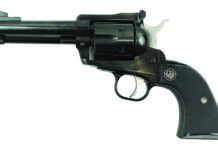
Chronographing these loads, we found that velocities were about 10 fps slower out of the Anaconda’s 6-inch barrel than they were from a Ruger Vaquero single-action revolver with a 4.6-inch barrel.
Our Team Said: The Standard Catalog of Firearms lists the 1996-era Colt Anaconda in 45 Colt with a New In Box price of $2500. An Anaconda in Excellent condition might be worth $1900 and $1450 in Very Good condition. SCoF further opines that for a big snake in Good shape, $1200 should get it done. One that’s Fair should fetch $800, and one in Poor condition, $500. Probably a better choice in the Anaconda would be the 44 Magnum chambering, but these collector’s prices will be high regardless of the round it fires. If you find one that’s NIB, for goodness sakes don’t shoot it — prices for them will likely continue to climb.
| 45 COLT RANGE DATA | ||
|---|---|---|
| Colt Anaconda | Remington 225-grain LSWC | Master 240-grain JHP |
| Average Velocity | 899 fps | 796 fps |
| Average Muzzle Energy | 404 ft.-lbs. | 338 ft.-lbs. |
| Smallest Group Size | 3.50 in. | 3.50 in. |
| Largest Group Size | 4.00 in. | 4.25 in. |
| Average Group Size | 3.73 in. | 3.85 in. |
Accuracy testing consisted of firing five consecutive five-shot groups with each load at 25 yards. Chronograph testing consisted of firing five consecutive shots with each load. Velocities were obtained using a Oehler Model 35.
Adapted by Gun Tests Staff, using evaluations from Gun Tests Team members. GT