













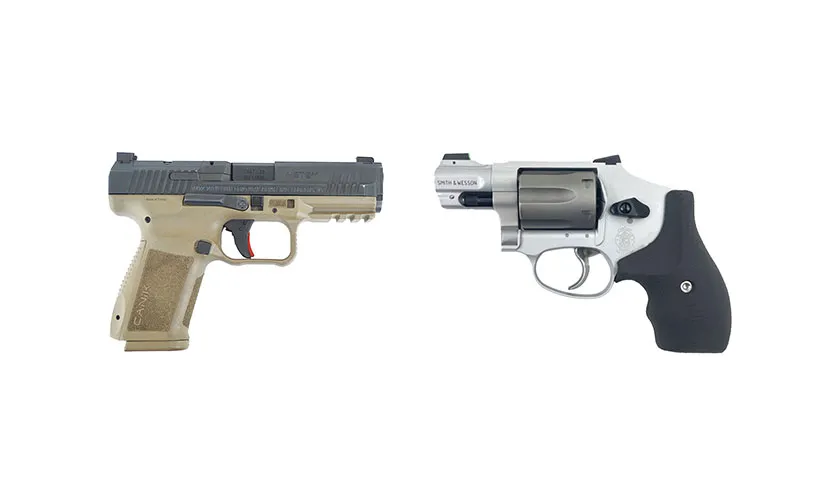
The revolver-vs-semi-auto debate has been running for decades, and it hasn’t been settled by any single “winner.” What’s changed in 2026 is mostly the gear on each side of the argument — better red dot optics, more reliable micro-compacts, and revolvers that have picked up modern touches like tritium sights and smoother triggers. The fundamentals of the debate, though, are the same ones your grandfather argued about.
Here’s how the two stack up on the things that actually matter for defending a home.
Capacity and Reload Speed
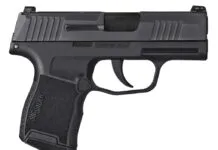
This is where semi-autos pull ahead clearly. A typical revolver holds 5-8 rounds; a compact semi-auto commonly holds 10-17+ depending on caliber and magazine. In a defensive encounter, more rounds on tap — and a magazine swap that takes under two seconds with practice — is a real advantage over a revolver reload, which even with speedloaders or moon clips takes meaningfully longer to master and execute under stress.
Edge: Semi-auto
Mechanical Simplicity and Reliability
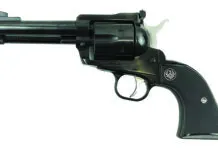
Revolvers have fewer failure modes. There’s no slide to short-stroke, no magazine to seat improperly, no round to stovepipe. If a cartridge fails to fire, you just pull the trigger again and the cylinder rotates to the next round. This makes revolvers famously forgiving of a nervous or untrained shooter in a crisis.
Semi-autos are more failure-prone in the sense that they have more parts and more can go wrong (limp-wristing, magazine issues, feed problems), but modern service and carry pistols are extremely reliable when properly maintained and fed quality ammunition. The failure rate gap has narrowed substantially over the last 20 years.
Edge: Revolver, but the gap has shrunk
Ease of Use Under Stress
For someone who doesn’t train regularly, a double-action revolver is about as simple as it gets: point and pull the trigger. There’s no safety to disengage, no slide to rack, no decision about whether a round is chambered. This matters enormously for a defensive gun that might sit unused for months or years before it’s needed in a middle-of-the-night scenario.
Semi-autos require more procedural knowledge — checking chamber status, working a safety or decocker if equipped, clearing malfunctions — which is fine for someone who trains, but can become a liability for someone who bought the gun once and never touched it again.
Edge: Revolver
Recoil and Follow-Up Shots
Semi-autos, especially in 9mm, generally have less felt recoil than revolvers chambered in 38 Special +P or 357 Magnum, because part of the recoil impulse cycles the action rather than transferring entirely to the shooter’s hand. This translates to faster, more controlled follow-up shots — relevant if more than one round is needed.
Edge: Semi-auto
Trigger Pull
Double-action revolver triggers are typically long and heavy (10-12+ lbs), which some shooters find harder to shoot accurately but others value as an extra layer of protection against an unintentional discharge. Striker-fired semi-autos usually have lighter, shorter triggers (5-6 lbs) that are easier to shoot well but offer less of that built-in friction.
Edge: Depends on the shooter’s priorities
Cost and Maintenance
Semi-autos generally have a slight edge in ammo cost per round at high volumes (9mm is cheap and plentiful) and are typically easier and cheaper to find magazines and accessories for. Revolvers require less frequent cleaning to maintain reliability and have fewer wear parts.
Edge: Roughly a wash
What’s Actually Changed for 2026
- Red dot optics on carry and home-defense pistols are now mainstream and genuinely improve accuracy for most shooters, widening the semi-auto’s practical accuracy advantage.
- Micro-compact high-capacity pistols (10+ rounds in a small footprint) have matured and become more reliable, eating into one of the revolver’s traditional advantages (concealability without giving up much beyond 5-6 rounds).
- Modern revolvers have gotten better triggers, better sights, and lighter frames, but the category hasn’t changed fundamentally.
So, Who Wins?
There isn’t a universal winner — it depends on the person holding the gun:
- Choose a revolver if: you want the simplest possible manual of arms, you won’t train regularly, or you value the “just pull the trigger” reliability above all else.
- Choose a semi-auto if: you’re willing to practice reloads and malfunction clearance, you want higher capacity and faster follow-up shots, and you’ll actually train with it periodically.
For most people who are willing to put in a modicum of practice, the semi-auto’s capacity, reload speed, and manageable recoil make it the more common recommendation from firearms instructors in 2026. But the revolver’s simplicity is a genuine, not outdated, advantage for the person who wants a gun that requires the least amount of upkeep and thought to use correctly under stress.
The best “winner” is the one you’ve actually trained with and trust — not the one that wins an internet argument.
This article is general information, not legal or safety advice. Firearm laws vary significantly by state and locality, and anyone considering a home-defense firearm should seek hands-on training from a qualified instructor.




Well, imho everyone needs to train with either gun. Especially reloading a revolver. I keep 2 357 mag. revolvers by the bed & 3 semi autos with an extra mag each all close by. I have 4 other semi autos, 1 for each additional room easy to get to on top of these other 5. Learn to use either no matter what.