

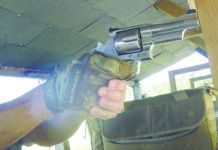
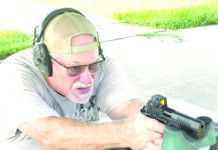
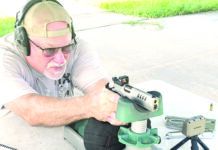
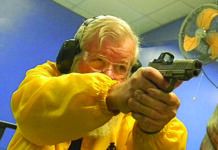






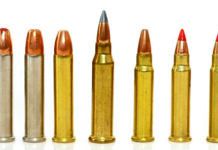

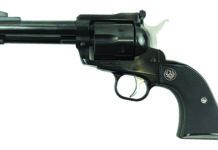
The 32 H&R Magnum has recently received a new home in the Smith & Wesson/Lipsey’s Exclusive Model 632. Announced in early 2025, the 632 J-frame wasn’t just chambered in the rare and uncommon 32 H&R Magnum cartridge, the revolver itself has gone through some enhancements to improve performance. With a new 32-caliber revolver available, we thought it would be a good to time to revisit the round and match it up against the longer and more powerful 327 Federal Magnum, another cartridge that lacks enthusiast attention. Is the lack of attention due to the mousy size of the bullet, or have 32 calibers had their day a century ago and are fading away like the 40 S&W cartridge? In our opinion, either of the 32-caliber magnums would make a viable alternative to 38 Special or 357 Magnum revolvers of the same size. The 32-caliber guns typically have a six-shot capacity compared to a five-shot capacity of the 38s and 357s. There is less recoil with the 32 magnums, yet the cartridges still provide a substantial punch. Remember, a snubnose revolver, like a subcompact semi-auto, is a get-off-me gun that provides the user a way to get out of a dire situation. They are not designed for extended gun fights with multiple reloads.
With that in mind, we pitted a Ruger LCR in 327 Federal Magnum against the S&W Model 632 in 32 H&R Magnum and discovered a newfound appreciation for these rounds. Sure, the bullet size is diminutive, but between the longer cases and extra powder, it is not the size of the bullet that matters, but how you shoot it and how it hits that count.
Both of these revolvers are double action only, feature fixed sights, have six-round capacities, and are easy to conceal. We looked at these revolvers for ease of use, smoothness of the DAO trigger pull, ease of conceal carry, and accuracy.
Both the 32 H&R Mag and the 327 Fed Mag are versatile because you are able to shoot both 32 S&W and 32 S&W Long in revolvers chambered for these two magnums. You can also fire the 32 H&R Mag in a revolver chambered for 327 Fed Mag. You can’t fire 327 Fed Mag in a 32 H&R Mag because the 327 Fed Mag cases are too long. We fired two types of 32 S&W Long ammo: Fiocchi 97-grain FMJs and Sellier & Bellot 100-grain LFNs, which offer minimal recoil and pretty darn good accuracy from DAO snubnose revolvers. Moving up the power ladder to 32 H&R Mag, we used Hornady Critical Defense with an 80-grain FTX bullet and fired a +P load with a 100-grain JHP from Buffalo Bore. The next rung up in power is the 327 Fed Mag, so we fired Hornady Critical Defense with an 80-grain FTX bullet and Federal American Eagle with a 100-grain JSP in the Ruger. We found that certain ammo worked great, while with others, empty cases jammed the chambers, and one made 6-inch groups with keyholing bullets.
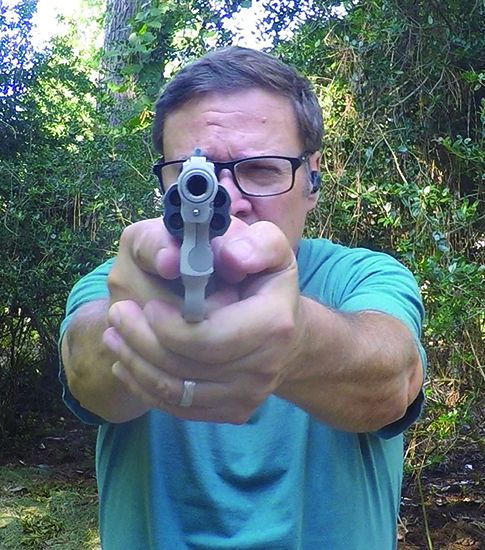
Accuracy with a DAO snubnose is almost a misnomer, but we tested accuracy at 10 yards using a rest, and we can vouch that the DAO triggers in both of these revolvers are very good, with smooth pulls and hardly any stacking. The true test of these snubbies is close-range shooting, so we performed the Failure Drill with them, which we feel is an excellent drill to test target acquisition, trigger press, speed shooting, and accuracy.
Also, we carried each revolver for a few weeks in high heat and humidity, both riding in a Galco StuckOn-U pocket holster ($34; GalcoGunLeather.com) in cargo shorts, along with Tuff Products eight-round QuickStrips (two sets for $12; TuffProducts.com). We found that both of these 32-caliber revolvers were comfortable to carry, even while we were wearing cargo shorts and T-shirts. The QuickStrips lay flat in your pocket and allow you to load two chambers at a time. They are not as fast at reloading as round speed loaders, but they are still quicker than loading a round at a time.
After the brass cooled, we found we liked to carry the S&W Model 632 better, but we liked the versatility of ammo choices with the Ruger LCR. Here are the details.
Smith & Wesson Model 632 14350 32 H&R Magnum,
$730
Gun Tests grade: A- [our pick]
Made on the company’s J-frame, the 632 is a very pocketable package with plenty of punch and capacity. We like the light weight, sights, and concealability.
| Action Type | Double action only, revolver |
| Overall Length | 6.3 in. |
| Barrel Length | 1.8 in. |
| Barrel Rifling Twist Rate | 1:18 in. |
| Sight Radius | 3.3 in. |
| Overall Height | 4.3 in. |
| Maximum Width | 1.3 in. |
| Weight Unloaded | 13.0 oz. |
| Weight Loaded | 15.3 oz. |
| Cylinder Gap | 0.007 in. |
| Capacity | 6 |
| Frame | Aluminum |
| Barrel | Stainless steel |
| Cylinder | Titanium |
| Frame Front Strap Height | 1.7 in. |
| Frame Back Strap Height | 3.5 in. |
| Grip | Hamre Forge AFR textured G10 |
| Grip Thickness (Maximum) | 1.1 in. |
| Grip Circumference (Maximum) | 5.0 in. |
| Front Sight | XS Sights green ring with tritium dot |
| Rear Sight | Fixed, U-notch |
| Trigger Pull Weight (DA) | 11.3 lbs. |
| Trigger Span (DA) | 2.9 in. |
| Safety | Hammer stop |
| Warranty | 1-year limited |
| Telephone | (800) 331-0852 |
| Website | Smith-Wesson.com |
| Made In | U.S. |
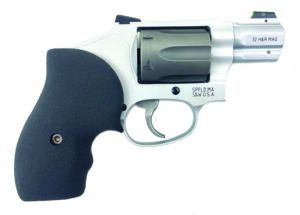
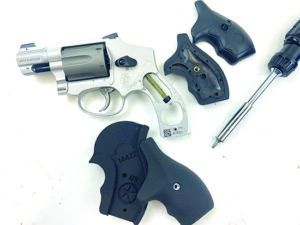
S&W’s J-frame revolvers are some of best concealed-carry handguns available. They are compact, safe, easy to carry, typically have serviceable trigger pulls, and are chambered in calibers ranging from 22 LR to 357 Magnum. You might think that the Model 632 in 32 H&R Magnum is just another J-frame, but it is not. Our sample 632 features an aluminum frame and titanium cylinder that gives the snubnose a total weight of 13 ounces. Even loaded with six rounds, this revolver is light in weight. Our sample had a matte-aluminum frame finish that contrasted nicely with the gray cylinder. The steel barrel is shrouded in a slab-sided aluminum sleeve that also helps reduce weight. It came with two sets of grips; a rubbery S&W brand with finger-groove grips and exposed backstrap and Hamre Forge AFR Undercover G10 grips that are larger and fuller and cover the backstrap. We tested the 632 with the Hamre Forge grips because we liked how the stock filled our hand, even the gap between the palm and side of the grip. It also allowed for a high grip to better control recoil. The texture is smooth, so it did not snag when it was drawn from the pocket holster.
Sights consisted of an XS Sights green-ring front sight with tritium dot and a dovetail black U-notch rear sight. These sights offered fast target acquisition and are well suited for close-range work. The big dot is easy to find, even during recoil.
The first thing we noticed with the 632 was how smoothly the DAO trigger cycled. The “Endurance Package” the 632 touts features upgrades like titanium pins and other components to improve the geometry of the trigger mechanism so it is smoother. We noticed a distinct difference in this trigger. It was definitely smoother and tripped faster than other J-frames we’ve run. The trigger pull averaged 11.3 pounds, but seemed less. We liked this trigger.
At 10 yards, we ran the accuracy test and found the 632 was a shooter — not something you usually attribute to a DAO snubnose revolver. The best group with mild 32 S&W ammo was with the Fiocchis, a 1.00-inch five-shot cluster, and the average was 1.08 inches. The Sellier & Bellot had a best of 1.08 inches and an average of 2.10 inches. Moving up in velocity to the 32 H&R Mag, the Hornady Critical Defense had a best group that measured 1.46 inches and an average of 1.78 inches. As a comparison, the 32 S&W ammo had a muzzle velocity between 571 to 738 fps, while the 32 H&R Mag had a muzzle velocity of 979 fps. The recoil was benignly mild with 32 S&W ammo, while the 32 H&R Mag had slightly more recoil. The 32 H&R Mag +P from Buffalo Bore had a muzzle velocity of 1090 fps and had a best group of 1.15 inches and an average of 1.57 inches. We were set on using the Buffalo Bore in concealed carry, even if it had more recoil pop, but the cases blew out and were difficult to extract. We had to tap the ejector rod on the wood bench to unseat the empty cases. The other ammo easily ejected, though the ejector wasn’t long enough to fully push out the cases, so we used gravity’s assistance by pointing the muzzle upward, and cases fell like brass hail to our feet. Recoil was tolerable with the 32 H&R Mag loads, due to the full and wide Hamre Forge G10 grip. We did note that point of impact was different between the mild 32 S&W loads and the 32 H&R Mag loads when using the same point of aim.
Moving to the Failure Drill, the super-slick DAO trigger and large XS big-dot sights were excellent for fast defense work. The trigger is smooth on the face, and we could easily stage it or smoothly stroke through it to fire the gun. Two shots to center of mass were fast and easy to control, even with the magnum loads. The more surgical head shot with a DAO trigger took effort and depended on the load being fired, so we needed to use a little Kentucky elevation to ensure hits were in the A-zone. Carrying the 632 was comfortable. We hardly knew we had a pistol in our pocket, and it was virtually invisible to anyone.
Our Team Said: The 632 is an excellent little J-frame with a slick DAO trigger and good sights for close-up work. We liked the ability to fire mild 32 S&W rounds and hotter 32 H&R Mag rounds through the same gun. If we owned this gun, we’d buy more brands of 32 H&R Mag ammo to determine which one gives the best accuracy, though the Hornady ammo ran fine. We’d take a hard pass on the Buffalo Bore ammo because the cases stuck in the chambers. The reduced recoil makes this caliber more user friendly, and in all honesty, we did not feel undergunned when we concealed-carried the 632. We wouldn’t hesitate to carry the 632 every day. In this test, it is Our Pick due to the very good trigger, light weight, ease of carry, and good performance target.
| 32 S&W LONG RANGE DATA | ||
| Fiocchi 97-grain FMJ | Ruger LCR | S&W Model 632 |
| Average Velocity | 736 fps | 738 fps |
| Muzzle Energy | 117 ft.-lbs. | 117 ft.-lbs. |
| Smallest Group | 0.64 in. | 1.00 in. |
| Average Group | 1.17 in. | 1.08 in. |
| Sellier & Bellot 100-grain LFN | Ruger LCR | S&W Model 632 |
| Average Velocity | 779 fps | 571 fps |
| Muzzle Energy | 135 ft.-lbs. | 125 ft.-lbs. |
| Smallest Group | 2.46 in. | 1.88 in. |
| Average Group | 2.95 in. | 2.10 in. |
| 32 H&R MAGNUM RANGE DATA | ||
| Hornady Critical Defense 80-grain FTX | Ruger LCR | S&W Model 632 |
| Average Velocity | 965 fps | 979 fps |
| Muzzle Energy | 165 ft.-lbs. | 170 ft.-lbs. |
| Smallest Group | 2.28 in. | 1.46 in. |
| Average Group | 2.41 in. | 1.78 in. |
| 32 H&R MAGNUM +P RANGE DATA | ||
| Buffalo Bore 100-grain JHP | Ruger LCR | S&W Model 632 |
| Average Velocity | 1238 fps | 1090 fps |
| Muzzle Energy | 341 ft.-lbs. | 263 ft.-lbs. |
| Smallest Group | 2.30 in. | 1.15 in. |
| Average Group | 2.90 in. | 1.57 in. |
| 327 FEDERAL MAGNUM RANGE DATA | |
| Hornady Critical Defense 80-grain FTX | Ruger LCR |
| Average Velocity | 1273 fps |
| Muzzle Energy | 288 ft.-lbs. |
| Smallest Group | NA |
| Average Group | NA |
| Federal American Eagle 100-grain JSP | Ruger LCR |
| Average Velocity | 1272 fps |
| Muzzle Energy | 359 ft.-lbs. |
| Smallest Group | 2.54 in. |
| Average Group | 2.87 in. |
To collect accuracy data, we fired five-shot groups from a bench using a rest. Distance: 10 yards with open sights. We recorded velocities and energies using a Garmin Xero C1 Pro chronograph.
Written and photographed by Robert Sadowski, using evaluations from Gun Tests Team members. GT