










New products are the lifeblood of most manufacturers, and the firearms industry is no exception. Nowhere is that more apparent than in barrel technology. Twist rates have accelerated to stabilize longer, high-ballistic-coefficient bullets, while overall tube lengths have shrunk to improve balance and handling, particularly for suppressor-equipped rifles. Carbon-fiber wrapping has become standard practice on premium barrels, shaving weight without sacrificing rigidity and accuracy.
New cartridges generate similar excitement. Some, like the Winchester Super Short Magnums, failed to find a lasting market. Others have been runaway successes, and early data on still more portend well for their futures. If you haven’t already, consult the April/May 2026 issue of Gun Tests for our coverage of the new 25 Creedmoor and its head-to-head comparison with several legacy rounds.
The 22-caliber centerfire world has experienced its own revolution in recent years, and we wanted to quantify it. Our baseline is the time-tested 22-250 Remington, measured against two new Hornady offerings — the 22 ARC and 22 Creedmoor — and the freshly redesigned 224 Weatherby Magnum. We evaluate muzzle energy for all four rounds, along with retained energy and wind deflection at 200 and 500 yards. Which load best fits your needs? Read on.
The Test Rifles
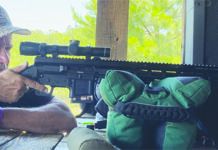
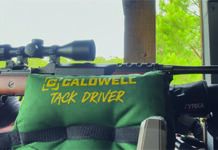
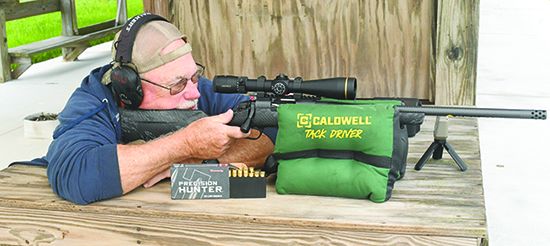
We selected rifles we believed best represented each cartridge and its most likely real-world application. To keep recoil figures comparable across the board, we used the weight of the heaviest rifle, the Tikka, for all recoil calculations. Support consisted of our customary Caldwell TackDriver shooting bag and a Tab Gear rear bag, heavy (TabGear.com).
Optics were standardized as well. This test group has developed considerable appreciation for Leupold VX-series scopes, and we equipped all four rifles with the latest Leupold VX-5HD (No. 183849, 3-15×44 CDS-ZL2), retailing for approximately $1500. The VX-5HD offers side-focus parallax adjustment, an HTMR reticle with half-mil stadia lines, and a new elevation-turret lock that simplifies returning to zero. The reticle provides enough wind and distance reference without cluttering the field of view. Is $1500 entry-level? Hardly. But we’ve hunted and shot matches where lesser glass simply could not resolve the target, and we learned our lesson.
Bergara B-14 Cima CF B14S1214CF 22 Creedmoor,
$1800
Gun Tests grade: A [our pick]
The lightest of the four rifles tested, the Bergara averaged sub-half-inch groups.

| Action Type | Bolt |
| Overall Length | 40.9 in. |
| Barrel Length/Twist | 20.0 in., 1:8 |
| Overall Height w/o Scope Mount | 6.25 in. |
| Weight Unloaded | 6.3 lbs. |
| Weight Loaded | 6.5 lbs. |
| Action Finish | Cerakote |
| Barrel Finish | Cerakote & carbon fiber |
| Magazine Capacity | 4 rounds |
| Magazine Type | Internal box |
| Stock | RTM carbon fiber |
| Stock Drop at Comb | 0.5 in. |
| Stock Drop at Heel | 0.5 in. |
| Stock Bedding | Carbon fiber & mini chassis |
| Stock Buttplate | Soft rubber |
| Stock Length of Pull | 13.5 in. |
| Receiver Scope-Base Pattern | Remington 700 |
| Trigger Pull Weight | 1.49 lbs. |
| Safety | 2-position thumb rocker |
| Warranty | Manufacturer’s defects for original owner |
| Telephone | (800) 320-8767 |
| Website | BergaraUSA.com |
| Made In | Spain |
Bergara began as a barrel maker in northern Spain before expanding into complete firearms, with U.S. operations based in Georgia. The Cima — Spanish for “peak” or “summit” — pairs the familiar B-14 action with a featherweight chassis designed for long approaches and steep climbs.
The action shows clear Remington 700 heritage, though Bergara has made substantive improvements: the bolt stop migrates to the left side of the receiver; the clipped extractor ring is replaced by a stronger sliding-plate version; the magazine release is more robust; and a TriggerTech trigger replaces the factory unit. The 20-inch barrel is carbon fiber–wrapped via Bergara’s proprietary CURE process, a method in which stainless steel is first wrapped in additional stainless steel before carbon fiber is applied in a pattern engineered to conduct heat away from the bore rather than trap it. In practice, the Cima ran noticeably cooler than the other rifles during our test strings.
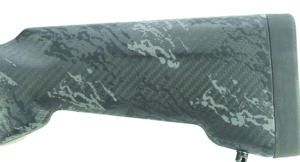
The stock is formed by Resin Transfer Molding (RTM), a process in which dry carbon fiber preforms are placed in a closed mold, injected with resin under pressure, and cured to produce a high-strength shell with excellent surface finish. Our sample weighed just 21.6 ounces with all hardware installed. A lightweight mini-chassis is molded in for a solid bedding platform, and the barrel is fully free-floated.
Additional details round out the package. The muzzle is threaded 5⁄8×24, and both a radial brake and thread protector are included. The TriggerTech Field trigger broke at 1.49 pounds, among the lightest in the group. We typically prefer flat trigger faces, but the flared, smooth face on this TriggerTech unit proved genuinely pleasant.
In the chamber, the 22 Creedmoor is a logical extension of the Creedmoor family: a well-proportioned powder column behind a small-caliber bullet. From the Bergara’s 20-inch barrel, Hornady’s 80-grain loads exceeded 3000 fps. The 22-250 holds a muzzle-velocity advantage of roughly 500 fps, yet the 22 Creedmoor carries more energy at the muzzle thanks to its heavier projectile. The 22-250 continues to lead on velocity and bullet drop through 200 yards; beyond that, the 22 Creedmoor pulls away decisively on energy, wind deflection, and retained velocity.
Feeding and function were flawless. We tested two Hornady loads: the 80-grain ELD-M averaged 0.444 inch with a best group of 0.384 inch; the 80-grain ELD-X averaged 0.515 inch with a best group of 0.388 inch. Neither quite matched the Weatherby’s precision, but this handy, light rifle could shoot.
Our Team Said: The lightest rifle in the group, the Bergara B-14 Cima averaged sub-half-inch groups, an impressive combination of portability and precision. It’s pricey, but it’s also a very good rifle chambered in 22 Creedmoor.
| 22 CENTERFIRE CARTRIDGE RANGE DATA | |||
| Tikka Super Varmint 22-250 Remington | Winchester 45-grain JHP | Hornady 50-grain V-Max | Hornady 55-grain Spire Point |
| Average Velocity | 3977 fps | 3968 fps | 3555 fps |
| Muzzle Energy | 1581 ft.-lbs. | 1748 ft.-lbs. | 1544 ft.-lbs. |
| Best Group | 0.60 in. | 0.72 in. | 0.34 in. |
| Average Group | 0.74 in. | 0.73 in. | 0.40 in. |
| Bergara B-14 Cima CF 22 Creedmoor | Hornady 80-grain ELD-M | Hornady 80-grain ELD-X | |
| Average Velocity | 3066 fps | 3027 fps | |
| Muzzle Energy | 1670 ft.-lbs. | 1628 ft.-lbs. | |
| Best Group | 0.38 in. | 0.39 in. | |
| Average Group | 0.44 in. | 0.52 in. | |
| Ruger American Gen II 22 ARC | Hornady 75-grain ELD-M | Hornady 88-grain ELD-M | |
| Average Velocity | 2974 fps | 2729 fps | |
| Muzzle Energy | 1473 ft.-lbs. | 1455 ft.-lbs. | |
| Best Group | 0.46 in. | 0.39 in. | |
| Average Group | 0.57 in. | 0.70 in. | |
| Weatherby Mk V Apex 224 Weatherby Magnum | Weatherby 80.5-grain Berger | ||
| Average Velocity | 2944 fps | ||
| Muzzle Energy | 1550 ft.-lbs. | ||
| Best Group | 0.41 in. | ||
| Average Group | 0.45 in. |
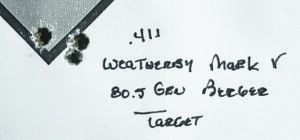
How We Tested: We shot for groups and function using a variety of Hornady and Weatherby ammo specific to each individual caliber. Testing was done at American Shooting Centers in west Houston. We shot the rifles off a Caldwell TackDriver Pro front bag (Brownells 100-027-023, $49), further supported by a large rear bag, heavy from Tab Gear (TabGear.com, $34). We measured velocities with a Garmin Xero C1 Pro (Garmin.com, $600). We fired all groups with a Leupold VX-5HD 3-15×44 scope (No. 183849, $1500).
| 22-CALIBER CENTERFIRE COMPARISONS | ||||
| Cartridge Bullet Hornady Firearm | 22-250 Remington 55-grain Spire Point Tikka T3x Super Varmint | 22 ARC Hornady 88-grain ELD-M Ruger American Gen II Predator | 22 Creedmoor Hornady 80-grain ELD-M Bergara B-14 Cima CF | 224 Weatherby Mag Berger 80.5-grain Target Weatherby Mark V Apex |
| Muzzle Velocity | 3555 fps | 2729 fps | 3066 fps | 2944 fps |
| Muzzle Energy | 1544 ft.-lbs. | 1456 ft.-lbs. | 1670 ft.-lbs. | 1550 ft.-lbs. |
| Recoil Energy | 5.4 ft.-lbs. | 5.97 ft.-lbs. | 7.31 ft.-lbs. | 5.33 ft.-lbs. |
| 200-Yard Velocity | 2726 fps | 2403 fps | 2704 fps | 2539 fps |
| 200-Yard Drop | 8.31 in. | 11.96 in. | 9.77 in. | 10.6 in. |
| 200-Yard Drift, 5-mph Wind | 2.09 in. | 1.05 in. | 1.05 in. | 1.05 in. |
| 200-Yard Drift, 10-mph Wind | 4.19 in. | 2.62 in. | 2.09 in. | 2.62 in. |
| 200-Yard Energy | 908 ft.-lbs. | 1128 ft.-lbs. | 1299 ft.-lbs. | 1153 ft.-lbs. |
| 500-Yard Velocity | 1729 fps | 1958 fps | 2212 fps | 1996 fps |
| 500-Yard Drop | 58.40 in. | 74.59 in. | 59.04 in. | 66.7 in. |
| 500-Yard Drift, 5-mph Wind | 15.71 in. | 7.85 in. | 6.54 in. | 7.85 in. |
| 500-Yard Drift, 10-mph Wind | 31.41 in. | 15.71 in. | 14.4 in. | 18.32 in. |
| 500-Yard Energy | 365 ft.-lbs. | 749 ft.-lbs. | 869 ft.-lbs. | 712 ft.-lbs. |
| 1000 Foot-Pound Range | 175 yards | 300 yards | 400 yards | 300 yards |
Written and photographed by Joe Woolley, using evaluations from Gun Tests Team members. GT