














New products are the lifeblood of most manufacturers, and the firearms industry is no exception. Nowhere is that more apparent than in barrel technology. Twist rates have accelerated to stabilize longer, high-ballistic-coefficient bullets, while overall tube lengths have shrunk to improve balance and handling, particularly for suppressor-equipped rifles. Carbon-fiber wrapping has become standard practice on premium barrels, shaving weight without sacrificing rigidity and accuracy.
New cartridges generate similar excitement. Some, like the Winchester Super Short Magnums, failed to find a lasting market. Others have been runaway successes, and early data on still more portend well for their futures. If you haven’t already, consult the April/May 2026 issue of Gun Tests for our coverage of the new 25 Creedmoor and its head-to-head comparison with several legacy rounds.
The 22-caliber centerfire world has experienced its own revolution in recent years, and we wanted to quantify it. Our baseline is the time-tested 22-250 Remington, measured against two new Hornady offerings — the 22 ARC and 22 Creedmoor — and the freshly redesigned 224 Weatherby Magnum. We evaluate muzzle energy for all four rounds, along with retained energy and wind deflection at 200 and 500 yards. Which load best fits your needs? Read on.
The Test Rifles
We selected rifles we believed best represented each cartridge and its most likely real-world application. To keep recoil figures comparable across the board, we used the weight of the heaviest rifle, the Tikka, for all recoil calculations. Support consisted of our customary Caldwell TackDriver shooting bag and a Tab Gear rear bag, heavy (TabGear.com).
Optics were standardized as well. This test group has developed considerable appreciation for Leupold VX-series scopes, and we equipped all four rifles with the latest Leupold VX-5HD (No. 183849, 3-15×44 CDS-ZL2), retailing for approximately $1500. The VX-5HD offers side-focus parallax adjustment, an HTMR reticle with half-mil stadia lines, and a new elevation-turret lock that simplifies returning to zero. The reticle provides enough wind and distance reference without cluttering the field of view. Is $1500 entry-level? Hardly. But we’ve hunted and shot matches where lesser glass simply could not resolve the target, and we learned our lesson.
Tikka T3x Super Varmint TFTT1352A73C9G6 22-250 Remington,
$1700
Gun Tests grade: B
Very accurate and a joy to shoot, the Tikka had an issue feeding very short rounds out of an action and magazine that were originally designed for something longer. Pointed and tipped bullets worked well, but the spire points hung up and hesitated to feed.
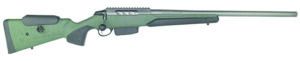
| Action Type | Bolt |
| Overall Length | 43.6 in. |
| Barrel Length/Twist | 24.0 in., 1:14 |
| Overall Height w/o Scope Mount | 6.5 in. |
| Weight Unloaded | 8.75 lbs. |
| Weight Loaded | 8.92 lbs. |
| Action Finish | Tungsten Cerakote |
| Barrel Finish | Tungsten Cerakote |
| Magazine Capacity | 5 rounds |
| Magazine Type | Tikka detachable box |
| Stock | Polymer, Green Roughtech Finish |
| Stock Drop at Comb | Adjustable |
| Stock Drop at Heel | 0.5 in. |
| Stock Bedding | None |
| Stock Buttplate | Soft rubber |
| Stock Length of Pull | 14.0 in. |
| Receiver Scope-Base Pattern | Tikka, Picatinny rail |
| Trigger Pull Weight | 1.48 lbs. |
| Safety | 2-position thumb rocker |
| Warranty | 2-year limited |
| Telephone | (301) 283-2191 |
| Website | Tikka-rifles.com |
| Made In | Finland |
The Tikka T3x Super Varmint served as our test bed for the 22-250, which was our baseline cartridge. This crew has owned a T3x Varmint in 223 Remington for years, regularly pushing 80.5-grain Berger Fullbore Target bullets beyond 2700 fps in consistent sub-0.75 MOA groups from an MPA chassis configured for PRS practice. The Super Varmint shares that rifle’s DNA while incorporating meaningful improvements.
The barrel is a medium-weight 23.6-inch tube (metric, naturally), which aids heat dissipation and, more practically, allows the shooter to spot impacts and make corrections between shots. The older blued finish gives way to Tungsten Cerakote on both barrel and action — more weather-resistant and better suited for field use. The muzzle is threaded 5⁄8×24 for a brake or suppressor.
Tikka reworked the stock as well. The foam-filled polymer chassis retains its basic architecture but gains a “Roughtech” green spider-web finish that improves grip and gives the rifle a lightly camouflaged appearance. The beavertail fore end overlay, previously an accessory sold separately through the Tikka website, is now standard. An adjustable cheek piece, secured by a right-side thumb wheel, adds versatility for different optics heights. The pistol grip is interchangeable; the more vertical of two options ships as standard equipment. Internally, the fore end features cross-rib reinforcement, is fully free-floated, and includes two sling-swivel studs plus a tapped hole for a bipod stud.
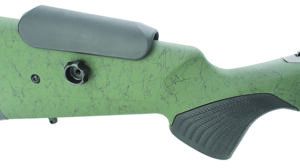
The action is everything we’ve come to expect from Tikka: exceptionally smooth and strong. Most Tikka actions are built on a long receiver, which keeps production costs down but can create feeding hiccups with shorter cartridges. Tikka addresses this by seating the magazine insert forward, but we still observed the stubby, flat-tipped 22-250 spire-point rounds striking the feed ramp rather than gliding cleanly into the chamber. Pointed or polymer-tipped bullets fed without issue. The factory trigger remains superb, and the spiral-fluted, oversized bolt handle cycles with buttery smoothness. The Picatinny rail is anchored by five screws and two recoil lugs — it isn’t going anywhere.
The early 20th century produced a generation of inventive wildcatters chasing velocity. Two of the most durable results were the 22-250 and the 220 Swift. The Swift began life as a necked-down 6mm Lee Navy case and pushed 22-caliber bullets past 4000 fps. Gunsmith Phil Sharpe, one of the leading figures in early wildcat development, argued that the Swift performed best at full velocity, yet it was brutally hard on brass and barrels, and it eventually faded from commercial relevance. Sharpe also necked the 250 Savage (also known as the 250-3000) to 22 caliber, producing a more forgiving alternative. It took nearly 30 years, but Remington standardized that wildcat as the 22-250 in 1965.
Today, the 22-250 remains a mainstay for varmint hunters and, loaded with properly constructed bullets, sees occasional use on deer-sized game. Its one persistent limitation is twist rate: legacy rifles typically ship with 1:12 or even 1:14 barrels, which stabilize 40- to 60-grain varmint bullets beautifully but cannot handle today’s longer, high-BC projectiles. Tikka now offers the Super Varmint with a 1:8 twist option, though we’d be curious whether the chamber geometry was updated to match.
Our test protocol focused on 45- to 55-grain bullets, the class the 22-250 was designed to excel with, before comparing those results against three modern rivals chambered for recently released cartridges sharing the same .224-inch bullet diameter.
Feeding issues with flat-based spire-point ammunition cost the Tikka a letter grade, but on the accuracy side, it delivered handsomely: three loads averaged 0.62 inch across multiple strings at 100 yards. Its favorite was the Hornady 55-grain Spire Point, which averaged a tidy 0.40 inch, a figure we adopted as the comparative baseline for this test.
Our Team Said: Extremely accurate and a joy to shoot, the Tikka stumbled only on feeding. Pointed and polymer-tipped bullets cycled flawlessly; flat-tipped spire points hesitated on the feed ramp, a consequence of a long action and magazine originally designed for larger cartridges.
| 22 CENTERFIRE CARTRIDGE RANGE DATA | |||
| Tikka Super Varmint 22-250 Remington | Winchester 45-grain JHP | Hornady 50-grain V-Max | Hornady 55-grain Spire Point |
| Average Velocity | 3977 fps | 3968 fps | 3555 fps |
| Muzzle Energy | 1581 ft.-lbs. | 1748 ft.-lbs. | 1544 ft.-lbs. |
| Best Group | 0.60 in. | 0.72 in. | 0.34 in. |
| Average Group | 0.74 in. | 0.73 in. | 0.40 in. |
| Bergara B-14 Cima CF 22 Creedmoor | Hornady 80-grain ELD-M | Hornady 80-grain ELD-X | |
| Average Velocity | 3066 fps | 3027 fps | |
| Muzzle Energy | 1670 ft.-lbs. | 1628 ft.-lbs. | |
| Best Group | 0.38 in. | 0.39 in. | |
| Average Group | 0.44 in. | 0.52 in. | |
| Ruger American Gen II 22 ARC | Hornady 75-grain ELD-M | Hornady 88-grain ELD-M | |
| Average Velocity | 2974 fps | 2729 fps | |
| Muzzle Energy | 1473 ft.-lbs. | 1455 ft.-lbs. | |
| Best Group | 0.46 in. | 0.39 in. | |
| Average Group | 0.57 in. | 0.70 in. | |
| Weatherby Mk V Apex 224 Weatherby Magnum | Weatherby 80.5-grain Berger | ||
| Average Velocity | 2944 fps | ||
| Muzzle Energy | 1550 ft.-lbs. | ||
| Best Group | 0.41 in. | ||
| Average Group | 0.45 in. |
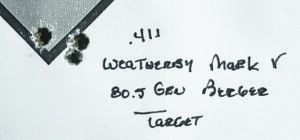
How We Tested: We shot for groups and function using a variety of Hornady and Weatherby ammo specific to each individual caliber. Testing was done at American Shooting Centers in west Houston. We shot the rifles off a Caldwell TackDriver Pro front bag (Brownells 100-027-023, $49), further supported by a large rear bag, heavy from Tab Gear (TabGear.com, $34). We measured velocities with a Garmin Xero C1 Pro (Garmin.com, $600). We fired all groups with a Leupold VX-5HD 3-15×44 scope (No. 183849, $1500).
| 22-CALIBER CENTERFIRE COMPARISONS | ||||
| Cartridge Bullet Hornady Firearm | 22-250 Remington 55-grain Spire Point Tikka T3x Super Varmint | 22 ARC Hornady 88-grain ELD-M Ruger American Gen II Predator | 22 Creedmoor Hornady 80-grain ELD-M Bergara B-14 Cima CF | 224 Weatherby Mag Berger 80.5-grain Target Weatherby Mark V Apex |
| Muzzle Velocity | 3555 fps | 2729 fps | 3066 fps | 2944 fps |
| Muzzle Energy | 1544 ft.-lbs. | 1456 ft.-lbs. | 1670 ft.-lbs. | 1550 ft.-lbs. |
| Recoil Energy | 5.4 ft.-lbs. | 5.97 ft.-lbs. | 7.31 ft.-lbs. | 5.33 ft.-lbs. |
| 200-Yard Velocity | 2726 fps | 2403 fps | 2704 fps | 2539 fps |
| 200-Yard Drop | 8.31 in. | 11.96 in. | 9.77 in. | 10.6 in. |
| 200-Yard Drift, 5-mph Wind | 2.09 in. | 1.05 in. | 1.05 in. | 1.05 in. |
| 200-Yard Drift, 10-mph Wind | 4.19 in. | 2.62 in. | 2.09 in. | 2.62 in. |
| 200-Yard Energy | 908 ft.-lbs. | 1128 ft.-lbs. | 1299 ft.-lbs. | 1153 ft.-lbs. |
| 500-Yard Velocity | 1729 fps | 1958 fps | 2212 fps | 1996 fps |
| 500-Yard Drop | 58.40 in. | 74.59 in. | 59.04 in. | 66.7 in. |
| 500-Yard Drift, 5-mph Wind | 15.71 in. | 7.85 in. | 6.54 in. | 7.85 in. |
| 500-Yard Drift, 10-mph Wind | 31.41 in. | 15.71 in. | 14.4 in. | 18.32 in. |
| 500-Yard Energy | 365 ft.-lbs. | 749 ft.-lbs. | 869 ft.-lbs. | 712 ft.-lbs. |
| 1000 Foot-Pound Range | 175 yards | 300 yards | 400 yards | 300 yards |
Written and photographed by Joe Woolley, using evaluations from Gun Tests Team members. GT