

















New products are the lifeblood of most manufacturers, and the firearms industry is no exception. Nowhere is that more apparent than in barrel technology. Twist rates have accelerated to stabilize longer, high-ballistic-coefficient bullets, while overall tube lengths have shrunk to improve balance and handling, particularly for suppressor-equipped rifles. Carbon-fiber wrapping has become standard practice on premium barrels, shaving weight without sacrificing rigidity and accuracy.
New cartridges generate similar excitement. Some, like the Winchester Super Short Magnums, failed to find a lasting market. Others have been runaway successes, and early data on still more portend well for their futures. If you haven’t already, consult the April/May 2026 issue of Gun Tests for our coverage of the new 25 Creedmoor and its head-to-head comparison with several legacy rounds.
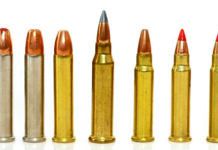
The 22-caliber centerfire world has experienced its own revolution in recent years, and we wanted to quantify it. Our baseline is the time-tested 22-250 Remington, measured against two new Hornady offerings — the 22 ARC and 22 Creedmoor — and the freshly redesigned 224 Weatherby Magnum. We evaluate muzzle energy for all four rounds, along with retained energy and wind deflection at 200 and 500 yards. Which load best fits your needs? Read on.
The Test Rifles
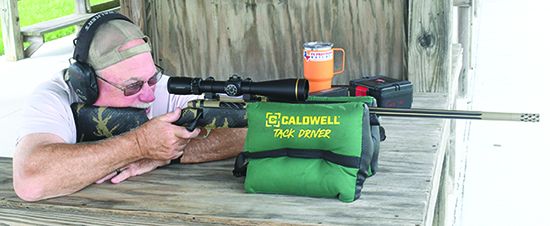
We selected rifles we believed best represented each cartridge and its most likely real-world application. To keep recoil figures comparable across the board, we used the weight of the heaviest rifle, the Tikka, for all recoil calculations. Support consisted of our customary Caldwell TackDriver shooting bag and a Tab Gear rear bag, heavy (TabGear.com).
Optics were standardized as well. This test group has developed considerable appreciation for Leupold VX-series scopes, and we equipped all four rifles with the latest Leupold VX-5HD (No. 183849, 3-15×44 CDS-ZL2), retailing for approximately $1500. The VX-5HD offers side-focus parallax adjustment, an HTMR reticle with half-mil stadia lines, and a new elevation-turret lock that simplifies returning to zero. The reticle provides enough wind and distance reference without cluttering the field of view. Is $1500 entry-level? Hardly. But we’ve hunted and shot matches where lesser glass simply could not resolve the target, and we learned our lesson.
Weatherby Mark V Apex MAX01N224WR6B 224 Weatherby Magnum,
$2400
Gun Tests grade: A-
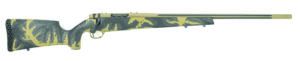
The most accurate rifle in this test, the Weatherby Apex came in second place in energy delivered and did it all in a very-classy-looking package. Pricey, but we think Weatherby fans are going to love the redesigned cartridge and rifle.
| Action Type | Bolt |
| Overall Length | 43.0 in. |
| Barrel Length/Twist | 24 in., 1:8 |
| Overall Height w/o Scope Mount | 6.25 in. |
| Weight Unloaded | 6.56 lbs. |
| Weight Loaded | 6.78 lbs. |
| Action | Finish Tan Cerakote |
| Barrel | Finish Tan Cerakote |
| Magazine Capacity | 5 rounds |
| Magazine Type | Internal |
| Stock | Carbon fiber |
| Stock Drop at Comb | 0.5 in. |
| Stock Drop at Heel | 0 in. |
| Stock Bedding | Spot bedding & pillars |
| Stock Buttplate | Hex recoil pad |
| Stock Length of Pull | 13.25 in. |
| Receiver Scope-Base Pattern | Weatherby Mark V 6-lug |
| Trigger Pull Weight | 1.58 lbs. |
| Safety | 2-position rocker |
| Warranty | Limited lifetime for original owner |
| Telephone | (307) 675-7840 |
| Website | Weatherby.com |
| Made In | U.S. |
Roy Weatherby founded his eponymous company in 1945 and quickly attracted a devoted following among Southern California’s sporting elite. The Mark V action, introduced in 1958 with nine locking lugs, was marketed as the strongest bolt action available, and it backed that claim with performance. Weatherby rifles were immediately recognizable: multi-piece wood stocks finished in high gloss, Monte Carlo cheek pieces, and a double-radius shoulder on proprietary cases that allowed unprecedented operating pressures. A 300 Weatherby Magnum that pushes a 180-grain Barnes TTSX past 3200 fps and generates nearly 4200 foot-pounds of muzzle energy illustrates the point.
Production moved from the U.S. to Germany, then to Japan. In 2018, Weatherby repatriated manufacturing by opening a plant in Sheridan, Wyoming. The move also brought a new action—the “307,” named for the Wyoming area code—along with updated cartridge offerings. The Mark V Apex is a product of that reinvention.
The Apex’s action is the most distinctive element. Six locking lugs, appropriate for a shorter action than the full-length Mark V requires, sit at the end of a full-diameter, fluted bolt. The extractor is AR-style; the ejector is plunger-type. The bolt stop is a stud riding in a track nearly the length of the bolt body; removal requires only pulling the trigger while drawing the bolt rearward (verify the chamber is empty first). The knurled bolt handle is generously sized, and the dual three-lug arrangement produces a short, positive throw.
One engineering challenge: the ejection port is too short to accommodate the 224 Weatherby Magnum cartridge in a conventional presentation. Weatherby solved this by milling a relief cut at the front-right of the receiver, allowing the cartridge to be inserted rim-first before pivoting the nose through the cut. It sounds awkward; in practice, it works smoothly.
The magazine is a staggered-column internal box that transitions to a single stack at the feed lips. Loading metal cartridges between metal lips feels unfamiliar at first, but function was flawless. The 24-inch barrel is fluted, finished in matte black, and threaded 5⁄8×24; the action wears tan Cerakote. A thread protector is factory-installed, and a muzzle brake is included.
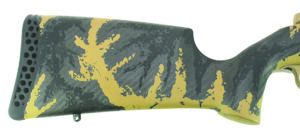
The rifle’s bottom metal is actual steel, with Weatherby logos engraved on both the trigger guard and magazine floorplate. The carbon-fiber stock features a flat fore end, a palm-swell grip, and the highest cheek piece in the group, capped by a quality recoil pad.
Introduced in 1963 as the Varmintmaster, the 224 Weatherby Magnum was designed to compete directly with the 22-250 before being discontinued in the early 1990s. Adam Weatherby and his engineering team recognized the opportunity presented by the long-range bullet revolution and brought it back, updated for the modern era. Faster-twist barrels and revised chamber geometry now allow the cartridge to stabilize heavy, high-BC projectiles that would have been impossible in the original design.
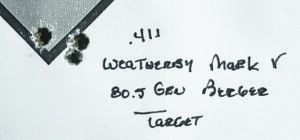
The case resembles a 223 Remington on a serious performance regimen: slightly wider, appreciably longer, and wearing the classic Weatherby double-radius shoulder and belted head. We had only one load available at test time — a disadvantage of proprietary cartridges — but it performed admirably: Weatherby’s 80.5-grain Berger Fullbore Target load clocked well past 2900 fps and averaged 0.452 inch for all groups, every one sub-half-inch.
Compared with the 22-250 baseline, the slower 224 Weatherby Magnum still posted greater muzzle energy owing to its heavier bullet. Drop at 200 and 500 yards ran slightly greater, but from that point forward, the 224 WM led in every meaningful category: energy, wind deflection, and retained velocity. Weatherby has a near-cult following, and we expect those fans to embrace what the company has done here.
Our Team Said: The most accurate rifle in the test, the Weatherby Apex finished second in delivered energy and did it all in a distinctly premium package. The price gives us pause, but Weatherby enthusiasts are going to love what the company has done with this cartridge and rifle combination.
The Bottom Line
The 22-250, even with its lighter bullet, surprised us by leading or matching the heavier modern loads through mid-range distances. Bullet drop favored it through 500 yards. Past that threshold, the high-BC projectiles of the 22 Creedmoor, 22 ARC, and 224 Weatherby Magnum left it behind.
Wind deflection, however, is where long-range shots are most often lost, and all three modern cartridges beat the 22-250 decisively in that category. The 22 Creedmoor delivered the highest retained velocity downrange. The 22 ARC was the most efficient cartridge of the group by a wide margin, achieving its ballistic results with roughly 40 percent less powder than the 22-250 requires. And the 224 Weatherby Magnum? It simply shot the smallest groups.
Each of these cartridges has a compelling case, and the right choice depends on your priorities: economy of means, extreme accuracy, raw downrange energy, or the cachet of a name that has meant performance for eight decades. What they share is proof that 22-caliber centerfires are far from finished evolving.
| 22 CENTERFIRE CARTRIDGE RANGE DATA | |||
| Tikka Super Varmint 22-250 Remington | Winchester 45-grain JHP | Hornady 50-grain V-Max | Hornady 55-grain Spire Point |
| Average Velocity | 3977 fps | 3968 fps | 3555 fps |
| Muzzle Energy | 1581 ft.-lbs. | 1748 ft.-lbs. | 1544 ft.-lbs. |
| Best Group | 0.60 in. | 0.72 in. | 0.34 in. |
| Average Group | 0.74 in. | 0.73 in. | 0.40 in. |
| Bergara B-14 Cima CF 22 Creedmoor | Hornady 80-grain ELD-M | Hornady 80-grain ELD-X | |
| Average Velocity | 3066 fps | 3027 fps | |
| Muzzle Energy | 1670 ft.-lbs. | 1628 ft.-lbs. | |
| Best Group | 0.38 in. | 0.39 in. | |
| Average Group | 0.44 in. | 0.52 in. | |
| Ruger American Gen II 22 ARC | Hornady 75-grain ELD-M | Hornady 88-grain ELD-M | |
| Average Velocity | 2974 fps | 2729 fps | |
| Muzzle Energy | 1473 ft.-lbs. | 1455 ft.-lbs. | |
| Best Group | 0.46 in. | 0.39 in. | |
| Average Group | 0.57 in. | 0.70 in. | |
| Weatherby Mk V Apex 224 Weatherby Magnum | Weatherby 80.5-grain Berger | ||
| Average Velocity | 2944 fps | ||
| Muzzle Energy | 1550 ft.-lbs. | ||
| Best Group | 0.41 in. | ||
| Average Group | 0.45 in. |
How We Tested: We shot for groups and function using a variety of Hornady and Weatherby ammo specific to each individual caliber. Testing was done at American Shooting Centers in west Houston. We shot the rifles off a Caldwell TackDriver Pro front bag (Brownells 100-027-023, $49), further supported by a large rear bag, heavy from Tab Gear (TabGear.com, $34). We measured velocities with a Garmin Xero C1 Pro (Garmin.com, $600). We fired all groups with a Leupold VX-5HD 3-15×44 scope (No. 183849, $1500).
| 22-CALIBER CENTERFIRE COMPARISONS | ||||
| Cartridge Bullet Hornady Firearm | 22-250 Remington 55-grain Spire Point Tikka T3x Super Varmint | 22 ARC Hornady 88-grain ELD-M Ruger American Gen II Predator | 22 Creedmoor Hornady 80-grain ELD-M Bergara B-14 Cima CF | 224 Weatherby Mag Berger 80.5-grain Target Weatherby Mark V Apex |
| Muzzle Velocity | 3555 fps | 2729 fps | 3066 fps | 2944 fps |
| Muzzle Energy | 1544 ft.-lbs. | 1456 ft.-lbs. | 1670 ft.-lbs. | 1550 ft.-lbs. |
| Recoil Energy | 5.4 ft.-lbs. | 5.97 ft.-lbs. | 7.31 ft.-lbs. | 5.33 ft.-lbs. |
| 200-Yard Velocity | 2726 fps | 2403 fps | 2704 fps | 2539 fps |
| 200-Yard Drop | 8.31 in. | 11.96 in. | 9.77 in. | 10.6 in. |
| 200-Yard Drift, 5-mph Wind | 2.09 in. | 1.05 in. | 1.05 in. | 1.05 in. |
| 200-Yard Drift, 10-mph Wind | 4.19 in. | 2.62 in. | 2.09 in. | 2.62 in. |
| 200-Yard Energy | 908 ft.-lbs. | 1128 ft.-lbs. | 1299 ft.-lbs. | 1153 ft.-lbs. |
| 500-Yard Velocity | 1729 fps | 1958 fps | 2212 fps | 1996 fps |
| 500-Yard Drop | 58.40 in. | 74.59 in. | 59.04 in. | 66.7 in. |
| 500-Yard Drift, 5-mph Wind | 15.71 in. | 7.85 in. | 6.54 in. | 7.85 in. |
| 500-Yard Drift, 10-mph Wind | 31.41 in. | 15.71 in. | 14.4 in. | 18.32 in. |
| 500-Yard Energy | 365 ft.-lbs. | 749 ft.-lbs. | 869 ft.-lbs. | 712 ft.-lbs. |
| 1000 Foot-Pound Range | 175 yards | 300 yards | 400 yards | 300 yards |
Written and photographed by Joe Woolley, using evaluations from Gun Tests Team members. GT