











More Tactical Pump Shotguns: Tristar and Mossberg Compete
There are times when a potential owner of a reliable self-defense shotgun might want to spend a little more money on upgraded features for the sake of comfort or convenience, so we ventured into the world of extra bells and whistles in this test of two higher-end tactical self-defense shotguns. This is the second part of a four-pack of pumps our team put through their paces. For this test we picked a pair of self-defense firearms in the $700 to $775 MSRP range to see how they would stand up to a thorough examination on the shooting range. The 12-gauge shotguns selected for this review were a Mossberg Model 590 Magpul with an adjustable stock listing for $773, and a Tristar TEC-12 capable of either pump action or semiautomatic fire that retails for $689. Both retail for around $500.
While budget is a key factor in the minds of many shooters as they ponder the purchase of a self defense shotgun, there are times when added features are too good to pass up despite the added cost.
Firearm manufacturers are well known for tossing in a few bells and whistles to make their product a little more attractive. The hope is that buyers will be willing to shell out a few dollars more for a feature that will make their new firearm more accurate, more comfortable, more attractive, etc. Sometimes the added features prove to be worth the additional cost, and sometimes the bell or whistle is just eye candy.
As noted in last month's review of two pump actions, self-defense shotguns fall into a category of rarely used but necessarily reliable firearms. When they are put into play, the shooter should be able to touch off consistently accurate, perfectly functioning rounds in what might be a life or death situation. There is a wide selection of these types of firearms carrying a price tag of $500 or less, most of which are so similar that distinctions in appearance and handling are minor at best.
In this match-up we selected a pair of what we would consider higher-priced shooting tools: The Mossberg Model 590 Magpul was outfitted with a fully adjustable stock and extended magazine retailing for $773. The Tristar TEC-12 was capable of either pump action or semiautomatic shooting, and it is available for $689.
Using the same type of shotgun ammunition that was fired through last month's shotguns, our test rounds included Rio Royal Buck 2.75-inch loads moving nine pellets of No. 00 buckshot at an average muzzle velocity of 1345 fps, and Winchester Reduced Recoil Winlite 2.75-inch loads pushing 0.9-ounce 400-grain sabot slugs with an average muzzle velocity of 1450 fps. Our function-fire and cycling rounds were Remington ShurShot Heavy Dove 2.75-inch loads with 11⁄8 ounces of No. 6 shot moving at an average of 1255 fps.
For shots in close-defense simulations, we fired test loads at Birchwood Casey Eze-Scorer 23-inch by 35-inch Bad Guy targets and the identically sized Targets Online paper images of potential threats. For slug shots at 25 yards, we used Champion VisiColor Zombies 12-inch by 18-inch Slasher Tusks targets. Only head shots were counted as acceptable results with the slug ammo because that is what Hollywood tells everyone is the way to dispatch a zombie. Here are our findings:

Browning Crossover 12 Gauge
At the request of a reader, Contributing Editor Ralph Winingham reviewed two break-action 12 gauge shotguns in the April 2015 issue.
Tactical Pump Shotguns: CZ-USA HC Versus Weatherby
Specific-use firearms such as tactical shotguns that are designed for self-defense situations are held to a higher standard than other shooting tools. If a self-defense shotgun fails to function or inadequately performs at the wrong time, there is no such thing as a do-over. Admittedly, most of these shotguns will never be fired in a life-or-death situation and generally don't see a lot of time on the shooting range. That does not mean the tactical shotgun owner does not demand the shooting tool, when it is necessary, handle its duties in an efficient and effective manner.
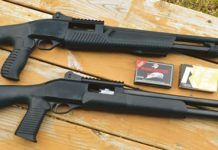
This is the first of two tactical pump-action shotgun evaluations. The next head-to-head match will feature a Tristar TEC-12 Pump/Auto 12 gauge listing for $689 against a Mossberg Model 590 Magpul Pump 12 gauge listing for $773. In that review, we will also name Our Pick of the four shotguns put through exactly the same test drills.
For this test, we selected a couple moderately priced pumps to see how they fared on the shooting range and whether they met the high standards of a firearm that might mean the difference between life and death. The two 12-gauge pump-action shotguns, both available for less than $500, that we put through their paces are the Weatherby PA-459 TR with a manufacturer's suggested retail price of $499 and the CZ-USA Model 612 HC-P 12 gauge (last reviewed in October 2013) listing for $366.
When a shooter absolutely, positively, without-a-doubt has to stop a threat, he or she can't have doubts about whether a firearm will function in a proper and effective manner. Not only does the self-defense firearm have to perform well, a shooter must have confidence the pattern will be placed on target in an effective manner. Also, a key element in any self-defense training is that the shooter is responsible for any lead that comes down the barrel in a shooting situation. Wounding or killing an innocent bystander with an errant pellet or slug is simply unacceptable on both moral and legal levels.
Spending time on the range to know how well a shotgun performs is a necessary factor with self-defense shotguns. Understanding that a typical tactical firearm packs quite a punch on both ends, we endured quite a bit of shoulder shock in conducting evaluations on these firearms. We encourage individuals who purchase these firearms do the same so they will become familiar with their specific self-defense tool.
Our ammunition for putting the two close-quarter shotguns into play included Rio Royal Buck 2.75-inch loads moving nine pellets of No. 00 buckshot at an average muzzle velocity of 1,345 fps; and Winchester Reduced Recoil Winlite 2.75-inch loads pushing 0.9-ounce 400-grain Sabot Slugs with an average muzzle velocity of 1,450 fps. In addition, our repeated function-fire and cycling rounds as part of the testing sequence were Remington ShurShot Heavy Dove 2.75-inch loads with 11⁄8 ounces of No. 6 shot moving at an average of 1,255 fps.
Rather than the standard patterning board used for our other shotgun testing, we utilized Birchwood Casey Eze-Scorer 23-inch by 35-inch Bad Guy and the same size Targets Online paper images of potential threats for our shots in home-defense simulations; and Champion VisiColor Zombies 12-inch by 18-inch Slasher Tusks targets for slug shots at 25 yards. On the zombies, only head shots were counted as acceptable results with the slug ammo. Here are our findings:
Gun Tests Review: Beretta A400 Xplore 28 Gauge Shotgun
For the May 2015 issue of Gun Tests, Contributing Editor Roger Eckstine assembled a team of shooters to test a 28-gauge Beretta A400 Xplore Action semi-auto.
Unlike many other semi-automatic shotguns, including the Legacy Pointer tested against it, the Xplore Action produced very little sensation of action cycling.
The Beretta's pistol grip was fashioned with fine, consistent checkering. The extra plate and shims were for tuning the gun to the shooter. Checkering around the trigger guard was a nice touch.
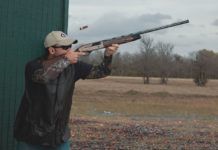
28-Gauge Semi-Automatics: Legacy Sport Versus Beretta
Skeet shooting is probably the most popular of all shotgun sports, perhaps because in the opinion of many dedicated upland-bird hunters, skeet is the game that offers the most realistic preparation for a day in the field. This alone may be reason enough to play, but for anyone who has tried big-time tournament skeet shooting, finding the right equipment can lead to sticker shock. Here's why.
Skeet tournaments require at least four rounds of shooting with four different gauges of shotguns. If you've ever tried to sign up for a tournament expecting to compete in only the 12-gauge events, your entry will likely be relegated to a wait list behind all the competitors who are ready to shoot all four gauges. The serious tournament competitors must have a complete stable of shotguns, including 20 gauge, 28 gauge and .410 bore, as well as a 12 gauge. Some shooters opt to have their 12-gauge shotgun precision fit with tubes that convert the bore to fire the full list of smaller gauge rounds. But there's another way to solve the problem, and it's one that lead us to a whole new field of pleasure.
After learning that we could compete with a 20-gauge shotgun in the 12-gauge round and shoot the 20-gauge events with a 28-gauge shotgun, we decided to try shooting all but the .410 events with a 28-gauge shotgun. As a result we found out that we liked shooting 28-gauge shotguns a whole lot, specifically the semi-automatic ones. We chose to shoot a semi-automatic rather than an over-under shotgun for two reasons. First, top-quality semi-automatic shotguns are still much less expensive than many medium-priced over-under shotguns. Maybe its because less hand-craftsmanship and fitting is required. Second, we have a variety of people on staff, and semi-automatic shotguns are easier to fit. The angles of cast and drop on the semi-autos can be changed to suit each shooter quite easily with the use of shims and templates installed between the receiver and the buttstock. Furthermore, it is well known that recoil from 28-gauge ammunition is relatively mild, so fatigue or injury over the course of a long practice session is far less likely than from the effects of 12-gauge or even 20-gauge ordnance. That goes about double for the gas operated semi-automatic shotguns that bleeds pressure from ignition and dampens recoil.
The two semi-automatic shotguns we chose for this evaluation fit different ends of the price range in this category. The Turkish-made Pointer shotgun is imported by Legacy Sports International of Reno, Nevada and carries a suggested retail price of $701, but typically sells for about $650. The Pointer line of shotguns, both semi-automatic and over/under, is not to be confused with the Japanese-made Charles Daly products of the same name from several years back.
The Beretta A400 Excel Action manufacturer's suggested retail price was $1600, but we found one for $1398 MAP (Manufacturers Advertised Pricing) at the Pro Shop at American Shooting Centers in Houston (AMShootCenters.com). The Pointer was capable of chambering 3-inch as well as 2.75-inch shells, but the Beretta's barrel listed only 2.75-inch loads. Otherwise, both guns featured gas operation, walnut stocks, alloy receivers, a rubber-like butt pad, 28-inch ribbed barrel with light-gathering fiber-optic beads, crossbolt safeties, and magazine cutoffs so the bolt need not be worked to empty the gun. A selection of five flush-fit choke tubes, including Full, Improved Modified, Modified, Improved Cylinder and Cylinder bore were supplied with the Pointer shotgun. The Beretta shipped with only three: Full, Modified and Cylinder bore chokes.
12 Gauges: Browning Citori Crossover v. Franchi Instinct SL
There is an old saying that competitors should "beware the one who uses one gun," meaning that a shooter who does everything with the same shotgun probably is very familiar with how the firearm handles in a variety of shooting situations.
Knowing what that one gun can and cannot do, plus being able to repeatedly and effectively put that firearm to good use, gives a shooter the edge in both the field and on a clay target range.
In today's high-tech world, finding that all-around over and under shotgun has become increasingly difficult. Most firearms are specialized for a certain use—a target gun probably doesn't perform as effectively on game as a field gun; and field guns can't seem to match the target-busting ability of a shotgun made for clays.
A Gun Tests reader in Pennsylvania, Randy Cornman, had asked us for a head-to-head test of the "new" Ruger Red Label shotgun at $1,800 against the new Browning Citori Crossover Target with an MSRP of $2,000. He said, "It's time for a real knock-down, drag-out, head-to-head comparison. Both with 30-inch barrels, of course. We need at least 500 to 1,000 shots apiece. With all glitches detailed." Apparently, we acted too slowly to get ahead of Ruger, which we learned last month was discontinuing the Red Label line for a second time. So in its place we substituted a much less expensive Franchi Instinct SL to see if the SL could out duel its pricier counterpart. Both shotguns retail for less than $2,000 and are marketed as being able to handle duties on both birds in the field and clays at the range.
For our patterning tests of the two 12-gauge over-and-unders, we selected Winchester AA Extra-Light Target 2.75-inch loads packing 1 ounce of No. 8 shot with an average muzzle velocity of 1,190 fps. We also used the Winchesters during our field and clay target sessions, in addition to Kemen Premium Sport 2.75-inch loads with 7⁄8 ounce of No. 71⁄2 shot with an average muzzle velocity of 1,340 fps.
Both shotguns handled both types of shells in the field and on the clay target range without a hitch. As more thoroughly covered below, the felt recoil was slightly higher with both loads when shooting the lighter-weight Franchi. Here are our findings:
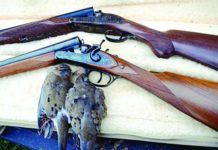
SxS 20-Gauge Showdown: CZ-USA and SIACE Shoot It Out
Every once in awhile, veteran shotgun enthusiasts might think back to the old days when hunting and target shooting proceeded at a slower pace, with a little more emphasis on fine form. Not that there is anything wrong with the quality over and under, semi-automatic, or pump-action shotguns on today's market, but in many minds, the old side-by-sides just give off an image of a little more class. A lot of today's veteran hunters started their shooting careers with an old double barrel handed down to them by their father or grandfather. Unfortunately, many of those old side-by-sides kicked like a mule and had so much drop in the stock that the shooter really had to work at obtaining a proper sight picture to hit anything.
Times have changed, and now the younger generation seems to have adjusted to modern technology with new model scatterguns that are easier to shoot and handle. Fine side-by-sides are few and far between on today's field and clay target ranges, but they have not been totally forgotten. We decided to jump into our time machine and take a little venture back to the days when side-by-sides were king. To cover the bases and pit old versus new within a reasonable price framework, we selected a used old-style SIACE Model 350G with double hammers and double triggers, available for about $2,000; and a recently introduced CZ-USA Ringneck hammerless with a single trigger, retailing for $1,022. Both of the doubles were 20-gauge models with screw-in internal chokes.
As most shooting instructors will point out, shooting a side-by-side can be a little more difficult to master than shooting down a single-barrel sight plane. The wider two-barrel image can be a distraction for a shooter who should be focusing on the target. If you are looking at the barrel and not the target, chances are the shot string will not be in the right place at the right time, and you'll miss.
In many cases, a shooter will slightly lift his or her head off the stock of a side-by-side when taking a shot (also related to having a wider sight plane and other design features of the double guns) causing the shot to go high. Shooting a little high is fine for flushing quail, grouse or pheasants, but can play havoc with a clay target score.
A similar shooter adjustment is required when the firearm features double triggers rather than a single trigger. When the front trigger only fires the right barrel and the back trigger only fires the left barrel, the shooter has to remember to switch from front to back to touch off two shots. With practice, this switching procedure is not a problem, but for double-trigger newbies, there is most definitely potential for confusion.
Although each of the 20-gauge double guns were designed to handle up to 3-inch shells, we decided to limit our test ammunition to lighter loads, with the understanding that increased recoil can be a major factor when shooting lighter side-by-sides. Our test ammunition included Noble Target Trap 2.75-inch loads, 2.5 dram equivalent, packing 7/8 ounce of No. 7.5 shot with an average muzzle velocity of 1,210 fps; and Federal Game 2.75-inch loads, 2.5 dram equivalent, with 7/8 ounce of No. 7.5 shot with an average muzzle velocity of 1,210 fps. The only ammunition malfunction we encountered was with a single Federal shell that had its primer seated too deep for the firing pin of either of the side-by-sides to touch off. Here are the rest of our findings:

Tactical Models: Mossberg 930 Versus Remington 870 Pumpgun
In the scheme of things, the defensive shotgun is the problem solver for homeowners, ranchers, ship captains, zookeepers, and anyone in need of decisive stopping power. In personal defense, area defense, and defense against animals, the shotgun reigns supreme. Powerful, effective, and versatile, the 12-gauge shotgun is an awesome defensive tool. The question is often whether the self-loader is the better choice, particularly since most of us use self-loading handguns and rifles. In this test we put two well-known and popular brands, Remington and Mossberg, to the test. We fire a version of Big Green's most popular service-grade pump-action shotgun — the Remington 870 — against the Mossberg 930 self-loading shotgun.
There are important differences and similarities between the shotguns, other than the operating systems, self-loading and manual. Each featured plastic furniture and bead front sights. Each was drilled and tapped for an optical sight.
Both shotguns produced similar patterns with Federal, Remington, and Winchester 2-inch full-power 00 buckshot loads. There was no difference in the patterns worth mentioning when the guns were fired at 7, 10, and 15 yards. Reduced-recoil WinLite loads showed the best pattern at short range, as they often do, while Federal Magnums began to show an advantage at 15 yards. We also fired a limited number of slugs and learned that the Remington fired to the point of aim with Federal slugs at 10 yards.
The Remington was simple and rugged, but the 930 was also a capable and effective choice. In the end, a single feeding bobble separated the pair:
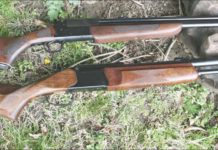
Two Combo Guns: Savage 24V Versus Baikals Model MP94
Mossberg Announces Expansion of Texas Manufacturing Facility
Converting Old Browning Model A-5s