




Those who are considering the purchase of a used 45 ACP pistol might want to read about two handguns we tested in the February 1995 issue: an Astra A-100 and a Colt’s M1991A1 Compact. Because these guns aren’t of the same type and size, we evaluated them individually. Each was fed more than 300 rounds of various ammunition, and accuracy firing was done from a rest. Here’s what we found:
Astra A-100: Poor Finish, But Reliable
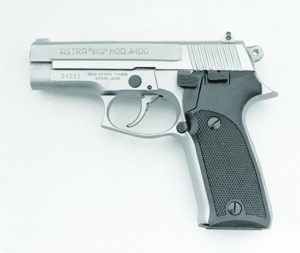
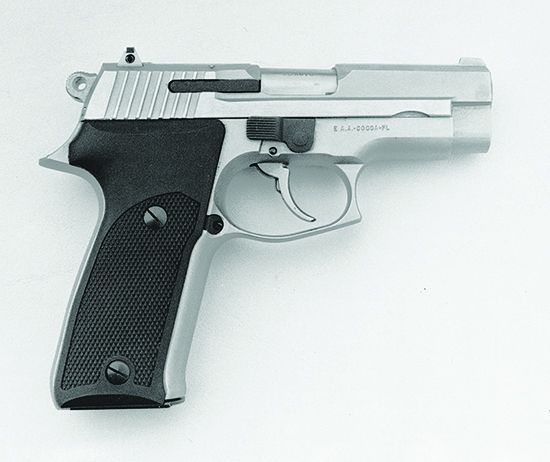
Astra’s A-100 is a Spanish rendition of a SIG P-series pistol. The location and operation of the controls and the locking system of the two pistols are the same. However, unlike the original, the A-100 is constructed entirely of steel. This double-action semiautomatic is available with a blued or nickel finish in 9mm, 40 S&W, and 45 ACP. Although its importer, European American Armory, describes it as a duty-size gun, this Astra is mid-sized compared to other 45 ACPs.
Regardless of the chambering, the A-100 comes with a 4-inch barrel. Overall, it measures 7.5 inches long and 5.5 inches tall. Due to its steel frame, the gun weighs about 34 ounces empty. In 45 ACP, this Astra’s staggered magazine has a capacity of nine rounds. According to European American Armory, the suggested retail price of the 45 ACP version is $423 with a blued finish.
Our test gun’s major components had a non-reflective nickel finish, while its controls were a dull blue-black. There were lots of file marks and ripples on the inner surface and edges of the trigger guard. The exterior of the slide, which one of the shooters described as shabby, had numerous casting and tool marks. However, moving parts had only a minimal amount of play. The blued-steel magazine featured a removable floor plate and a plastic follower. Although the back side of its body was covered with vertical tool marks, it was solidly constructed.
We felt the A-100 was a bit top heavy, but it sat evenly in the hand and came to a good point. The grip provided more than enough room for a two-handed hold, and its rounded shape was reasonably comfortable. However, in the double-action mode, reaching the trigger with enough finger to pull it back was a stretch for those with small hands. The magazine-release button at the rear of the trigger guard wasn’t difficult to reach with the appropriate finger of either hand, but it operated stiffly.
Functionally, the A-100 performed satisfactorily. Inserting the last two rounds into the magazine took a considerable amount of muscle, but it locked into the magazine well with ease and dropped out after only a slight hesitation. Slide movement was somewhat gritty, but it operated freely. All of the ammunition we tried fed and fired without a hitch. Extraction was smooth, and spent casings were briskly ejected 6 feet to the right rear of the shooter. The pistol’s passive firing-pin block, which prevented firing unless the trigger was pulled all the way to the rear, never failed.
Trigger movement was acceptable. The single-action pull was smooth all the way through and released at 4.75 pounds. Double action, it had a long pull with quite a bit of creep and broke at 11 pounds. Both modes had a moderate amount of overtravel.
Undoubtedly, this pistol’s worst feature was its sights, which were on a radius of 5.5 inches. The front was a relatively short nickel-plated blade that was integral to the slide with a poorly painted red dot. The rear consisted of a blue-black blade with a square notch mounted on a nickel-plated base that was dovetailed to the slide. There was a windage-adjustment screw on the rear sight, but turning this small screw barely moved the blade. Consequently, the pistol shot high and to the left at distances from 7 to 20 yards. Our test gun’s accuracy was below average. Remington Golden Saber 230-grain jacketed hollow points achieved the tightest five-shot average groups, measuring 2.5 inches at 15 yards. Federal’s American Eagle brand 230-grain full metal jackets weren’t far behind with 2.75-inch groups. Fiocchi 200-grain jacketed hollow points could be counted on for 3 inches at the same distance.
Bottom Line: Our Astra A-100’s functioning and accuracy were, at least, adequate. However, its finish needed improvement to earn our approval.
Colt’s M1991A1 Compact: Fairly Accurate Despite Trigger
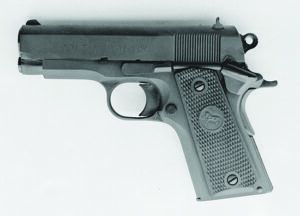
The Compact is the smallest of the three members of Colts’ economical M1991A1 line of pistols. This Parkerized 45 ACP is essentially a no-frills version of the Colt Officer’s model that comes with a standard-style hammer and grip safety as well as a plastic trigger, mainspring housing and grips, allowing it to be sold for around $178 less.
Like all of this manufacturer’s M1991A1 pistols, the Compact carries a suggested retail price of $517 and isn’t made with any options. Although this down-sized single-action has a 3.5-inch barrel, an overall length of 7.125 inches and weighs 34 ounces empty, it holds only one fewer round than its full-size counterpart. The pistol is shipped in a plastic carrying case with one six-round magazine.
Our test gun had a very uniform matte-gray finish. There were some tool marks on the inside of the slide, and the sides of the barrel lug were rough. But most moving parts, including the slide and barrel (when locked into battery), didn’t have any side-to-side movement. Grip-to-metal mating was as tight as it could be. The single-column magazine was made entirely of blued steel. It didn’t have any sharp edges or other shortcomings.
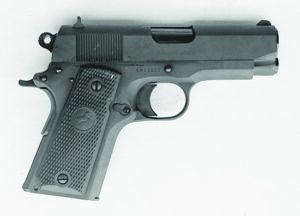
We found the Compact to be well balanced, with most of its weight from the grip area to the trigger guard. This, along with its short muzzle and straight mainspring housing, made it a fast, instinctive pointer. The functionally checkered grip panels provided the shooter with just enough purchase to keep the gun from shifting in the hand, and the grip frame was long enough for all but the largest hands to grasp it with three fingers. Muzzle whip was sharp, especially with 230-grain ammunition.
Shooters with small and medium-size hands had to shift their grip to depress the slide-catch lever because its movement was extremely stiff. This pistol’s magazine release and manual safety could easily be reached and manipulated with the right-handed shooter’s dominant thumb, our shooters said.
The Compact 45’s magazine loaded to capacity with only a modest amount of effort and fed flawlessly. Firing-pin strikes were solid. Extraction was uneventful, and ejection was consistent.
This pistol’s downfall was its single-action trigger. The pull had several stops, which was a side effect of the gun’s passive firing-pin block, and felt very gritty with a release at 7.5 pounds.
The Compact’s fixed sights had a three-dot sighting system and a radius of 5.25 inches. This arrangement’s rounded front blade and dovetailed rear were low enough in profile to be reasonably snag resistant yet still provided a clean sight picture. The bright white dots also made it easy to pick up.
Despite its poor trigger, our test gun’s accuracy was credible for a 45 ACP of this size. Fiocchi 200-grain jacketed hollow points produced the smallest five-shot average groups, measuring 2 inches at 15 yards. Remington’s Golden Saber 230-grain jackets hollow points achieved 3-inch groups, and MagTech 230-grain ball ammunition could be counted on for 3.25 inches at the same 15-yard distance.
Bottom Line: Our Colt’s Manufacturing Co. M1991A1 Compact pistol didn’t malfunction and was surprisingly accurate for a subcompact 45 ACP, but we weren’t satisfied with the fitting of some of its parts.
In Standard Catalog of Firearms, the Colt M1991A1 Compact was listed for $850 if in NIB condition, $600 in Excellent condition, and $420 in Very Good condition. We really wouldn’t consider one in worse shape than VG, and the prices seem high to us based on the function of our original test gun. We really can’t see going more than $450 for a Compact in near-mint condition. It just wasn’t that great 30 years ago, and we don’t think it improved with age.
The Blue Book of Gun Values has the Astra A-100 priced at $400 for a 100% sample, $350 for a 98% condition, and $300-95%, $270-90%, and $220-80%. That seems a little rich to us for a gun that was last imported in 1997. We think our top price would be $300 for a gun in great shape.
Adapted by Gun Tests Staff, using evaluations from Gun Tests Team members. GT