






About a hundred years ago, there were quite a few service-size pistols in 380 ACP. The Walther PP, Browning 1922, JP Sauer 38H, Colt 1903, and a few others were considered service and battlefield pistols. These nice-sized handguns were popular, if only for a badge of office. While many nations adopted the 9mm service pistol after World War II, oddly enough, the Soviets adopted an upgraded Walther PP redesign. This size pistol is often lauded as ideal for personal defense. Handling and convenience are valued over combat ability. This is, after all, a handgun that may always be with you without a huge weight penalty. They may be held close to the body with good retention and handled quickly in the home. A double-action first-shot trigger and manual safety add safety measures for a purse or night-stand gun. This type of handgun and high-capacity variants, such as the Beretta 84, were popular service pistols just before the first wave of terrorism in Europe. So what do similar-size handguns offer today? A lot of convenience, easy shooting, and a degree of terminal ballistics.
Not long ago, one of our readers took us to task for not reviewing the new Walther PD380, a pistol he had a high opinion of. We agreed it was overdue for a look-see, so we got one and added two other double-action first-shot pistols of similar size and configuration, the Bersa Thunder 380 and the new Rock Island Armory LI380.
We fired the pistols with a good supply of ammunition. We’ve found 380 ACP prices are still higher than 9mm Luger, but we were able to find a fair deal on 100-round boxes of Remington 88-grain JHPs and 50-round boxes of Fiocchi 95-grain FMJs. We fired 50 rounds of each load in each handgun in a thorough test fire of 100 cartridges in each pistol.
Moving to accuracy, we fired five-shot groups from a benchrest position at 15 yards. We used the Hornady 90-grain XTP, Lehigh 68-grain all-copper loading, and the Remington 88-grain JHP for these comparison chores.
After the range work, we found three pistols with good features, one of which was a favorite. One was more primitive than the price would suggest, and another was far smoother than its modest price would have indicated. Here’s how they performed:
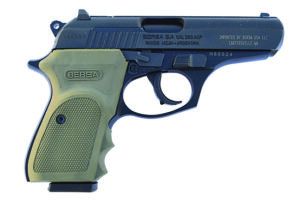
Bersa Thunder 380 Combat T380MC 380 ACP,
$288
Gun Tests grade: A- [best buy]
The Bersa came out of the box firing, without coughing on any of the loads we fed it. The pistol turned in the best combat groups. There is no light rail, and left-hand use is possible, but not the best of the test.
| Action D | ouble-action to single-action trigger, blowback operation |
|---|---|
| Overall Length | 6.6 in. |
| Overall Height | 4.7 in. |
| Maximum Width | 1.3 in. |
| Weight Unloaded | 22.0 oz. |
| Weight Loaded | 24.1 oz. |
| Barrel Length | 3.5 in. |
| Magazine | 8-rd detachable box |
| Magazine Price | $23 |
| Slide | Dark matte steel |
| Slide Retraction Effort | 14.0 lbs. |
| Frame | Dark matte alloy |
| Frame Front Strap Height | 2.0 in. |
| Frame Rear Strap Height | 3.0 in. |
| Grips | Checkered polymer |
| Grip Thickness Maximum | 1.0 in. |
| Grip Circumference | 5.4 in. |
| Front Sight | Post, white dot |
| Rear Sight | White outline |
| Trigger Pull Weight Single Action | 5.5 lbs. |
| Trigger Pull Weight Double Action | 10.0 lbs. |
| Trigger Span Single Action | 2.4 in. |
| Trigger Span Double Action | 2.7 in. |
| Safeties | Lever, decocker, firing pin block, internal lock |
| Warranty | 1 year |
| Telephone | (833) 476-1547 |
| Website | BersaUSA.com |
We have tested several Bersa handguns in the past with good results. This handgun is slightly different from the others, intended to offer a smoother profile for concealed carry. The pistol is supplied in a cardboard box similar to the Rock Island Armory, although the Rock also has a nylon sleeve and spare magazine. The Bersa didn’t have a spare magazine. The finish is a nice matte-gray low-profile presentation. The green-tinted wraparound plastic grips feature finger grooves. The grips feature a slight thumb rest on each side. The slide differs considerably from the similar Rock Island pistol. The slide is nicely finished and features an integral solid rib. The sights are a Glock-like pattern with a white dot in the front sight and white outline rear. The Bersa uses a spur hammer. Unlike the other two pistols, there is no light rail. Since the three are considered pocket pistols by most shooters, we did not rate the Bersa down on the lack of an accessory rail.
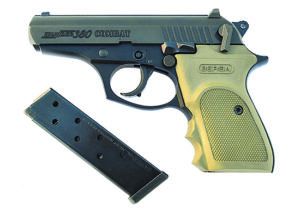
Takedown is as described with the Rock Island Armory LI pistol. The Bersa Thunder 380 also features a magazine safety and decock/safety combination.
The Bersa’s single magazine holds eight rounds. We used the Rock Island Mec-Gar made magazines in both pistols during the test. The Rock’s magazines feature finger pads, while the Bersa is a flush-fit magazine. The pistol is in a narrow range of weight, half an ounce more than the Walther and 2 ounces lighter than the Rock. The pistol’s heft and balance are well suited to concealed carry. In takedown and handling, it is identical to the Rock’s features. The action is slightly heavier than the Rock Island pistol, but it is lighter than the Walther. We had fired the Rock Island and did not need additional familiarization with the controls of the Bersa. We found the magazine release a bit stiff, but that isn’t necessarily a demerit in a pistol intended for pocket carry, or at least close-body carry.
The takedown lever and action lock are identical to the Rock’s. The trigger transfer bar, however, differs in design while operating in the same manner. This external trigger bar is a Beretta type and usually provides smoother operation than a Walther PPK pistol type.
We loaded the Mec-Gar magazines with ball ammunition for the firing evaluation. We noted during the test that one of the three magazines was difficult to load to eight rounds, while the other two were not. This is on Mec-Gar more than the pistol maker, but perhaps an inspection would have caught this problem. As it turned out, the recalcitrant magazine never smoothed up, but it also never failed to feed.
The Bersa’s trigger was one of those combinations that isn’t the lightest, but the double-action trigger is smooth and even across its travel. The single-action firing mode was also smooth, but not the lightest. Take up and overtravel were modest. Reset is sharp. The Bersa may not have been the smoothest trigger action, but when it came to brass tacks, the pistol turned in results better than the other handguns. On the firing course, the Bersa consistently turned in the best combat groups at all ranges. The sights, while not adjustable like on the other pistols, were properly regulated for 90- to 95-grain FMJ ammunition.
The hammer isn’t so prominent that it is likely to snag, but unlike on the Rock, the Bersa allows easy thumb cocking of the hammer for a deliberate single-action shot. The Bersa handgun provided the best combat-shooting groups. The Bersa also exhibited the best off-the-bench accuracy.
Our Team Said: We preferred the Bersa over the Rock. The sights are better than the Rock’s odd set up. The dovetailed front sight of the Bersa is more stable than the Rock’s front sight. Fit and finish are similar. The Rock does have a light rail, but we don’t feel this is particularly useful in a small defensive handgun. The Bersa is more accurate than the Rock, so we moved the Bersa up over the Rock. The Bersa cost more, but this was outweighed by performance. Compared to the Walther, the Bersa outshot it. It was one round short compared to the Walther, but it was slightly more compact. It is about $180 less expensive than the Walther, giving the owner plenty of room to purchase a spare magazine. The testers were split on the magazine safety and did not rate the pistol one way or the other on this feature.
We found the Bersa to be the Best Buy pistol of the test.
| 380 ACP RANGE DATA | |||
|---|---|---|---|
| Lehigh Defense XD 68-grain Fluted | Rock Island LI380 | Bersa Thunder 380 | Walther PD380 |
| Average Velocity | 1045 fps | 1060 fps | 1089 fps |
| Muzzle Energy | 165 ft.-lbs. | 170 ft.-lbs. | 179 ft.-lbs. |
| Best Group | 2.9 in. | 2.2 in. | 2.5 in. |
| Average Group | 3.5 in. | 2.6 in. | 2.9 in. |
| Remington UMC 88-grain JHP | Rock Island LI380 | Bersa Thunder 380 | Walther PD380 |
| Average Velocity | 888 fps | 884 fps | 916 fps |
| Muzzle Energy | 154 ft.-lbs. | 153 ft.-lbs. | 164 ft.-lbs. |
| Best Group | 3.0 in. | 2.4 in. | 2.6 in. |
| Average Group | 4.2 in. | 2.8 in. | 2.9 in. |
| Hornady American Gunner 90-grain XTP 90104 | Rock Island LI380 | Bersa Thunder 380 | Walther PD380 |
| Average Velocity | 890 fps | 900 fps | 911 fps |
| Muzzle Energy | 158 ft.-lbs. | 162 ft.-lbs. | 166 ft.-lbs. |
| Best Group | 3.2 in. | 2.0 in. | 2.4 in. |
| Average Group | 4.0 in. | 2.8 in. | 2.8 in. |
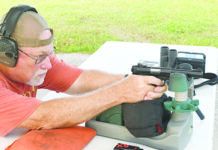
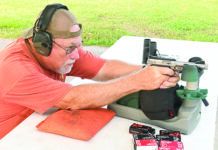
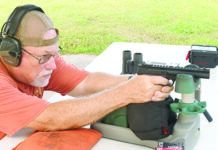
We fired groups double action at 15 yards from a bench using an MTM Case-Gard K-Zone Pistol Rest. We measured velocities with a Competition Electronics Pro Chrony. The first screen of the chronograph was 10 feet from the muzzles.
Written and photographed by Robert Campbell, using evaluations from Gun Tests Team members. GT