






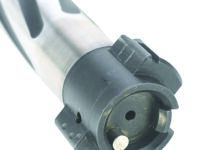
Recent emails from readers requested that we look at modern muzzleloading rifles, and with the introduction of Federal’s Firestick technology in 2020, we also think it is a good time. We chose two well-known muzzleloading brands with a pedigree for evolving muzzleloader technology: Traditions and CVA. The Traditions NitroFire Pro Series uses Federal’s Firestick ignition, and the CVA Optima uses powder pellets or loose powder. Both are .50 caliber and have 26-inch fluted barrels. They feature break actions and are hammer fired. Stocks are polymer, and finishes are weather resistant as well as corrosion resistant.
Load Development
With muzzleloaders, the user has to decide the load combination of bullet, powder, and primer. The process is simple, even if you are not a ballistics junky. First let’s talk about powder, all of which we sourced at Midway.com.
We chose 100-grain Firesticks to use in the NitroFire. They cost $30 for a 10 pack. Firesticks feature a polymer cartridge filled with Hodgdon Triple Eight powder in 80-, 100- or 120-grain amounts. For the CVA, we used both Triple Seven ($40 for 100 pack) and White Hots ($34 for 72 pack) pellets. One White Hots or Triple Seven pellet is 50 grains, therefore two pellets are loaded for a total of 100 grains, or three pellets can be loaded for 150 grains.
All of the pellet propellants offer higher velocities and easier clean up without too much of the rotten-egg smell of original black powder. Because the powder charge in the Firesticks is encased in a polymer cartridge, they offer a higher level of convenience over pellets by protecting against moisture and are easier loading and unloading. As deer hunters know, unloading a muzzleloader means either shooting the loaded round or removing the breech block and the powder charge. With loose powder, the charge is wasted and many times, pellets are tainted from gun oil and handling. In our opinion, the Traditions NitroFire with Firestick technology offers the most convenience, while the CVA Optima offers the ability to customize the powder charge for optimal accuracy and power, if you choose to go the loose-powder route. The trade off with pellets and Firesticks is that you can’t tweak the charge for maximum velocity and accuracy like you can with loose powder, but you have the convenience of a pellet. If you are new to muzzleloaders or don’t want to be bothered measuring loose powder, then using pellets or Firesticks are two options. Firesticks also add a level of safety because loading a double charge is impossible.
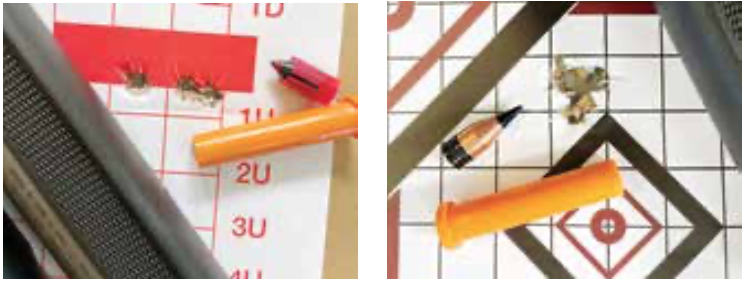
Next are primers, which have evolved from plain 209 shotgun primers. Muzzleloading primers are designed for hot ignition and offer moisture resistance and reduced fouling. Federal Muzzleloading 209MZ primers ($19 for a 100 pack at Sportsmans.com) were used to ignite the Firesticks. We used Winchester Triple Seven primers ($18 for a 100 pack at Midway.com) with the Triple Seven and White Hots pellets.
Finally, there are also a slew of muzzleloader projectile options. The bullets used in this match up included sabot-style and belted projectiles. Sabot projectiles use a polymer cup with petals that encase the bullet. Belted rounds use a polymer base that the bullet sits in. In the sabot camp, we used Hornady SST Low Drag Sabots loaded with a 250-grain .45-caliber SST‑ML bullet with a Flex Tip ($23 for a 20 pack at Muzzle-Loaders.com) and Traditions Smackdown Carnivores with 250-grain .45-caliber bullets ($19 for 15 pack at Muzzle-Loaders.com). Belted bullets included Powerbelt Bullets 270-grain ELR (Extended Long Range) projectiles ($27 for 15 pack at Muzzle-Loaders.com) and Hornady’s Bore Driver with a 290-grain Flex-Tip bullet ($27 for 20 pack at Muzzle-Loaders.com). The Powerbelt projectile has a high ballistic coefficient, so it maintains velocity and accuracy at longer distances. It has a steep-tapered point compared to the other projectiles and required a special seating attachment to the ramrod, which is included with each pack of bullets.
During the test we were looking for accuracy, ease of loading, fast ignition, and ease in unloading and cleaning. We swabbed rifle barrels after three shots to remove fouling with Traditions pre-saturated cleaning patches ($10 for 100 at TraditionsFirearms.com). To ease loading, we used a Traditions Ultimate Loading/Cleaning Rod ($34 at TraditionsFirearms.com. This rod is sturdier than the ramrods that come with the rifles, and it made starting the bullet down the barrel and loading easy. We had no fear the ramrods that came with their rifles would bend when loading the rifles; the heavy-duty rod just eased the process. It also helps to swab and clean the barrel. This rod breaks down into three pieces and has a sturdy T-handle. We liked this rod a lot and recommend one.
After slinging heavy slugs downrange, we have a newfound respect for these modern inline muzzleloaders. When the smoke cleared — and it takes a second or two with muzzleloaders — this is what we discovered.
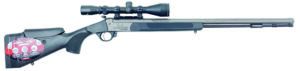
Traditions NitroFire Pro CR53-84660450 .50 Caliber
$603
Gun Tests grade: A- (Our Pick)
The NitroFire offers ease of loading and unloading with Firestick powder cartridges that use a primer which is easier to insert. Accuracy was excellent. The adjustable stock is comfortable. The sticker on the buttstock is quite gaudy.
| Action Type | Break, hammer fire |
|---|---|
| Overall Length | 41.5 in. |
| Barrel Length | 26.0 in. |
| Barrel Rifling Twist Rate | 1:24 in. |
| Weight w/Scope | 6.2 lbs. |
| Receiver | Steel, gray Cerakote |
| Barrel | Steel, fluted, gray Cerakote |
| Stock | Adj. black polymer, checkered |
| Stock Length of Pull | 13.5 to 14.5 in. |
| Stock Drop at Comb | 1.2 in. |
| Stock Drop at Heel | 1.7 in. |
| Stock | Buttplate Textured rubber |
| Sights | None, factory installed 3.5-10x44 scope |
| Trigger Pull Weight | 3.4 lbs. |
| Safety | Manual trigger block |
| Warranty | Limited lifetime |
| Telephone | (860) 388-4656 |
| Website | TraditionsFirearms.com |
| Made In | Spain |
The NitroFire Pro series is feature rich. The polymer stock and fore end have plenty of checkering for a sure grip. The stock’s length of pull is adjustable using a series of 1⁄4-inch spacers, and the comb adjusts for a custom cheek weld when using a scope. A screwdriver is needed to adjust either dimension. The recoil pad is rubbery, but shouldering the NitroFire Pro was snag free. We would have liked the edges to have a more pronounced radii, but we are nitpicking. Sling studs are included.
Our test rifle came with a factory-mounted Chinese-made 3.5-10x44mm scope with a simple Duplex reticle, with additional aiming points on the X and Y strata. Simple yet helpful to manage wind and trajectory on longer shots. The clarity was decent. Turrets were capped, and each click was a ¼ inch of bullet movement on target at 100 yards. It’s a basic scope that we found out helped us achieve excellent accuracy. There are no iron sights, but it is drilled and tapped for Williams fiber-optic iron sights.
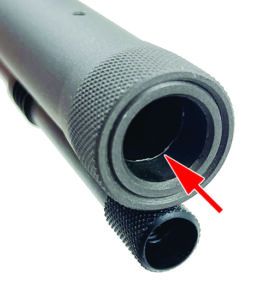
The barrel is fluted and threaded for a muzzle brake, which might be an option for hunters wanting to stifle recoil. The bore at the muzzle was enlarged to accept a bullet by pushing it in with your thumb. The two-piece ramrod is lightweight aluminum and includes a Quick-T polymer handle. The end of the ramrod unscrews and is rotated 180 degrees to use the concave end when loading a bullet. The other end is a cleaning jag. The Quick-T handle makes it comfortable to seat a bullet, and it can be stored on the ramrod on the rifle. It doesn’t make any noise when it rides on the ramrod and provides quick access when loading in the field.
The NitroFire breaks open similarly to a single-shot shotgun. A barrel-release lever is built into the front of the trigger guard and is easy to press to break the action. The hammer has rounded knurled extensions on either side for left- and right-handed shooters to cock the hammer, especially with a scope mounted. The hammer is smooth to cock. An internal passive hammer block prevents the hammer from contacting the firing pin until the trigger is pulled, and it is rebounding.
The trigger had two stages; first was about a 1⁄4-inch of take up, then the second stage had a slight bit of creep and a pull that measured, on average, 3.4 pounds. A decent trigger overall.
To load the NitroFire, place a bullet in the muzzle. Some of the projectiles used could be pressed in with our thumb, but we used the heavy-duty range rod to seat and ram the bullet home. A shelf is built into the bore that the bullets rest on, so you know when the bullet is seated. When you feel the shelf, the bullet is fully seated. Next, break open the action and insert a Firestick. It loads like a shotgun shell in a single-shot shotgun. Place a primer in the base of the Firestick and close the action. Then cock the hammer, and the NitroFire is ready to fire.
Our best three-shot group at 100 yards was 0.4 inches with 100-grain Firesticks and 270-grain Powerbelt ELR bullets. Impressive accuracy. Average accuracy gave us 0.5 inches. The best accuracy with the sabot-style projectiles and 100-grain Firesticks was with the 250-grain Traditions Smackdown Carnivore with a 1.15-inch group; average was 1.43 inches. Across all the projectiles and 100-grain Firesticks, accuracy averaged about 1.5 inches. We thought this was excellent, especially over the assortment of projectiles. Recoil was very tolerable. We expected minute-of-deer accuracy and were happy to see sub-minute-of-angle groups.
Clean up with the Firesticks was not a chore. We removed the fore end, which is attached with a hex screw, to separate the barrel from the receiver. We would have liked the screw to be captured or to have seen a push-button system to remove the fore end. We ran a few swabs wet with solvent, a brush, and a few clean patches down the bore, and that was all it took. We even let the rifle sit after a shooting session for three days to see if rust would start to form, but none did.
Our Team Said: The NitroFire with Firestick cartridges was expensive, but it was good to go out of the box. Firestick cartridges offer an advantage when loading, and safety. Accuracy ranged from excellent to good with a variety of projectiles. The stock and inexpensive scope helped us achieve some nice accuracy. The trigger was helpful, too, even if it wasn’t perfectly crisp. Clean-up was simple and fast. This is Our Pick for a hunting muzzleloader.
| TRADITIONS NITROFIRE PRO RANGE DATA | ||
|---|---|---|
| Bullet Powder Primer | Hornady SST Sabot 250-grain (.45 cal.) Firestick 100-grain Federal 209MZ | Hornady Bore Driver 290-grain (.50 cal.) Firestick 100-grain Federal 209MZ |
| Muzzle Velocity | 2020 fps | 1817 fps |
| Muzzle Energy | 2266 ft.-lbs. | 2270 ft.-lbs. |
| Smallest Group 1.44 in. | 1.44 in. | 1.50 in. |
| Average Group | 1.48 in. | 1.54 in. |
| Bullet Powder Primer | Powerbelt ELR 270-grain (.50 cal.) Firestick 100-grain Federal 209MZ | Traditions Smackdown Carnivore 250-grain Firestick 100-grain Federal 209MZ |
| Muzzle Velocity | 1905 fps | 2000 fps |
| Muzzle Energy | 2338 ft.-lbs. | 2220 fps |
| Smallest Group | 0.40 in. | 1.15 in. |
| Average Group | 0.50 in. | 1.43 in. |
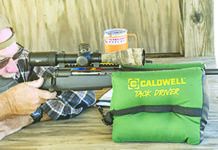
To collect accuracy data for both rifles, we fired three-shot groups from a bench using a rest. Distance: 100 yards with a scope. Velocities and energies were recorded using a Garmin Xero C1 Pro chronograph.
| CVA OPTIMA V2 RANGE DATA | ||
|---|---|---|
| Bullet Powder Primer | Hornady SST Sabot 250-grain (.45 cal.) White Hot 100-grain Winchester 209 Triple 7 | Hornady Bore Driver 290-grain (.50 cal.) White Hot 100-grain Winchester 209 Triple 7 |
| Muzzle Velocity | 1531 fps | 1466 fps |
| Muzzle Energy | 1301 ft.-lbs. | 1389 ft.-lbs. |
| Smallest Group | 1.44 in. | 1.50 in. |
| Average Group | 1.48 in. | 1.54 in. |
| Bullet Powder Primer | Powerbelt ELR 270-grain (.50 cal.) White Hot 100-grain Winchester 209 Triple 7 | Traditions Smackdown Carnivore 250-grain White Hot 100-grain Winchester 209 Triple 7 |
| Muzzle Velocity | 1510 fps | 1530 fps |
| Muzzle Energy | 1367 ft.-lbs. | 1300 ft.-lbs. |
| Smallest Group | 1.00 in. | 1.25 in. |
| Average Group | 1.30 in. | 1.31 in. |
| Bullet Powder Primer | Hornady SST Sabot 250-grain (.45 cal.) Triple Seven 100-grain Winchester 209 Triple 7 | Hornady Bore Driver 290-grain (.50 cal.) Triple Seven 100-grain Winchester 209 Triple 7 |
| Muzzle Velocity | 1541 fps | 1422 fps |
| Muzzle Energy | 1318 ft.-lbs. | 1304 ft.-lbs. |
| Smallest Group | 1.76 in. | 1.37 in. |
| Average Group | 1.97 in. | 1.75 in. |
| Bullet Powder Primer | Powerbelt ELR 270-grain (.50 cal.) Triple Seven 100-grain Winchester 209 Triple 7 | Traditions Smackdown Carnivore 250-grain Triple Seven 100-grain Winchester 209 Triple 7 |
| Muzzle Velocity | 1529 fps | 1535 fps |
| Muzzle Energy | 1401 ft.-lbs. | 1308 ft.-lbs. |
| Smallest Group | 1.29 in. | 1.43 in. |
| Average Group | 1.53 in. | 1.64 in. |
Written and photographed by Robert Sadowski, using evaluations from Gun Tests Team members. GT