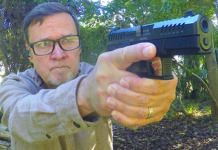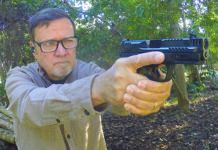


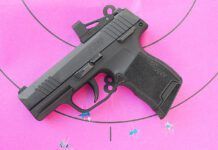
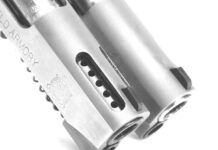







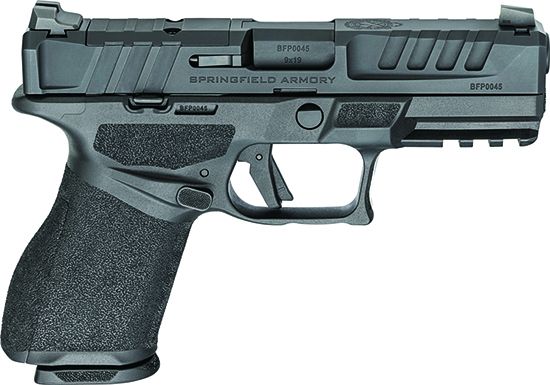
Two new recently introduced guns demanded our attention: the Ruger RXM, a pistol resembling the Glock Generation 3 Model 19, and the Springfield Armory Echelon 4.0C, a compact version of the Echelon 9mm. We elected to pitch them against the most modern version of the Glock, the G19 Generation 5 MOS. These pistols are similar in size and weight as well as capacity, and each is optics ready and has extended magazines available. All are simple to operate, with the only controls being a slide lock, magazine latch, and takedown trigger. There is no manual safety, only safety features. Outside those similarities, the Glock has the greatest aftermarket support at present, but the Ruger will build on that.
We did not make the three types of optics mounting systems a huge part of the test. However, there are differences worth discussing. Even today, every gun doesn’t accept every red dot. The more common footprints offer the most choice, and some otherwise excellent European optics using the Docter foot print are not compatible with some pistols. While all three pistols are optics ready, the Glock and Springfield seem more versatile.
The Ruger’s direct mount is fine for most uses and should be secure. But be certain to choose the red-dot optic first and be certain the handgun is compatible with the optic you want to purchase. Follow procedure, mount the red dot and torque its screw properly, and use just a dot of blue Loctite to secure the optic. Don’t allow Loctite to gravitate into the extractor channel.
The Echelon is a purpose-designed optics-ready pistol, and the red dot sits lower on it than on other pistols. The Springfield’s Echelon’s pin set up is a different mounting process from direct mounting or MOS plates. These pins seem to be the most secure, we thought.
It’s been almost 10 years since the announcement of the Glock Modular Optics System, or MOS. This system uses a series of proprietary numbered plates to adapt the Glock MOS slide from simple iron sights to any of the popular red-dot patterns. The MOS system is fairly straightforward, but it can be difficult for those who have never tried to mount an optic on a pistol before. The manual offers a detailed explanation of the process, but an early pitfall to avoid when purchasing your initial MOS kit is to make sure to purchase the kit for the width of your handgun’s slide.
Springfield Echelon 4.0C EC9409B-U-15 9mm Luger,
$630
Gun Tests grade: A [OUR PICK]
The Springfield Echelon compact checks all of the boxes. The pistol isn’t simply a standard Echelon with a shorter slide and grip; some effort went into restyling the grip frame for a better hand hold.
| Action | Semi-auto recoil-operated locked breech, striker fired |
|---|---|
| Trigger | Double action |
| Overall Length | 7.25 in. |
| Overall Height | 5.25 in. |
| Maximum Width | 1.2 in. |
| Weight Unloaded | 24.0 oz. |
| Weight Loaded | 33.2 oz. |
| Barrel | 4.0 in. |
| Slide | Black-phosphate-finished steel |
| Slide Retraction Effort | 17.0 lbs. |
| Receiver | Black Melonite |
| Front Strap Height | 2.1 in. |
| Rear Strap Height | 3.5 in. |
| Barrel Length | 4.0 in. |
| Grip | Replaceable inserts |
| Grip Thickness | 1.25 in. |
| Grip Circumference | 5.6 in. |
| Magazines | (1) 15 round; (1) 18 round |
| Magazine Price | $34 for 15 rounders |
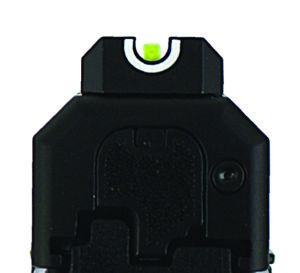
| Rear Sight | White-outline U-notch |
| Front Sight | Fixed tritium dot |
| Sight Radius | 6.1 in. |
| Trigger Pull Weight | 4.2 lbs. |
| Trigger Span | 2.5 in. |
| Safety | Trigger lever |
| Warranty | Limited lifetime |
| Telephone | (800) 680-6866 |
| Website | Springfield-Armory.com |
| Made In | Croatia |
This pistol resulted in giving the original Echelon a new designation. The full-size gun didn’t need an “S” in its model number — 4.5 S for the 4.5-inch-barrel Standard unit — until the 4-inch Compact, aka 4.0C — was introduced. The 4.0C is a Croatian-manufactured Springfield Echelon 4.0 package (UPC: 706397982522) that is lighter, shorter in length, and shorter in height, and with a grip that is shorter and thinner as well. Thus, the 4.0C makes for a good-size carry gun.
In common with the Beretta APX, SIG P320, and Ruger RXM, the Echelon features a central operating group, or COG, offering modularity. The pistol may be used with different grip modules, even including a recently introduced aluminum frame from an aftermarket maker. Although the height of the original Springfield Echelon is 5.4 inches and the new 4.0C is 5.125 inches, the grip feels considerably different. Small hands will appreciate this grip, and even large hands found it comfortable. While a compact pistol should be shorter, of course, there is more to the equation. Some pistols’ compact version will offer a nice S curve in the grip that is more comfortable than a full-size gun. The Echelon 4.0C is about 0.02 inch thinner than the full-size 4.5-inch-barrel gun back to front. The girth is a total 0.1 inch thinner. One tester noted that Springfield doesn’t have to introduce a pistol with a short slide and big frame, the equivalent of a Glock G45 9mm. The Echelon 4.0C with its 18-round magazine accomplishes the same thing.
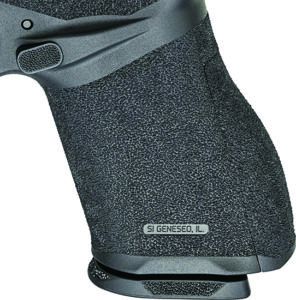
The original Echelon introduced Springfield’s Adaptive Grip Texture, which features a good mix of abrasion and adhesion. The grip isn’t overly abrasive, however. The more pressure put on the grip the more traction is gained, an interesting design feature. The texture extends to the trigger guard, and there are finger-location spots on the frame. The frame features a beveled magazine well. This magazine well is not as wide as either the Ruger or the Glock. Another feature is that the extractor protrudes slightly when a cartridge is chambered. It can be felt, but is not really visible.
This striker-fired polymer-frame pistol appears markedly different from the Glock and Ruger, pistols that are basically twins of the other externally. The Springfield features an ambidextrous slide lock, a big plus for left-handed shooters. The magazine release is easily manipulated, but protected by risers in the grip frame. We rated the 4.0C’s grip texture to be the best of the three pistols, and the controls were our favorites as well.
Moving to the slide, the pistol features well-defined cocking serrations. The deep-cut forward cocking serrations are especially useful. Rear cocking serrations are punctuated by a small ledge in each side, HK style, that makes a difference in racking the slide for many of us, providing greater leverage. The takedown lever features an unexpected benefit. The lever offers a good rest for shooters using the aggressive thumbs-forward grip. The pistol field-strips easily using the takedown lever. We prefer this take down to the Glock/Ruger spring-loaded takedown. It is a single motion rather than pulling two levers.
The pistol field strips easiest of the three handguns. After making certain to unload the pistol, lock the slide to the rear. Remove the magazine. Rotate the takedown lever, run the slide off the frame, and pull the recoil rod and spring assembly out. Then simply raise the barrel from the slide. The pistol’s internal finish didn’t show any tool marks.
When Springfield downsized the pistol, they were able to keep three notches in the accessory rail rather than four in the original pistol. This still provides plenty of security when mounting combat lights, as confirmed during the test by mounting and using three types of combat lights. The slide is Melonite finished, well suited for hard use.
We fired all three pistols with iron sights, and we think the Springfield’s set is a good example of combat sights. One of our testers, a highly trained shooter and instructor, prefers a single tritium dot, and if the pistol features three dots, he finds the set up confusing to some students. He said it is even confusing for the tester “depending on how fast he goes” and “how dark it is.” The Springfield and Ruger each feature a single tritium sight front post. We rated the Springfield as being the more visible, but only by a slight margin. The U notch in the rear sight of the Springfield is faster for combat shooting, while the Ruger’s square notch would seem better suited to target shooting. Still, the Springfield pistol is more accurate off the bench.
The Echelon 4.0C is supplied with two magazines, a 15-round flush fit and an 18-round extended magazine. We find this to be the best magazine set up of the three pistols. However, the Glock 19 MOS Gen 5 comes with three magazines, which is not shabby by any means. The 18-round Echelon magazine easily rides in most belt-mounted magazine carriers. This magazine was difficult to load to capacity, requiring an assist from the magazine loader and breaking in only slightly by the end of the firing tests.
We explored the mounting of red-dot sights to some extent, and we relied upon the raters’ personal experience in assessing them. The Springfield’s Variable Interface System (VIS) features a series of pins in addition to the usual screws, allowing mounting all of the popular footprints without resorting to different plates. This set up also allows the red dot to ride lower. It is important to note that the Echelon was designed as an optics-ready pistol. The others were redesigned to accept optics. The result is noticeable, with the Springfield being the easier pistol to train on because the low-riding red dot makes rapid acquisition of the dot simpler. Springfield claims the VIS system is less susceptible to moving out of position from knocks and drops than other types of slide/optic interfaces. This is difficult to confirm, of course, but it makes mechanical and engineering sense. We rated the Echelon’s optics interface to be the most modern. In practice, the Ruger worked out well, largely due to the Ruger’s grip design presenting the red dot to the line of sight consistently.
Concerning the grips, changing the Springfield’s backstrap inserts wasn’t difficult. We remove the slide first before changing panels. Insert a finger into the magazine well and press the square block on the insert inwards. The Springfield and Glock were not difficult at all to change, but the Glock requires a tool. The Ruger did not have the option. All three pistols were acceptable as issued for hand sizes. The grip inserts are primarily beneficial to shooters with larger hands.
All three of the striker-fired trigger actions were similar. Trigger action is difficult to compare in some ways. However, trigger break, weight, and reset are measurable. Some raters prefer a tighter action with less free movement, and others prefer a trigger action with take up before the action meets a wall and breaks. We call the Springfield trigger tight. The trigger breaks at a smooth 4.1 pounds and is rated overall the best trigger of the trio, with the Ruger practically as useful (and preferred by a tester in the minority), and the Glock the heaviest trigger action at 5.5 pounds.
Regarding our ammunition, we picked 50 rounds of steel-cased Tula rounds knowing that some guns just don’t run well with steel-cased ammunition. However, the Glock does, and that was a baseline. To earn an equal rating on reliability, the other handguns also had to feed and function with steel-cased ammunition. We also fired 50 rounds of CCI Blazer 115-grain 9mm ammunition in each pistol in offhand combat firing. Also, we fired one magazine of Hornady American Gunner 124-grain +P in each pistol, 15 rounds, to evaluate performance and reliability with +P loads. In accuracy testing, we fired three loads. These were the Black Hills Ammunition 124-grain JHP, Hornady Critical Duty 135 grain, and Federal 147-grain HST, all expanding-bullet loads.
Fired off hand, the Springfield responded well to a trained shooter. Speed to an accurate first shot is good. The pistol is controllable in rapid fire. The combination of an excellent gripping surface, a good trigger, and good sights turned in the best combat groups of the test. We liked the way the pistol shoots. Blazer loads were slightly more accurate, with fewer sparks and a cleaner powder burn compared to the Tula loads. Combat shooting took place from 5 to 15 yards. Moving to benchrest firing, the Springfield was the most accurate pistol tested. The best 25-yard group was 1.9 inches. Most were larger, but still appropriately sized. The pistol proved accurate, reliable, and combat capable. Accuracy was also the best, although it was only slightly more accurate than the Ruger.
Our Team Said: While the Echelon pistol doesn’t kick much, as most 9mm handguns this size don’t, recoil impulse from it was rated as more than the Glock or Ruger. This was due to the thin grip, but not enough to be rated down. Actual control was best of the test.
As for left-hand use, the Springfield Echelon features an ambidextrous slide lock and magazine release, which the other handguns lack. After considerable debate, the test team reached a unanimous verdict: The Springfield Armory Echelon 4.0C is a better choice for concealed-carry defense than the Glock 19 or Ruger RXM.
| 9MM LUGER RANGE DATA | |||
|---|---|---|---|
| Black Hills Factory New 124-grain JHP | Springfield Armory Echelon 4.0C | Ruger RXM | Glock 19 Gen 5 MOS |
| Average Velocity | 1090 fps | 1068 fps | 1101 fps |
| Muzzle Energy | 327 ft.-lbs. | 314 ft.-lbs. | 334 ft.-lbs. |
| Smallest Group | 1.9 in. | 2.3 in. | 2.4 in. |
| Average Group | 2.2 in. | 2.6 in. | 3.0 in. |
| Hornady Critical Duty 135-grain FlexLock 90236 | Springfield Armory Echelon 4.0C | Ruger RXM | Glock 19 Gen 5 MOS |
| Average Velocity | 1056 fps | 1038 fps | 1070 fps |
| Muzzle Energy | 334 ft.-lbs. | 323 ft.-lbs. | 343 ft.-lbs. |
| Smallest Group | 2.0 in. | 2.2 in. | 2.4 in. |
| Average Group | 2.4 in. | 2.6 in. | 2.8 in. |
| Federal Tactical LE 147-grain HST P9HST2 | Springfield Armory Echelon 4.0C | Ruger RXM | Glock 19 Gen 5 MOS |
| Average Velocity | 996 fps | 1004 fps | 980 fps |
| Muzzle Energy | 324 ft.-lbs. | 329 ft.-lbs. | 313 ft.-lbs. |
| Smallest Group | 2.1 in. | 2.3 in. | 2.6 in. |
| Average Group | 2.4 in. | 2.7 in. | 2.9 in. |
To collect accuracy data, we fired five-shot groups from a bench using an MTM Case-Gard K-Zone rest. Distance: 25 yards. We measured velocities with a Competition Electronics Pro Chrony with the first screen 10 feet from the muzzles.
Written and photographed by Bob Campbell, using evaluations from Gun Tests Team members. GT