




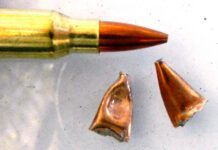
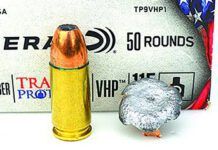



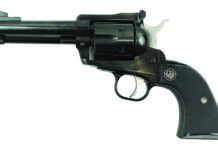
There are two schools of thought in handgun ballistics. One favors medium-caliber high-velocity rounds, like the 357 Magnum or +P 9mm. The other favors large-caliber slow-moving bullets, like the 45 ACP.
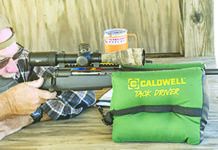
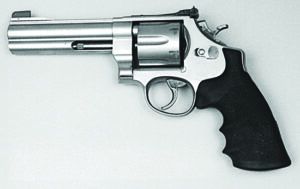
A revolvers chambered in this round, a Smith & Wesson Model 625 in 45 ACP, is the subject of this test. It was fed two kinds of ammunition for a total of 300 rounds. A sandbag rest was used during accuracy testing. All firing was done on an indoor range. Here’s what we thought of it:
Smith & Wesson Model 625 45 ACP
$591
Gun Tests grade: A-
Fans of the 45 ACP cartridge liked the Model 625, while others considered its half-moon clips to be a pain in the butt. We don’t recommend using this revolver for self-defense without clips, though
| Finish | Stainless |
|---|---|
| Weight (unloaded) | 45 oz. |
| Overall Length | 10.25 in. |
| Overall Height | 6.0 in. |
| Barrel Length | 5.0 in. |
| Sight Radius | 6.25 in. |
| Capacity | 6 |
| Grip | Composition Rubber |
| Grip Length | 4.38 in. |
| Grip Width | 1.24 in. |
| Grip Depth | 1.91 in. |
| Warranty | Limited lifetime |
During World War I, manufacturers couldn’t keep up with the U.S. military’s demand for 1911 pistols. To help fill this void, Smith & Wesson produced thousands of Model 1917 45 ACP double-action revolvers. This N-Frame gun utilized half-moon clips to aid extraction of the 45 cartridge’s rimless casing.
The present-day version of this big-bore revolver is the Model 625. Unlike its blued-steel predecessor, which had a standard barrel and fixed sights, this stainless-steel six-shooter features a heavy barrel with a full-length underlug and adjustable sights. It comes in a plastic carrying case with four half-moon clips.
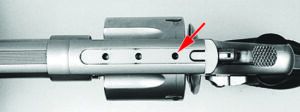
Our Model 625 had a uniformly frosted finish, but a few superficial tool marks were noted on the recoil shield and the inner side of the cylinder crane. Moving parts had almost no side-to-side movement, and the barrel-to-cylinder gap measured an acceptable 0.008 inch. Except for a small line of dross on their outer edges, the half-moon clips were cleanly stamped. The Hogue Monogrip was well-molded, and it mated with the frame closely.
Due to its 5-inch barrel, this Smith & Wesson struck a fair compromise between ease of pointing and muzzle stability. Those with small hands found the grip to be a bit large, but its comfortable contouring (finger grooves and palm swell) kept the grip from being overly bulky. Felt recoil wasn’t significantly different from that of a full-size 44 Special revolver. The cylinder release on the left side of the frame, which unlatched the cylinder when pushed forward, operated very smoothly.
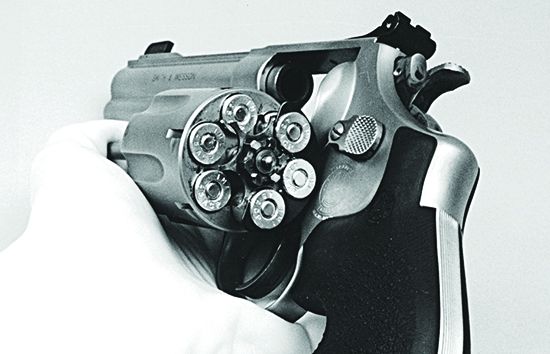
The procedure for loading the Model 625 consists of “snapping” three rounds into each half-moon clip, then inserting two clips into the cylinder. Because the 45 ACP casing has an extractor groove instead of a protruding rim, the clips serve as a rim for the extractor to push rearward during extraction.
The half-moon clips provided with this Smith & Wesson made extracting fired brass a snap. However, on two occasions, when one of our shooters hurriedly dropped a loaded clip into the cylinder without ensuring that the unit seated properly, the resulting misalignment prevented the cylinder from rotating. Also, inserting and removing rounds from the clips took more time and muscle than what some of our shooters cared to expend.
This revolver could be loaded and fired without the half-moon clips, but doing so presented two difficulties. First, the only way to remove spent brass from the chambers was to push them out with a ramrod. Second, since rounds loaded in this manner headspaced on the mouth of the casing, instead of at the back as with the clips, cartridges with a case length of 0.884 inch or shorter didn’t extend back far enough for the firing pin to reach its primer properly. Consequently, three of the 100 rounds we attempted to fire without clips misfired due to light firing-pin strikes.
We encountered no other function problems. The internal safeties, Smith & Wesson’s usual rebound slide and hammer block, prevented firing unless the trigger was intentionally pulled.
We felt the trigger, which had a smooth face, was satisfactory. In single action, it had no slack and broke cleanly at 4 pounds. The double-action pull released at 12.5 pounds and had some overtravel.
This handgun was equipped with black target-style sights. The front was a Patridge blade pinned to a ramp on the barrel, while the fully click-adjustable rear had a plain blade with a square notch. The rear sight’s mounting screw shot loose after about 200 rounds. Nevertheless, this arrangement provided a precise sight picture.
For those who would like the option of using an optic sight, the gun’s topstrap was drilled and tapped in three places for a scope mount. Removing the rear sight was necessary to access these holes.
Accuracy was respectable. This Smith & Wesson produced five-shot average groups that measured 3.55 inches or less at 25 yards from a sandbagged rest.
Ballistically, Winchester Silvertip and Hansen FMJs were around 20 fps slower than they were from a full-size 45 ACP pistol, which also had a 5-inch barrel.
Our Team Said: Fans of the 45 ACP cartridge liked the Smith & Wesson Model 625, while others considered its half-moon clips to be a pain. We don’t recommend using this revolver for self-defense without clips, though. The Standard Catalog of Firearms lists the Smith & Wesson Model of 1989 625-3 in 45 ACP with a New In Box price of $1500; Excellent, $1200; Very Good, $1000; Good, $800; Fair, $500; and one in Poor condition, $300. If you find a NIB sample, we’d advise not shooting it. It’s too valuable as a collectible. Would we buy one used and shoot the heck out of it? You bet. In the mild 45 ACP chambering, it should easily outlast you, with reasonable care.
| 45 ACP RANGE DATA | ||
|---|---|---|
| Smith & Wesson Model 625 | Winchester 185-grain STHP | Hansen 230-grain FMJ |
| Average Velocity | 947 fps | 844 fps |
| Average Muzzle Energy | 369 ft.-lbs. | 364 ft.-lbs. |
| Smallest Group Size | 3.00 in. | 3.00 in. |
| Largest Group Size | 3.63 in. | 4.00 in. |
| Average Group Size | 3.23 in. | 3.55 in. |
Accuracy testing consisted of firing five consecutive five-shot groups with each load at 25 yards. Chronograph testing consisted of firing five consecutive shots with each load. Velocities were obtained using a Oehler Model 35.
Adapted by Gun Tests Staff, using evaluations from Gun Tests Team members. GT