












The 1911 pistol is a mature platform. The sidearms have been in common use by military, law enforcement, and civilians alike for more than 100 years. Properly-trained gunsmiths know how to make them run reliably, and properly-trained shooters know how to employ them. The grip angle is just about perfect, and the single-action trigger can be one of the best in the handgun world. Sights have improved exponentially over the last century, as have magazines and the ammo that goes in them. Primary concerns for those using a 1911 on a regular basis are ammo capacity and price. Here, we have two imported 9mm pistols that we think address both issues.
Our first selection is the Rock Island Armory TAC Ultra MS HC Combo 56632 9mm Luger, $700, which makes great use of the high-capacity frame pioneered by Para-Ordnance in the mid-1990s. The company then added a modern Picatinny rail on the dust cover, an adjustable rear sight, and a fiber-optic front. This combo also included a second barrel for the 22 TCM cartridge, which we didn’t test in this comparison.
Our second selection is the Tisas 1911 Duty B9R Double Stack 12500017, $670, a Turkish hybrid model whose frame of steel and polymer was made popular by STI (now Staccato). The Tisas is also fitted with a fiber-optic front sight, but the small rear sight is adjustable for windage only. However, the slide in front of that sight has been milled for a red-dot sight, which is a nice option for a gun of this price. We tested using the iron sights on both pistols.
Rock Island Armory TAC Ultra MS HC Combo 56632 9mm Luger,
$700
Gun Tests grade: B
Comfortable grip. Steel parts lead to a fairly heavy lower receiver that reduces muzzle flip. Integral plunger tube won’t come off. Chamber is fully supported by an integral ramp. Nice Series 70 trigger design. Adjustable sights are nice and easy to see. No malfs, good accuracy.
| Action Type | Single action semi-auto |
|---|---|
| Overall Length | 8.0 in. |
| Overall Height | 5.5 in. |
| Maximum Width | 1.47 in. |
| Weight Unloaded | 43.8 oz. |
| Weight Loaded | 51.4 oz. |
| Slide Material | Carbon steel |
| Slide Retraction Effort | 15.3 lbs. |
| Receiver Material | Carbon steel |
| Finish | PECVD coating |
| Front Strap Height | 2.75 in. |
| Back Strap Height | 3.25 in. |
| Barrel Length | 4.25 in. |
| Grip Thickness (Maximum) | 1.41 in. |
| Grip Circumference | 5.0 in. |
| Magazines | Two 17 round |
| Rear Sight | Drift-adjustable two-dot white |
| Front Sight | Drift-adjustable red fiber optic |
| Sight Radius | 5.87 in. |
| Trigger Pull Weight | 3.89 lbs. |
| Trigger Span | 3.25 in. |
| Safety | Manual thumb and grip |
| Warranty | Limited lifetime |
| Telephone | (775) 537-1444 |
| Website | Armscor.com |
| Made In | Philippines |
This test team’s shooters cut their competition teeth on single-stack 1911 pistols in the mid-1980s. Back then, if you had an eight-round magazine for your Government Model 45, you were at the cutting edge of technology. The 38 Super cartridge changed that, bringing smaller-diameter bullets (0.355 to 0.357 inch) and the ability to pack more rounds into the same magazine. Couple that with much reduced recoil when shot from a ported pistol, and it set the USPSA world afire. But it could still only carry 10 rounds in a conventional magazine.
Two Canadian designers, Ted Szabo and Thanos Polyzos, took the design a giant leap further. They engineered a double-stack magazine and a steel frame that would fit around it. Their early frames were somewhat bulky. Especially noticeable was the edge of the grip frame immediately in front of the grip panel. The side panels extended farther forward than current versions which, in turn, pushed the leading edge further forward. The net effect was a squared-off front strap and a larger circumference for the grips.
The current version of the Rock Island A2MS-Tactical pistol uses a second-generation grip frame that fixes some of the issues we once had to address by hand. The sides of the front strap have been thinned and moved to the rear to allow a much more comfortable grip. Note that there is still plenty of material to work with if you like a checkered front strap instead of the five vertical serrations currently provided. The magazine well has been lightly beveled, and the metal mainspring housing has been nicely checkered. In fact, all the working parts we looked at were steel. That includes an ambidextrous thumb safety, Commander-style slotted hammer, beavertail grip safety, and the extended magazine release. The slide stop has also been checkered. Even the trigger is steel. The dust cover has been reinforced and a two-slot Picatinny rail added. The grip panels are a thin G10 laminate that has been machined with grooves and divots for better purchase. The result of all of this metal is a fairly heavy lower receiver that contributes greatly to a reduction in muzzle flip. One of the other things we liked about the frame was the design for the plunger tube. Normally, it’s a thin piece staked to the left side of the frame where it can work loose at the wrong time). This version casts the plunger tube integral with the frame, so this one isn’t coming off.
The top end provides its own share of beefy metal parts. The slide is slab-sided almost all the way to the muzzle, though it does provide seven slanted grooves at the rear for traction. The barrel measures to almost exactly the same outside diameter as the 45-caliber version. Because the hole through the tube on the 9mm version is going to be almost .010 smaller (.355 versus .452 inch), the common outside diameter means that the walls of the barrel are thicker and add just a bit more weight to the muzzle. The chamber on this tube is fully supported by an integral ramp to help contain even 9mm +P pressures.
The recoil system uses an almost conventional set of parts. The Rock Island version sports a standard barrel bushing and a short, lightweight recoil spring. The guide rod is longer than normal and requires an open spring plug that allows the slide to travel properly. The locking lugs were clean and sharp, with a snug link that made everything lock up tightly.
We’ve mentioned firing-pin safety systems before. These parts are designed to prevent an accidental/negligent discharge in case the pistol is dropped on the muzzle. The resulting impact might allow the firing pin enough movement to build up sufficient speed and energy to detonate the primer of a round in the tube. This is the very reason old single-action revolvers are always carried with an empty chamber under the resting firing pin. In the 1980s, a much more litigious world convinced Colt (and others) that more needed to be done to secure the firing pin. A couple of designs worked, and Colt selected a method that ran a linkage from the rear of the trigger bow to a lever that would push up on an internal safety to allow the firing pin to move. The design worked, but it also placed more requirements on the trigger and restricted its free movement. Engineers have recently noted that changing the weight on a few parts can allow the trigger to move freely while still allowing a proper safety margin. Going back to the earlier Series 70 design, they changed to a heavier firing-pin spring along with a much lighter (frequently titanium) firing pin. Now we have the best of both worlds, a trigger that can’t build up enough momentum to cause a problem, and a trigger that slides smoothly once again.
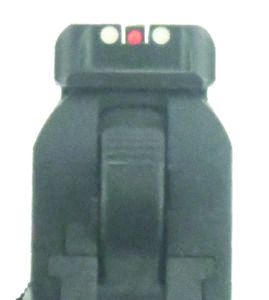
Most of the rest of the pistol would look familiar to the 1911 aficionado. There are seven grasping grooves on the rear of the slide only. The top of the slide has been milled to a flat for less glare on the sights. The rear sight is fully adjustable and sports two white dots on the sight blade. The front sight is a bright-red fiber-optic tube mounted in a dovetail. The extractor is internal, and the ejector is the extended piece we would expect.
We fed these pistols a variety of defensive ammunition that ran from 65-grain screamers manufactured by Shell Tech up to the 124-grain Speer Gold Dot load — a round that features prominently in our everyday-carry pistols. This was the first time we had tested Shell Tech, and we were impressed. Velocities out of the RIA averaged 1569 fps (out of a 4.25-inch barrel on a pistol) and averaged 1.39-inch five-shot groups. We would love to see some data as to how they work on the street. Everything fed perfectly, and no malfunctions were noted. Average group size across four different types of ammo for this pistol was just under 1.75 inches, and that was with iron sights. We compared the results for these two pistols versus the Staccato and Springfield Armory Prodigy 3.5-inch 2011s we reviewed recently. Especially with the red-dot sights employed on the earlier tests (see the August/September 2025 issue), the Staccato and the Prodigy were more accurate, but they were actually a little slower for us to bring up on target and fire. We’ve found that pistols presenting a red-dot sight take us about 0.1 second longer to verify and fire the first shot. Follow-up shots are normally at a faster pace than irons. We keep hearing about this little thing called practice that might fix our problems.
Our Team Said: This is a good pistol for a reasonable price. In this match-up, it comes in a close second to the Tisas, but we won’t be offended if you buy the Rock Island and enjoy it for years.
| 9MM LUGER RANGE DATA | ||
|---|---|---|
| Shell Tech 65-grain Copper Polymer Fluted | Rock Island Armory A2MS-Tactical | Tisas B9R-DS |
| Average Velocity | 1577 fps | 1569 fps |
| Muzzle Energy | 359 ft.-lbs. | 355 ft.-lbs. |
| Best Group | 1.38 in. | 1.23 in. |
| Average Group | 2.08 in. | 1.39 in. |
| Black Hills HoneyBadger 100-grain CF +P | Rock Island Armory A2MS-Tactical | Tisas B9R-DS |
| Average Velocity | 1203 fps | 1225 fps |
| Muzzle Energy | 322 ft.-lbs. | 333 ft.-lbs. |
| Best Group | 1.11 in. | 1.68 in. |
| Average Group | 1.23 in. | 1.74 in. |
| Hornady Critical Defense 115-grain FTX 90260 | Rock Island Armory A2MS-Tactical | Tisas B9R-DS |
| Average Velocity | 1128 fps | 1106 fps |
| Muzzle Energy | 325 ft.-lbs. | 312 ft.-lbs. |
| Best Group | 1.91 in. | 1.68 in. |
| Average Group | 1.95 in. | 1.89 in. |
| Speer Gold Dot 124-grain GDHP 23618GD | Rock Island Armory A2MS-Tactical | Tisas B9R-DS |
| Average Velocity | 1136 fps | 1124 fps |
| Muzzle Energy | 355 ft.-lbs. | 348 ft.-lbs. |
| Best Group | 1.21 in. | 1.59 in. |
| Average Group | 1.48 in. | 1.81 in. |
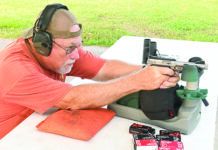
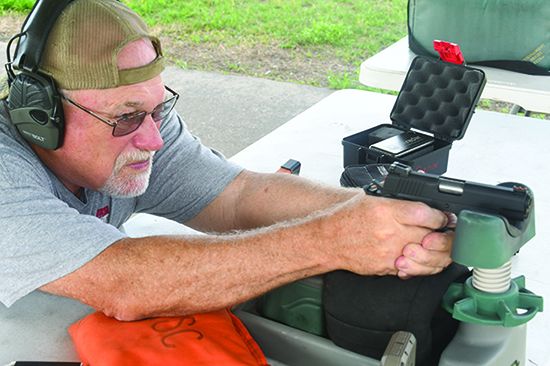
We tested at American Shooting Centers in west Houston. We fired for accuracy at 15 yards by shooting multiple five-shot groups from a well-sandbagged Caldwell Pistolero Shooting Rest (MidwayUSA.com 517357, $28) assisted by a Mini DRC Fortune Cookie from Wiebad.com ($75, MINIFC). We recorded velocities with a Garmin Xero C1 Pro chronograph ($600). CPF = copper polymer fluted. CF = copper fluted. GDHP = Gold Dot hollow point.
| DRILL NO. 1 DATA | |
|---|---|
| Pistol | Single Shot Average Time |
| Rock Island | 0.773 |
| Tisas | 0.754 |
Process: Fire one shot from low ready at a USPSA A Zone (5×11 inches) at 7 yards. Times in seconds are averages for 10 reps
| DRILL NO. 2 DATA | |||
|---|---|---|---|
| Pistol | 1st Shot | Split Average | Total Time |
| Rock Island | 0.757 | 0.203 | 0.955 |
| Tisas | 0.837 | 0.173 | 1.015 |
Process: Fire two shots from low ready at a USPSA A Zone (5×11 inches) placed at 7 yards. Times in seconds are averages for five reps.
| DRILL NO. 3 DATA | |||
|---|---|---|---|
| Pistol | 1st Shot | Split Average | Total Time |
| Rock Island | 0.78 | 0.198 | 1.061 |
| Tisas | 0.796 | 0.188 | 1.108 |
Process: Fire three shots from low ready at a USPSA A Zone (5×11 inches) placed at 7 yards. Times in seconds are averages for three reps.
Our speed tests are not designed to show how fast a firearm can be fired, but to use the same test on multiple guns fired by the same person to look for differences in the guns’ capabilities.
Written and photographed by Joe Woolley, using evaluations from Gun Tests Team members. GT


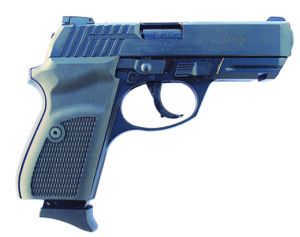
I’m quite sure you have included an incorrect photograph for this RIA pistol in the article above. The photograph (showing the right-side profile of a pistol) posted just above the table that lists various product details looks nothing like a 1911 pistol, and it doesn’t match the pistol shown in the photograph at the beginning of the article, which, according to the caption, depicts the article’s author aiming the RIA pistol while it is mounted in a Caldwell rest.
I echo the above question. While you referenced Para-Ordnance in the article, nothing was said about either of the above pistols being an LDA type trigger, only typical single action 1911s.